
India Optical Fibre Exports Jump 158%: AI's Hidden Winners

India's Optical Fibre Exports Jump 158% as Japan's Chip Shipments Surge 49%: The Hidden Winners of the AI Infrastructure Boom
Artificial intelligence may be transforming the technology industry, but some of its most important economic beneficiaries are not necessarily the companies developing AI models.
They may be the businesses manufacturing the physical infrastructure that makes artificial intelligence possible.
Two new trade developments highlight this shift.
Japan reported a 49.4% year-on-year increase in semiconductor exports in September 2026, supported by demand for advanced electronics and AI-related investment.
Meanwhile, India's exports of optical fibres, fibre bundles and cables surged 158% year-on-year to $483 million during April–August FY 2026–27.
The figures cover different periods and product categories, but together they reveal an important development: global investment in AI is creating demand across several layers of the manufacturing and digital-infrastructure supply chain.
For investors, this raises a question:
Could the next major beneficiaries of the AI boom emerge from semiconductor equipment, optical-fibre networks, industrial manufacturing and data-centre infrastructure rather than only from the world's largest technology companies?
1. Japan's Semiconductor Exports Reveal Continued AI Investment
Fresh trade figures released on October 21 showed that Japan's overall exports increased 16.7% year-on-year in September.
Although this represented the 13th consecutive month of export growth, it fell short of the approximately 20.1% increase expected in a Reuters economist survey.
The most interesting development was within technology-related exports.

Source: Japan Ministry of Finance data reported by Reuters and Bloomberg, October 21, 2026.
Japan occupies an important position in the semiconductor supply chain.
While Taiwan is a major centre of advanced chip fabrication and South Korea is a leading producer of memory chips, Japan supplies critical materials, manufacturing technologies and specialised equipment.
This makes Japanese export data a useful indicator of investment across the broader Asian semiconductor ecosystem.
For example, when semiconductor manufacturers expand production capacity, they may need additional fabrication equipment, precision components and supporting technologies.
Rising shipments of these products can therefore indicate that the AI investment cycle is extending beyond software and into factory-level spending.
However, strong export growth does not guarantee sustained demand. A slowdown in semiconductor capital expenditure could quickly affect Japanese manufacturers.
The important signal is that AI-related spending is becoming visible in international trade data, not just technology-company announcements.
For additional context, read our analysis: AI Is Reviving Asia's Factories: Is Global Manufacturing Finally Turning?.
2. India Reports a 158% Surge in Optical-Fibre Exports
Japan's semiconductor numbers are important, but the latest development from India may be particularly interesting for domestic investors.
According to trade figures cited by India's Ministry of Commerce and Industry, exports of optical fibres, fibre bundles and cables reached approximately $483 million during April–August FY2026–27.
That represents a remarkable 158% increase compared with the corresponding period a year earlier.
The geographical distribution is also significant.

Source: Ministry of Commerce and Industry figures reported by Financial Express, October 20, 2026. Figures are rounded.
The United States accounted for approximately 55% of India's exports within these product categories.
That concentration is meaningful because the U.S. remains an important market for cloud computing, hyperscale data centres and digital infrastructure investment.
Exports are also reaching China, Europe and several other international markets.
This suggests that India's manufacturing opportunity is not restricted to domestic telecommunications projects.
It is becoming connected to the broader international digital-infrastructure supply chain.
There is one important qualification: optical fibre is used in broadband, telecommunications, enterprise networks and several other applications. The total reported export increase should not be interpreted as exclusively AI-generated demand.
Nevertheless, AI-related data-centre investment can be an additional demand driver for the industry.
3. Why Optical Fibre Matters to Artificial Intelligence
When investors discuss AI infrastructure, they usually focus on GPUs, semiconductor fabrication and electricity.
But there is another essential component: high-speed data transmission.
Modern AI workloads depend on moving enormous quantities of information between processing units, servers, storage systems and data centres.
Optical communication technologies make much of this connectivity possible.
A simplified AI infrastructure chain looks like this:
AI applications → Cloud platforms → Data centres → Servers and processors → High-speed networking → Optical connectivity
Different parts of this network require different types of equipment, including optical transceivers, specialised fibre, switches and high-performance cables.
As computing clusters become larger, networking performance becomes increasingly important.
The significance for India is straightforward.
A country does not need to manufacture the world's most advanced AI processors to participate in the global AI economy.
It can also benefit by supplying high-quality physical infrastructure that supports advanced computing.
That could create opportunities across industrial manufacturing, connectivity solutions, data-centre services and electrical infrastructure.
For a broader explanation of this capital-investment cycle, see AI Infrastructure Boom: $126 Billion Flows Into Chips, Data Centres and Power.
4. Japan and India: Two Different Positions in the AI Supply Chain
The latest export data offer an interesting comparison.
Japan and India participate in different segments of the global technology ecosystem.

Note: These growth rates are not directly comparable because the products, reporting periods and starting export values differ.
The distinction matters.
Japanese semiconductor equipment is closely linked to manufacturing investment, while Indian optical-fibre products serve a much broader communications market.
Yet both can benefit from an environment in which more computing power requires more physical infrastructure.
The wider opportunity could therefore stretch across multiple countries and industries.
The United States develops many of the leading AI models and computing platforms.
Taiwan and South Korea play major roles in advanced processors and memory.
Japan supplies important equipment and industrial technologies.
India has an opportunity to expand its position in electronics, connectivity and other infrastructure-related manufacturing.
The AI economy is increasingly a global manufacturing network rather than simply a collection of American technology companies.
5. Which Indian Industries Could Benefit?
India's optical-fibre export growth does not automatically identify winning stocks.
However, it provides a useful starting point for sector research.
Optical-fibre and cable manufacturers
Companies manufacturing optical-fibre products, specialised cables and connectivity equipment may benefit from additional overseas demand.
Investors should examine the proportion of revenue generated from exports, changes in order books, capacity utilisation and operating margins.
Data-centre infrastructure providers
Higher AI adoption could encourage investment in computing facilities, networking equipment and supporting infrastructure.
But additional demand does not guarantee attractive returns. Data-centre projects can be highly capital-intensive and depend on reliable electricity, financing and customer commitments.
Electrical equipment and power infrastructure
Computing facilities require continuous electricity, cooling and reliable power distribution.
Companies involved in transformers, switchgear, power systems and transmission equipment may experience indirect demand if data-centre construction accelerates.
Electronics and precision manufacturing
The expansion of semiconductor and digital infrastructure supply chains could create opportunities for specialised component manufacturers.
For India, the critical challenge will be moving toward higher-value products while maintaining quality, productivity and globally competitive costs.
The opportunity is substantial in principle, but company-specific financial performance remains the deciding factor.
Investors can follow domestic sector trends and broader market movements through the LiveWorldMarket India Stock Market Dashboard.
6. The Biggest Question: Can Export Growth Become Earnings Growth?
This is where the investment analysis becomes more demanding.
A 158% increase in exports sounds extraordinary.
But stock-market returns depend on more than shipment growth.
A manufacturer might report stronger sales while profitability remains weak because of raw-material inflation, aggressive pricing or investment in new production facilities.
Before assuming that rising exports will create shareholder value, investors should monitor five indicators.
Investment indicatorWhy it matters
Export order-book growth
Tests whether demand extends beyond one reporting period
Operating and EBITDA margins
Shows whether higher shipments are profitable
Capacity utilisation
Indicates operational efficiency and room for growth
Free cash flow
Tests whether reported earnings are converting into cash
Customer and geographic concentration
Reveals exposure to a few buyers or countries
The latest export figures provide encouraging evidence of industry demand.
They do not establish that every listed fibre-optic manufacturer will benefit equally.
A company with better technology, stable customers, disciplined capital expenditure and strong cash flow may be positioned very differently from a manufacturer facing falling margins.
The market's next challenge is distinguishing AI infrastructure growth from profitable AI infrastructure growth.
7. Three Risks Investors Should Not Ignore
Despite the positive export numbers, several risks deserve attention.
Risk 1: A slowdown in U.S. AI capital expenditure
U.S. technology companies and their supply chains play an important role in global AI infrastructure demand.
If cloud providers reduce investment because of disappointing returns, demand for some semiconductor equipment and networking products could weaken.
This is relevant to India because the United States currently accounts for more than half of the reported optical-fibre-related export value.
Risk 2: Rising energy and manufacturing costs
Geopolitical disruptions and expensive crude oil can increase costs for manufacturers, shipping companies and energy-intensive businesses.
Japan's latest trade figures already reflect pressure from disrupted energy shipments.
Manufacturers might experience higher sales but weaker profit margins if rising costs cannot be passed on to customers.
Risk 3: Valuation risk in infrastructure-related stocks
An industry can enjoy strong long-term growth while individual stocks remain expensive.
If investors price several years of rapid earnings growth into valuations, even modest disappointments can trigger significant share-price corrections.
That is especially important when interest rates remain elevated.
For more on this relationship, read AI Stocks vs. 5.2% Treasury Yields: Is the S&P 500 Too Dependent on AI?.
8. What Investors Should Watch Next
The next phase of the AI infrastructure story should be tested against measurable data rather than market enthusiasm alone.
Three developments will be particularly important.
First, watch semiconductor equipment demand across Japan and Asia. Continued growth would suggest that semiconductor manufacturers remain willing to invest in capacity.
Second, monitor India's optical-fibre exports over the coming months. Sustained growth would be more meaningful than a single strong five-month comparison, particularly if accompanied by higher margins and broader customer diversification.
Third, follow the capital-expenditure guidance of major global cloud and semiconductor companies. A reduction in spending plans could affect suppliers well beyond the technology sector.
There are also two possible outcomes.
In a stronger scenario, AI applications expand, businesses invest in computing capacity, networking infrastructure demand increases and manufacturers benefit from a multi-year investment cycle.
In a weaker scenario, AI monetisation disappoints, technology companies slow their investments, order growth moderates and valuations adjust.
The latest export numbers support the view that physical investment remains an important part of the AI story, but they cannot determine which scenario will dominate.
Readers can follow cross-market volatility and macroeconomic stress through our Global Market Risk Monitor.
9. What This Means for the Indian Stock Market
For Indian equity investors, the most useful takeaway may be that the AI opportunity extends beyond software services and fashionable technology themes.
India has an opportunity to participate in international supply chains through connectivity equipment, electrical products, electronics manufacturing and associated industrial infrastructure.
But this should not be interpreted as a reason to buy every company associated with data centres, cables or semiconductors.
A more disciplined approach would be to examine:
- Which businesses have actual export orders rather than only expansion announcements?
- Are international customers contributing to revenue and profits?
- Is the company improving its technological capabilities?
- Can management sustain growth without excessive debt or dilution?
- Are valuations supported by realistic earnings assumptions?
Investors should also pay attention to the global environment. A stronger dollar, higher bond yields or another technology-stock selloff could affect share prices even when underlying industrial demand remains healthy.
For daily international cues, visit What Changed While You Slept? on LiveWorldMarket.
10. The Bigger Picture: AI's Next Winners May Be Less Obvious
The first stage of the AI investment boom was dominated by attention on software models, advanced processors and major technology companies.
The next stage could place greater importance on the industrial systems required to support those technologies.
Japan's semiconductor export surge and India's optical-fibre export acceleration illustrate how technology investment can spread through international manufacturing supply chains.
That does not mean the opportunity is risk-free.
AI spending could slow. Export growth could moderate. Competition could pressure margins. Infrastructure projects could produce lower returns than expected.
But the developments highlight a useful change in perspective.
Rather than asking only which technology company will dominate artificial intelligence, investors may increasingly ask which businesses supply the equipment, connectivity and physical infrastructure that keep the entire ecosystem operating.
Final Takeaway
Japan's 49.4% semiconductor export growth and India's 158% optical-fibre export surge suggest that AI-related investment is creating opportunities beyond the best-known technology companies.
For India, the figures provide encouraging evidence that domestic manufacturers are participating in global digital-infrastructure demand.
The next test will be whether that momentum translates into sustainable orders, stronger margins and improving cash flow.
The hidden winners of AI may not be the companies making the loudest announcements.
They may be the businesses supplying the components the AI economy cannot function without.
Frequently Asked Questions
Why did India's optical-fibre exports rise 158%?
Trade data show rising international demand for optical-fibre-related products used across digital connectivity and communications infrastructure. Expansion in AI, data centres, broadband and telecommunications can contribute to this demand.
Does India manufacture AI chips?
India is expanding its semiconductor manufacturing capabilities, but it does not currently have the same established advanced-chip fabrication ecosystem as the world's leading semiconductor manufacturing locations. Its opportunities extend to packaging, electronics, connectivity and infrastructure.
Which Indian stocks could benefit from AI infrastructure growth?
Companies operating in optical communications, electrical infrastructure, digital connectivity and data-centre-related businesses may have exposure. However, investors must verify company-specific orders, earnings, margins and valuations.
Does rising semiconductor demand guarantee a rally in AI stocks?
No. Stock prices also depend on earnings expectations, valuations, interest rates, capital expenditure and broader investor sentiment.
Sources and Data Notes
- Reuters — Japan's September exports rise 16.7% as AI chip demand supports trade, October 21, 2026.
- The Japan Times — Japan's export growth stays solid, supported by chips and cars, October 21, 2026.
- Financial Express — Optical fibre exports zoom 158% on global AI boom, October 20, 2026.
Data note: Japanese semiconductor export growth refers to September 2026, while India's optical-fibre export growth refers to April–August FY2026–27. The statistics are not directly comparable in size or composition.
Disclaimer: This article is for educational and informational purposes only and does not constitute investment advice or a recommendation to buy or sell securities. Investors should conduct independent research and consult an appropriately registered investment adviser when necessary.
Comments (0)
Be the first to comment.
About the author

NISM-Series-X-A Investment Adviser Level 1 examination completed
Amit writes about Indian equity markets, technical analysis, macro themes and the day-to-day mechanics of trading, with a focus on making the flow of global markets legible for retail investors. He has completed the NISM-Series-X-A Investment Adviser Level 1 examination.
You May Also Like
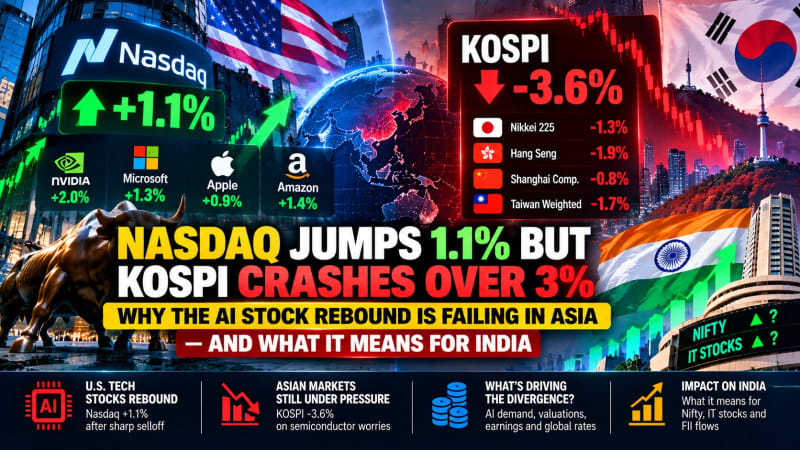
Nasdaq Rises 1.1%, KOSPI Falls 3.6%: AI Stocks and India Impact
Global Markets & Economy · Oct 20, 2026 · 12 min read
Nasdaq Jumps 1.1% but KOSPI Crashes Over 3%: Why the AI Stock Rebound Is Failing in Asia—and What It Means for India Global technology stocks are sending conflicting signals. On Monday, October 19, the Nasdaq Composite gained 1.11%, recovering part of the losses suffered during the previous week's technology selloff. U.S. semiconductor stocks also rebounded, with the…
Read more...
Jio IPO 2026: $108 Billion Valuation Amid Global AI Selloff
Market Valuation & Behaviour · Oct 19, 2026 · 14 min read
Jio IPO at $108 Billion Amid Global AI Stock Selloff: Can India's Biggest IPO Defy the Tech Market Rout? India is preparing for what could become its largest-ever initial public offering at a time when global investors are reassessing technology valuations, artificial intelligence spending and the financial sustainability of digital infrastructure. Jio Platforms, the digital…
Read more...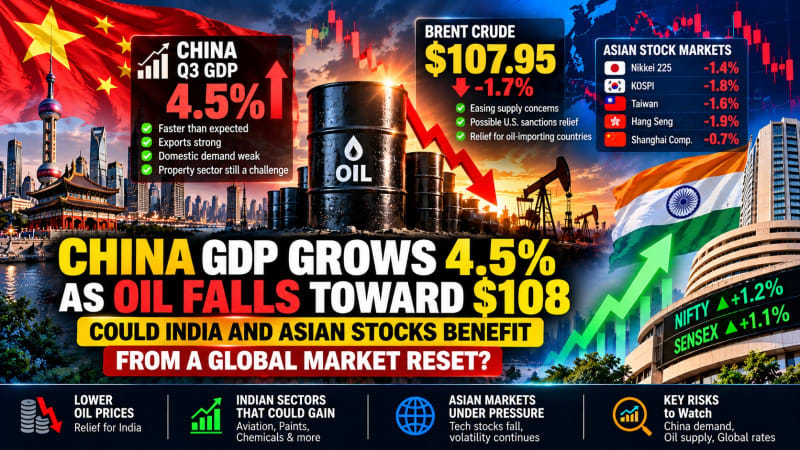
China GDP Grows 4.5% as Oil Falls: Can India Stocks Benefit?
Global Markets & Economy · Oct 19, 2026 · 12 min read
China GDP Grows 4.5% as Oil Falls Toward $108: Could India and Asian Stocks Benefit From a Global Market Reset? China's economy expanded faster than expected in the third quarter of 2026, but the latest economic data reveals a growing divide between its powerful export industries and weak domestic demand. At the same time, global crude oil prices declined toward $108 per…
Read more...
STOXX 600 Rises 2% as Nasdaq Falls 4.5%: Is Europe Taking the Lead?
Global Markets & Economy · Oct 18, 2026 · 13 min read
Europe’s STOXX 600 Gains Over 2% as Nasdaq Falls 4.5%: Is Global Stock Market Leadership Shifting? Europe's stock markets delivered their strongest week since June while U.S. technology shares suffered their worst weekly decline in months. The divergence raises a critical question for global investors: Is the market beginning to reward diversified earnings growth instead of…
Read more...
CoreWeave Bond Yields Hit 16%: AI Data Center Debt Risks
Technology & Sectors · Oct 17, 2026 · 13 min read
CoreWeave Bond Yields Hit 16%: Is AI Data-Center Debt Becoming the Next Big Risk for Global Stocks? The artificial intelligence boom has entered a new phase. Investors are no longer asking only how much money AI companies can earn. They are increasingly questioning how much it costs to finance the infrastructure supporting that growth. This week, CoreWeave, a U.S.-based AI…
Read more...
Indonesia Stocks Crash 11.57%: Will MSCI Downgrade Benefit India?
India & Global Connections · Oct 16, 2026 · 12 min read
Indonesia Stocks Plunge 11% as MSCI Proposes Downgrade: Could India and Other Emerging Markets Benefit? Indonesia's stock market has suffered its sharpest one-day decline in nearly three decades, but the bigger story extends far beyond Jakarta. A proposed MSCI downgrade could eventually force global index funds to remove Indonesian equities from their portfolios, potentially…
Read more...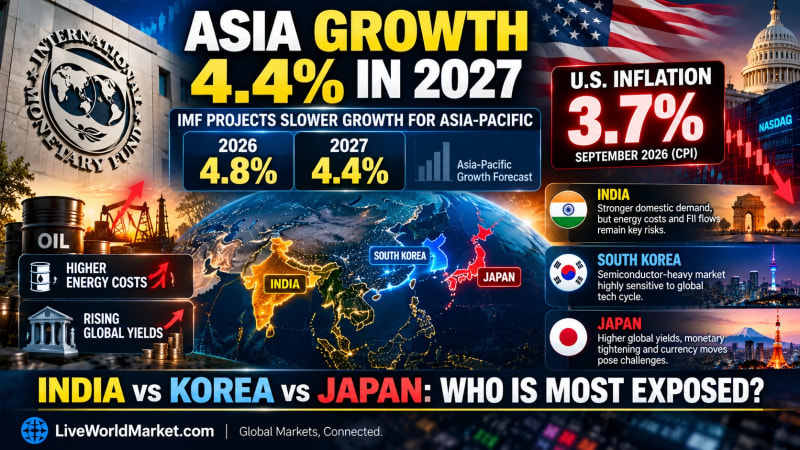
IMF Asia Growth 4.4%, US CPI 3.7%: Which Stocks Are at Risk?
News · Oct 15, 2026 · 12 min read
IMF Sees Asia Growth Slowing to 4.4% as U.S. Inflation Hits 3.7%: Which Stock Markets Are Most Vulnerable? Asia's stock markets are facing a critical test as two major economic developments collide: the International Monetary Fund's warning about slower regional growth and an unexpected rise in U.S. inflation. The IMF's October Asia-Pacific outlook projects regional economic…
Read more...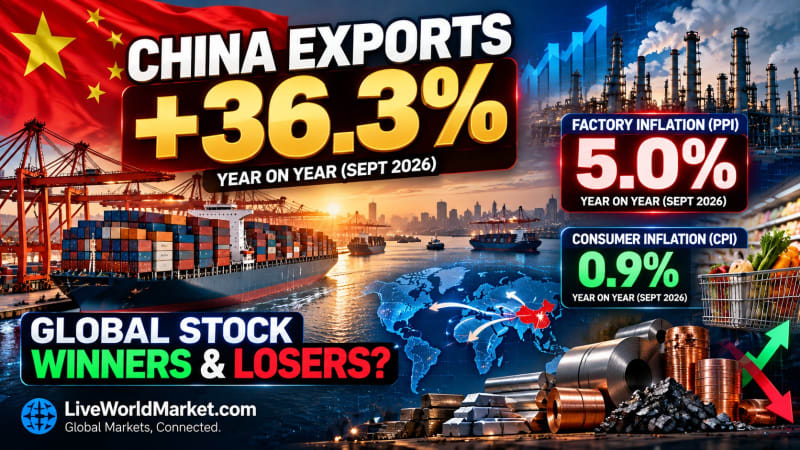
China Exports Surge 36.3%, PPI Hits 5%: Stock Winners & Losers
Geopolitics & Trade · Oct 14, 2026 · 11 min read
China's Exports Surge 36.3% as Factory Inflation Hits 5%: Which Global Stocks Could Win or Lose? China's factories are shipping more goods overseas than expected, but a sharp rise in producer prices is raising a new question about the profitability of the world's manufacturing powerhouse. Official data released on October 14 showed that China's exports surged 36.3%…
Read more...
CXMT DRAM Breakthrough: Samsung, SK Hynix & Micron at Risk?
Technology & Sectors · Oct 13, 2026 · 11 min read
China's CXMT DRAM Breakthrough: Could a Memory Price War Threaten Samsung, SK Hynix and Micron? The global semiconductor industry is confronting a new question: Could China's progress in memory-chip technology eventually undermine the pricing power of the world's largest DRAM manufacturers? Chinese chipmaker ChangXin Memory Technologies (CXMT) has reportedly made progress in a…
Read more...
RBI Dollar Window: Can Rupee Near ₹97 Survive $100 Oil?
Central Banks & Rates · Oct 12, 2026 · 9 min read
RBI Opens Special Dollar Window as Rupee Nears ₹97: Can India Protect Its Stock Market From $100 Oil? India's central bank has introduced a new defense against rupee weakness at a time when crude oil prices remain above $100 per barrel. The Reserve Bank of India (RBI) has announced a special dollar facility for three government-owned oil marketing companies, beginning October…
Read more...