
Apple Overtakes Nvidia: Is Lower AI Spending Winning?
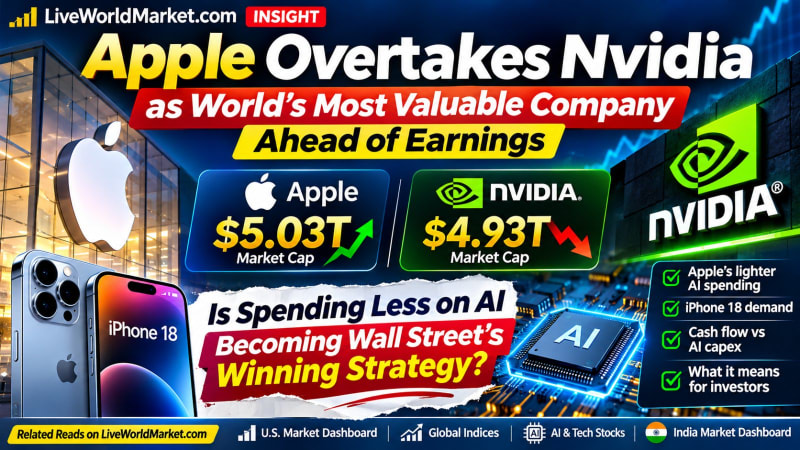
Apple Overtakes Nvidia as World's Most Valuable Company Ahead of Earnings: Is Spending Less on AI Becoming Wall Street's Winning Strategy?
Key takeaway: Apple has reclaimed the title of the world's most valuable publicly traded company, overtaking Nvidia as investors reassess the enormous cost of artificial intelligence infrastructure. With Apple's upcoming earnings in focus, Wall Street faces a new question: could companies that monetize AI through existing products outperform those spending billions to build the infrastructure behind it?
Apple Reclaims the Market-Cap Crown
The global technology sector is entering a potentially important phase in the artificial intelligence investment cycle.
After months of enthusiasm surrounding AI chips, data centres and cloud infrastructure, investors are increasingly questioning how quickly unprecedented capital expenditure will translate into sustainable profits.
Against this backdrop, Apple overtook Nvidia in market capitalization at the end of October 2026, becoming the world's most valuable publicly traded company.
At the October 30 close, Apple's market capitalization stood at approximately $5.03 trillion, compared with Nvidia's $4.93 trillion.
The change did not result from a dramatic rally in Apple shares. Instead, Nvidia experienced a sharper decline as technology stocks came under pressure.
That distinction is important: Apple's return to the top reflects both its own business resilience and changing investor sentiment toward AI-related spending.
The upcoming earnings report will provide a critical test of whether Apple's premium hardware ecosystem can sustain its valuation.
Apple vs Nvidia: Two Different Approaches to the AI Economy
Apple and Nvidia occupy fundamentally different positions in the global AI value chain.
Nvidia: Supplying the AI infrastructure
Nvidia provides graphics processing units, networking equipment and computing platforms used to train and run advanced artificial intelligence models.
Its growth is closely connected to spending by hyperscale cloud providers, AI developers and enterprises building computing infrastructure.
The opportunity is substantial, but Nvidia's valuation is sensitive to expectations about the future pace of AI investment.
Apple: Monetizing AI through devices and services
Apple operates a consumer-focused ecosystem built around the iPhone, Mac, iPad, wearables and digital services.
Rather than competing primarily to sell data-centre infrastructure, Apple can integrate AI capabilities into products already used by its customers.
This creates a different investment proposition: AI could improve device functionality, support premium pricing, encourage upgrades and strengthen customer retention.
However, lower infrastructure spending does not automatically mean superior AI economics. Apple still faces substantial research, development, cloud-computing and competitive costs.
Why Wall Street Is Questioning the AI Spending Boom
The latest earnings season has brought renewed attention to the relationship between AI investment and financial returns.
Large technology companies are investing heavily in computing infrastructure, advanced chips, networking systems and energy-intensive data centres.
These investments may create long-term competitive advantages, but they also introduce financial risks.
1. Capital expenditure can reduce free cash flow
A company may report strong revenue growth while generating less cash because it is investing heavily in infrastructure.
Investors therefore need to examine operating cash flow, capital expenditure and free cash flow together.
2. AI infrastructure requires continuing investment
Advanced computing systems can become technologically outdated relatively quickly.
Companies may need to replace or upgrade hardware even before earlier investments have delivered their full expected returns.
3. Revenue growth does not guarantee attractive returns
AI demand can remain strong while competition, operating costs and infrastructure requirements reduce profitability.
The central question is no longer simply how much companies are investing in AI, but how much economic value they can generate from those investments.
Is Apple's Lower-Capital-Intensity Strategy an Advantage?
Apple's business model offers several potential advantages.
Its enormous installed base provides an established distribution channel for new software and AI capabilities.
Its services business generates recurring revenue, while its integrated hardware and software ecosystem can encourage customers to remain within the Apple platform.
If AI features stimulate device upgrades or increase services engagement, Apple may capture additional revenue without needing to replicate the full infrastructure spending of major cloud providers.
But there are important limitations.
Apple depends on external semiconductor manufacturing partners, faces intense competition in smartphones and must demonstrate that consumers value its AI features.
It may also need to increase spending on AI development, computing and partnerships over time.
The key investment distinction is capital efficiency—not simply spending less.
A company investing heavily in AI can create substantial shareholder value if its returns exceed its cost of capital. Conversely, a company investing less may underperform if it fails to develop compelling AI products.
Apple's Upcoming Earnings: What Investors Should Watch
Apple's upcoming results could help determine whether its valuation premium is supported by underlying business performance.
Analysts have been anticipating quarterly revenue of approximately $113 billion, with earnings per share near $2, although estimates can change before the official release.
Five areas deserve particular attention.
iPhone 18 demand: Strong sales would indicate that Apple's core hardware franchise remains resilient despite a mature global smartphone market.
Greater China performance: Revenue trends in China will help investors evaluate competition, consumer demand and Apple's international growth outlook.
Services revenue: Continued expansion would strengthen the case for recurring, higher-margin earnings.
AI-related product demand: Management commentary could reveal whether new AI capabilities are influencing upgrades, customer engagement or monetization.
Free cash flow and capital expenditure: These figures will help investors compare Apple's investment intensity with that of infrastructure-focused technology companies.
The market's response may depend as much on forward guidance as on reported quarterly results.
What Does Apple's Rise Mean for Nvidia?
Apple overtaking Nvidia does not necessarily indicate that demand for AI chips is weakening.
Nvidia remains a major supplier of advanced computing hardware, and its future earnings depend on several factors, including data-centre investment, demand for AI inference, competitive developments and supply availability.
Nevertheless, the market-cap reversal highlights an important valuation risk.
Even companies delivering exceptional revenue growth can experience sharp share-price declines if investors reduce the premium they are willing to pay for future earnings.
Nvidia's stock therefore remains exposed not only to operating performance but also to changing expectations about AI spending.
Investors should distinguish between a temporary valuation adjustment and evidence of a structural slowdown in the AI infrastructure market.
What This Means for Indian Technology and Electronics Stocks
The Apple-versus-Nvidia debate has implications beyond the United States.
India's technology sector includes IT services companies, electronics manufacturers, engineering firms and semiconductor-related businesses with different exposure to the global AI investment cycle.
Electronics manufacturing
Companies involved in smartphone assembly, components and electronics manufacturing could benefit if Apple's device demand remains strong.
However, revenue growth and profitability will depend on customer contracts, manufacturing volumes, component costs and operating margins.
Indian IT services
Companies such as TCS, Infosys, HCLTech and Wipro may benefit from enterprise AI adoption, cloud modernization and digital transformation.
But increased AI investment by global clients does not automatically translate into higher outsourcing revenue.
Investors should watch whether AI projects move from experimentation into commercially meaningful deployments.
Semiconductor and engineering services
Indian companies exposed to semiconductor design, engineering services and data-centre infrastructure may experience opportunities linked to the global AI ecosystem.
Their performance will depend on order conversion, execution and profitability rather than AI-related announcements alone.
Readers can follow Indian market movements through the LiveWorldMarket India Market Dashboard and monitor US technology-sector developments using the US Market Dashboard.
Three Possible Scenarios for Technology Stocks
Scenario 1: Apple's Earnings Reinforce the Capital-Efficiency Narrative
If Apple reports strong iPhone demand, healthy services growth and robust cash generation, investors may become more interested in technology companies capable of generating incremental profits without exceptionally large infrastructure investments.
This could support renewed attention to cash flow, margins and capital returns.
Scenario 2: AI Infrastructure Spending Continues to Deliver Strong Returns
If cloud providers demonstrate that AI investment is generating sustainable revenue and profitability, infrastructure-focused companies could regain investor confidence.
In this scenario, Nvidia and other semiconductor suppliers may continue benefiting from substantial computing demand.
Scenario 3: Technology Valuations Face a Broader Reset
If consumer demand weakens while AI infrastructure costs remain elevated, investors may reassess valuations across both hardware and software businesses.
Apple's comparatively different business model would not make it immune to a broad technology-sector correction.
These are possible outcomes rather than market forecasts.
Five Indicators Investors Should Track
Investors assessing the next phase of the AI investment cycle should monitor:
- Free cash flow: How much cash companies retain after funding capital expenditure.
- AI revenue monetization: Whether AI products and services generate measurable commercial returns.
- Capital expenditure growth: Whether infrastructure spending continues rising faster than revenue.
- Operating margins: Whether AI-related costs are affecting profitability.
- Valuation multiples: Whether share prices already reflect aggressive future growth assumptions.
For a broader perspective on global market trends, visit LiveWorldMarket.com and explore the latest market dashboards.
LiveWorldMarket Insight: The AI Race May Be Entering Its Capital-Efficiency Phase
Apple's return to the top of the global market-cap rankings raises a question about the next stage of the AI investment cycle.
During the early stages of the AI boom, investors rewarded companies positioned to supply the infrastructure required for rapid technological expansion.
The next phase may place greater emphasis on how effectively companies convert AI investment into sustainable earnings and free cash flow.
Apple's business model offers one possible route: integrating AI into an established ecosystem of products and services.
Nvidia represents another: supplying the computing infrastructure that makes advanced AI applications possible.
Both approaches can create substantial economic value, but they carry different risks.
The emerging investment question is not which company spends the least on AI. It is which company earns the strongest sustainable return on the capital it deploys.
For global investors, that distinction could become increasingly important as the AI investment cycle matures.
Frequently Asked Questions
Why did Apple overtake Nvidia in market capitalization?
Apple moved ahead of Nvidia at the October 30, 2026 close after Nvidia experienced a larger share-price decline. The ranking can change with daily market movements.
Does Apple spend less on AI than Nvidia?
The companies have different business models and accounting structures, making direct comparisons difficult. Apple focuses heavily on consumer devices and software, while Nvidia develops and sells AI computing hardware.
Is Nvidia's AI growth slowing?
A decline in Nvidia's share price does not establish that its underlying AI business is slowing. Investors need to evaluate revenue growth, order demand, margins and customer spending plans.
How could Apple's earnings affect Indian stocks?
Strong device demand could be relevant to Indian electronics manufacturers, while management commentary on AI adoption could influence sentiment toward technology services and engineering companies.
Is lower AI spending better for shareholders?
Not necessarily. The important measure is whether investment generates returns above its cost of capital and supports sustainable cash flow.
Sources and Further Reading
- Apple Investor Relations — Financial Results
- Nvidia Investor Relations — Financial Reports
- Reuters — Global Markets Coverage
- LiveWorldMarket — Global Market Dashboards
Disclaimer: This article is for informational and educational purposes only and does not constitute investment advice. Market capitalizations, analyst estimates and share-price movements may change. Figures should be checked against official market data and company announcements before publication.
Comments (0)
Be the first to comment.
About the author

NISM-Series-X-A Investment Adviser Level 1 examination completed
Amit writes about Indian equity markets, technical analysis, macro themes and the day-to-day mechanics of trading, with a focus on making the flow of global markets legible for retail investors. He has completed the NISM-Series-X-A Investment Adviser Level 1 examination.
You May Also Like

ExxonMobil Refining Profits Surge: Impact on Indian Oil Stocks
Commodities & Energy · Nov 1, 2026 · 8 min read
ExxonMobil's Refining Profits Overtake Oil Drilling for First Time in 6 Years: Why India's Oil Stocks May Miss the Windfall Key Takeaway: ExxonMobil's refining business has emerged as a bigger earnings contributor than oil production, highlighting an extraordinary shift in global energy markets. But Indian oil companies such as IOC, BPCL and HPCL face a different challenge…
Read more...
Fed Decision and Microsoft–Google Earnings: Two Critical Tests for the AI Stock Market Rally
Global Markets & Economy · Oct 28, 2026 · 15 min read
Global stock markets are approaching one of the most important financial evenings of October 2026. The U.S. Federal Reserve is preparing to announce its latest interest-rate decision, while Microsoft and Alphabet, Google's parent company, are scheduled to publish quarterly earnings after Wall Street closes. These developments arrive as investors reassess the sustainability of…
Read more...
JetBlue Stock Surges 20%, Bond Yield Tops 30%: Warning?
Global Markets & Economy · Oct 28, 2026 · 16 min read
JetBlue Stock Surges 20% While Its Bonds Yield Over 30%: Is Airline Debt Flashing a Warning for Investors? Something unusual is happening in the U.S. airline industry. Shares of JetBlue Airways surged approximately 20% on October 27, after the airline raised its revenue outlook and attempted to reassure investors about its financial position. But an entirely different story…
Read more...
US Consumer Staples Rally 9.6%: FMCG Valuation Risk for India
Global Markets & Economy · Oct 25, 2026 · 16 min read
US Consumer Staples Surge 9.6% as Valuations Overtake Tech: Is the Safe-Stock Trade Becoming a Trap for Indian FMCG Investors? Something unexpected is happening on Wall Street. As investors become increasingly cautious about expensive artificial intelligence stocks, money has been moving into an unlikely market leader: consumer staples. The U.S. consumer-staples sector has…
Read more...
SpaceX 80,000 Cell Sites: Will Starlink Challenge Jio & Airtel?
Global Markets & Economy · Oct 24, 2026 · 17 min read
SpaceX's 80,000 Cell-Site Plan Sends US Telecom Stocks Down 8%: Could Starlink Disrupt Jio and Airtel Next? A major shift may be emerging in the global telecommunications industry—and Wall Street has already started reacting. Shares of American telecommunications giants AT&T and T-Mobile plunged nearly 8% on October 23 after reports revealed that Elon Musk's SpaceX was…
Read more...
US 10-Year Treasury Yield Below 5%: Growth Shock Warning?
Central Banks & Rates · Oct 23, 2026 · 17 min read
US 10-Year Treasury Yield Falls Below 5% Despite $114 Oil: Is the Bond Market Warning of a Global Growth Shock? Something unusual is happening across global financial markets. The yield on the benchmark U.S. 10-year Treasury has fallen sharply below the psychologically important 5% level, even as Brent crude oil has surged toward $114 per barrel and technology stocks have…
Read more...
Brent Crude Tops $110: Impact on Indian Stocks & Earnings
Global Markets & Economy · Oct 22, 2026 · 14 min read
Brent Crude Tops $110: Why Indian Airlines, Paints and Tyre Stocks Face a Hidden Earnings Risk Brent crude oil has climbed above $110 per barrel, intensifying concerns that rising global energy prices could squeeze corporate profit margins, increase India's import costs and create further volatility in domestic equities. On October 22, Brent futures traded above $111 after…
Read more...
India Optical Fibre Exports Jump 158%: AI's Hidden Winners
Global Markets & Economy · Oct 21, 2026 · 12 min read
India's Optical Fibre Exports Jump 158% as Japan's Chip Shipments Surge 49%: The Hidden Winners of the AI Infrastructure Boom Artificial intelligence may be transforming the technology industry, but some of its most important economic beneficiaries are not necessarily the companies developing AI models. They may be the businesses manufacturing the physical infrastructure that…
Read more...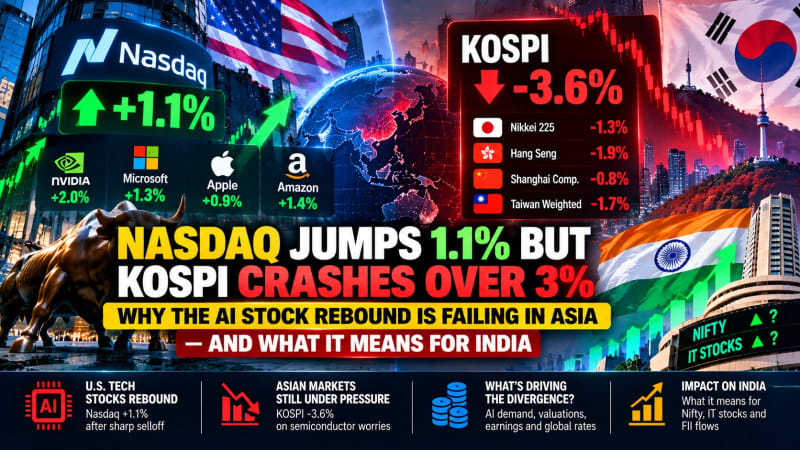
Nasdaq Rises 1.1%, KOSPI Falls 3.6%: AI Stocks and India Impact
Global Markets & Economy · Oct 20, 2026 · 12 min read
Nasdaq Jumps 1.1% but KOSPI Crashes Over 3%: Why the AI Stock Rebound Is Failing in Asia—and What It Means for India Global technology stocks are sending conflicting signals. On Monday, October 19, the Nasdaq Composite gained 1.11%, recovering part of the losses suffered during the previous week's technology selloff. U.S. semiconductor stocks also rebounded, with the…
Read more...
Jio IPO 2026: $108 Billion Valuation Amid Global AI Selloff
Market Valuation & Behaviour · Oct 19, 2026 · 14 min read
Jio IPO at $108 Billion Amid Global AI Stock Selloff: Can India's Biggest IPO Defy the Tech Market Rout? India is preparing for what could become its largest-ever initial public offering at a time when global investors are reassessing technology valuations, artificial intelligence spending and the financial sustainability of digital infrastructure. Jio Platforms, the digital…
Read more...