
Nasdaq Rises 1.1%, KOSPI Falls 3.6%: AI Stocks and India Impact
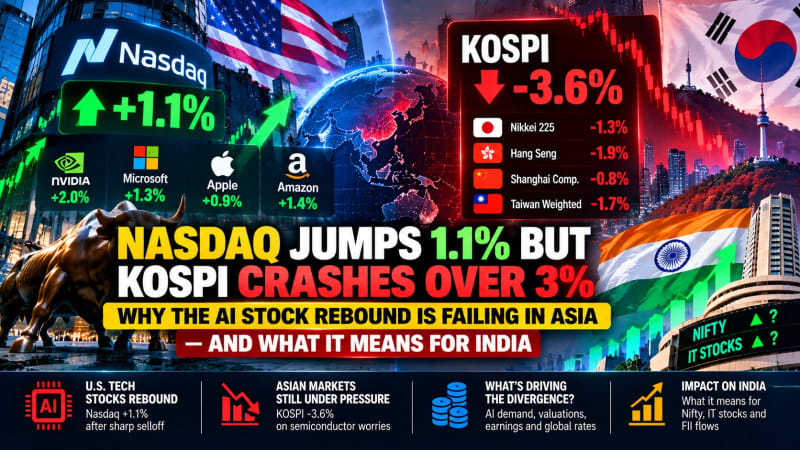
Nasdaq Jumps 1.1% but KOSPI Crashes Over 3%: Why the AI Stock Rebound Is Failing in Asia—and What It Means for India
Global technology stocks are sending conflicting signals.
On Monday, October 19, the Nasdaq Composite gained 1.11%, recovering part of the losses suffered during the previous week's technology selloff. U.S. semiconductor stocks also rebounded, with the Philadelphia Semiconductor Index rising approximately 1.6% and ending an eight-session losing streak.
But the recovery failed to carry over into Asian markets.
During Tuesday's morning trading, South Korea's KOSPI fell approximately 3.6%, Japan's Nikkei declined around 1.3%, and the broader MSCI Asia-Pacific index excluding Japan dropped roughly 0.9%.
The divergence raises an important question for global investors:
Why are U.S. technology stocks recovering while Asian semiconductor-heavy markets remain under pressure?
The answer may lie in differences in market concentration, investor positioning, financing conditions and uncertainty surrounding the profitability of the global artificial intelligence investment boom.
For Indian investors, this divergence could influence IT-sector valuations, foreign institutional investment flows and sentiment toward technology-related businesses.
1. What Happened Overnight? Nasdaq Rebounds, Asian Markets Sell Off
The Nasdaq Composite closed October 19 at approximately 26,430.89, gaining 290.85 points, or 1.11%.
The S&P 500 advanced 0.41%, while the Dow Jones Industrial Average slipped 0.07%.
Technology and semiconductor stocks helped drive the U.S. recovery after a difficult previous week.
The Philadelphia Semiconductor Index gained about 1.6%, ending eight consecutive sessions of losses.
However, the mood changed during Tuesday's Asian trading session.
South Korea's KOSPI declined approximately 3.6% in an early market snapshot, while Japan's Nikkei and the broader regional benchmark also weakened.
This was particularly notable because South Korea is home to major memory-chip manufacturers, including Samsung Electronics and SK Hynix.
The contrast suggests that investors are not yet treating the U.S. rebound as convincing evidence that technology-sector risks have disappeared.
[INSERT POLISHED IMAGE TABLE 1: Nasdaq vs KOSPI — October 19–20 Market Divergence]
Market note: U.S. figures are October 19 closing returns. Asian figures are October 20 intraday observations and may change before the session closes.
2. Why Did U.S. Semiconductor Stocks Recover?
Several factors helped U.S. technology shares recover after last week's selloff.
Short-Covering and Bargain Hunting
After several consecutive declines, some investors viewed semiconductor stocks as oversold.
Traders who had positioned for further losses may also have closed short positions, contributing to the rebound.
However, short-covering rallies can occur without a lasting improvement in business fundamentals.
Strong Long-Term AI Demand
Artificial intelligence remains an important driver of semiconductor demand.
Advanced processors, memory chips and networking equipment are essential for training and running AI systems.
Investors continue to expect substantial investment in computing infrastructure.
Upcoming Technology Earnings
The market is awaiting financial results from several major technology companies.
These earnings reports could provide new information about AI spending, customer demand, operating margins and capital expenditure.
Stabilizing Sentiment
A sharp selloff can create opportunities for selective buying, particularly when investors believe the longer-term business outlook remains intact.
However, the recovery in U.S. stocks does not eliminate concerns about high valuations or expensive AI infrastructure financing.
Related: Explore the U.S. Stock Market Dashboard.
3. Why Is South Korea's KOSPI Falling Despite the Nasdaq Rebound?
South Korea's stock market is highly sensitive to the global semiconductor investment cycle.
Large companies such as Samsung Electronics and SK Hynix have significant influence on the index.
When investors become cautious about memory-chip demand, semiconductor valuations or AI-related capital expenditure, Korean equities can experience substantial pressure.
Semiconductor Concentration
South Korea's market has meaningful exposure to electronics, memory chips and technology hardware.
This creates opportunities when semiconductor demand is strong.
But it can also amplify losses when global investors reduce exposure to the sector.
Foreign Institutional Selling
Foreign investment flows can significantly influence Korean equity-market performance.
During Tuesday's early session, reports indicated selling pressure from foreign and institutional investors.
Concerns About AI Investment Returns
AI infrastructure expansion requires enormous spending on GPUs, memory, networking equipment and data centers.
Investors are increasingly questioning whether that investment will generate sufficient revenue and free cash flow.
Even if chip demand remains strong today, concerns about future spending can affect semiconductor valuations.
Profit-Taking After Strong Gains
Technology stocks that previously benefited from the AI investment boom may be vulnerable to profit-taking when market sentiment deteriorates.
The key distinction: A strong semiconductor business can still experience a sharp stock-price decline when expectations and valuations become stretched.
4. The AI Investment Paradox: Strong Chip Demand, Weak Investor Confidence
One of the most important developments in global markets is the growing separation between AI demand and AI investment profitability.
AI-related businesses do not all operate under the same financial model.
Semiconductor Manufacturers
Chipmakers sell processors, memory and related components to customers building AI infrastructure.
Their revenue depends on orders, production capacity, pricing and customer demand.
AI Cloud and Data-Center Operators
These companies purchase expensive computing equipment and build infrastructure to provide AI computing services.
Their profitability depends on utilization, customer contracts, financing costs and the useful life of hardware.
Technology Platforms
Large technology companies invest in AI infrastructure to support cloud services, advertising, software and other products.
Investors want evidence that these investments are improving revenue growth, efficiency or customer retention.
Financial Institutions
Banks, bondholders and private-credit providers help finance infrastructure expansion.
Their exposure depends on borrowers' ability to generate cash and meet financial obligations.
[INSERT POLISHED IMAGE TABLE 2: AI Value Chain — Business Models and Financial Risks]
This explains why strong demand for AI chips does not automatically guarantee attractive returns across the entire AI ecosystem.
5. Why Rising Bond Yields Matter for Technology Stocks
Global interest rates remain an important influence on technology valuations.
The U.S. 10-year Treasury yield rose to approximately 5.14% following Monday's session.
Higher government bond yields can influence stock markets in two ways.
Higher Discount Rates
Investors value companies partly by estimating the present value of future earnings and cash flows.
When interest rates rise, those future cash flows may be valued less highly.
Companies whose valuations depend heavily on long-term growth can be particularly sensitive.
More Expensive Financing
AI infrastructure operators require substantial investment.
Higher borrowing costs can make new data-center projects less attractive and refinancing more expensive.
This creates a challenge for businesses that depend heavily on external capital.
The issue is not necessarily that AI demand is collapsing.
Rather, investors are becoming more selective about which companies can finance expansion profitably.
6. Why Asian Chipmakers May Be More Vulnerable Than U.S. Technology Platforms
The global technology sector includes businesses with very different revenue models.
Asian semiconductor manufacturers are closely linked to hardware demand, manufacturing investment and export markets.
Large U.S. technology platforms often generate revenue from a wider mix of cloud services, advertising, software subscriptions and digital ecosystems.
This does not mean U.S. technology companies are immune to risk.
However, their revenue diversification may influence how investors respond to changes in AI investment expectations.
Key Differences
Asian chip manufacturers: Sensitive to semiconductor orders, memory pricing, export demand and manufacturing cycles.
U.S. technology platforms: Sensitive to cloud revenue, advertising demand, software spending and returns on AI investment.
AI infrastructure operators: Sensitive to utilization, debt financing, customer commitments and hardware replacement costs.
The distinction matters because a recovery in U.S. platform stocks does not automatically imply an immediate recovery in Asian hardware manufacturers.
7. What Do Upcoming U.S. Technology Earnings Mean for Asia?
This week's technology earnings could become an important test of the global AI investment narrative.
Investors are looking for evidence that large AI-related capital expenditures are generating sustainable business returns.
Meta Platforms
Meta's results may offer insights into advertising demand, AI infrastructure spending and the financial returns from AI-related investment.
Tesla
Tesla's earnings could provide information about vehicle demand, margins, capital expenditure and its technology initiatives.
Lam Research
Lam Research is an important supplier of semiconductor manufacturing equipment.
Its orders and outlook can help investors assess chipmakers' investment plans.
Texas Instruments
Texas Instruments provides exposure to industrial, automotive and broader semiconductor demand.
Its results may reveal trends outside the most advanced AI computing segment.
What Would Reassure Investors?
Positive signals would include strong revenue growth, healthy margins, improving cash-flow generation and disciplined capital expenditure.
Conversely, aggressive spending plans without convincing evidence of financial returns could renew concerns.
The key question is whether AI investment is producing enough incremental earnings to justify the scale of capital being committed.
8. What Does the Nasdaq–KOSPI Divergence Mean for Indian IT Stocks?
Indian IT services companies have a different business model from semiconductor manufacturers.
Businesses such as TCS, Infosys, HCLTech and Wipro primarily generate revenue by providing technology services to enterprise customers.
Their performance depends on client technology budgets, outsourcing demand, project execution and operating margins.
They are not directly comparable to companies manufacturing memory chips or operating GPU-heavy data centers.
Potential Opportunities
AI adoption could create demand for enterprise modernization, data engineering, cloud integration, cybersecurity and automation services.
Indian IT companies may benefit if businesses increase spending on deploying AI applications.
Potential Risks
If global corporations become more cautious about technology spending, discretionary IT projects could be delayed.
Higher interest rates and weaker economic confidence may also affect client budgets.
Why the Difference Matters
A semiconductor selloff does not necessarily mean Indian IT earnings will deteriorate at the same pace.
However, broader technology-sector risk aversion can still influence valuations.
Investors should distinguish between share-price sentiment and actual changes in business fundamentals.
Related: Follow the Indian Stock Market Dashboard.
9. Could India's Technology Sector Benefit From a Shift in AI Spending?
As businesses evaluate the cost of AI infrastructure, they may place greater emphasis on practical applications and measurable productivity gains.
This could create opportunities for technology service providers.
Enterprise AI Integration
Companies may need assistance integrating AI tools into existing software and business processes.
Cloud Optimization
Businesses may seek to reduce infrastructure costs and improve cloud efficiency.
Data Management
AI systems require reliable data pipelines, governance and security.
Automation
Organizations may invest in AI-enabled automation to improve operational efficiency.
Cybersecurity
Greater adoption of AI and cloud technologies can increase the need for cybersecurity and risk-management services.
However, these opportunities will not necessarily translate into immediate revenue growth.
The timing and profitability of AI-related service contracts remain important.
10. How Could Foreign Institutional Investors Respond?
Global investors often adjust portfolios when market volatility increases.
A sharp decline in semiconductor-heavy markets may encourage some funds to reduce technology exposure.
Others may use lower valuations to increase positions.
The implications for India are therefore uncertain.
Potential Positive Scenario
Investors seeking more diversified earnings exposure may consider Indian businesses with strong domestic demand and relatively stable cash flows.
Potential Negative Scenario
A broad reduction in global risk appetite could lead to selling across emerging markets, including India.
Currency and Interest-Rate Effects
Foreign investment decisions also depend on the U.S. dollar, Treasury yields and local currency movements.
Higher U.S. yields can make dollar-denominated assets more attractive relative to riskier markets.
A decline in South Korean equities does not automatically translate into foreign investment inflows into India.
Actual FII/FPI data is needed to establish whether such a shift is occurring.
11. India vs South Korea: Different Technology Exposures
India and South Korea participate in the global technology economy in different ways.
South Korea is a major semiconductor and electronics manufacturing center.
India has a substantial IT services industry, alongside a growing electronics manufacturing and digital infrastructure ecosystem.
Their stock markets therefore respond differently to changes in global technology demand.
[INSERT POLISHED IMAGE TABLE 3: India vs South Korea — Technology Market Exposure]
For investors, the important lesson is to compare business models rather than assuming that all technology-related companies face identical risks.
12. Three Scenarios for Global Technology Stocks
Scenario One: AI Earnings Restore Confidence
Major technology companies report strong results and demonstrate improving returns on AI investment.
Semiconductor orders remain healthy, financing concerns ease and global risk appetite improves.
Asian technology stocks could recover as confidence strengthens.
Scenario Two: Selective Recovery
U.S. technology platforms stabilize, but highly valued semiconductor and infrastructure stocks remain volatile.
Investors increasingly distinguish between businesses with strong cash flow and those relying heavily on future growth.
This scenario could favor selective stock picking over broad technology-sector exposure.
Scenario Three: AI Financing Concerns Intensify
Borrowing costs remain elevated and investors become more concerned about the profitability of infrastructure spending.
Technology valuations decline further, affecting U.S. and Asian markets.
Foreign portfolio outflows and currency volatility could create additional pressure on emerging markets.
These are analytical scenarios, not predictions with assigned probabilities.
13. Seven Indicators Investors Should Monitor Next
1. Nasdaq and semiconductor index performance
Watch whether the U.S. rebound extends beyond one session.
2. KOSPI and SK Hynix
Monitor whether selling pressure in Korean memory-chip stocks stabilizes.
3. U.S. technology earnings
Focus on revenue growth, margins, cash flow and AI capital expenditure.
4. U.S. Treasury yields
Higher yields may continue to pressure growth-stock valuations.
5. AI infrastructure credit spreads
Wider spreads may signal rising financing concerns.
6. Nifty IT performance
Compare Indian IT stocks with global technology benchmarks.
7. Foreign portfolio investment in India
Track whether international investors are increasing or reducing exposure to Indian equities.
For broader market developments, visit LiveWorldMarket.com and explore the latest Market Insights.
LiveWorldMarket View: The AI Trade Is Entering a More Selective Phase
The divergence between the Nasdaq and South Korea's KOSPI highlights an important change in global investor behavior.
The Nasdaq's 1.11% rebound suggests that some investors remain willing to buy technology stocks after sharp declines.
But the KOSPI's approximately 3.6% morning fall shows that confidence has not returned uniformly across the global technology supply chain.
This does not establish that AI demand is collapsing.
It suggests that investors are increasingly distinguishing between companies generating strong earnings today and businesses whose valuations depend on expensive future investment.
For India, the implications are mixed.
Indian IT services companies could benefit from enterprise AI adoption, cloud optimization and digital transformation.
However, they remain exposed to global technology budgets, valuations and investor sentiment.
The next major signal will come from corporate earnings.
If leading technology companies demonstrate that AI investment is producing sustainable revenue and profits, confidence could improve across global markets.
If spending continues rising faster than financial returns, volatility may persist.
The key takeaway: The AI investment cycle is not necessarily ending, but investors are becoming more selective about where profits are generated, how growth is financed and whether valuations are justified.
For Indian investors, the strongest approach is to monitor company fundamentals, global financing conditions and foreign investment flows rather than assume that a rebound in the Nasdaq guarantees a recovery across Asian technology markets.
Read more at LiveWorldMarket Insights, U.S. Stock Market and India Stock Market.
Sources and Further Reading
- Reuters — Asian shares tumble as markets await AI sector results, October 20, 2026
- Associated Press — U.S. stock market performance, October 19, 2026
- Bloomberg via Moneycontrol — Asian stocks decline despite U.S. chip rally
- Seoul Economic Daily — KOSPI falls despite U.S. semiconductor rebound
- Nasdaq — Official market data
- NSE India — Official Indian market data
Disclaimer: This article is for educational and informational purposes only and does not constitute personalized investment advice. U.S. figures refer to October 19 closing data; Asian market figures refer to October 20 intraday observations and may change. Investment scenarios are not guaranteed outcomes.
Comments (0)
Be the first to comment.
About the author

NISM-Series-X-A Investment Adviser Level 1 examination completed
Amit writes about Indian equity markets, technical analysis, macro themes and the day-to-day mechanics of trading, with a focus on making the flow of global markets legible for retail investors. He has completed the NISM-Series-X-A Investment Adviser Level 1 examination.
You May Also Like

US Midterm Elections 2026: Impact on Stocks, Dollar & India
Global Markets & Economy · Nov 4, 2026 · 10 min read
US Midterm Elections 2026: Why Treasury Yields, the Dollar and Indian Stocks Could React More Than Wall Street Key Takeaway: Democrats have won control of both chambers of the US Congress in the 2026 midterm elections, creating a divided government under President Donald Trump. The immediate market reaction has been revealing: US Treasury yields declined, the dollar weakened…
Read more...
Apple Overtakes Nvidia: Is Lower AI Spending Winning?
Technology & Sectors · Nov 2, 2026 · 9 min read
Apple Overtakes Nvidia as World's Most Valuable Company Ahead of Earnings: Is Spending Less on AI Becoming Wall Street's Winning Strategy? Key takeaway: Apple has reclaimed the title of the world's most valuable publicly traded company, overtaking Nvidia as investors reassess the enormous cost of artificial intelligence infrastructure. With Apple's upcoming earnings in focus…
Read more...
ExxonMobil Refining Profits Surge: Impact on Indian Oil Stocks
Commodities & Energy · Nov 1, 2026 · 8 min read
ExxonMobil's Refining Profits Overtake Oil Drilling for First Time in 6 Years: Why India's Oil Stocks May Miss the Windfall Key Takeaway: ExxonMobil's refining business has emerged as a bigger earnings contributor than oil production, highlighting an extraordinary shift in global energy markets. But Indian oil companies such as IOC, BPCL and HPCL face a different challenge…
Read more...
Fed Decision and Microsoft–Google Earnings: Two Critical Tests for the AI Stock Market Rally
Global Markets & Economy · Oct 28, 2026 · 15 min read
Global stock markets are approaching one of the most important financial evenings of October 2026. The U.S. Federal Reserve is preparing to announce its latest interest-rate decision, while Microsoft and Alphabet, Google's parent company, are scheduled to publish quarterly earnings after Wall Street closes. These developments arrive as investors reassess the sustainability of…
Read more...
JetBlue Stock Surges 20%, Bond Yield Tops 30%: Warning?
Global Markets & Economy · Oct 28, 2026 · 16 min read
JetBlue Stock Surges 20% While Its Bonds Yield Over 30%: Is Airline Debt Flashing a Warning for Investors? Something unusual is happening in the U.S. airline industry. Shares of JetBlue Airways surged approximately 20% on October 27, after the airline raised its revenue outlook and attempted to reassure investors about its financial position. But an entirely different story…
Read more...
US Consumer Staples Rally 9.6%: FMCG Valuation Risk for India
Global Markets & Economy · Oct 25, 2026 · 16 min read
US Consumer Staples Surge 9.6% as Valuations Overtake Tech: Is the Safe-Stock Trade Becoming a Trap for Indian FMCG Investors? Something unexpected is happening on Wall Street. As investors become increasingly cautious about expensive artificial intelligence stocks, money has been moving into an unlikely market leader: consumer staples. The U.S. consumer-staples sector has…
Read more...
SpaceX 80,000 Cell Sites: Will Starlink Challenge Jio & Airtel?
Global Markets & Economy · Oct 24, 2026 · 17 min read
SpaceX's 80,000 Cell-Site Plan Sends US Telecom Stocks Down 8%: Could Starlink Disrupt Jio and Airtel Next? A major shift may be emerging in the global telecommunications industry—and Wall Street has already started reacting. Shares of American telecommunications giants AT&T and T-Mobile plunged nearly 8% on October 23 after reports revealed that Elon Musk's SpaceX was…
Read more...
US 10-Year Treasury Yield Below 5%: Growth Shock Warning?
Central Banks & Rates · Oct 23, 2026 · 17 min read
US 10-Year Treasury Yield Falls Below 5% Despite $114 Oil: Is the Bond Market Warning of a Global Growth Shock? Something unusual is happening across global financial markets. The yield on the benchmark U.S. 10-year Treasury has fallen sharply below the psychologically important 5% level, even as Brent crude oil has surged toward $114 per barrel and technology stocks have…
Read more...
Brent Crude Tops $110: Impact on Indian Stocks & Earnings
Global Markets & Economy · Oct 22, 2026 · 14 min read
Brent Crude Tops $110: Why Indian Airlines, Paints and Tyre Stocks Face a Hidden Earnings Risk Brent crude oil has climbed above $110 per barrel, intensifying concerns that rising global energy prices could squeeze corporate profit margins, increase India's import costs and create further volatility in domestic equities. On October 22, Brent futures traded above $111 after…
Read more...
India Optical Fibre Exports Jump 158%: AI's Hidden Winners
Global Markets & Economy · Oct 21, 2026 · 12 min read
India's Optical Fibre Exports Jump 158% as Japan's Chip Shipments Surge 49%: The Hidden Winners of the AI Infrastructure Boom Artificial intelligence may be transforming the technology industry, but some of its most important economic beneficiaries are not necessarily the companies developing AI models. They may be the businesses manufacturing the physical infrastructure that…
Read more...