
US 10-Year Treasury Yield Below 5%: Growth Shock Warning?
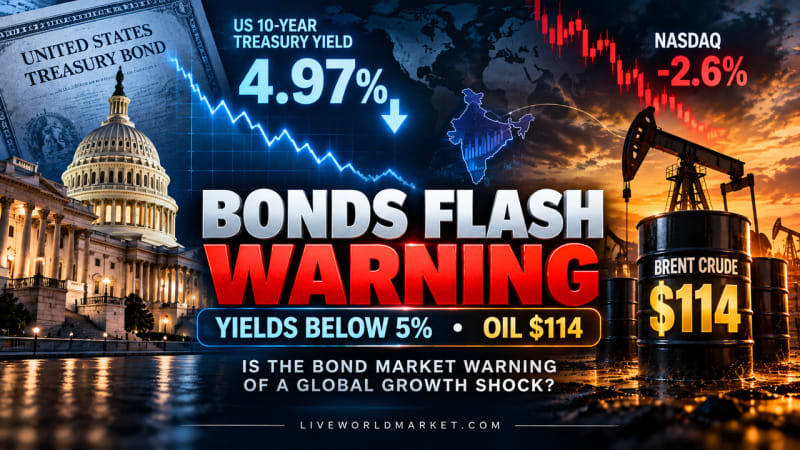
US 10-Year Treasury Yield Falls Below 5% Despite $114 Oil: Is the Bond Market Warning of a Global Growth Shock?
Something unusual is happening across global financial markets.
The yield on the benchmark U.S. 10-year Treasury has fallen sharply below the psychologically important 5% level, even as Brent crude oil has surged toward $114 per barrel and technology stocks have suffered another major selloff.
On October 22, the Nasdaq Composite declined 2.6%, while the Philadelphia Semiconductor Index lost approximately 6.7%.
At the same time, investors rushed into U.S. government bonds, pushing the 10-year Treasury yield down more than 19 basis points—its biggest one-day decline since March 2023.
By Friday morning, October 23, the benchmark yield had stabilised near 4.97%.
Meanwhile, Brent crude climbed to a five-month high around $114.10, driven by renewed geopolitical concerns in the Middle East.
This combination presents an important question for investors.
If higher oil prices increase inflation risks, why are U.S. Treasury yields falling instead of rising?
One possible explanation is that investors are becoming increasingly concerned about economic growth, technology-sector investment and the sustainability of corporate spending.
The bond market could be signalling that the risk of weaker economic activity is becoming more important than the immediate inflation threat.
But there is an essential distinction: a sharp bond rally can reflect temporary demand for safety without necessarily forecasting a recession.
For Indian investors, understanding the difference matters because U.S. bond yields influence global capital flows, currency markets, borrowing costs and equity valuations.
1. What Happened in Global Markets Overnight?
The October 22 U.S. trading session revealed a striking divergence between technology stocks and the broader market.
The Nasdaq Composite fell 2.6% to 26,008.86, while the S&P 500 declined approximately 1.2%.
The Dow Jones Industrial Average, however, finished marginally higher.
This suggests that the selloff was particularly concentrated in technology and AI-related investments rather than representing an equally severe decline across all industries.
Semiconductor shares faced substantially greater pressure.
The Philadelphia Semiconductor Index dropped approximately 6.7%, reflecting renewed concerns over the financing and profitability of enormous artificial-intelligence investments.
The sharpest move may have occurred in the bond market.
The 10-year Treasury yield fell more than 19 basis points in one session, before stabilising around 4.97% on October 23.
Meanwhile, the two-year Treasury yield also dropped sharply, settling near 4.66% in early Friday trading.
The decline suggests that investors were reassessing both economic risks and expectations for future Federal Reserve policy.
Global Market Snapshot — October 23, 2026

Source: Reuters, October 23; Associated Press, October 22. Market levels reflect the respective reporting times, not live quotes.
The unusual market combination is the starting point for a larger macroeconomic discussion.
Stocks are reacting to concerns about growth and corporate spending, while bonds are benefiting from demand for safety—even though oil prices remain elevated.
Investors can track U.S. Treasury yields, equity futures, the dollar and technology-sector performance through the LiveWorldMarket U.S. Stock Market Dashboard.
2. Why Are U.S. Treasury Yields Falling When Oil Prices Are Rising?
Under normal circumstances, sustained increases in crude oil prices can create inflationary pressure.
Higher oil prices can raise transportation costs, manufacturing expenses and consumer energy bills.
If investors expect inflation to remain elevated, they may demand higher bond yields to compensate.
However, bond yields respond to several different forces at the same time.
These include expected inflation, real interest rates, anticipated Federal Reserve policy, government borrowing requirements and demand for relatively safe assets.
The latest market reaction suggests that some investors are placing greater emphasis on growth risks and capital preservation.
When uncertainty rises sharply, institutional investors may purchase U.S. government bonds.
Because bond prices and yields move in opposite directions, increased demand can push Treasury prices higher and yields lower.
That can happen even when crude oil prices are rising.
Four Possible Oil-and-Bond-Market Combinations

The current combination—oil prices rising while Treasury yields fall—can emerge when several conditions overlap.
First, geopolitical instability increases oil supply risks.
Second, investors become concerned that expensive energy could weaken business activity and household spending.
Third, falling equity prices encourage demand for government bonds.
Fourth, expectations for future monetary policy shift as markets reassess potential economic weakness.
Importantly, none of these factors can be isolated from a single trading session.
It would be premature to conclude that the bond market has definitively predicted a recession.
A more accurate interpretation is that investors are currently assigning greater weight to economic uncertainty.
For background on the earlier rise in Treasury yields, read our analysis: US 10-Year Treasury Yield Hits 5%: Why Rising Bond Yields Could Be the Next Risk for Global Stocks.
3. Is the Bond Market Signalling a Global Growth Scare?
A growth scare occurs when investors begin reducing their expectations for future economic activity, even before official data confirm a meaningful slowdown.
The latest Treasury rally has several characteristics associated with such an environment.
Technology shares are falling sharply.
Investors are questioning the profitability of large capital-expenditure programmes.
Demand for government bonds is increasing.
And markets are reducing expectations for additional Federal Reserve tightening.
According to Reuters, markets no longer fully priced a December U.S. rate increase by October 23, with the implied probability falling to approximately 85%.
This is a significant repricing of monetary-policy expectations.
However, one important counterargument should not be ignored.
The U.S. stock-market selloff has not been equally broad.
On October 22, the Dow finished marginally higher, the Russell 2000 edged upward, and a majority of U.S. shares gained despite the Nasdaq's significant decline.
That suggests investors may also be rotating away from richly valued technology companies rather than indiscriminately selling all risk assets.
A true growth shock would become more concerning if weakness expanded into credit markets, employment, business activity and corporate earnings.
The bond market is displaying signs of increased economic caution, but the evidence does not yet establish that a broad recessionary downturn is underway.
4. AI Spending Concerns Are Becoming a Macro Risk
One of the most important developments behind the latest selloff involves artificial-intelligence investment.
During the past several years, leading U.S. technology companies have committed substantial capital to data centres, semiconductor equipment, networking systems and energy infrastructure.
The investment has helped support technology-sector earnings expectations and manufacturing demand across several economies.
But investors are now paying more attention to the financing requirements of these projects.
Meta shares fell nearly 8% during the October 22 session amid concerns over the company's AI-related expenditure and financing plans.
Tesla declined approximately 3.1% after revising its 2026 capital-spending plans.
These developments have renewed questions about the relationship between AI expenditure and financial returns.
For example, a company can experience strong revenue growth while simultaneously committing enormous cash resources to build infrastructure.
If those investments fail to generate sufficiently attractive returns, free cash flow and shareholder returns may disappoint.
This matters beyond the technology sector.
A slowdown in AI infrastructure expenditure could eventually affect semiconductor manufacturers, electrical equipment suppliers, data-centre construction, industrial automation and power infrastructure.
The transmission would depend on the size and duration of any investment reduction.
The concern is not that artificial intelligence has stopped growing.
It is that financial markets are becoming more selective about how much companies spend, how investments are financed and when they generate profits.
This marks a potential change from the earlier phase of the AI investment cycle, when large capital commitments were often interpreted primarily as evidence of future growth.
Related reading: AI Stocks vs. 5.2% Treasury Yields: Is the S&P 500 Too Dependent on AI?.
5. Brent Crude at $114 Creates a Difficult Inflation-and-Growth Combination
While the bond market is responding to growth concerns, crude oil is highlighting an important inflation risk.
Brent reached approximately $114.10 per barrel on October 23, a five-month high.
Renewed tensions in the Middle East and attacks involving Saudi Arabian infrastructure increased concerns about energy supply disruptions.
For the global economy, the consequences of sustained high crude prices extend beyond fuel expenses.
More expensive oil can raise transportation costs, increase production expenses, reduce household purchasing power and weaken business profitability.
Importantly, a supply-driven oil shock can create pressure on both economic growth and inflation.
Economists sometimes describe this combination as a stagflationary risk.
However, an actual period of stagflation would require sustained weak growth and elevated inflation—not merely one week of higher oil prices.
The distinction matters for monetary policy.
If inflation remains high while economic activity slows, central banks face difficult choices.
Increasing interest rates may help control inflation but can also weaken demand.
Reducing rates may support economic activity but risks allowing inflation pressures to persist.
This explains why the simultaneous rise in crude oil and fall in Treasury yields deserves attention.
The two markets may be focusing on different consequences of the same economic environment.
Oil traders are assessing supply risks.
Bond investors may be weighing financial stability, future growth and the outlook for monetary policy.
For a broader explanation of the interaction between oil and borrowing costs, see Oil Above $100 and U.S. Yields Near 5%: Impact on India and Global Markets.
6. What Does the Treasury Rally Mean for India?
India faces a complex combination of potential opportunities and risks.
On one hand, lower U.S. Treasury yields can reduce some of the pressure associated with global interest-rate differentials and financing conditions.
On the other hand, expensive crude oil and weaker international risk appetite can create challenges for Indian equities and the rupee.
The net impact will depend on which force becomes more persistent.
India Impact: Global Bonds, Oil and Equities

A. Foreign Institutional Investor Flows
U.S. Treasury yields influence global investment decisions.
When U.S. bond yields rise, high-quality dollar-denominated investments can become relatively more attractive.
This can reduce the incentive to take additional risk in emerging-market assets.
Lower U.S. yields may partially reverse that pressure.
However, the reason yields are declining is important.
If yields fall because inflation expectations improve and global economic conditions remain stable, emerging markets may benefit.
If yields fall because investors are frightened about a global downturn, foreign portfolio investors may still reduce exposure to emerging-market equities.
Therefore, falling Treasury yields are not automatically bullish for Indian stocks.
B. Indian Rupee and the Dollar
Lower U.S. bond yields can reduce support for the dollar by narrowing interest-rate differentials.
But the currency outcome also depends on investor sentiment, trade flows and the relative outlook for growth.
India's oil-import exposure creates an additional complication.
Higher crude prices increase the foreign-currency cost of energy imports, assuming import volumes and exchange rates remain comparable.
That can increase dollar demand and place pressure on the rupee.
If global investors simultaneously reduce exposure to emerging markets, these effects can reinforce one another.
C. Indian Government Bonds
A rally in U.S. Treasuries can influence bond markets globally.
Lower international yields may provide a supportive backdrop for Indian government securities.
However, India's inflation outlook and fiscal considerations also matter.
If elevated crude prices raise imported inflation, domestic bond yields may not decline as much as U.S. yields.
Investors should therefore monitor the Indian 10-year government bond yield alongside Brent crude and USD/INR.
D. Indian IT Companies
For Indian IT services companies, weaker U.S. growth can create a different challenge.
Large Indian technology businesses depend significantly on spending decisions by international corporate clients.
If U.S. companies delay software projects, reduce discretionary technology budgets or reassess AI-related spending, revenue growth expectations could weaken.
Lower U.S. bond yields might provide some valuation relief, but that benefit could be outweighed by weaker earnings projections.
The important indicator is not just the direction of U.S. rates.
It is whether technology spending remains resilient.
E. Oil-Sensitive Industries
Higher crude prices may place renewed cost pressure on airlines, paints, tyres, transportation and companies using petroleum-derived materials.
The financial impact depends on the ability to recover higher costs through selling-price increases, contractual adjustments or operational efficiencies.
Lower global interest rates do not immediately eliminate those cost pressures.
Companies with limited pricing power may remain vulnerable even if equity valuations benefit from lower discount rates.
Investors can follow Indian indices, sector movements and Nifty constituents using the India Stock Market Dashboard.
7. Why Falling Treasury Yields May Not Be Bullish for Global Stocks
Under standard valuation theory, a lower risk-free rate can increase the present value of a company's expected future cash flows.
That can be particularly supportive for growth companies whose anticipated profits lie further in the future.
But valuation is only one component of equity pricing.
A stock's value also depends on expected revenue growth, profitability, cash generation and the risk premium investors demand.
Consider two hypothetical scenarios.
Scenario One: Yields decline because inflation is easing.
In this environment, economic activity remains reasonably stable, borrowing costs fall and companies maintain healthy earnings growth.
Lower bond yields can become supportive for equities.
Scenario Two: Yields decline because economic growth expectations deteriorate.
Here, investors buy bonds for safety while reducing expectations for corporate profits.
Although discount rates fall, weaker earnings and higher risk premiums may create greater downward pressure on share prices.
These scenarios demonstrate why investors should avoid interpreting every bond rally as positive news for stocks.
The explanation behind the move can be more important than the direction of yields alone.
8. What Could Confirm a Genuine Growth Shock?
The sharp fall in Treasury yields is an important market signal, but investors need additional evidence.
Several indicators can help distinguish temporary risk aversion from a more persistent economic slowdown.
Growth-Scare Confirmation Checklist

One particularly useful indicator is the difference between nominal and inflation-adjusted Treasury yields.
A nominal bond yield reflects real-yield expectations, inflation compensation and other market factors.
If nominal yields decline primarily because real yields fall, investors may be reassessing economic growth or monetary-policy expectations.
If inflation compensation declines significantly, the market may be anticipating lower future inflation.
Credit spreads provide another important clue.
If lower Treasury yields coincide with widening corporate credit spreads, it suggests investors are becoming more cautious about lending to riskier businesses.
Conversely, if credit spreads remain stable and economic data remain resilient, a bond rally may reflect a temporary market adjustment rather than a severe deterioration in fundamentals.
Investors should also watch business activity indicators, employment trends and corporate earnings guidance.
A single market move cannot confirm a recession.
A sustained deterioration across several indicators would provide stronger evidence.
LiveWorldMarket readers can track several cross-asset indicators through the Global Market Risk Monitor.
9. Three Scenarios for Global Markets
The next few weeks may determine whether the latest bond rally represents a temporary reaction or a more persistent change in market expectations.
Scenario 1: Temporary Risk-Off, Followed by Stabilisation
Technology stocks stabilise, AI-related corporate spending remains broadly intact and geopolitical tensions ease.
Treasury yields could recover as investors reduce defensive positions.
Under this scenario, the latest move may prove to be a sharp but temporary market adjustment.
Scenario 2: Growth Concerns Persist While Oil Remains Elevated
Treasury yields remain relatively low because investors continue to seek safety.
At the same time, Brent crude stays expensive due to supply risks.
This would create a difficult environment for companies facing slower demand alongside higher costs.
For India, imported energy inflation and weaker export demand could become more important challenges.
Scenario 3: A Broader Global Growth Slowdown
Corporate spending plans weaken, credit spreads widen, economic indicators deteriorate and equity-market losses expand beyond technology.
Under these conditions, Treasury yields could fall further as investors reassess the outlook for growth and Federal Reserve policy.
However, even in this scenario, long-term government bond yields would remain sensitive to inflation, fiscal deficits and Treasury issuance.
These are conditional scenarios, not forecasts. No single outcome can be inferred from the October 22–23 market moves.
10. What Indian Investors Should Watch Next
For Indian investors, the most useful approach is to follow the relationship between several indicators rather than focusing on the 5% Treasury yield threshold in isolation.
The benchmark U.S. 10-year yield provides insight into global borrowing costs and risk sentiment.
Brent crude provides information about potential energy inflation and India's external cost pressures.
The dollar and USD/INR indicate how international financial conditions may be influencing currency markets.
U.S. credit spreads help reveal whether concerns are spreading from equity valuations into corporate financing.
And the performance of Nifty IT, banking, energy and other sectors can help identify how the latest global developments are affecting Indian equity-market expectations.
It is especially important to distinguish a favourable decline in global yields from one driven by deteriorating growth.
Both can produce similar movements in bond prices but lead to very different outcomes for corporate earnings.
For daily overnight market analysis, follow What Changed While You Slept?.
11. LiveWorldMarket Insight: The Bond Market Is Asking a Different Question
The latest developments reveal an important shift in the global investment debate.
Earlier, the central question was whether higher Treasury yields would undermine expensive technology-stock valuations.
Now, after the sharp Nasdaq selloff and Treasury rally, another question has emerged.
Could the economic and financial consequences of enormous AI investment spending become a greater concern than the level of interest rates itself?
Investors are increasingly examining the relationship between capital expenditure, financing requirements, free cash flow and future earnings.
Meanwhile, the increase in Brent crude introduces an additional source of uncertainty.
The result is a market environment in which different asset classes are sending seemingly contradictory messages.
Oil is warning about supply-related inflation pressure.
Government bonds are reflecting greater demand for safety and changing monetary-policy expectations.
Technology shares are reacting to concerns about valuations and capital spending.
These signals should not be viewed independently.
Together, they suggest that markets are reassessing the balance between inflation, investment and economic growth.
The important question is whether this repricing remains concentrated in particular industries or spreads into broader economic activity.
12. Final Takeaway: Is the Bond Market Warning of a Global Growth Shock?
The U.S. 10-year Treasury yield falling below 5% while Brent crude trades near $114 represents one of the more interesting cross-market divergences of October 2026.
The decline in Treasury yields suggests that investors are increasingly seeking safety and reconsidering expectations for economic growth and monetary policy.
The simultaneous decline in technology shares adds another dimension, as markets question the funding and profitability of large AI investments.
For India, the development creates both potential support and significant risks.
Lower U.S. yields could ease some global financing pressure.
However, elevated oil prices, weaker international growth and reduced investor risk appetite could offset those benefits.
The most important conclusion is that falling bond yields are not automatically good news for equity markets.
If yields decline because inflation is easing while growth remains healthy, equities may benefit.
If yields decline because investors are becoming concerned about an economic slowdown, weaker earnings could outweigh the benefit of lower interest rates.
The bond market may be flashing a warning, but its message still requires confirmation.
Investors should watch the next phase of economic data, credit-market conditions, corporate earnings and global capital flows before drawing stronger conclusions.
Frequently Asked Questions
Why did the U.S. 10-year Treasury yield fall below 5%?
The yield declined sharply as investors purchased government bonds amid technology-sector volatility, concerns about AI investment financing and changing expectations for Federal Reserve policy.
Why are Treasury yields falling even though oil prices are rising?
Higher oil prices can increase inflation pressure, but Treasury yields also respond to economic growth expectations, interest-rate forecasts and demand for safe assets. Strong bond buying can reduce yields despite higher oil prices.
Does a falling 10-year Treasury yield mean a recession is coming?
Not necessarily. Falling yields can reflect lower inflation expectations, reduced interest-rate expectations, portfolio rebalancing or demand for safety. Confirmation of a downturn requires broader economic evidence.
Is a U.S. Treasury yield below 5% positive for the Nifty 50?
It can reduce some valuation and global financing pressure. However, if yields decline because investors expect weaker economic growth, Indian equities may still face pressure through earnings expectations and foreign capital flows.
Which Indian sectors are most sensitive to these developments?
IT exporters, financial companies, airlines, paints, tyres, energy businesses and other internationally exposed sectors may be affected in different ways. Outcomes depend on demand, input costs, company fundamentals and valuations.
What indicators should investors monitor after the Treasury rally?
The U.S. 10-year yield, Brent crude, USD/INR, high-yield credit spreads, inflation expectations, business activity data, technology earnings guidance and foreign portfolio investment flows into India.
Sources and References
- Reuters — Tech selloff slows in Asia, oil hits five-month high, October 23, 2026.
- Associated Press — How major U.S. stock indexes fared Thursday, October 22, October 22, 2026.
- Reuters — Trading Day: Maximum pAIn, October 22–23, 2026.
Data note: Market figures refer to different closing or intraday reporting times on October 22 and 23, 2026. They are historical snapshots and should not be interpreted as current live prices.
Disclaimer: This article is for educational and informational purposes only. It does not constitute investment advice or a recommendation to buy or sell securities. The market scenarios discussed are illustrative and uncertain. Readers should conduct their own research and consult an appropriately registered investment adviser when necessary.
Comments (0)
Be the first to comment.
About the author

NISM-Series-X-A Investment Adviser Level 1 examination completed
Amit writes about Indian equity markets, technical analysis, macro themes and the day-to-day mechanics of trading, with a focus on making the flow of global markets legible for retail investors. He has completed the NISM-Series-X-A Investment Adviser Level 1 examination.
You May Also Like

Brent Crude Tops $110: Impact on Indian Stocks & Earnings
Global Markets & Economy · Oct 22, 2026 · 14 min read
Brent Crude Tops $110: Why Indian Airlines, Paints and Tyre Stocks Face a Hidden Earnings Risk Brent crude oil has climbed above $110 per barrel, intensifying concerns that rising global energy prices could squeeze corporate profit margins, increase India's import costs and create further volatility in domestic equities. On October 22, Brent futures traded above $111 after…
Read more...
India Optical Fibre Exports Jump 158%: AI's Hidden Winners
Global Markets & Economy · Oct 21, 2026 · 12 min read
India's Optical Fibre Exports Jump 158% as Japan's Chip Shipments Surge 49%: The Hidden Winners of the AI Infrastructure Boom Artificial intelligence may be transforming the technology industry, but some of its most important economic beneficiaries are not necessarily the companies developing AI models. They may be the businesses manufacturing the physical infrastructure that…
Read more...
Nasdaq Rises 1.1%, KOSPI Falls 3.6%: AI Stocks and India Impact
Global Markets & Economy · Oct 20, 2026 · 12 min read
Nasdaq Jumps 1.1% but KOSPI Crashes Over 3%: Why the AI Stock Rebound Is Failing in Asia—and What It Means for India Global technology stocks are sending conflicting signals. On Monday, October 19, the Nasdaq Composite gained 1.11%, recovering part of the losses suffered during the previous week's technology selloff. U.S. semiconductor stocks also rebounded, with the…
Read more...
Jio IPO 2026: $108 Billion Valuation Amid Global AI Selloff
Market Valuation & Behaviour · Oct 19, 2026 · 14 min read
Jio IPO at $108 Billion Amid Global AI Stock Selloff: Can India's Biggest IPO Defy the Tech Market Rout? India is preparing for what could become its largest-ever initial public offering at a time when global investors are reassessing technology valuations, artificial intelligence spending and the financial sustainability of digital infrastructure. Jio Platforms, the digital…
Read more...
China GDP Grows 4.5% as Oil Falls: Can India Stocks Benefit?
Global Markets & Economy · Oct 19, 2026 · 12 min read
China GDP Grows 4.5% as Oil Falls Toward $108: Could India and Asian Stocks Benefit From a Global Market Reset? China's economy expanded faster than expected in the third quarter of 2026, but the latest economic data reveals a growing divide between its powerful export industries and weak domestic demand. At the same time, global crude oil prices declined toward $108 per…
Read more...
STOXX 600 Rises 2% as Nasdaq Falls 4.5%: Is Europe Taking the Lead?
Global Markets & Economy · Oct 18, 2026 · 13 min read
Europe’s STOXX 600 Gains Over 2% as Nasdaq Falls 4.5%: Is Global Stock Market Leadership Shifting? Europe's stock markets delivered their strongest week since June while U.S. technology shares suffered their worst weekly decline in months. The divergence raises a critical question for global investors: Is the market beginning to reward diversified earnings growth instead of…
Read more...
CoreWeave Bond Yields Hit 16%: AI Data Center Debt Risks
Technology & Sectors · Oct 17, 2026 · 13 min read
CoreWeave Bond Yields Hit 16%: Is AI Data-Center Debt Becoming the Next Big Risk for Global Stocks? The artificial intelligence boom has entered a new phase. Investors are no longer asking only how much money AI companies can earn. They are increasingly questioning how much it costs to finance the infrastructure supporting that growth. This week, CoreWeave, a U.S.-based AI…
Read more...
Indonesia Stocks Crash 11.57%: Will MSCI Downgrade Benefit India?
India & Global Connections · Oct 16, 2026 · 12 min read
Indonesia Stocks Plunge 11% as MSCI Proposes Downgrade: Could India and Other Emerging Markets Benefit? Indonesia's stock market has suffered its sharpest one-day decline in nearly three decades, but the bigger story extends far beyond Jakarta. A proposed MSCI downgrade could eventually force global index funds to remove Indonesian equities from their portfolios, potentially…
Read more...
IMF Asia Growth 4.4%, US CPI 3.7%: Which Stocks Are at Risk?
News · Oct 15, 2026 · 12 min read
IMF Sees Asia Growth Slowing to 4.4% as U.S. Inflation Hits 3.7%: Which Stock Markets Are Most Vulnerable? Asia's stock markets are facing a critical test as two major economic developments collide: the International Monetary Fund's warning about slower regional growth and an unexpected rise in U.S. inflation. The IMF's October Asia-Pacific outlook projects regional economic…
Read more...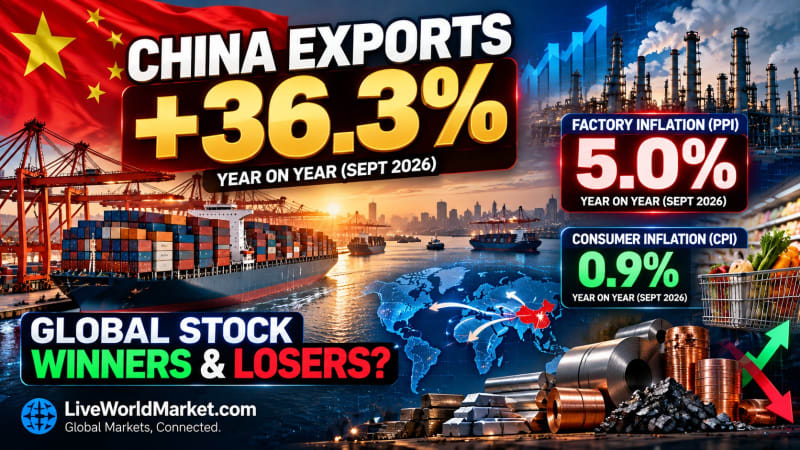
China Exports Surge 36.3%, PPI Hits 5%: Stock Winners & Losers
Geopolitics & Trade · Oct 14, 2026 · 11 min read
China's Exports Surge 36.3% as Factory Inflation Hits 5%: Which Global Stocks Could Win or Lose? China's factories are shipping more goods overseas than expected, but a sharp rise in producer prices is raising a new question about the profitability of the world's manufacturing powerhouse. Official data released on October 14 showed that China's exports surged 36.3%…
Read more...