
US Midterm Elections 2026: Impact on Stocks, Dollar & India
US Midterm Elections 2026: Why Treasury Yields, the Dollar and Indian Stocks Could React More Than Wall Street
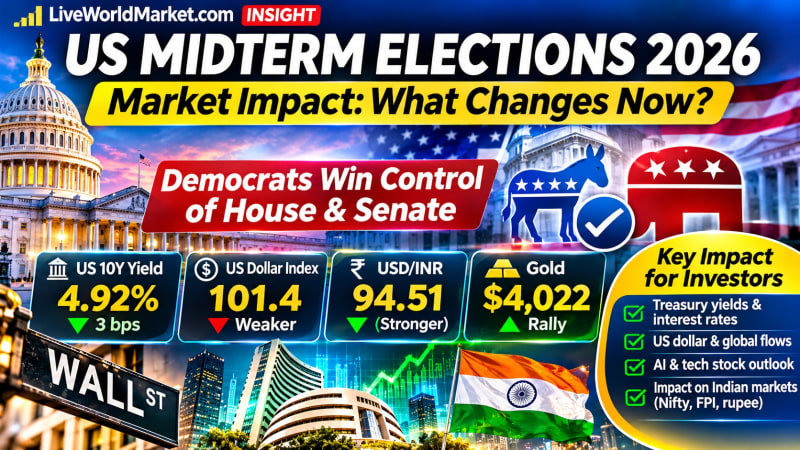
Key Takeaway: Democrats have won control of both chambers of the US Congress in the 2026 midterm elections, creating a divided government under President Donald Trump. The immediate market reaction has been revealing: US Treasury yields declined, the dollar weakened, and global technology stocks faced renewed concerns about AI regulation. For Indian investors, the bigger story may be how changing US fiscal expectations influence foreign capital flows, the rupee and domestic stock-market valuations.
US Midterm Election Results Trigger a Global Market Reassessment
The November 3, 2026 US midterm elections have introduced a significant change in Washington's political balance.
Democrats secured majorities in both the House of Representatives and the Senate, shifting congressional control away from President Donald Trump's Republican Party.
The outcome creates a divided-government environment in which passing major legislation may require more negotiation between the White House and Congress.
Financial markets initially reacted with caution.
US stock futures declined sharply overnight, while investors moved toward government bonds and several currencies strengthened against the dollar.
However, equities subsequently recovered as investors reassessed the economic implications of the election results.
The reaction illustrates an important market principle:
Election results do not affect asset prices solely through political headlines. Their influence depends on how investors expect fiscal policy, regulation, economic growth and interest rates to change.
For investors in India, these transmission channels could matter more than the immediate movement in the Dow Jones or Nasdaq.
1. Why US Treasury Yields Fell After the Elections
One of the clearest early market reactions appeared in the US government bond market.
The benchmark 10-year Treasury yield declined approximately three basis points to 4.92% on November 4, after briefly touching around 4.89% overnight.
Bond prices and yields generally move in opposite directions.
When investors buy Treasury bonds, their prices rise and yields fall.
Why did investors buy bonds?
The election outcome raised expectations that divided government could make additional fiscal stimulus, tax changes and large spending initiatives more difficult to implement.
If investors anticipate slower government spending growth, weaker economic momentum or reduced inflation pressure, they may expect lower future interest rates.
That can increase demand for longer-duration bonds.
However, divided government does not automatically reduce fiscal deficits. Existing spending commitments, debt-servicing costs and political negotiations can produce different outcomes.
Why this matters for global stocks
US Treasury yields are a major reference point for global asset valuations.
Lower yields can reduce the discount rate applied to future corporate earnings, potentially supporting equity valuations.
They can also influence international capital flows by changing the relative attractiveness of US bonds and emerging-market assets.
For India, this creates an important link between Washington's political developments and domestic equity-market conditions.
2. The US Dollar Weakens: Could Emerging Markets Benefit?
The US dollar also came under pressure following the election results.
On November 4, the US Dollar Index declined toward 101.4, reaching approximately a one-month low during early trading.
The euro, British pound, Japanese yen and Swiss franc strengthened against the dollar.
Several factors contributed to the move.
First, lower US Treasury yields reduced the relative yield attraction of dollar-denominated assets.
Second, investors reconsidered the outlook for US economic growth and fiscal policy.
Third, concerns about additional scrutiny of AI infrastructure investment introduced uncertainty around an important driver of US technology-sector growth.
Why a weaker dollar matters for India
A weaker dollar can influence India through several channels:
- It may reduce currency pressure on emerging-market economies.
- It can improve the relative attractiveness of Indian equities to international investors.
- It may reduce the rupee-denominated cost of dollar-priced imports, assuming commodity prices remain unchanged.
- It can change the outlook for export-oriented businesses that earn revenue in US dollars.
However, the relationship is not automatic.
A weaker dollar caused by fears of a severe US slowdown could also weaken global demand and investor risk appetite.
The reason behind the dollar's decline therefore matters as much as the decline itself.
3. Indian Rupee Strengthens as Foreign Investment Sentiment Improves
The Indian rupee responded positively to the dollar's weakness.
During November 4 trading, the rupee strengthened to approximately ₹94.51 per US dollar, its strongest level in nearly two weeks, before surrendering part of the gain.
The currency movement coincided with improving foreign portfolio investment sentiment.
Recent data showed that foreign investors had purchased approximately $1.5 billion of Indian equities over three trading sessions, including more than $700 million on November 3.
This follows a period in which Indian markets had faced pressure from global capital moving toward US technology and AI-related investments.
Could foreign capital rotate toward India?
If global investors become less enthusiastic about expensive AI-linked stocks, they may reassess opportunities in other markets.
India could attract attention because of its domestic consumption base, financial services sector, infrastructure investment and corporate earnings opportunities.
However, sustained foreign investment will depend on valuations, earnings growth, currency stability and broader global liquidity.
One day of currency appreciation or equity inflows is insufficient to establish a durable trend.
For live market developments, explore the LiveWorldMarket India Stock Market Dashboard.
4. AI Stocks Face a New Political Risk
The election results also introduced a fresh dimension to the global artificial intelligence investment debate.
In recent years, AI infrastructure investment has supported demand for advanced semiconductors, data centres, networking equipment and electricity generation.
Companies such as Nvidia, Microsoft, Alphabet and Amazon have become central to investor expectations about AI-driven growth.
Following the midterm results, investors began considering whether a Democratic-controlled Congress might increase scrutiny of AI development and data-centre expansion.
Potential areas of debate include electricity consumption, environmental approvals, competition, data protection and the economic effects of AI deployment.
Why this matters for technology valuations
AI infrastructure companies depend on continued investment by large technology businesses.
If regulatory uncertainty delays projects or increases costs, investors may reassess revenue growth and profitability assumptions.
However, congressional control does not guarantee specific regulatory changes.
Any major legislation would face negotiations, and the president retains veto authority.
Moreover, strong commercial demand for AI computing could continue even in a more demanding regulatory environment.
The investment risk is not simply regulation itself, but the possibility that infrastructure spending becomes more expensive or slower to convert into profitable revenue.
5. What the Election Means for the S&P 500 and Nasdaq
The initial equity-market response was volatile rather than uniformly negative.
US stock futures fell as much as approximately 2% overnight before recovering into positive territory during the European trading session.
This suggests investors were weighing competing forces.
On one side, increased political uncertainty and possible AI regulation created concerns for technology companies.
On the other, lower bond yields and expectations of more constrained fiscal policy offered potential support for valuations.
Why the Nasdaq deserves particular attention
The Nasdaq has substantial exposure to technology companies whose valuations depend on expectations of future earnings.
Lower Treasury yields can support those valuations mathematically, but uncertainty about future growth can offset that benefit.
Investors should therefore monitor whether falling yields are being driven by improving inflation expectations or concerns about weaker economic activity.
The same bond-market movement can carry very different implications depending on its cause.
Track broader US market performance through the LiveWorldMarket US Stock Market Dashboard.
6. Which Indian Sectors Could Be Affected?
The impact of US political developments will vary across Indian industries.
Indian IT services
Companies such as TCS, Infosys, HCLTech and Wipro depend significantly on international enterprise technology spending.
Changes in US corporate confidence, technology budgets, immigration policies and AI investment could influence demand.
The sector may also face uncertainty around regulatory developments and cross-border services.
Banking and financial services
Indian financial companies could benefit indirectly if improved foreign investment sentiment supports domestic equity markets.
However, bank profitability will continue to depend primarily on credit growth, deposit costs, asset quality and domestic interest rates.
Oil marketing companies
A weaker dollar can help reduce rupee-denominated crude import costs, provided international oil prices do not rise enough to offset the currency benefit.
For IOC, BPCL and HPCL, refining margins and domestic fuel marketing profitability remain equally important.
Export-oriented businesses
A stronger rupee can reduce the rupee value of dollar-denominated revenue for some exporters.
This means currency appreciation is not universally positive for Indian equities.
The overall sector impact depends on each company's revenue mix, imported inputs, hedging arrangements and operating margins.
7. Could Divided Government Change US Trade Policy?
Trade policy is another area Indian investors should monitor.
India and the United States have important commercial relationships across technology services, pharmaceuticals, electronics, manufacturing and energy.
Changes in congressional oversight could affect debates about tariffs, trade agreements and immigration rules.
However, the US president retains significant authority in several areas of trade and foreign policy.
Therefore, the election result should not be interpreted as an automatic reversal of existing tariffs or restrictions.
For Indian companies, the practical questions are whether trade negotiations progress, market access improves and regulatory uncertainty declines.
8. Three Market Scenarios Following the US Midterms
Scenario 1: Lower Yields and a Weaker Dollar Support Emerging Markets
If Treasury yields remain lower and global risk appetite stabilizes, emerging-market assets could attract additional investment.
Indian equities and the rupee might benefit from improved foreign capital flows.
Scenario 2: AI Regulatory Uncertainty Weighs on Technology Stocks
If investors anticipate greater costs or delays for AI infrastructure projects, technology valuations could face pressure.
That may increase volatility in the Nasdaq and semiconductor-related markets.
Indian technology companies could experience indirect effects through global sector sentiment and enterprise spending expectations.
Scenario 3: Fiscal Negotiations Increase Market Volatility
If disagreements over government funding, taxation or debt policy intensify, investors could demand higher risk premiums.
Treasury yields, the dollar and equities might experience renewed volatility.
These scenarios are illustrative and should not be treated as forecasts.
9. Five Indicators Investors Should Track Next
The immediate election reaction may fade, but several financial indicators will help reveal whether the policy implications are becoming more important.
US 10-year Treasury yield: Watch whether yields continue declining or reverse as investors reassess fiscal and growth expectations.
US Dollar Index: A sustained dollar move could influence global liquidity, currencies and commodity markets.
Foreign portfolio flows into India: Consistent buying would provide stronger evidence of improving international investor interest.
Nasdaq and semiconductor stocks: Their performance may reveal how markets are pricing AI regulation and infrastructure spending risks.
USD/INR and Brent crude: Together, these indicators help assess currency and energy-import pressures on India's economy.
LiveWorldMarket Insight: The Biggest Election Trade May Be Outside Wall Street
The 2026 US midterm elections have changed the political balance in Washington, but their financial-market implications extend well beyond American equities.
The early reaction suggests investors are particularly sensitive to the outlook for Treasury yields, the dollar, AI regulation and international capital flows.
For India, these developments create a potentially important combination of opportunities and risks.
A weaker dollar and lower US bond yields could support foreign investment sentiment, while uncertainty around US technology spending and trade policy could create challenges for export-oriented sectors.
The key takeaway is that the most important market impact of the US midterm elections may emerge through currencies, bonds and global capital allocation—not simply through the next move in the S&P 500.
Investors should focus on how these channels develop over the coming weeks rather than drawing conclusions from the first trading session after the election.
For ongoing global market coverage, visit LiveWorldMarket.com.
Frequently Asked Questions
Who won the 2026 US midterm elections?
Democrats secured majorities in both the House of Representatives and the Senate, resulting in divided government under President Donald Trump.
Why did US Treasury yields fall after the election?
Investors reassessed expectations for fiscal spending, economic growth and future interest rates. Increased demand for Treasury bonds contributed to lower yields.
Why did the US dollar weaken?
Lower Treasury yields and changing expectations about economic policy and AI-related investment reduced demand for the dollar during the initial market reaction.
Could the US election results benefit Indian stocks?
A weaker dollar and lower US yields can support emerging-market capital flows, but the effect depends on global risk appetite, valuations, earnings and trade developments.
Will the US midterm elections affect Nvidia and other AI stocks?
The election may increase expectations of congressional scrutiny of AI and data-centre investment. However, specific regulatory changes remain uncertain, and commercial demand will continue to influence company performance.
Sources and Further Reading
- Reuters — Stocks rally, dollar dips after Democrats' midterm sweep, November 4, 2026.
- Reuters — Dollar retreats as Democratic wins in US midterms stoke AI regulation jitters, November 4, 2026.
- Reuters — Indian stocks post longest winning streak in nearly five months on FPI inflow hopes, November 4, 2026.
- Reuters — Rupee ends a tad higher as dollar slips after US midterms, November 4, 2026.
Disclaimer: This article is intended for educational and informational purposes only and does not constitute investment advice. Financial-market prices and political developments may change. Readers should independently assess investment risks before making financial decisions.
Comments (0)
Be the first to comment.
About the author

NISM-Series-X-A Investment Adviser Level 1 examination completed
Amit writes about Indian equity markets, technical analysis, macro themes and the day-to-day mechanics of trading, with a focus on making the flow of global markets legible for retail investors. He has completed the NISM-Series-X-A Investment Adviser Level 1 examination.
You May Also Like

Apple Overtakes Nvidia: Is Lower AI Spending Winning?
Technology & Sectors · Nov 2, 2026 · 9 min read
Apple Overtakes Nvidia as World's Most Valuable Company Ahead of Earnings: Is Spending Less on AI Becoming Wall Street's Winning Strategy? Key takeaway: Apple has reclaimed the title of the world's most valuable publicly traded company, overtaking Nvidia as investors reassess the enormous cost of artificial intelligence infrastructure. With Apple's upcoming earnings in focus…
Read more...
ExxonMobil Refining Profits Surge: Impact on Indian Oil Stocks
Commodities & Energy · Nov 1, 2026 · 8 min read
ExxonMobil's Refining Profits Overtake Oil Drilling for First Time in 6 Years: Why India's Oil Stocks May Miss the Windfall Key Takeaway: ExxonMobil's refining business has emerged as a bigger earnings contributor than oil production, highlighting an extraordinary shift in global energy markets. But Indian oil companies such as IOC, BPCL and HPCL face a different challenge…
Read more...
Fed Decision and Microsoft–Google Earnings: Two Critical Tests for the AI Stock Market Rally
Global Markets & Economy · Oct 28, 2026 · 15 min read
Global stock markets are approaching one of the most important financial evenings of October 2026. The U.S. Federal Reserve is preparing to announce its latest interest-rate decision, while Microsoft and Alphabet, Google's parent company, are scheduled to publish quarterly earnings after Wall Street closes. These developments arrive as investors reassess the sustainability of…
Read more...
JetBlue Stock Surges 20%, Bond Yield Tops 30%: Warning?
Global Markets & Economy · Oct 28, 2026 · 16 min read
JetBlue Stock Surges 20% While Its Bonds Yield Over 30%: Is Airline Debt Flashing a Warning for Investors? Something unusual is happening in the U.S. airline industry. Shares of JetBlue Airways surged approximately 20% on October 27, after the airline raised its revenue outlook and attempted to reassure investors about its financial position. But an entirely different story…
Read more...
US Consumer Staples Rally 9.6%: FMCG Valuation Risk for India
Global Markets & Economy · Oct 25, 2026 · 16 min read
US Consumer Staples Surge 9.6% as Valuations Overtake Tech: Is the Safe-Stock Trade Becoming a Trap for Indian FMCG Investors? Something unexpected is happening on Wall Street. As investors become increasingly cautious about expensive artificial intelligence stocks, money has been moving into an unlikely market leader: consumer staples. The U.S. consumer-staples sector has…
Read more...
SpaceX 80,000 Cell Sites: Will Starlink Challenge Jio & Airtel?
Global Markets & Economy · Oct 24, 2026 · 17 min read
SpaceX's 80,000 Cell-Site Plan Sends US Telecom Stocks Down 8%: Could Starlink Disrupt Jio and Airtel Next? A major shift may be emerging in the global telecommunications industry—and Wall Street has already started reacting. Shares of American telecommunications giants AT&T and T-Mobile plunged nearly 8% on October 23 after reports revealed that Elon Musk's SpaceX was…
Read more...
US 10-Year Treasury Yield Below 5%: Growth Shock Warning?
Central Banks & Rates · Oct 23, 2026 · 17 min read
US 10-Year Treasury Yield Falls Below 5% Despite $114 Oil: Is the Bond Market Warning of a Global Growth Shock? Something unusual is happening across global financial markets. The yield on the benchmark U.S. 10-year Treasury has fallen sharply below the psychologically important 5% level, even as Brent crude oil has surged toward $114 per barrel and technology stocks have…
Read more...
Brent Crude Tops $110: Impact on Indian Stocks & Earnings
Global Markets & Economy · Oct 22, 2026 · 14 min read
Brent Crude Tops $110: Why Indian Airlines, Paints and Tyre Stocks Face a Hidden Earnings Risk Brent crude oil has climbed above $110 per barrel, intensifying concerns that rising global energy prices could squeeze corporate profit margins, increase India's import costs and create further volatility in domestic equities. On October 22, Brent futures traded above $111 after…
Read more...
India Optical Fibre Exports Jump 158%: AI's Hidden Winners
Global Markets & Economy · Oct 21, 2026 · 12 min read
India's Optical Fibre Exports Jump 158% as Japan's Chip Shipments Surge 49%: The Hidden Winners of the AI Infrastructure Boom Artificial intelligence may be transforming the technology industry, but some of its most important economic beneficiaries are not necessarily the companies developing AI models. They may be the businesses manufacturing the physical infrastructure that…
Read more...
Nasdaq Rises 1.1%, KOSPI Falls 3.6%: AI Stocks and India Impact
Global Markets & Economy · Oct 20, 2026 · 12 min read
Nasdaq Jumps 1.1% but KOSPI Crashes Over 3%: Why the AI Stock Rebound Is Failing in Asia—and What It Means for India Global technology stocks are sending conflicting signals. On Monday, October 19, the Nasdaq Composite gained 1.11%, recovering part of the losses suffered during the previous week's technology selloff. U.S. semiconductor stocks also rebounded, with the…
Read more...