
Brent Crude Tops $110: Impact on Indian Stocks & Earnings

Brent Crude Tops $110: Why Indian Airlines, Paints and Tyre Stocks Face a Hidden Earnings Risk
Brent crude oil has climbed above $110 per barrel, intensifying concerns that rising global energy prices could squeeze corporate profit margins, increase India's import costs and create further volatility in domestic equities.
On October 22, Brent futures traded above $111 after renewed attacks on Saudi Arabian infrastructure raised fears of additional disruptions to energy supplies from the Middle East.
The pressure was visible in Indian markets. The Sensex declined 460.30 points to 73,249.39, while the Nifty 50 fell 123.70 points to close at 22,687.65.
But the real risk may extend well beyond the stock-market decline.
Higher crude prices could gradually erode the earnings of businesses that depend on aviation fuel, petroleum-based raw materials, synthetic rubber and industrial chemicals.
Airlines, paint manufacturers, tyre producers and oil marketing companies are among the sectors facing the most immediate questions about costs and pricing power.
For investors, the crucial issue is no longer simply whether crude oil can cross $110.
It is whether Indian companies can protect their profitability if energy prices remain elevated for several quarters.
1. Why Has Brent Crude Crossed $110?
The latest rally is being driven by renewed geopolitical concerns in the Middle East, one of the world's most important energy-producing regions.
Reports of further Houthi attacks in Saudi Arabia have increased uncertainty about regional oil infrastructure and shipping security.
On October 22, Reuters reported that Brent crude futures had advanced to approximately $111.24 per barrel during U.S. trading.
Oil markets are particularly sensitive to developments involving the Strait of Hormuz, the Red Sea and the Bab el-Mandeb shipping passage.
These routes play important roles in global energy transportation.
Even when oil production has not been directly interrupted, investors and physical-market participants may demand a higher price to compensate for potential disruptions.
This additional cost is often described as a geopolitical risk premium.
Oil Market Snapshot — October 22, 2026

Figures reflect October 22 intraday reporting and are not live quotes.
One important distinction deserves attention.
A rise caused by robust global demand can sometimes coincide with improving industrial earnings.
A rise caused primarily by potential supply disruption is different.
Businesses may face increasing costs without experiencing a corresponding increase in customer demand.
That makes the present environment especially challenging for oil-dependent industries.
For historical context, see our earlier analysis: Crude Oil Above $100 a Barrel: What It Means for the Global Economy.
2. India's Crude Oil Import Bill Is Already Under Pressure
India is highly exposed to global oil-price fluctuations because it imports most of the crude oil it consumes.
The economic impact is becoming increasingly visible.
According to Petroleum Planning and Analysis Cell figures reported on October 21, India's crude oil import bill increased approximately 46.3% year-on-year to $90.6 billion during April–September 2026.
Import volumes remained relatively stable, highlighting the significant role played by higher prices.
This matters because imported oil creates several channels of economic pressure.
First, higher international prices increase the foreign-currency cost of energy imports.
Second, greater dollar demand for imports can add pressure to the Indian rupee, although other capital flows and policy interventions also influence exchange rates.
Third, higher transportation and industrial costs may eventually reach consumers through price increases.
Finally, inflation risks can complicate monetary-policy decisions and contribute to higher borrowing costs.
The transmission is not automatic or immediate, but sustained high oil prices can create simultaneous challenges for India's trade balance, corporate earnings and financial markets.
Why Higher Oil Prices Matter to India

The macroeconomic picture explains why even companies with no direct connection to the energy sector may be influenced by developments in crude oil.
Investors can track the interaction between global markets, the dollar, commodities and volatility through the LiveWorldMarket Global Market Risk Monitor.
3. Which Indian Sectors Face the Greatest Earnings Risk?
Not all companies respond to higher crude prices in the same way.
The most vulnerable businesses are generally those facing a combination of high oil-linked input costs, limited pricing power and a delay before higher costs can be passed on to customers.
Sector Exposure Comparison

Qualitative assessment only. Actual exposure varies by company, product mix, hedging arrangements and contractual pricing.
The critical difference is cost pass-through—the ability of a business to recover higher input expenses by increasing selling prices.
Companies that can raise prices quickly may protect margins.
Those facing competitive markets, long-term contracts or price-sensitive customers may struggle.
4. Airlines: Why Expensive Oil Can Quickly Hurt Profitability
Aviation is among the most directly exposed industries.
Airlines require significant quantities of aviation turbine fuel (ATF), making changes in fuel prices an important determinant of operating expenses.
For major Indian airlines, fuel costs can account for approximately 30–40% of operating costs, although the proportion varies with fuel prices, fleet efficiency and operating conditions.
This means that a prolonged increase in crude-derived aviation fuel costs can create substantial pressure.
Consider InterGlobe Aviation (IndiGo) and SpiceJet.
Both operate businesses exposed to aviation fuel prices, but their financial positions, route economics and ability to raise fares can differ substantially.
Higher fuel costs do not necessarily translate into lower profits in every quarter.
Airlines may offset the pressure through stronger passenger demand, higher ticket prices, greater aircraft utilisation and operational efficiency.
However, passing higher costs to travellers can become difficult when demand weakens or competition limits fare increases.
Key Indicators for Airline Investors
Investors should monitor ATF prices, passenger yields, load factors, fuel expense as a percentage of revenue, operating margins and management commentary on fare increases.
The most important question is whether ticket revenue can rise fast enough to compensate for higher fuel expenses.
5. Paint Companies: The Margin Squeeze That May Appear With a Delay
Paint manufacturers represent another important crude-sensitive sector.
Their production costs include various petroleum-derived materials, such as solvents and certain resins, alongside pigments, additives and packaging.
Companies such as Asian Paints, Berger Paints and Kansai Nerolac may experience changes in input costs as petroleum-linked commodity prices move.
However, the effect is rarely immediate.
Manufacturers often hold inventories of raw materials purchased at earlier prices.
This can temporarily protect margins during an oil-price increase.
Once those inventories are consumed and replaced at higher costs, profitability may come under pressure.
Paint manufacturers can attempt to offset this through product price increases, premium products, productivity improvements and purchasing efficiencies.
But consumer demand and industry competition can limit the speed of adjustment.
The important risk is therefore not only the increase in crude prices.
It is the time gap between input-cost inflation and selling-price increases.
If raw-material costs rise during one quarter but higher selling prices become effective only in the next, operating margins can weaken in the intervening period.
This lag makes quarterly earnings commentary especially important.
6. Tyre Manufacturers: Two Raw-Material Risks at Once
Tyre companies face a somewhat different challenge.
Their production depends on several major materials, including natural rubber, synthetic rubber, carbon black, steel cords and industrial chemicals.
Synthetic rubber and carbon black have important links to petroleum and petrochemical supply chains.
Higher crude prices can therefore affect manufacturing costs.
Companies such as MRF, CEAT, Apollo Tyres and JK Tyre are worth monitoring for changes in material costs and gross margins.
However, crude is not the only driver.
Natural rubber prices, foreign-exchange movements, domestic vehicle demand and competitive pricing also influence profitability.
A tyre manufacturer may be able to pass higher costs to customers during a strong replacement-demand cycle.
The same manufacturer may struggle to raise prices during a period of weaker automotive demand.
Investors should therefore avoid assuming that every increase in crude oil will produce an identical impact across tyre companies.
The correct analysis must consider the complete raw-material basket and the company's ability to protect its selling-price realisations.
7. Oil Marketing Companies: Higher Crude Does Not Always Mean Higher Profits
Oil marketing companies occupy a more complex position.
Businesses such as Indian Oil Corporation, BPCL and HPCL buy crude oil, refine it and sell petroleum products.
Higher crude prices can raise procurement expenses.
If retail selling prices fail to increase sufficiently, marketing margins can narrow.
But these companies also operate refining businesses, where profitability depends on the spread between petroleum-product prices and crude costs.
That means an increase in oil prices can have competing effects.
Strong refining margins may offset some pressure in marketing operations.
Inventory gains or losses can also influence reported earnings.
As a result, evaluating these companies requires more than looking at the international crude benchmark.
Key variables include gross refining margins, product cracks, marketing margins, inventory accounting and government pricing decisions.
Investors should not treat oil producers, refiners and fuel retailers as though they have identical economics.
8. The Hidden Earnings Risk: How a Small Cost Increase Can Cause a Bigger Profit Decline
One of the most overlooked aspects of commodity inflation is operating leverage.
A relatively small change in production costs can produce a much larger percentage decline in profits.
Consider a simplified manufacturing company.
Assume its annual revenue is ₹100 crore, its total raw-material expenditure is ₹60 crore and 30% of those raw-material costs are linked to oil-derived inputs.
Also assume that its starting EBITDA is ₹12 crore.
If its oil-linked input costs increase by 10%, without any offsetting price increases or cost savings, the financial impact looks like this.
Illustrative Margin Sensitivity

The example demonstrates why investors must look beyond revenue growth.
A company could report stable sales and still experience meaningful earnings deterioration.
This is the central investment risk associated with sustained commodity inflation.
It also explains why companies with strong pricing power, efficient operations and disciplined inventory management may prove more resilient.
9. What Does Oil Above $110 Mean for Nifty and Sensex?
Indian equities ended October 22 in negative territory as concerns about rising oil prices, inflation and global uncertainty weighed on sentiment.
Indian Market Closing Snapshot — October 22

Source: Reuters, October 22, 2026.
Higher crude prices can influence the Indian market through several channels simultaneously.
First, investors may reduce earnings estimates for companies facing rising input costs.
Second, inflation concerns may affect expectations for interest rates and borrowing costs.
Third, pressure on the trade balance and currency can alter foreign-investor sentiment.
Fourth, higher energy costs can reduce disposable household income if those costs ultimately reach consumers.
However, a single weak trading session cannot establish that oil prices alone caused the entire market decline.
Company-specific news, profit-taking, institutional flows and broader global risk sentiment also influence equity markets.
Readers can monitor sector movements, Nifty constituents and market breadth through the LiveWorldMarket India Stock Market Dashboard.
10. Three Oil-Price Scenarios Indian Investors Should Understand
The direction of crude oil will depend heavily on geopolitical developments, production flows, shipping conditions and global demand.
Rather than making a single price prediction, investors can consider three hypothetical scenarios.

These are hypothetical planning scenarios, not oil-price forecasts.
The duration of elevated prices may be more important than any single daily price.
A brief geopolitical spike may have a limited impact on a company carrying lower-cost inventories or using hedges.
Several months of elevated crude prices could create a more persistent challenge.
For further analysis of how oil and borrowing costs interact, read Oil Above $100 & U.S. Yields Near 5%: Impact on India and Global Markets.
11. What Investors Should Monitor Over the Next Few Weeks
Rather than reacting only to the oil-price headline, investors should follow a combination of commodity, currency and company-level indicators.
Brent and the Indian crude basket: These reveal changes in international benchmark prices and the effective cost environment faced by domestic refiners.
USD/INR: Currency weakness can amplify the rupee cost of imports even when international oil prices are stable.
Aviation turbine fuel prices: These offer a more direct measure of airline fuel costs than Brent alone.
Corporate pricing announcements: Price increases by paint, tyre or chemical manufacturers can indicate attempts to protect margins.
Quarterly earnings and management guidance: Gross margins, EBITDA margins, inventory costs and management commentary can reveal whether cost pressures are affecting profits.
Middle East shipping and supply developments: Changes in export flows, transport routes and infrastructure security may influence the geopolitical premium embedded in oil.
Readers can follow global cross-asset developments each morning through What Changed While You Slept?.
12. LiveWorldMarket Insight: The Real Story Is Pricing Power, Not Just Oil
Crude oil above $110 is an important market headline.
But the more useful investment question is how the cost shock will be distributed across companies.
Consider two manufacturers operating in the same industry.
One has a premium product portfolio, strong customer loyalty, efficient procurement and the ability to raise prices.
The other operates in a highly competitive market, holds expensive inventory and depends on low-margin products.
Both may face the same commodity-price increase.
Yet their earnings outcomes could be very different.
This highlights three characteristics investors should examine during periods of sustained energy inflation.
Pricing power: Can the company recover higher costs without losing significant sales volume?
Operating efficiency: Can manufacturing improvements, procurement strategies and inventory discipline limit the impact?
Balance-sheet strength: Can the business absorb a temporary earnings slowdown without excessive borrowing?
Investors who focus on these variables may develop a clearer understanding of which businesses are capable of protecting profitability during an adverse commodity cycle.
A high crude price does not automatically make every oil-consuming stock unattractive.
Likewise, a company with exposure to higher selling prices does not automatically become an attractive investment.
Valuation, competitive position and balance-sheet quality remain important.
13. Final Takeaway: Oil Above $110 Could Become an Earnings Test
Brent crude's renewed move above $110 has brought energy inflation back into focus for global and Indian financial markets.
For India, the consequences extend beyond petrol and diesel prices.
Higher oil costs can affect the import bill, currency stability, inflation expectations, industrial profitability and equity-market valuations.
Airlines, paints, tyres, chemicals and oil marketing companies face different forms of exposure.
Some businesses may protect profits through price increases and operational efficiency.
Others may experience margin compression if costs rise faster than revenues.
The key question for investors is no longer just how high oil prices can rise. It is which companies can defend earnings if oil remains expensive.
That distinction could become increasingly important as quarterly results reveal the true impact of the latest energy-price shock.
Frequently Asked Questions
Why did Brent crude rise above $110 in October 2026?
Renewed attacks on Saudi Arabian infrastructure and concerns about energy supplies and shipping security in the Middle East increased the geopolitical risk premium in oil markets.
Which Indian stocks are sensitive to higher crude oil prices?
Businesses exposed to aviation fuel, petroleum-derived raw materials, refining and retail fuel pricing can be affected. Examples include IndiGo, Asian Paints, Berger Paints, MRF, CEAT, Indian Oil, BPCL and HPCL. The effect varies by business model and should not be interpreted as a prediction of share-price direction.
Is higher crude oil bad for all Indian companies?
No. Upstream oil producers may benefit from stronger oil realisations, while some refiners can benefit from wider product margins. Oil-consuming companies may face higher costs, although their actual earnings depend on pricing power, hedging and demand.
Can Brent crude reach $120 per barrel?
A move above $120 is possible under a more severe supply-disruption scenario, but it is not guaranteed. Global production, shipping conditions, demand and diplomatic developments will influence the direction of prices.
Why does crude oil affect the Indian stock market?
India imports most of its crude requirement. Higher prices can increase import costs, affect inflation and the rupee, and reduce profitability for businesses that cannot pass higher costs to customers.
Sources and Data References
- Reuters — Oil hits five-month high as Houthi attacks stoke supply fears, October 22, 2026.
- Reuters — Indian shares extend losses as high oil prices heighten inflation worries, October 22, 2026.
- Moneycontrol — India's crude import bill surges 46% to $90.6 billion, October 21, 2026.
- Business Today — Brent oil futures hit $110: Oil-sensitive stocks to watch, October 17, 2026.
Disclaimer: This article is intended for general educational and informational purposes only. It does not constitute investment advice, a securities recommendation or an invitation to buy or sell any financial instrument. Market conditions, commodity prices and company fundamentals can change rapidly. Investors should independently assess financial information and consult an appropriately registered investment adviser where necessary.
Comments (0)
Be the first to comment.
About the author

NISM-Series-X-A Investment Adviser Level 1 examination completed
Amit writes about Indian equity markets, technical analysis, macro themes and the day-to-day mechanics of trading, with a focus on making the flow of global markets legible for retail investors. He has completed the NISM-Series-X-A Investment Adviser Level 1 examination.
You May Also Like

US Midterm Elections 2026: Impact on Stocks, Dollar & India
Global Markets & Economy · Nov 4, 2026 · 10 min read
US Midterm Elections 2026: Why Treasury Yields, the Dollar and Indian Stocks Could React More Than Wall Street Key Takeaway: Democrats have won control of both chambers of the US Congress in the 2026 midterm elections, creating a divided government under President Donald Trump. The immediate market reaction has been revealing: US Treasury yields declined, the dollar weakened…
Read more...
Apple Overtakes Nvidia: Is Lower AI Spending Winning?
Technology & Sectors · Nov 2, 2026 · 9 min read
Apple Overtakes Nvidia as World's Most Valuable Company Ahead of Earnings: Is Spending Less on AI Becoming Wall Street's Winning Strategy? Key takeaway: Apple has reclaimed the title of the world's most valuable publicly traded company, overtaking Nvidia as investors reassess the enormous cost of artificial intelligence infrastructure. With Apple's upcoming earnings in focus…
Read more...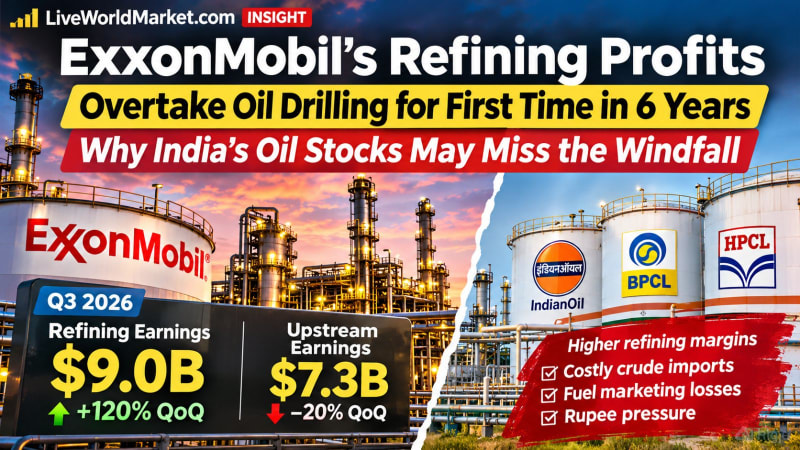
ExxonMobil Refining Profits Surge: Impact on Indian Oil Stocks
Commodities & Energy · Nov 1, 2026 · 8 min read
ExxonMobil's Refining Profits Overtake Oil Drilling for First Time in 6 Years: Why India's Oil Stocks May Miss the Windfall Key Takeaway: ExxonMobil's refining business has emerged as a bigger earnings contributor than oil production, highlighting an extraordinary shift in global energy markets. But Indian oil companies such as IOC, BPCL and HPCL face a different challenge…
Read more...
Fed Decision and Microsoft–Google Earnings: Two Critical Tests for the AI Stock Market Rally
Global Markets & Economy · Oct 28, 2026 · 15 min read
Global stock markets are approaching one of the most important financial evenings of October 2026. The U.S. Federal Reserve is preparing to announce its latest interest-rate decision, while Microsoft and Alphabet, Google's parent company, are scheduled to publish quarterly earnings after Wall Street closes. These developments arrive as investors reassess the sustainability of…
Read more...
JetBlue Stock Surges 20%, Bond Yield Tops 30%: Warning?
Global Markets & Economy · Oct 28, 2026 · 16 min read
JetBlue Stock Surges 20% While Its Bonds Yield Over 30%: Is Airline Debt Flashing a Warning for Investors? Something unusual is happening in the U.S. airline industry. Shares of JetBlue Airways surged approximately 20% on October 27, after the airline raised its revenue outlook and attempted to reassure investors about its financial position. But an entirely different story…
Read more...
US Consumer Staples Rally 9.6%: FMCG Valuation Risk for India
Global Markets & Economy · Oct 25, 2026 · 16 min read
US Consumer Staples Surge 9.6% as Valuations Overtake Tech: Is the Safe-Stock Trade Becoming a Trap for Indian FMCG Investors? Something unexpected is happening on Wall Street. As investors become increasingly cautious about expensive artificial intelligence stocks, money has been moving into an unlikely market leader: consumer staples. The U.S. consumer-staples sector has…
Read more...
SpaceX 80,000 Cell Sites: Will Starlink Challenge Jio & Airtel?
Global Markets & Economy · Oct 24, 2026 · 17 min read
SpaceX's 80,000 Cell-Site Plan Sends US Telecom Stocks Down 8%: Could Starlink Disrupt Jio and Airtel Next? A major shift may be emerging in the global telecommunications industry—and Wall Street has already started reacting. Shares of American telecommunications giants AT&T and T-Mobile plunged nearly 8% on October 23 after reports revealed that Elon Musk's SpaceX was…
Read more...
US 10-Year Treasury Yield Below 5%: Growth Shock Warning?
Central Banks & Rates · Oct 23, 2026 · 17 min read
US 10-Year Treasury Yield Falls Below 5% Despite $114 Oil: Is the Bond Market Warning of a Global Growth Shock? Something unusual is happening across global financial markets. The yield on the benchmark U.S. 10-year Treasury has fallen sharply below the psychologically important 5% level, even as Brent crude oil has surged toward $114 per barrel and technology stocks have…
Read more...
India Optical Fibre Exports Jump 158%: AI's Hidden Winners
Global Markets & Economy · Oct 21, 2026 · 12 min read
India's Optical Fibre Exports Jump 158% as Japan's Chip Shipments Surge 49%: The Hidden Winners of the AI Infrastructure Boom Artificial intelligence may be transforming the technology industry, but some of its most important economic beneficiaries are not necessarily the companies developing AI models. They may be the businesses manufacturing the physical infrastructure that…
Read more...
Nasdaq Rises 1.1%, KOSPI Falls 3.6%: AI Stocks and India Impact
Global Markets & Economy · Oct 20, 2026 · 12 min read
Nasdaq Jumps 1.1% but KOSPI Crashes Over 3%: Why the AI Stock Rebound Is Failing in Asia—and What It Means for India Global technology stocks are sending conflicting signals. On Monday, October 19, the Nasdaq Composite gained 1.11%, recovering part of the losses suffered during the previous week's technology selloff. U.S. semiconductor stocks also rebounded, with the…
Read more...