
ExxonMobil Refining Profits Surge: Impact on Indian Oil Stocks
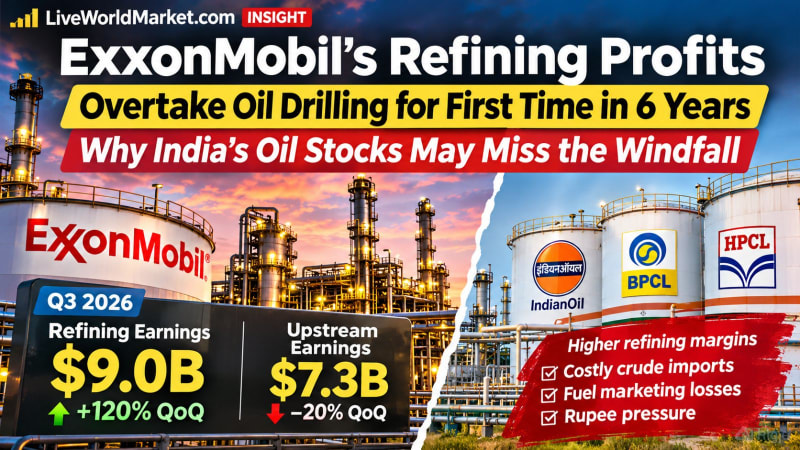
ExxonMobil's Refining Profits Overtake Oil Drilling for First Time in 6 Years: Why India's Oil Stocks May Miss the Windfall
Key Takeaway: ExxonMobil's refining business has emerged as a bigger earnings contributor than oil production, highlighting an extraordinary shift in global energy markets. But Indian oil companies such as IOC, BPCL and HPCL face a different challenge: strong refining margins are being offset by fuel marketing losses, expensive crude imports and currency pressure.
ExxonMobil's Earnings Reveal an Unusual Shift in Global Oil Markets
Global energy markets are experiencing an unusual reversal. For the first time in at least six years, ExxonMobil's refining and energy products operations have generated more adjusted earnings than its upstream oil and gas production business.
In its third-quarter 2026 results, ExxonMobil reported adjusted earnings of approximately $17.5 billion, or $4.23 per share, supported by exceptionally strong refining margins.
The company's Energy Products segment generated approximately $9 billion in adjusted earnings, compared with roughly $7.3 billion from upstream operations.
This shift highlights a fundamental change in global energy economics: processing crude oil into usable fuels has temporarily become more profitable than extracting the crude itself.
The implications extend well beyond the United States, particularly for India, where state-owned oil companies operate both refineries and extensive domestic fuel retail networks.
Why Are Global Refining Margins Rising?
Refining margins measure the difference between the value of refined petroleum products and the cost of the crude oil used to produce them.
The current refining boom has been driven by three developments.
1. Geopolitical supply disruptions
Conflict-related disruptions in major oil-producing and refining regions have constrained supplies of diesel, gasoline and other petroleum products.
2. Limited spare refining capacity
Even when crude oil is available, refining bottlenecks can restrict the supply of finished fuels. This increases the premium paid for products such as diesel and aviation fuel.
3. Strong demand for transportation fuels
Demand for diesel, gasoline and aviation fuel has remained sufficiently resilient to support elevated product spreads despite broader economic uncertainty.
The result is an unusual environment in which refiners can earn substantial margins even when crude oil prices are already high.
However, these profits depend on the difference between crude input costs and refined-product selling prices—not simply on the direction of oil prices.
Chevron's Results Confirm the Broader Refining Boom
ExxonMobil is not the only major energy company benefiting from elevated refining profitability.
Chevron also exceeded earnings expectations in the third quarter, reporting adjusted earnings of approximately $5.28 per share.
Its downstream operations benefited from stronger fuel-processing margins, reinforcing the view that the current earnings improvement reflects broader industry conditions rather than an ExxonMobil-specific development.
For global investors, this creates an important distinction between upstream oil producers, refiners and integrated energy companies.
Higher crude prices do not affect all three business models equally.
Why India's Oil Companies Face a Different Reality
India is heavily dependent on imported crude oil. Its major public-sector oil marketing companies—Indian Oil Corporation (IOC), Bharat Petroleum Corporation (BPCL) and Hindustan Petroleum Corporation (HPCL)—operate across refining, distribution and fuel retailing.
This integrated structure creates competing financial effects.
When global refining margins increase, their refineries may earn more from processing crude.
However, when domestic petrol and diesel selling prices do not rise sufficiently to cover increased input costs, their retail marketing businesses may experience losses.
Consequently, stronger refining earnings do not automatically translate into stronger consolidated profitability.
Indian Oil Companies: Q2 FY2026–27 Earnings Comparison

Source: Company results reported in November 2026.
Together, these companies generated approximately ₹30,106 crore in standalone quarterly profit.
IOC's performance demonstrates that Indian refiners are already benefiting from favorable market conditions. However, the weaker year-on-year results at BPCL and HPCL reveal the uneven distribution of those benefits.
Fuel Marketing Losses Could Absorb Refining Gains
One of the biggest challenges for Indian oil marketing companies is the gap between international fuel procurement costs and domestic selling prices.
Industry estimates have indicated substantial under-recoveries on petrol and diesel sales during periods of elevated crude prices.
For example, a company may generate additional refining earnings but lose a significant portion of those gains through its domestic fuel distribution operations.
This is why investors should evaluate refining and marketing profitability separately rather than relying exclusively on gross refining margins.
The same issue extends to LPG operations, where subsidy compensation and reimbursement timing can affect working capital and cash generation.
A Weaker Rupee Adds Another Layer of Pressure
India purchases much of its imported crude oil in US dollars.
When the Indian rupee depreciates, the domestic-currency cost of crude purchases increases, even if international crude prices remain unchanged.
This creates a double challenge when crude prices rise and the rupee weakens simultaneously.
For Indian oil companies, the combination can increase inventory costs, working-capital requirements and financing pressure.
As a result, movements in USD/INR may be almost as important as Brent crude prices when assessing short-term earnings risks.
Readers can track the broader market environment through the LiveWorldMarket Global Indices Dashboard.
Which Indian Oil Stocks Are Most Exposed?
Different energy companies face different combinations of opportunities and risks.
Indian Oil Corporation (IOC)
IOC's large refining operations and diversified business portfolio provide significant exposure to stronger refining margins. However, domestic marketing losses and inventory volatility remain important risks.
Bharat Petroleum (BPCL)
BPCL benefits from refining and retail distribution operations, but profitability depends on the balance between refining spreads, fuel marketing margins and operating costs.
Hindustan Petroleum (HPCL)
HPCL has meaningful exposure to domestic fuel retailing, making marketing profitability particularly important when crude prices rise.
Mangalore Refinery and Petrochemicals (MRPL)
MRPL offers more direct exposure to refining economics, although crude sourcing costs, utilization rates and product spreads can materially influence earnings.
Reliance Industries
Reliance's integrated refining, petrochemical and energy businesses provide a different earnings profile, including exposure to international product markets and petrochemical demand.
These differences mean that a global refining boom should not be interpreted as a uniform positive signal for every Indian energy stock.
Three Possible Scenarios for Oil Stocks in 2027
Scenario 1: Refining Margins Remain Elevated
If geopolitical disruptions persist and global fuel supply remains constrained, refiners could continue generating strong processing margins.
Indian companies with high refinery utilization and manageable marketing losses may benefit.
Scenario 2: High Crude Prices Continue to Pressure Fuel Retailing
If crude oil remains expensive while domestic fuel prices remain relatively stable, refining gains could be offset by marketing losses.
This scenario would place additional importance on cash flow, debt levels and subsidy recoveries.
Scenario 3: Global Energy Supply Normalizes
If disrupted production and refining capacity recover, refining margins could decline.
However, lower crude prices could simultaneously reduce import costs and improve domestic marketing profitability.
The net effect would depend on each company's business mix.
Five Indicators Indian Investors Should Monitor
Investors evaluating Indian oil companies should focus on five indicators:
- Gross refining margins: Whether strong refining spreads can be sustained.
- Fuel marketing margins: Whether domestic petrol and diesel sales are profitable.
- Brent crude prices: The direction and volatility of international crude costs.
- USD/INR exchange rate: The currency impact on India's crude import bill.
- Operating cash flow: Whether reported profits translate into sustainable cash generation.
For additional market context, explore LiveWorldMarket's U.S. Market Dashboard and India Market Dashboard.
The Bigger Picture: Why Higher Oil Prices Do Not Benefit Every Energy Company
ExxonMobil's third-quarter earnings demonstrate how dramatically global energy profitability can shift when refined fuel supplies become constrained.
But India's oil sector tells a more complicated story.
While IOC has already recorded substantial earnings gains, BPCL and HPCL have experienced more mixed outcomes.
For Indian investors, the critical issue is not whether global refining margins are high. It is whether those margins can translate into sustainable profits after accounting for domestic fuel pricing, crude import costs, currency movements and working-capital requirements.
LiveWorldMarket Insight: The Real Opportunity Is in Sustainable Margins
The global refining boom is creating extraordinary profits, but not every oil company will retain those profits equally.
ExxonMobil's results highlight the benefits of tight refined-fuel supply. India's oil companies demonstrate how retail pricing constraints and currency exposure can change the financial outcome.
The most important question for investors heading into 2027 is whether refining profits will remain strong long enough to outweigh marketing losses—or whether the extraordinary earnings cycle is already approaching its peak.
For more global market analysis, visit LiveWorldMarket.com.
Frequently Asked Questions
Why did ExxonMobil's refining profits exceed oil production profits?
Elevated refining margins increased the profitability of converting crude oil into diesel, gasoline and other fuels, allowing its Energy Products segment to outperform upstream operations.
Are high oil prices good for IOC, BPCL and HPCL?
Not necessarily. Higher crude prices can support refining spreads under certain conditions but also increase input costs and fuel marketing losses.
Which Indian oil companies benefit from higher refining margins?
IOC, BPCL, HPCL, MRPL and other refiners can benefit, although the final earnings impact depends on their refining capacity, marketing exposure, operating costs and inventory positions.
Will oil refining margins remain high in 2027?
That depends on geopolitical developments, global refinery availability, fuel demand and crude oil supply. Current elevated margins should not automatically be assumed to continue indefinitely.
Sources
- Reuters — ExxonMobil and Chevron earnings, October 30, 2026
- Business Standard — IOC, BPCL and HPCL Q2 earnings, November 1, 2026
- Financial Express — Crude import costs and rupee pressure
Disclaimer: This article is intended solely for educational and informational purposes. It does not constitute investment advice, stock recommendations or a solicitation to trade securities. Market data and financial figures reflect information reported as of November 1, 2026.
Comments (0)
Be the first to comment.
About the author

NISM-Series-X-A Investment Adviser Level 1 examination completed
Amit writes about Indian equity markets, technical analysis, macro themes and the day-to-day mechanics of trading, with a focus on making the flow of global markets legible for retail investors. He has completed the NISM-Series-X-A Investment Adviser Level 1 examination.
You May Also Like

Apple Overtakes Nvidia: Is Lower AI Spending Winning?
Technology & Sectors · Nov 2, 2026 · 9 min read
Apple Overtakes Nvidia as World's Most Valuable Company Ahead of Earnings: Is Spending Less on AI Becoming Wall Street's Winning Strategy? Key takeaway: Apple has reclaimed the title of the world's most valuable publicly traded company, overtaking Nvidia as investors reassess the enormous cost of artificial intelligence infrastructure. With Apple's upcoming earnings in focus…
Read more...
Fed Decision and Microsoft–Google Earnings: Two Critical Tests for the AI Stock Market Rally
Global Markets & Economy · Oct 28, 2026 · 15 min read
Global stock markets are approaching one of the most important financial evenings of October 2026. The U.S. Federal Reserve is preparing to announce its latest interest-rate decision, while Microsoft and Alphabet, Google's parent company, are scheduled to publish quarterly earnings after Wall Street closes. These developments arrive as investors reassess the sustainability of…
Read more...
JetBlue Stock Surges 20%, Bond Yield Tops 30%: Warning?
Global Markets & Economy · Oct 28, 2026 · 16 min read
JetBlue Stock Surges 20% While Its Bonds Yield Over 30%: Is Airline Debt Flashing a Warning for Investors? Something unusual is happening in the U.S. airline industry. Shares of JetBlue Airways surged approximately 20% on October 27, after the airline raised its revenue outlook and attempted to reassure investors about its financial position. But an entirely different story…
Read more...
US Consumer Staples Rally 9.6%: FMCG Valuation Risk for India
Global Markets & Economy · Oct 25, 2026 · 16 min read
US Consumer Staples Surge 9.6% as Valuations Overtake Tech: Is the Safe-Stock Trade Becoming a Trap for Indian FMCG Investors? Something unexpected is happening on Wall Street. As investors become increasingly cautious about expensive artificial intelligence stocks, money has been moving into an unlikely market leader: consumer staples. The U.S. consumer-staples sector has…
Read more...
SpaceX 80,000 Cell Sites: Will Starlink Challenge Jio & Airtel?
Global Markets & Economy · Oct 24, 2026 · 17 min read
SpaceX's 80,000 Cell-Site Plan Sends US Telecom Stocks Down 8%: Could Starlink Disrupt Jio and Airtel Next? A major shift may be emerging in the global telecommunications industry—and Wall Street has already started reacting. Shares of American telecommunications giants AT&T and T-Mobile plunged nearly 8% on October 23 after reports revealed that Elon Musk's SpaceX was…
Read more...
US 10-Year Treasury Yield Below 5%: Growth Shock Warning?
Central Banks & Rates · Oct 23, 2026 · 17 min read
US 10-Year Treasury Yield Falls Below 5% Despite $114 Oil: Is the Bond Market Warning of a Global Growth Shock? Something unusual is happening across global financial markets. The yield on the benchmark U.S. 10-year Treasury has fallen sharply below the psychologically important 5% level, even as Brent crude oil has surged toward $114 per barrel and technology stocks have…
Read more...
Brent Crude Tops $110: Impact on Indian Stocks & Earnings
Global Markets & Economy · Oct 22, 2026 · 14 min read
Brent Crude Tops $110: Why Indian Airlines, Paints and Tyre Stocks Face a Hidden Earnings Risk Brent crude oil has climbed above $110 per barrel, intensifying concerns that rising global energy prices could squeeze corporate profit margins, increase India's import costs and create further volatility in domestic equities. On October 22, Brent futures traded above $111 after…
Read more...
India Optical Fibre Exports Jump 158%: AI's Hidden Winners
Global Markets & Economy · Oct 21, 2026 · 12 min read
India's Optical Fibre Exports Jump 158% as Japan's Chip Shipments Surge 49%: The Hidden Winners of the AI Infrastructure Boom Artificial intelligence may be transforming the technology industry, but some of its most important economic beneficiaries are not necessarily the companies developing AI models. They may be the businesses manufacturing the physical infrastructure that…
Read more...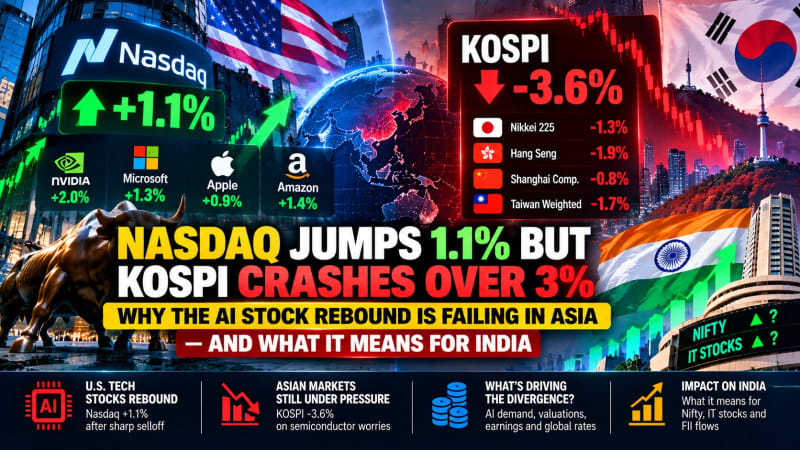
Nasdaq Rises 1.1%, KOSPI Falls 3.6%: AI Stocks and India Impact
Global Markets & Economy · Oct 20, 2026 · 12 min read
Nasdaq Jumps 1.1% but KOSPI Crashes Over 3%: Why the AI Stock Rebound Is Failing in Asia—and What It Means for India Global technology stocks are sending conflicting signals. On Monday, October 19, the Nasdaq Composite gained 1.11%, recovering part of the losses suffered during the previous week's technology selloff. U.S. semiconductor stocks also rebounded, with the…
Read more...
Jio IPO 2026: $108 Billion Valuation Amid Global AI Selloff
Market Valuation & Behaviour · Oct 19, 2026 · 14 min read
Jio IPO at $108 Billion Amid Global AI Stock Selloff: Can India's Biggest IPO Defy the Tech Market Rout? India is preparing for what could become its largest-ever initial public offering at a time when global investors are reassessing technology valuations, artificial intelligence spending and the financial sustainability of digital infrastructure. Jio Platforms, the digital…
Read more...