
AI Stocks vs 5.2% Treasury Yields: Is the S&P 500 Too Dependent on AI?
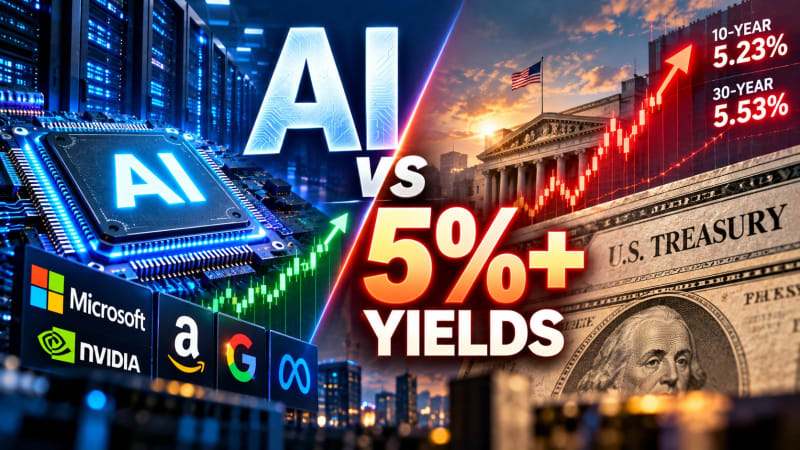
AI Stocks Keep Rising While Bond Yields Hit Multi-Decade Highs: Is the Stock Market Becoming Too Dependent on AI?
Something unusual is happening across global financial markets.
Bond investors are confronting some of the highest yields seen in decades. The U.S. 10-year Treasury yield has moved above 5%, longer-dated yields have climbed even further, and Japanese government bond yields have reached levels not seen in roughly three decades.
Normally, that combination would create significant pressure on expensive growth stocks.
Yet U.S. equities continue to show remarkable resilience.
The S&P 500 and Nasdaq finished Friday higher, with artificial-intelligence-related companies once again providing important support to the market.
That creates one of the most important questions facing investors today:
Are AI earnings and investment strong enough to overcome historically high bond yields—or has the stock market simply become too dependent on a relatively narrow group of AI-related companies?
The answer matters not only for technology investors but for anyone holding broad index funds linked to the S&P 500 or Nasdaq.
Why Are Bond Yields Becoming a Bigger Problem?
The U.S. 10-year Treasury yield briefly climbed to around 5.23%, its highest level since 2007.
The 30-year Treasury yield moved above 5.5%, reaching levels not seen since 2004.
Japan is experiencing its own historic bond-market repricing as the Bank of Japan moves away from decades of exceptionally loose monetary policy.
This is no longer simply a U.S. bond story.
It is increasingly a global rise in the cost of capital.
Higher bond yields matter because they influence almost every major asset class.
They affect:
- mortgage rates
- corporate borrowing costs
- government financing
- currency markets
- emerging-market capital flows
- equity valuations
And for technology companies, the valuation effect can be particularly important.
Why 5% Treasury Yields Should Normally Pressure AI Stocks
Investors constantly compare the potential returns available from different assets.
When U.S. government bonds offered yields close to zero, the decision was relatively easy.
Investors seeking higher returns had strong incentives to own equities.
Today, the calculation looks very different.
Investors can potentially earn more than 5% from U.S. government bonds without taking the same business and earnings risks associated with stocks.
That raises the return hurdle for equities.
A simplified comparison is:
U.S. Treasuries: 5%+ yield
versus
Stocks: higher potential return, but significantly greater volatility and risk.
For expensive growth stocks, the challenge becomes even greater.
Many technology companies are valued partly on earnings expected years into the future.
Higher interest rates increase the discount rate applied to those future profits.
The basic relationship is:
Higher bond yields → higher discount rates → lower present value of future earnings.
That should normally create valuation pressure.
Yet AI stocks continue to attract investors.
Why?
AI Earnings Are Providing a Powerful Counterforce
The answer begins with growth.
Artificial intelligence remains one of the strongest investment cycles in the global economy.
Technology companies continue spending enormous amounts on:
- AI processors
- data centres
- high-bandwidth memory
- cloud infrastructure
- networking
- electricity
- cooling
- semiconductor equipment
At the same time, AI is moving beyond infrastructure.
Consumer and enterprise adoption is expanding.
AI assistants and agents are increasingly being integrated into software, search, productivity applications and business workflows.
This creates a powerful earnings narrative.
Investors are effectively making a calculation:
Can AI-related earnings grow quickly enough to compensate for higher interest rates?
So far, markets appear willing to give many leading AI companies the benefit of the doubt.
Read AI Stocks vs 5% Treasury Yields: Can the Global Tech Rally Continue? for our earlier analysis of this relationship.
The Bigger Risk May Be Market Concentration
The more interesting issue is no longer simply whether AI stocks are expensive.
It is how important they have become to the overall market.
Major U.S. equity indices are weighted by market capitalization.
That means the largest companies have considerably more influence over index movements than smaller businesses.
When several enormous technology companies rise together, they can lift the S&P 500 even if large parts of the broader market are performing poorly.
This creates an important distinction:
A strong S&P 500 does not necessarily mean the average stock is equally strong.
That makes market breadth increasingly important.
The S&P 500 Is Not an Equal-Weight Portfolio
Consider two hypothetical markets.
Market A
400 stocks rise modestly while the largest technology companies decline sharply.
The S&P 500 could struggle despite healthy participation across most companies.
Market B
Hundreds of stocks are flat or falling, but a handful of enormous AI companies rally strongly.
The S&P 500 could still rise.
The headline in Market B would say:
“S&P 500 rises.”
But underneath the surface, the market might be far less healthy.
This is why investors should increasingly compare the standard S&P 500 with measures such as the equal-weight S&P 500 and broader market breadth.
AI Has Become More Than a Technology Trade
Artificial intelligence increasingly affects the entire index ecosystem.
The AI investment chain now stretches across:
Software
↓
Cloud computing
↓
Data centres
↓
GPUs and AI accelerators
↓
High-bandwidth memory
↓
Networking
↓
Electricity infrastructure
↓
Semiconductor manufacturing
This means AI-related investment can support companies across multiple sectors.
It also means weakness in AI spending could eventually spread far beyond traditional technology companies.
Microsoft Shows Why AI Leadership Still Matters
Microsoft's latest gains provide a useful example.
Shares rose sharply following new Copilot capabilities as investors continued to focus on AI's potential to increase software productivity and create new revenue streams.
This represents the next phase of the AI story.
The first phase was:
Build AI infrastructure.
The next phase is:
Monetize AI infrastructure.
Investors increasingly want evidence that enormous spending on chips and data centres will translate into:
- subscription revenue
- productivity gains
- enterprise adoption
- advertising
- commerce
- higher margins
If that monetization develops successfully, strong earnings could continue supporting AI valuations despite high bond yields.
AI Agents Could Strengthen the Earnings Story
AI agents may become particularly important.
Traditional chatbots answer questions.
Agents can potentially perform tasks.
That could include:
- sending emails
- arranging travel
- making purchases
- searching products
- scheduling meetings
- completing business workflows
Each task may require multiple AI operations.
That increases inference demand.
The potential chain becomes:
More AI-agent users
↓
More AI tasks
↓
More inference
↓
More cloud computing
↓
More data-centre capacity
↓
More chips and memory
Read AI Agents Are Becoming the New Catalyst for Chip Stocks: Why Consumer Adoption Could Matter More Than the Next Nvidia Earnings for our detailed analysis.
Semiconductor Stocks Remain at the Centre
The semiconductor industry sits at the physical centre of the AI boom.
Every AI model ultimately requires computing hardware.
Demand therefore extends across:
- advanced processors
- high-bandwidth memory
- networking
- storage
- semiconductor equipment
- advanced packaging
The AI trade is consequently becoming broader than simply one or two chip companies.
Taiwan and South Korea remain particularly important because of their roles in advanced semiconductor manufacturing and memory.
This has turned AI into a genuinely global equity-market theme.
But What Happens If AI Earnings Disappoint?
This is where concentration becomes a risk.
When markets depend heavily on a small number of companies, those companies need to keep delivering.
Imagine that AI companies report:
slower cloud growth
or
weaker AI monetization
or
lower data-centre spending
or
pressure on profit margins.
Investors might suddenly question whether current valuations remain justified.
If AI leadership weakens while Treasury yields remain above 5%, the market could lose two supports simultaneously:
Lower earnings expectations
High discount rates.
That would be a much more challenging environment for technology valuations.
The Market Is Becoming a Battle Between Earnings and Yields
The current environment can be understood as a competition between two powerful forces.
Force 1: Higher Bond Yields
Higher yields:
- increase financing costs
- provide an attractive alternative to stocks
- pressure valuation multiples
- tighten global financial conditions
Force 2: AI Earnings Growth
AI:
- drives capital expenditure
- supports semiconductor demand
- creates new software revenue
- increases cloud usage
- potentially raises productivity
The market's direction may increasingly depend on which force proves stronger.
Is the S&P 500 Actually Expensive?
There is another interesting development.
Despite strong headline index performance, the S&P 500's forward price-to-earnings ratio has recently fallen to its lowest level since 2023.
At first glance, that sounds contradictory.
How can stocks rise while valuations decline?
The answer is earnings.
If expected corporate earnings rise faster than stock prices, the forward P/E ratio can fall even while the index rises.
That means the current market cannot be described simply as:
“Stock prices are rising because valuations are becoming more expensive.”
Part of the resilience is coming from stronger earnings expectations.
That distinction matters.
AI Could Be Supporting the Economy—and Keeping Rates High
There is also an important feedback loop.
The AI investment boom itself is creating economic activity.
Technology companies are spending heavily on:
- construction
- data centres
- electricity
- semiconductors
- networking
- cloud infrastructure
That spending supports economic growth.
But stronger economic activity can keep inflation pressure elevated.
That can encourage central banks to maintain higher interest rates.
The cycle can therefore look like:
AI investment
↓
Stronger economic growth
↓
Persistent inflation
↓
Higher interest rates
↓
Higher Treasury yields
↓
Pressure on AI valuations
The AI boom may therefore indirectly contribute to the higher-rate environment that challenges AI stocks.
Read U.S. 10-Year Yield Back Above 5%: Why Strong Growth Is Now a Risk for Stocks for more on this unusual relationship.
Japan Adds Another Layer to the Global Yield Story
High yields are no longer confined to the United States.
Japanese government-bond yields have risen dramatically as the Bank of Japan normalizes monetary policy.
That matters globally because Japanese investors have historically been major buyers of overseas bonds.
Higher domestic yields could gradually encourage more Japanese capital to remain at home.
If that reduces international demand for bonds such as U.S. Treasuries, global yields could face additional upward pressure.
Read Japan's Bond Yields Are Surging: Could Trillions in Japanese Money Start Coming Home? for our analysis of this changing global capital-flow dynamic.
Why This Matters for India
Indian investors should not view this as only a U.S. technology story.
High U.S. Treasury yields influence global capital allocation.
International investors compare:
5%+ U.S. government bonds
with
Indian equities
and
other emerging-market assets.
The higher developed-market yields become, the greater the return investors may demand from emerging markets.
India also faces another complication from elevated oil prices.
Higher crude prices can affect:
- inflation
- the rupee
- India's import bill
- corporate margins
- government finances
So Indian markets may need to navigate:
high global yields + expensive oil + changing foreign capital flows.
Three Scenarios for AI and the Broader Market
Scenario 1: AI Earnings Keep Accelerating
AI adoption expands.
Cloud revenue grows.
Data-centre spending remains strong.
Semiconductor demand continues rising.
Corporate earnings expectations improve.
In this environment, stocks may continue absorbing unusually high Treasury yields.
Scenario 2: AI Growth Remains Strong but Yields Rise Further
AI earnings continue improving, but the U.S. 10-year moves materially beyond current levels.
The valuation hurdle becomes increasingly difficult.
Under this scenario, companies producing strong free cash flow may outperform more speculative AI names.
Scenario 3: AI Earnings Disappoint While Yields Stay High
This is the concentration-risk scenario.
AI monetization disappoints.
Capital expenditure slows.
Technology earnings estimates decline.
Meanwhile, Treasury yields remain above 5%.
The market would then face:
weaker leadership + high discount rates.
If the S&P 500 has become unusually dependent on AI-related companies, this scenario could expose that dependence quickly.
What Investors Should Watch Next
Rather than watching the S&P 500 alone, investors may want to monitor:
- Nasdaq versus S&P 500
- S&P 500 equal-weight index
- market breadth
- semiconductor index
- AI capital expenditure
- cloud revenue growth
- AI-agent adoption
- corporate earnings revisions
- U.S. 10-year Treasury yield
- U.S. 30-year Treasury yield
- Japan 10-year yield
- VIX
- bond-market volatility
Readers can monitor major U.S., Asian, European and Indian markets through the LiveWorldMarket Global Indices & Futures Hub.
The Bigger Picture: AI Is Carrying More Weight
The remarkable feature of today's market is not simply that AI stocks are rising.
It is that they are rising while the financial environment around them becomes increasingly difficult.
Treasury yields are at levels not seen in decades.
Japan is normalizing interest rates.
Central banks remain focused on inflation.
Borrowing costs are elevated.
Yet major stock indices remain resilient.
That tells us something important.
Investors still believe AI can generate enough earnings growth to overcome a historically high cost of capital.
That belief may prove correct.
But the stronger AI leadership becomes, the more important another question becomes:
How dependent is the broader stock market on that belief remaining intact?
If AI earnings continue delivering, market resilience could continue.
If AI expectations weaken while bond yields remain historically high, investors may discover that the apparent strength of the broader market was more concentrated than headline index levels suggested.
The next phase of the market may therefore be less about whether AI is transformative.
It may be about whether AI can continue carrying an increasingly large share of the stock market while the global cost of money keeps rising.
Related LiveWorldMarket Analysis
AI Stocks vs 5% Treasury Yields: Can the Global Tech Rally Continue?
AI Agents Are Becoming the New Catalyst for Chip Stocks
U.S. 10-Year Yield Back Above 5%: Why Strong Growth Is Now a Risk for Stocks
Japan's Bond Yields Are Surging: Could Trillions in Japanese Money Start Coming Home?
Disclaimer: This article is for informational and educational purposes only. It does not constitute investment advice or a recommendation to buy or sell any security or financial instrument. Financial markets, bond yields and corporate earnings expectations can change rapidly.
Comments (0)
Be the first to comment.
About the author

NISM-Series-X-A Investment Adviser Level 1 examination completed
Amit writes about Indian equity markets, technical analysis, macro themes and the day-to-day mechanics of trading, with a focus on making the flow of global markets legible for retail investors. He has completed the NISM-Series-X-A Investment Adviser Level 1 examination.
You May Also Like

Japan Bond Yields Surge: Could Japanese Money Leave Global Markets?
Fundamental · Sep 25, 2026 · 12 min read
Japan’s Bond Yields Are Surging: Could Trillions in Japanese Money Start Coming Home? For decades, Japan played an unusual but enormously important role in global financial markets. Interest rates at home were exceptionally low. Japanese banks, insurers, pension funds and other institutional investors therefore searched overseas for better returns. That helped direct enormous…
Read more...
U.S. 10-Year Yield Back Above 5%: Why Strong Growth Is Now a Risk for Stocks
Fundamental · Sep 24, 2026 · 12 min read
U.S. 10-Year Yield Is Back Above 5%—But This Time Strong Growth Is Driving It: Why That Matters for Stocks The U.S. 10-year Treasury yield is back above 5%. Normally, that headline alone would be enough to make equity investors nervous. But something important is different this time. Treasury yields are not rising only because investors are worried about inflation, oil prices…
Read more...
AI Agents Could Be the Next Catalyst for Semiconductor and Chip Stocks
Technology & Sectors · Sep 23, 2026 · 12 min read
AI Agents Are Becoming the New Catalyst for Chip Stocks: Why Consumer Adoption Could Matter More Than the Next Nvidia Earnings For most of the artificial-intelligence boom, investors have focused on one question: How much will technology companies spend on AI? That question helped drive enormous investment into GPUs, data centers, high-bandwidth memory, networking equipment…
Read more...
Trump-Xi Meeting: What It Could Mean for AI and Semiconductor Stocks
News · Sep 22, 2026 · 11 min read
Trump-Xi Meeting Could Be the Next Big Catalyst for AI and Semiconductor Stocks: What Global Markets Are Watching Artificial intelligence stocks are surging again. The Nasdaq has reached a record closing high, semiconductor stocks have jumped sharply, and enthusiasm around the next wave of AI investment is once again driving global technology markets. But the next major…
Read more...
Vietnam Joins Emerging Markets: Could a $6 Billion FTSE Upgrade Trigger the Next Big Asian Stock-Market Re-Rating?
Global Markets & Economy · Sep 21, 2026 · 9 min read
Vietnam has officially entered a new chapter in its stock-market development. On September 21, Vietnamese equities joined FTSE Russell's emerging-market indexes, moving the country further into the global institutional investment universe after years of market reforms. The change may appear technical, but its implications could be much larger. FTSE Russell estimates that the…
Read more...
Why Are Investors Pulling Billions From U.S. Stocks While the S&P 500 Barely Falls?
Fundamental · Sep 20, 2026 · 11 min read
Something unusual is happening underneath global stock markets. Investors withdrew $23.21 billion from global equity funds during the week ended September 16, the largest weekly outflow in nine months. The move was even more dramatic in the United States. U.S. equity funds recorded approximately $31.44 billion in withdrawals, marking a fourth consecutive week of outflows. Yet…
Read more...
AI Stocks Rebound After a Brutal Week: Is the Semiconductor Rally Strong Enough to Overcome 5% Treasury Yields?
Fundamental · Sep 19, 2026 · 12 min read
Key Takeaways AI and semiconductor stocks are rebounding, helping support the S&P 500 and Nasdaq after a volatile week. The U.S. 10-year Treasury yield recently crossed 5%, creating a much higher valuation hurdle for growth and technology stocks. AI infrastructure spending remains a major support for chip demand, extending beyond processors into memory, storage, networking and…
Read more...Gold Near $4,400 Despite Fed Rate Hikes: Why Is Gold Rising When Interest Rates Are Going Up?
Commodities & Energy · Sep 18, 2026 · 11 min read
Gold is doing something that may look unusual at first glance. The Federal Reserve has raised interest rates. U.S. Treasury yields remain historically elevated. The U.S. dollar has also been relatively strong. Normally, all three conditions can create pressure on gold. Yet gold has rebounded toward the $4,400-per-ounce area, keeping the precious metal close to historically…
Read more...Fed Signals Rates Could Stay Around 4% Through 2027: Is ‘Higher for Longer’ Becoming a Bigger Risk Than Another Rate Hike?
Central Banks & Rates · Sep 17, 2026 · 8 min read
The Federal Reserve has raised interest rates again, but the latest quarter-point increase may not be the most important message for global financial markets. The bigger issue is how long borrowing costs could remain elevated. On September 16, 2026, the Federal Reserve raised the federal funds target range by 25 basis points to 3.75%–4.00%, marking its first rate increase…
Read more...US 10-Year Treasury Yield Hits 5%: Why Rising Bond Yields Could Be the Next Risk for Global Stocks
Global Markets & Economy · Sep 15, 2026 · 8 min read
The U.S. 10-year Treasury yield has crossed the psychologically important 5% level, putting global bond markets—and increasingly equity investors—on alert. On September 15, the benchmark yield climbed to around 5.03%, its highest level since 2007. The move comes as investors confront a difficult combination of higher oil prices, renewed inflation concerns, expectations of…
Read more...