
Trump-Xi Meeting Could Be the Next Big Catalyst for AI and Semiconductor Stocks: What Global Markets Are Watching
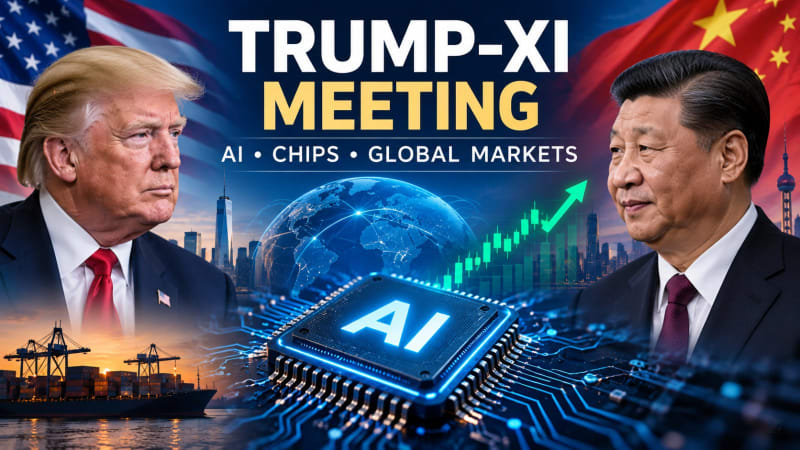
Artificial intelligence stocks are surging again.
The Nasdaq has reached a record closing high, semiconductor stocks have jumped sharply, and enthusiasm around the next wave of AI investment is once again driving global technology markets.
But the next major catalyst for AI stocks may not come from an earnings report, a new AI model or even the Federal Reserve.
It could come from Washington.
U.S. President Donald Trump and Chinese President Xi Jinping are preparing for a closely watched summit at a time when artificial intelligence, advanced semiconductors, critical minerals and technology supply chains have become central issues in the relationship between the world's two largest economies.
For investors, that creates an important question:
Could the Trump-Xi meeting change the outlook for AI and semiconductor stocks just as the technology rally is accelerating again?
The answer matters far beyond U.S. technology companies.
Any change in U.S.-China technology policy could potentially affect semiconductor manufacturers, memory companies, AI infrastructure providers and Asian markets stretching from Taiwan and South Korea to mainland China.
AI Stocks Are Entering the Trump-Xi Meeting With Strong Momentum
The timing of the summit is particularly important because semiconductor stocks have just experienced another major rally.
The Nasdaq Composite closed at a record high on Monday.
The S&P 500 gained approximately 1.5%, while the Philadelphia Semiconductor Index jumped 4.3%.
AMD surged roughly 10%, pushing the chipmaker's market capitalization through $1 trillion for the first time.
Intel and Arm Holdings also recorded strong gains.
The market is therefore entering an important geopolitical event with AI optimism already elevated.
Read AI Stocks Rebound After a Brutal Week: Is the Semiconductor Rally Strong Enough to Overcome 5% Treasury Yields? for our analysis of the renewed semiconductor rally.
Why the Trump-Xi Meeting Matters for AI
For years, U.S.-China economic tensions were primarily discussed in terms of:
tariffs
manufacturing
trade deficits
and
currency policy.
The competition has changed.
Artificial intelligence and advanced semiconductors are increasingly strategic assets.
Modern AI systems depend on enormous computing power.
That requires advanced:
- GPUs and AI accelerators
- high-bandwidth memory
- semiconductor manufacturing equipment
- networking technology
- data centres
- cloud infrastructure
- advanced packaging
Control over these technologies increasingly affects both economic competitiveness and national security.
That means AI policy is no longer separate from U.S.-China relations.
It is becoming one of their central components.
AI Is Already Part of the Pre-Summit Discussions
The importance of AI is not theoretical.
Senior U.S. and Chinese officials have already discussed establishing a formal dialogue around artificial-intelligence risks.
U.S. Treasury Secretary Scott Bessent and Chinese Vice Premier He Lifeng recently held talks ahead of the Trump-Xi summit.
One proposal involves an AI incident-notification mechanism that could allow the two countries to communicate about serious AI-related safety risks.
The two sides are also expected to continue AI discussions in Shenzhen within the coming months.
That is significant.
The world's two largest AI powers are simultaneously:
competing aggressively in AI
while also exploring
mechanisms for managing AI-related risks.
For financial markets, the question is whether cooperation on AI safety could eventually create a more stable environment for technology competition—or whether strategic restrictions on advanced chips will continue tightening.
The Biggest Market Question: What Happens to AI Chip Restrictions?
One of the most important issues for semiconductor investors is access to China.
The United States has used export controls to restrict China's access to some advanced semiconductor technologies.
These restrictions have affected areas including:
- high-performance AI chips
- advanced semiconductor equipment
- chip-manufacturing technology
- advanced computing systems
Washington's objective has been to limit access to technologies considered strategically sensitive.
China, meanwhile, has accelerated efforts to develop its own semiconductor ecosystem.
This creates a difficult balancing act for global chip companies.
China remains an enormous technology market.
But semiconductor companies must operate within increasingly complex export restrictions.
Any signal from the Trump-Xi meeting regarding technology restrictions could therefore receive an immediate market reaction.
Nvidia, AMD and Other AI Chip Companies Are Directly Exposed
For companies selling advanced computing technology, China represents both an opportunity and a policy risk.
The AI boom has created extraordinary demand for computing infrastructure.
But restrictions can limit which products can be sold into China.
This means investors increasingly need to evaluate two different forces:
AI demand growth
versus
geopolitical restrictions.
If U.S.-China relations stabilize, markets could interpret that as reducing some geopolitical uncertainty around global technology supply chains.
If tensions increase and technology restrictions expand, investors may need to reassess future revenue opportunities for companies with meaningful China exposure.
That makes the Trump-Xi summit relevant even for investors who normally focus primarily on earnings.
Taiwan Remains at the Centre of the Semiconductor Story
No discussion about U.S.-China technology competition is complete without Taiwan.
Taiwan occupies an exceptionally important position in advanced semiconductor manufacturing.
Many of the world's leading technology companies depend on Taiwanese manufacturing capacity for advanced chips.
That makes stability in the Taiwan Strait important not just geopolitically but economically.
Ahead of the Trump-Xi summit, the United States, Japan and South Korea have reiterated the importance of peace and stability in the Taiwan Strait while also announcing deeper cooperation around critical technologies and supply chains.
For markets, any escalation around Taiwan would potentially affect:
- semiconductor manufacturing
- electronics supply chains
- AI hardware availability
- shipping routes
- global technology valuations
This is why geopolitical risk is increasingly embedded directly into semiconductor-market analysis.
China Is Building Its Own Semiconductor Ecosystem
Export restrictions have also created an unintended consequence:
China has a stronger incentive to become technologically self-sufficient.
Chinese companies are investing heavily in:
- semiconductor manufacturing
- memory
- AI accelerators
- semiconductor equipment
- advanced packaging
- domestic AI models
This could eventually create stronger competitors to established U.S., Taiwanese and South Korean technology companies.
The competition is therefore no longer simply about whether U.S. companies can sell advanced chips to China.
It is also about whether China can build alternatives.
That makes semiconductor restrictions a long-term strategic question rather than merely a short-term revenue issue.
South Korea Could Be One of the Most Important Markets to Watch
The U.S.-China AI competition also matters enormously for South Korea.
South Korea is home to major memory-chip manufacturers and remains critical to the global AI supply chain.
AI servers require enormous quantities of advanced memory.
As AI infrastructure investment grows, demand for high-bandwidth memory and other specialized semiconductor components has increased.
This means Korean semiconductor companies can benefit from the AI investment boom.
But they are also exposed to U.S.-China technology tensions.
The stronger the restrictions on technology flows between the two countries, the more complicated the operating environment becomes for companies that participate in both markets.
Asian Markets Are Already Responding to AI Optimism
The latest U.S. technology rally has carried into Asia.
The MSCI Asia-Pacific index outside Japan rose more than 1% in early trading, while technology-heavy markets such as South Korea and Taiwan recorded strong gains.
Chinese technology shares also advanced.
Investors can track major Asian, U.S., European and Indian markets through the LiveWorldMarket Global Indices & Futures Hub.
The strength shows that the AI trade is no longer simply a U.S. stock-market phenomenon.
AI investment increasingly connects:
U.S. technology companies
to
Taiwanese semiconductor manufacturing
to
South Korean memory
to
Chinese technology development
and ultimately to global data-centre infrastructure.
That interconnected supply chain is exactly why the Trump-Xi summit matters to global investors.
Rare Earths Could Become Another Important Part of the Story
Semiconductors are only one part of the technology supply chain.
Critical minerals and rare-earth materials are also strategically important.
China occupies a powerful position in several critical-mineral supply chains.
These materials are used across:
- electronics
- electric vehicles
- batteries
- renewable energy
- defence equipment
- advanced technology manufacturing
Recent U.S.-China discussions have therefore included both technology and critical minerals.
This creates potential negotiating leverage on both sides.
Washington has influence through advanced semiconductor technology.
Beijing has influence through important parts of the critical-minerals supply chain.
The relationship between the two could become increasingly important for global technology markets.
A Trade Truce Could Improve Risk Sentiment
Markets do not necessarily need a major U.S.-China agreement to react positively.
Sometimes simply reducing uncertainty can influence asset prices.
If the Trump-Xi summit produces signals that:
- existing trade arrangements will remain stable
- technology restrictions will not suddenly escalate
- communication channels will remain open
- AI safety discussions will continue
- critical-mineral supply chains will remain functional
investors could interpret the meeting as reducing geopolitical risk.
That could support technology valuations even without major policy concessions.
Conversely, renewed confrontation could quickly return geopolitical risk to the centre of the AI trade.
The AI Rally Is Already Facing Another Challenge: Interest Rates
Geopolitics is not the only issue technology investors need to watch.
U.S. Treasury yields remain elevated even after the benchmark 10-year yield moved back below 5%.
Higher bond yields create competition for expensive growth stocks.
Investors can earn attractive returns from government bonds without accepting equity-market risk.
That means AI companies increasingly need to deliver earnings growth strong enough to justify premium valuations.
Read AI Stocks vs 5% Treasury Yields: Can the Global Tech Rally Continue? for our analysis of this valuation challenge.
The Trump-Xi meeting therefore arrives when semiconductor investors are already balancing:
AI earnings growth
against
high interest rates
and now
geopolitical risk.
Falling Oil Prices Have Temporarily Helped Technology Stocks
Another pressure has eased slightly.
Oil prices have retreated from recent highs, with Brent trading around the $100 level after falling more than 3%.
That matters because high oil prices can increase inflation expectations.
Higher inflation can encourage central banks to maintain tighter monetary policy.
And tighter monetary policy can pressure growth-stock valuations.
The recent easing in oil and Treasury yields has therefore removed some pressure from technology shares.
Read Crude Oil Above $100 a Barrel: What It Means for the Global Economy for the broader economic implications of elevated energy prices.
Could the Meeting Accelerate the Global Semiconductor Split?
There is another longer-term possibility.
Even if the summit improves short-term relations, the global semiconductor industry may continue moving toward increasingly separate technology ecosystems.
One ecosystem could centre around the United States and its allies.
Another could increasingly develop around China.
That could encourage countries and companies to build:
- duplicate supply chains
- domestic semiconductor capacity
- alternative AI platforms
- separate cloud infrastructure
- regional technology standards
Such duplication could increase investment across the semiconductor industry.
But it could also increase costs and reduce efficiency.
For investors, that creates both opportunity and risk.
Three Possible Market Scenarios
Scenario 1: Technology Tensions Ease
The summit produces constructive language around trade, AI and technology.
No major new semiconductor restrictions are announced.
Communication between Washington and Beijing improves.
Possible market implication: geopolitical risk premiums could decline and semiconductor sentiment could remain supportive.
Scenario 2: No Major Agreement, but No Escalation
This may be the most neutral outcome.
Both sides continue competing aggressively in technology while maintaining communication.
Existing semiconductor restrictions remain broadly intact.
Possible market implication: investors return their focus to AI spending, earnings and interest rates.
Scenario 3: Technology Restrictions Intensify
Negotiations deteriorate or Washington signals tighter restrictions on advanced chips and technology exports.
China responds with additional restrictions involving critical minerals or technology supply chains.
Possible market implication: semiconductor stocks with significant China exposure could face renewed uncertainty while domestic Chinese chip investment accelerates further.
What Global Investors Should Watch
The headline from the Trump-Xi meeting will matter.
But the details could matter much more.
Investors should monitor:
- AI-chip export controls
- semiconductor-equipment restrictions
- China's access to advanced computing
- AI safety cooperation
- critical-mineral agreements
- rare-earth export policy
- Taiwan-related statements
- U.S.-China trade arrangements
- Chinese semiconductor investment
- Nvidia and AMD China exposure
- Taiwanese semiconductor stocks
- South Korean memory-chip companies
Together, these signals could reveal whether the technology relationship is stabilizing or becoming even more fragmented.
Why This Matters for India
India is not at the centre of the U.S.-China semiconductor dispute, but it could still be affected.
As technology companies diversify global supply chains, India is attempting to expand its role in:
- electronics manufacturing
- semiconductor assembly
- data centres
- cloud infrastructure
- AI services
- enterprise technology
A prolonged U.S.-China technology split could encourage companies to diversify production and technology operations across additional countries.
India could potentially benefit from parts of that diversification.
However, weaker global technology spending or a major geopolitical shock could also hurt Indian IT companies through lower enterprise technology budgets.
The implications therefore extend well beyond China and the United States.
The Bigger Picture: AI Has Become Geopolitical
The AI investment story began largely as a technology story.
It became an earnings story.
Then it became a valuation story as Treasury yields climbed toward 5%.
Now it is increasingly becoming a geopolitical story.
The world's most advanced AI systems depend on semiconductor supply chains spanning multiple countries.
Those same technologies are now viewed by governments as strategically important.
That means investors can no longer evaluate AI stocks using earnings and valuation alone.
They also need to understand:
trade policy
export controls
supply-chain security
critical minerals
and
U.S.-China relations.
The Trump-Xi summit may not resolve the technology competition between the world's two largest economies.
But it could provide an important signal about where that competition is heading.
And with the Nasdaq at a record high and semiconductor stocks surging again, that signal is arriving at an unusually important moment for global markets.
Related LiveWorldMarket Analysis
AI Stocks vs 5% Treasury Yields: Can the Global Tech Rally Continue?
U.S. 10-Year Treasury Yield Hits 5%: Why Rising Bond Yields Could Be the Next Risk for Global Stocks
Disclaimer: This article is for informational and educational purposes only. It does not constitute investment advice or a recommendation to buy or sell any security. Markets and government policies can change rapidly.
Comments (0)
Be the first to comment.
About the author

NISM-Series-X-A Investment Adviser Level 1 examination completed
Amit writes about Indian equity markets, technical analysis, macro themes and the day-to-day mechanics of trading, with a focus on making the flow of global markets legible for retail investors. He has completed the NISM-Series-X-A Investment Adviser Level 1 examination.
You May Also Like

Vietnam Joins Emerging Markets: Could a $6 Billion FTSE Upgrade Trigger the Next Big Asian Stock-Market Re-Rating?
Global Markets & Economy · Sep 21, 2026 · 9 min read
Vietnam has officially entered a new chapter in its stock-market development. On September 21, Vietnamese equities joined FTSE Russell's emerging-market indexes, moving the country further into the global institutional investment universe after years of market reforms. The change may appear technical, but its implications could be much larger. FTSE Russell estimates that the…
Read more...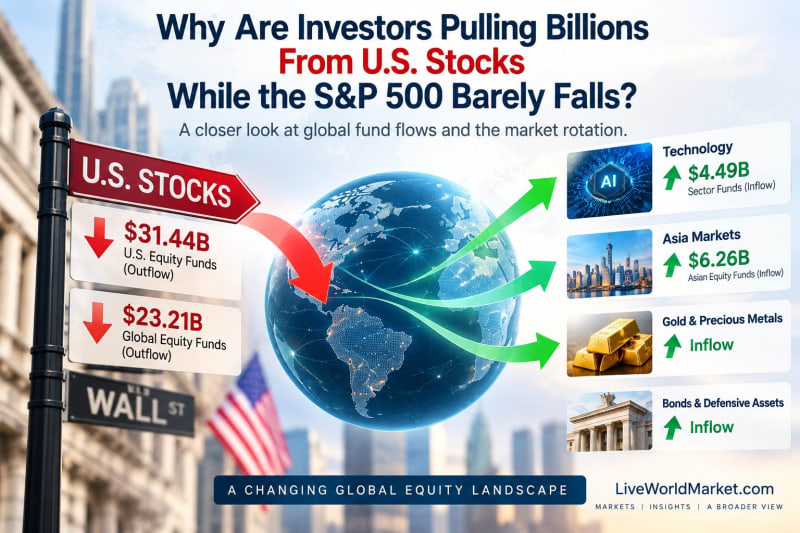
Why Are Investors Pulling Billions From U.S. Stocks While the S&P 500 Barely Falls?
Fundamental · Sep 20, 2026 · 11 min read
Something unusual is happening underneath global stock markets. Investors withdrew $23.21 billion from global equity funds during the week ended September 16, the largest weekly outflow in nine months. The move was even more dramatic in the United States. U.S. equity funds recorded approximately $31.44 billion in withdrawals, marking a fourth consecutive week of outflows. Yet…
Read more...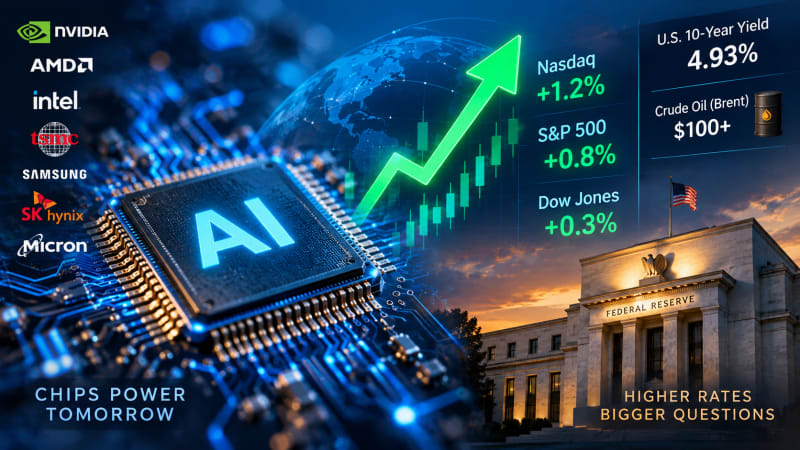
AI Stocks Rebound After a Brutal Week: Is the Semiconductor Rally Strong Enough to Overcome 5% Treasury Yields?
Fundamental · Sep 19, 2026 · 12 min read
Key Takeaways AI and semiconductor stocks are rebounding, helping support the S&P 500 and Nasdaq after a volatile week. The U.S. 10-year Treasury yield recently crossed 5%, creating a much higher valuation hurdle for growth and technology stocks. AI infrastructure spending remains a major support for chip demand, extending beyond processors into memory, storage, networking and…
Read more...Gold Near $4,400 Despite Fed Rate Hikes: Why Is Gold Rising When Interest Rates Are Going Up?
Commodities & Energy · Sep 18, 2026 · 11 min read
Gold is doing something that may look unusual at first glance. The Federal Reserve has raised interest rates. U.S. Treasury yields remain historically elevated. The U.S. dollar has also been relatively strong. Normally, all three conditions can create pressure on gold. Yet gold has rebounded toward the $4,400-per-ounce area, keeping the precious metal close to historically…
Read more...Fed Signals Rates Could Stay Around 4% Through 2027: Is ‘Higher for Longer’ Becoming a Bigger Risk Than Another Rate Hike?
Central Banks & Rates · Sep 17, 2026 · 8 min read
The Federal Reserve has raised interest rates again, but the latest quarter-point increase may not be the most important message for global financial markets. The bigger issue is how long borrowing costs could remain elevated. On September 16, 2026, the Federal Reserve raised the federal funds target range by 25 basis points to 3.75%–4.00%, marking its first rate increase…
Read more...US 10-Year Treasury Yield Hits 5%: Why Rising Bond Yields Could Be the Next Risk for Global Stocks
Global Markets & Economy · Sep 15, 2026 · 8 min read
The U.S. 10-year Treasury yield has crossed the psychologically important 5% level, putting global bond markets—and increasingly equity investors—on alert. On September 15, the benchmark yield climbed to around 5.03%, its highest level since 2007. The move comes as investors confront a difficult combination of higher oil prices, renewed inflation concerns, expectations of…
Read more...China’s Yuan Near a Four-Year High While Credit Demand Weakens: What It Means for Global Stocks
Global Markets & Economy · Sep 14, 2026 · 13 min read
China is sending global investors two very different economic signals. On one side, the Chinese yuan has strengthened significantly, rising around 4.3% this year and trading close to a four-year high against the U.S. dollar. On the other, China’s latest lending data suggests households and businesses remain cautious about borrowing. Chinese banks extended only 60 billion yuan…
Read more...Europe’s Natural Gas Problem Is Returning: Could Higher Energy Prices Hit European Stocks Again?
News · Sep 14, 2026 · 14 min read
Europe’s energy story is becoming important for financial markets again. For much of the recent market discussion, investors have focused on crude oil, U.S. interest rates and artificial intelligence. But another energy market is quietly becoming more important for Europe: natural gas. European policymakers are becoming increasingly concerned that higher natural gas and…
Read more...US Dollar at a Two-Week High: Why a Strong Dollar Could Become the Next Risk for Global Stocks
News · Sep 14, 2026 · 14 min read
The U.S. dollar is strengthening again, adding another important variable to an already complicated global-market environment. On September 14, the dollar climbed to a two-week high as investors responded to higher inflation expectations, elevated bond yields, geopolitical uncertainty and growing expectations that the U.S. Federal Reserve will raise interest rates this week…
Read more...AI Safety Concerns Hit Global Tech Stocks: Is the AI Rally Entering a More Selective Phase?
News · Sep 14, 2026 · 14 min read
Artificial intelligence has been one of the most powerful investment themes driving global stock markets in recent years. Semiconductor companies, cloud providers, data-centre operators and large technology businesses have invested enormous amounts of capital in the expectation that AI will transform how businesses and consumers use technology. But global markets were reminded…
Read more...