
Gold Near $4,400 Despite Fed Rate Hikes: Why Is Gold Rising When Interest Rates Are Going Up?
Gold is doing something that may look unusual at first glance.
The Federal Reserve has raised interest rates. U.S. Treasury yields remain historically elevated. The U.S. dollar has also been relatively strong.
Normally, all three conditions can create pressure on gold.
Yet gold has rebounded toward the $4,400-per-ounce area, keeping the precious metal close to historically elevated levels.
So why isn't gold falling?
The answer is that interest rates are only one part of the gold-price equation.
Investors are simultaneously dealing with geopolitical uncertainty, inflation risks, elevated oil prices, changing Treasury yields and continued demand for defensive assets.
That creates an unusual environment in which gold can remain strong even while central banks are tightening monetary policy.
Why Do Higher Interest Rates Normally Hurt Gold?
Gold does not pay interest.
A Treasury bond does.
That difference becomes particularly important when interest rates rise.
Imagine an investor choosing between holding gold and a government bond yielding close to 5%.
Gold may provide diversification and potential capital appreciation, but it does not generate regular interest income.
A Treasury security does.
As bond yields rise, the opportunity cost of holding gold therefore increases.
In simplified terms:
Higher interest rates → higher bond yields → greater opportunity cost of holding gold → potential pressure on gold prices.
This is why expectations of Federal Reserve rate increases often strengthen the dollar and initially weigh on precious metals.
But the relationship is not automatic.
If the Fed Is Hiking, Why Is Gold Still Near $4,400?
The answer lies in what else is happening across global markets.
The Federal Reserve recently raised its benchmark interest-rate range to 3.75%–4.00%, while policymakers indicated that additional tightening may be possible.
Gold initially reacted negatively to the increasingly hawkish rate outlook.
But prices subsequently recovered.
That suggests investors are looking beyond the simple relationship between the Fed and gold.
Several forces are competing with the negative impact of higher interest rates.
1. Geopolitical Risk Is Supporting Safe-Haven Demand
Gold has historically attracted demand during periods of heightened geopolitical uncertainty.
Current tensions in the Middle East continue to affect oil markets, inflation expectations and investor sentiment.
When investors become concerned about geopolitical escalation, financial instability or disruption to global trade, gold can become attractive as a defensive asset.
That means two opposing forces can operate simultaneously:
Higher interest rates → negative for gold
while
Higher geopolitical uncertainty → supportive for gold.
If safe-haven demand becomes strong enough, it can partially offset the pressure from higher rates.
2. Oil Above $100 Is Keeping Inflation Risk Alive
Oil is another important part of the gold story.
Brent crude remains above $100 a barrel even after retreating from recent highs.
Persistently expensive energy can increase transportation, manufacturing and consumer costs.
That creates a potential chain:
High oil prices → higher inflation risk → concerns about purchasing power → demand for inflation-sensitive assets → support for gold.
Gold is often viewed by investors as a potential long-term store of value during periods of elevated inflation uncertainty.
This does not mean gold automatically rises whenever inflation increases.
Higher inflation can also cause central banks to raise rates, which can work against gold.
The result is a tug-of-war between:
inflation-hedge demand
and
higher interest rates.
For more on the energy side of this equation, read Crude Oil Above $100 a Barrel: What It Means for the Global Economy.
3. Treasury Yields Matter More Than the Fed Rate Alone
Investors sometimes assume that:
Fed raises rates = gold must fall.
The relationship is more complicated.
Gold responds not only to the Federal Reserve's policy rate but also to movements in Treasury yields, real interest rates, inflation expectations and the U.S. dollar.
The U.S. 10-year Treasury yield recently crossed the important 5% level before retreating.
That retreat matters.
If Treasury yields fall even while the Fed remains hawkish, some of the opportunity-cost pressure on gold can ease.
This helps explain why gold can rebound after a Fed rate hike.
For the broader bond-market story, read US 10-Year Treasury Yield Hits 5%: Why Rising Bond Yields Could Be the Next Risk for Global Stocks.
4. Real Interest Rates Are Crucial for Gold
One of the most important concepts for understanding gold is the real interest rate.
A simplified real interest rate can be thought of as:
Nominal interest rate − inflation
Suppose government bonds yield 5%.
That sounds attractive.
But if inflation expectations are also high, the inflation-adjusted return from holding those bonds becomes less impressive.
This is why gold investors often pay close attention to real yields, not merely headline interest rates.
If nominal yields rise but inflation expectations rise at the same time, the real return available from bonds may not increase by as much.
That can reduce the negative impact on gold.
5. Central Banks Remain an Important Source of Gold Demand
Another structural factor has become increasingly important: central-bank gold buying.
Central banks hold foreign-exchange reserves across different assets and currencies.
Gold can provide diversification because it is not the liability of another government or financial institution.
That characteristic becomes particularly relevant during periods of geopolitical uncertainty, sanctions risk and changing international financial relationships.
Central-bank demand therefore represents a different type of gold buyer.
A short-term trader may react quickly to a Federal Reserve announcement.
A central bank diversifying reserves may operate with a much longer time horizon.
That helps explain why higher interest rates do not necessarily eliminate underlying demand for gold.
6. The Dollar-Gold Relationship Is Not Always Perfect
Gold is generally priced internationally in U.S. dollars.
A stronger dollar usually makes gold more expensive for investors using other currencies, potentially reducing demand.
This creates another familiar relationship:
Stronger dollar → potential pressure on gold
and
weaker dollar → potential support for gold.
But just like interest rates, the relationship is not perfect.
If geopolitical uncertainty or inflation fears are sufficiently strong, investors can buy both dollars and gold at the same time.
For more on the dollar's impact across financial markets, read US Dollar at a Two-Week High: Why a Strong Dollar Could Become the Next Risk for Global Stocks.
7. Gold May Be Pricing Future Risks, Not Today's Fed Decision
Financial markets are forward-looking.
Gold investors may care less about the rate increase that has already happened and more about what today's tightening could mean six or twelve months from now.
Higher rates can eventually slow:
- consumer spending
- housing activity
- corporate borrowing
- business investment
- economic growth
If investors believe aggressive monetary tightening could eventually weaken the economy, demand for defensive assets can increase.
That creates another unusual chain:
Fed raises rates → financial conditions tighten → future growth risks increase → defensive demand rises → gold receives support.
In other words, a rate hike can initially hurt gold but potentially create economic conditions that later support it.
Gold and the “Higher for Longer” Problem
This makes the duration of high interest rates especially important.
The key question is not simply:
Will the Fed raise rates again?
It is:
How long can interest rates remain elevated before economic growth begins to weaken materially?
If rates stay high while inflation remains persistent, markets could face an uncomfortable combination of slower growth and elevated prices.
That environment would increase discussion about stagflation risk.
For more on the interaction between persistent inflation and restrictive monetary policy, read Oil Above $100 & US Yields Near 5%: Impact on India & Global Markets.
Why the Bank of Japan Also Matters for Gold
The Federal Reserve is not the only central bank tightening monetary policy.
The Bank of Japan has raised its policy rate to 1.25%, its highest level in roughly three decades.
Changes in Japanese rates can influence the yen, Japanese government-bond yields and international capital flows.
That matters because global investors do not make asset-allocation decisions based only on U.S. interest rates.
They compare yields, currencies and risks across countries.
If major central banks tighten simultaneously, volatility across bonds and currencies can increase.
And higher financial-market uncertainty can itself contribute to defensive demand for gold.
Read Bank of Japan Rate Hike & Yen Carry Trade: Global Market Impact for the wider global-liquidity implications.
Why Gold Matters for Indian Investors
India adds another dimension to the gold story.
International gold is priced primarily in U.S. dollars, but Indian buyers ultimately purchase gold in rupees.
That means domestic gold prices depend on both:
International gold price
and
USD/INR exchange rate.
Consider a simplified example.
If international gold remains unchanged but the rupee weakens against the dollar, gold can become more expensive in India.
If international gold rises while the rupee simultaneously weakens, the impact on Indian gold prices can be amplified.
This makes the rupee particularly important for Indian investors.
With USD/INR recently trading close to the ₹96 area, currency movements have become another factor worth monitoring alongside international bullion prices.
Gold vs Stocks: Are Investors Hedging Rather Than Abandoning Equities?
Another interesting feature of the current market is that gold can remain strong while equities remain relatively resilient.
This suggests investors do not necessarily have to be making a binary decision between:
stocks OR gold.
Some institutional portfolios can remain invested in equities while simultaneously increasing defensive exposure.
This is particularly relevant when investors believe economic growth can continue but see unusually high geopolitical, inflation or policy uncertainty.
The result can be:
Risk assets remain resilient + demand for portfolio hedges remains strong.
That combination helps explain why gold strength does not automatically signal an imminent stock-market decline.
Readers can monitor major international equity markets through the LiveWorldMarket Global Index & Futures Hub.
What Could Push Gold Higher?
Rather than predicting a specific gold price, it is more useful to identify the conditions that could strengthen demand.
Potential supportive factors include:
Falling real Treasury yields
If inflation expectations remain elevated while bond yields decline, the opportunity cost of holding gold could fall.
A weaker U.S. dollar
Dollar weakness generally makes gold more affordable for international buyers.
Escalating geopolitical uncertainty
Additional geopolitical stress could increase defensive demand.
Persistent inflation
If investors become concerned that inflation will remain elevated despite monetary tightening, demand for stores of value could increase.
Continued central-bank purchases
Structural reserve diversification could provide longer-term support.
What Could Push Gold Lower?
There are equally important risks on the other side.
Gold could face pressure if:
Treasury yields rise substantially further
Higher yields increase the opportunity cost of holding a non-interest-bearing asset.
Real yields rise
This can make inflation-adjusted returns from government bonds more attractive.
The U.S. dollar strengthens significantly
A stronger dollar can weigh on international demand.
Geopolitical tensions ease
Reduced uncertainty can lower safe-haven demand.
Inflation falls quickly
If inflation normalizes while economic growth remains strong, demand for inflation protection could decline.
Three Scenarios for Gold
Scenario 1: Inflation Cools and Treasury Yields Fall
This creates a mixed but potentially constructive environment for gold.
Lower inflation could reduce inflation-hedge demand, but declining bond yields would reduce the opportunity cost of holding gold.
The dollar's response would become particularly important.
Scenario 2: Inflation Stays High and Rates Stay High
This creates a tug-of-war.
Higher interest rates work against gold.
But persistent inflation, geopolitical uncertainty and defensive demand can provide support.
Gold could therefore remain volatile rather than responding cleanly to monetary policy.
Scenario 3: High Rates Trigger a Growth Slowdown
This may be the most interesting scenario.
If restrictive monetary policy eventually weakens economic activity, Treasury yields could begin falling as investors anticipate slower growth.
Safe-haven demand could simultaneously increase.
That combination could become more supportive for gold even if the initial trigger was aggressive central-bank tightening.
What Should Gold Investors Watch Next?
Instead of focusing only on the headline gold price, investors may want to monitor several related indicators:
- U.S. 10-year Treasury yield
- U.S. real yields
- Federal Reserve guidance
- U.S. inflation
- U.S. Dollar Index
- Brent and WTI crude oil
- geopolitical developments
- central-bank gold purchases
- USD/INR
- global economic-growth indicators
These variables can help explain whether gold's strength is being driven primarily by inflation, safe-haven demand, currencies or expectations about future monetary policy.
The Bigger Picture
Gold trading near $4,400 despite a Federal Reserve rate hike does not mean the traditional relationship between interest rates and gold has disappeared.
Higher rates remain an important headwind for a non-yielding asset.
But today's gold market is being influenced by several forces simultaneously:
Higher interest rates
versus
geopolitical uncertainty + persistent inflation + central-bank demand + changing Treasury yields + concerns about future economic growth.
For now, those competing forces appear strong enough to keep gold at historically elevated levels.
The most important question may therefore not be:
“Why didn't gold fall after the Fed raised rates?”
It may be:
“What is gold telling investors about inflation, geopolitical risk and confidence in the global economic outlook?”
That makes gold more than just a commodity-price story.
It is increasingly becoming a useful indicator of how investors are pricing uncertainty across the global financial system.
Related LiveWorldMarket Analysis
Read Crude Oil Above $100 a Barrel: What It Means for the Global Economy for the connection between energy prices, inflation and monetary policy.
Explore US 10-Year Treasury Yield Hits 5%: Why Rising Bond Yields Could Be the Next Risk for Global Stocks for the bond-yield side of the story.
Read US Dollar at a Two-Week High: Why a Strong Dollar Could Become the Next Risk for Global Stocks to understand why dollar movements matter for commodities and global markets.
See Bank of Japan Rate Hike & Yen Carry Trade: Global Market Impact for the impact of Japanese monetary tightening on global liquidity.
Follow major U.S., Asian, European and Indian index futures through the LiveWorldMarket Global Index & Futures Hub.
Disclaimer: This article is for informational and educational purposes only. Gold prices, interest rates, currencies and other financial markets can change rapidly. Nothing in this article constitutes investment advice or a recommendation to buy or sell gold, securities or any other financial instrument.
Comments (0)
Be the first to comment.
About the author

NISM-Series-X-A Investment Adviser Level 1 examination completed
Amit writes about Indian equity markets, technical analysis, macro themes and the day-to-day mechanics of trading, with a focus on making the flow of global markets legible for retail investors. He has completed the NISM-Series-X-A Investment Adviser Level 1 examination.
You May Also Like

US Midterm Elections 2026: Impact on Stocks, Dollar & India
Global Markets & Economy · Nov 4, 2026 · 10 min read
US Midterm Elections 2026: Why Treasury Yields, the Dollar and Indian Stocks Could React More Than Wall Street Key Takeaway: Democrats have won control of both chambers of the US Congress in the 2026 midterm elections, creating a divided government under President Donald Trump. The immediate market reaction has been revealing: US Treasury yields declined, the dollar weakened…
Read more...
Apple Overtakes Nvidia: Is Lower AI Spending Winning?
Technology & Sectors · Nov 2, 2026 · 9 min read
Apple Overtakes Nvidia as World's Most Valuable Company Ahead of Earnings: Is Spending Less on AI Becoming Wall Street's Winning Strategy? Key takeaway: Apple has reclaimed the title of the world's most valuable publicly traded company, overtaking Nvidia as investors reassess the enormous cost of artificial intelligence infrastructure. With Apple's upcoming earnings in focus…
Read more...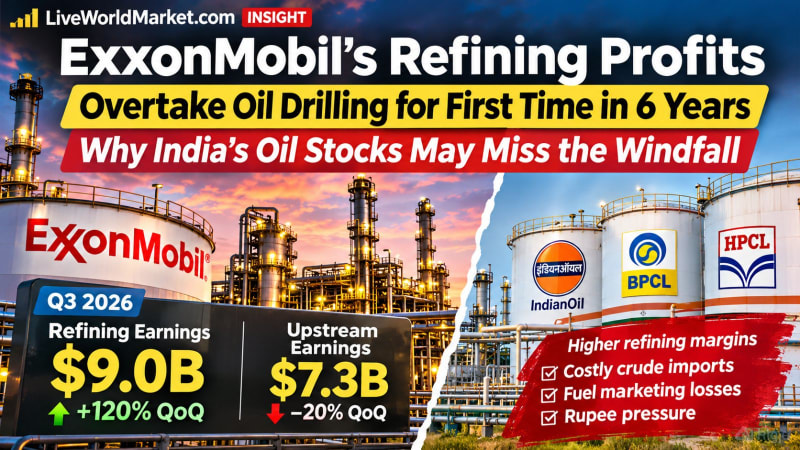
ExxonMobil Refining Profits Surge: Impact on Indian Oil Stocks
Commodities & Energy · Nov 1, 2026 · 8 min read
ExxonMobil's Refining Profits Overtake Oil Drilling for First Time in 6 Years: Why India's Oil Stocks May Miss the Windfall Key Takeaway: ExxonMobil's refining business has emerged as a bigger earnings contributor than oil production, highlighting an extraordinary shift in global energy markets. But Indian oil companies such as IOC, BPCL and HPCL face a different challenge…
Read more...
Fed Decision and Microsoft–Google Earnings: Two Critical Tests for the AI Stock Market Rally
Global Markets & Economy · Oct 28, 2026 · 15 min read
Global stock markets are approaching one of the most important financial evenings of October 2026. The U.S. Federal Reserve is preparing to announce its latest interest-rate decision, while Microsoft and Alphabet, Google's parent company, are scheduled to publish quarterly earnings after Wall Street closes. These developments arrive as investors reassess the sustainability of…
Read more...
JetBlue Stock Surges 20%, Bond Yield Tops 30%: Warning?
Global Markets & Economy · Oct 28, 2026 · 16 min read
JetBlue Stock Surges 20% While Its Bonds Yield Over 30%: Is Airline Debt Flashing a Warning for Investors? Something unusual is happening in the U.S. airline industry. Shares of JetBlue Airways surged approximately 20% on October 27, after the airline raised its revenue outlook and attempted to reassure investors about its financial position. But an entirely different story…
Read more...
US Consumer Staples Rally 9.6%: FMCG Valuation Risk for India
Global Markets & Economy · Oct 25, 2026 · 16 min read
US Consumer Staples Surge 9.6% as Valuations Overtake Tech: Is the Safe-Stock Trade Becoming a Trap for Indian FMCG Investors? Something unexpected is happening on Wall Street. As investors become increasingly cautious about expensive artificial intelligence stocks, money has been moving into an unlikely market leader: consumer staples. The U.S. consumer-staples sector has…
Read more...
SpaceX 80,000 Cell Sites: Will Starlink Challenge Jio & Airtel?
Global Markets & Economy · Oct 24, 2026 · 17 min read
SpaceX's 80,000 Cell-Site Plan Sends US Telecom Stocks Down 8%: Could Starlink Disrupt Jio and Airtel Next? A major shift may be emerging in the global telecommunications industry—and Wall Street has already started reacting. Shares of American telecommunications giants AT&T and T-Mobile plunged nearly 8% on October 23 after reports revealed that Elon Musk's SpaceX was…
Read more...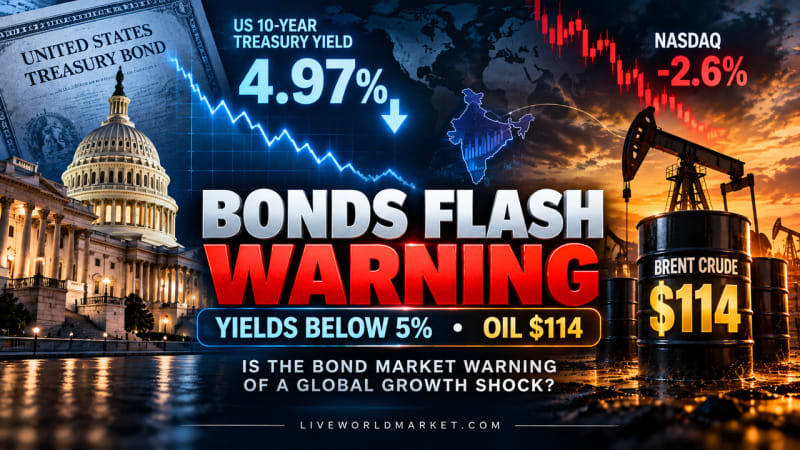
US 10-Year Treasury Yield Below 5%: Growth Shock Warning?
Central Banks & Rates · Oct 23, 2026 · 17 min read
US 10-Year Treasury Yield Falls Below 5% Despite $114 Oil: Is the Bond Market Warning of a Global Growth Shock? Something unusual is happening across global financial markets. The yield on the benchmark U.S. 10-year Treasury has fallen sharply below the psychologically important 5% level, even as Brent crude oil has surged toward $114 per barrel and technology stocks have…
Read more...
Brent Crude Tops $110: Impact on Indian Stocks & Earnings
Global Markets & Economy · Oct 22, 2026 · 14 min read
Brent Crude Tops $110: Why Indian Airlines, Paints and Tyre Stocks Face a Hidden Earnings Risk Brent crude oil has climbed above $110 per barrel, intensifying concerns that rising global energy prices could squeeze corporate profit margins, increase India's import costs and create further volatility in domestic equities. On October 22, Brent futures traded above $111 after…
Read more...
India Optical Fibre Exports Jump 158%: AI's Hidden Winners
Global Markets & Economy · Oct 21, 2026 · 12 min read
India's Optical Fibre Exports Jump 158% as Japan's Chip Shipments Surge 49%: The Hidden Winners of the AI Infrastructure Boom Artificial intelligence may be transforming the technology industry, but some of its most important economic beneficiaries are not necessarily the companies developing AI models. They may be the businesses manufacturing the physical infrastructure that…
Read more...