
US 10-Year Treasury Yield Hits 5%: Why Rising Bond Yields Could Be the Next Risk for Global Stocks
The U.S. 10-year Treasury yield has crossed the psychologically important 5% level, putting global bond markets—and increasingly equity investors—on alert.
On September 15, the benchmark yield climbed to around 5.03%, its highest level since 2007. The move comes as investors confront a difficult combination of higher oil prices, renewed inflation concerns, expectations of tighter monetary policy and worries about government borrowing.
For stock-market investors, the important question is no longer simply whether the Federal Reserve raises interest rates.
A bigger question may be emerging:
What happens to global stocks if long-term bond yields remain above 5% for an extended period?
Why Has the US 10-Year Treasury Yield Risen Above 5%?
Bond yields do not move for a single reason. The latest rise appears to reflect several pressures arriving at the same time.
1. Higher Oil Prices Are Reviving Inflation Concerns
Crude oil prices have climbed sharply amid renewed concerns about Middle East supply disruptions.
Higher energy prices can feed through to transportation, manufacturing, logistics and consumer prices. If energy remains expensive, inflation could prove more persistent than investors previously expected.
That matters to bond markets because investors generally demand higher yields when they expect inflation to remain elevated.
The chain can look something like this:
Higher oil prices → higher inflation expectations → tighter monetary-policy expectations → bond selling → higher Treasury yields
This is one reason developments in the energy market are now having an increasingly direct impact on both bonds and equities.
2. The Federal Reserve Is Back in Focus
Markets are closely watching the Federal Reserve's September policy meeting.
When investors expect policy rates to remain high—or move higher—Treasury yields can adjust upward as the bond market reprices the future path of interest rates and inflation.
However, the 10-year yield reflects much more than the current federal funds rate.
It also incorporates expectations about future growth, inflation, government borrowing and the additional return investors demand for holding longer-term debt.
This means Treasury yields could potentially remain elevated even if the Federal Reserve eventually stops raising rates.
And that distinction could become increasingly important for stock markets.
3. US Government Borrowing Is Becoming Part of the Market Story
Another factor is the large supply of government debt that markets must absorb.
When Treasury issuance increases, investors need to purchase a larger volume of bonds. If demand does not increase proportionally, bond prices can come under pressure and yields may rise.
Investors are therefore watching not only Federal Reserve policy but also the broader US fiscal outlook and future financing requirements.
This creates an unusual environment where monetary policy, inflation and government borrowing are simultaneously influencing long-term interest rates.
Why Does a 5% Treasury Yield Matter for Stocks?
The 10-year Treasury yield is one of the most important reference rates in global finance.
A move from roughly 3% or 4% to around 5% can materially change the investment calculation for equities.
Consider the choice facing an investor.
When government bonds offer relatively low yields, investors may be more willing to accept the additional uncertainty associated with equities in pursuit of higher returns.
But when a highly liquid US Treasury security offers around 5%, the comparison becomes more demanding.
Stocks must offer investors enough potential return to justify taking considerably more risk.
That can create pressure on equity valuations.
High-Valuation Growth Stocks Could Be More Sensitive
Technology and other growth stocks can be particularly sensitive to rising bond yields.
Many growth companies are valued partly on profits expected far into the future.
Financial valuation models discount those future cash flows back to today's value. When the discount rate increases, the present value of those future earnings generally falls.
In simplified terms:
Higher Treasury yields → higher discount rates → lower present value of future earnings → pressure on valuation multiples
That does not mean every technology stock automatically falls whenever Treasury yields rise.
Earnings growth, margins, artificial-intelligence investment, productivity improvements and company-specific fundamentals remain important.
But a sustained 5% Treasury yield creates a considerably higher valuation hurdle.
Could 5% Treasuries Pull Money Away From Stocks?
Potentially.
This is one of the most important questions for global markets.
Investors can now compare the expected return from equities with a materially higher yield available from US government debt.
If investors decide that the additional return expected from stocks is insufficient to compensate for their additional risk, some capital could gradually rotate toward fixed-income assets.
That does not necessarily produce an immediate stock-market crash.
Instead, it can create a more subtle problem:
equity valuations may struggle to expand even when corporate earnings remain relatively strong.
This could become particularly important for market segments already trading at elevated valuation multiples.
The Risk Goes Beyond Wall Street
The significance of the Treasury move is not limited to the S&P 500 or Nasdaq.
The US Treasury market sits at the center of the global financial system.
Higher US yields can influence bond markets, currencies and capital flows across Europe, Asia and emerging markets.
Germany's benchmark government-bond yield has also climbed sharply, while yields across several other developed economies have moved higher.
This suggests investors may be dealing with something broader than a US-specific bond selloff.
It could be part of a global repricing of long-term interest rates.
What Higher US Yields Could Mean for India
India faces an additional complication: higher Treasury yields are arriving alongside expensive crude oil.
India imports a large share of its energy requirements, so sustained increases in oil prices can affect inflation expectations, the trade balance and the rupee.
At the same time, higher US yields can make dollar-denominated assets more attractive to international investors.
The combination of:
Higher crude oil + stronger dollar + higher US Treasury yields
can therefore create a more challenging environment for Indian financial markets.
On September 15, the Nifty 50 fell to a five-month low as investors reacted to elevated crude prices and rising global bond yields.
For Indian investors, developments in the US bond market are consequently becoming nearly as important to monitor as movements in the S&P 500.
What About European Stocks?
Europe faces a slightly different challenge.
Higher global bond yields are arriving while the region is also dealing with renewed energy-price pressures.
Higher borrowing costs can affect businesses, consumers and governments, while elevated energy prices can squeeze corporate margins.
European equities could therefore face pressure from two directions:
higher financing costs and higher input costs.
This makes movements in Germany's Bund yield, European inflation expectations and energy prices particularly important indicators to watch.
Three Scenarios Investors Should Watch
Scenario 1: Treasury Yield Falls Back Below 5%
If oil prices stabilize and inflation concerns ease, demand for bonds could recover.
Treasury yields falling meaningfully below 5% would reduce some of the valuation pressure on equities, particularly long-duration growth stocks.
Scenario 2: Yield Stabilizes Around 5%
This could create a prolonged adjustment rather than a sudden market shock.
Companies with strong earnings and cash flows may continue to perform, but expensive stocks could face greater valuation scrutiny.
In this environment, investors may increasingly focus on earnings quality rather than multiple expansion.
Scenario 3: Yield Moves Significantly Above 5%
This would represent the more difficult scenario.
A sustained move well above 5% could tighten financial conditions further, increase borrowing costs and intensify competition between bonds and equities.
At that point, the bond market could become a larger source of volatility for global stocks.
What Investors Should Monitor Next
Several indicators could determine whether the move above 5% becomes temporary or develops into a longer-term trend:
- US 10-year and 30-year Treasury yields
- Federal Reserve policy and forward guidance
- US inflation data
- Brent and WTI crude-oil prices
- US government debt issuance
- US Dollar Index
- German and Japanese government-bond yields
- S&P 500 and Nasdaq valuation multiples
- Foreign institutional flows into emerging markets
- USD/INR and Indian government-bond yields
Together, these indicators can provide a clearer picture of whether financial conditions are continuing to tighten.
The Bigger Picture
For much of the recent equity rally, investors focused heavily on corporate earnings, artificial intelligence and expectations for future monetary easing.
The bond market is now demanding attention again.
A US 10-year Treasury yield above 5% changes the financial backdrop because it increases borrowing costs while simultaneously offering investors a more attractive alternative to equities.
The key issue is therefore not whether touching 5% automatically triggers a stock-market correction.
It does not.
The more important question is how long yields remain elevated and how companies, consumers and investors adjust to a world where long-term borrowing costs are substantially higher.
If 5% proves temporary, equity markets may absorb the move relatively quickly.
If it becomes the new normal, however, global stock valuations may need to adjust to a very different interest-rate environment.
LiveWorldMarket View
The 5% level should be viewed as a market signal rather than a prediction.
Investors should watch the interaction between Treasury yields, crude oil, inflation expectations and equity valuations rather than treating any individual indicator as a standalone buy or sell signal.
Follow LiveWorldMarket's Global Indices, US Stock Market Dashboard, India Stock Market Dashboard, Market Analysis, and Insight sections for updates across global equities, bonds, currencies and commodities.
Market data and economic conditions can change rapidly. This article is provided for informational and educational purposes only and should not be considered investment advice or a recommendation to buy or sell any security.
Comments (0)
Be the first to comment.
About the author

NISM-Series-X-A Investment Adviser Level 1 examination completed
Amit writes about Indian equity markets, technical analysis, macro themes and the day-to-day mechanics of trading, with a focus on making the flow of global markets legible for retail investors. He has completed the NISM-Series-X-A Investment Adviser Level 1 examination.
You May Also Like
Big Tech Gains $750B as AI Data Centre Stocks Crash
Global Markets & Economy · Nov 5, 2026 · 12 min read
Big Tech Gains $750 Billion After US Midterms, but AI Data-Centre Stocks Crash: Is Wall Street Rewarding Less AI Spending? Key Takeaway: Wall Street's reaction to the 2026 US midterm elections has exposed a surprising divide in the artificial intelligence investment boom. Established technology giants rallied, with five major companies on course to add more than $750 billion…
Read more...
US Midterm Elections 2026: Impact on Stocks, Dollar & India
Global Markets & Economy · Nov 4, 2026 · 10 min read
US Midterm Elections 2026: Why Treasury Yields, the Dollar and Indian Stocks Could React More Than Wall Street Key Takeaway: Democrats have won control of both chambers of the US Congress in the 2026 midterm elections, creating a divided government under President Donald Trump. The immediate market reaction has been revealing: US Treasury yields declined, the dollar weakened…
Read more...
Apple Overtakes Nvidia: Is Lower AI Spending Winning?
Technology & Sectors · Nov 2, 2026 · 9 min read
Apple Overtakes Nvidia as World's Most Valuable Company Ahead of Earnings: Is Spending Less on AI Becoming Wall Street's Winning Strategy? Key takeaway: Apple has reclaimed the title of the world's most valuable publicly traded company, overtaking Nvidia as investors reassess the enormous cost of artificial intelligence infrastructure. With Apple's upcoming earnings in focus…
Read more...
ExxonMobil Refining Profits Surge: Impact on Indian Oil Stocks
Commodities & Energy · Nov 1, 2026 · 8 min read
ExxonMobil's Refining Profits Overtake Oil Drilling for First Time in 6 Years: Why India's Oil Stocks May Miss the Windfall Key Takeaway: ExxonMobil's refining business has emerged as a bigger earnings contributor than oil production, highlighting an extraordinary shift in global energy markets. But Indian oil companies such as IOC, BPCL and HPCL face a different challenge…
Read more...
Fed Decision and Microsoft–Google Earnings: Two Critical Tests for the AI Stock Market Rally
Global Markets & Economy · Oct 28, 2026 · 15 min read
Global stock markets are approaching one of the most important financial evenings of October 2026. The U.S. Federal Reserve is preparing to announce its latest interest-rate decision, while Microsoft and Alphabet, Google's parent company, are scheduled to publish quarterly earnings after Wall Street closes. These developments arrive as investors reassess the sustainability of…
Read more...
JetBlue Stock Surges 20%, Bond Yield Tops 30%: Warning?
Global Markets & Economy · Oct 28, 2026 · 16 min read
JetBlue Stock Surges 20% While Its Bonds Yield Over 30%: Is Airline Debt Flashing a Warning for Investors? Something unusual is happening in the U.S. airline industry. Shares of JetBlue Airways surged approximately 20% on October 27, after the airline raised its revenue outlook and attempted to reassure investors about its financial position. But an entirely different story…
Read more...
US Consumer Staples Rally 9.6%: FMCG Valuation Risk for India
Global Markets & Economy · Oct 25, 2026 · 16 min read
US Consumer Staples Surge 9.6% as Valuations Overtake Tech: Is the Safe-Stock Trade Becoming a Trap for Indian FMCG Investors? Something unexpected is happening on Wall Street. As investors become increasingly cautious about expensive artificial intelligence stocks, money has been moving into an unlikely market leader: consumer staples. The U.S. consumer-staples sector has…
Read more...
SpaceX 80,000 Cell Sites: Will Starlink Challenge Jio & Airtel?
Global Markets & Economy · Oct 24, 2026 · 17 min read
SpaceX's 80,000 Cell-Site Plan Sends US Telecom Stocks Down 8%: Could Starlink Disrupt Jio and Airtel Next? A major shift may be emerging in the global telecommunications industry—and Wall Street has already started reacting. Shares of American telecommunications giants AT&T and T-Mobile plunged nearly 8% on October 23 after reports revealed that Elon Musk's SpaceX was…
Read more...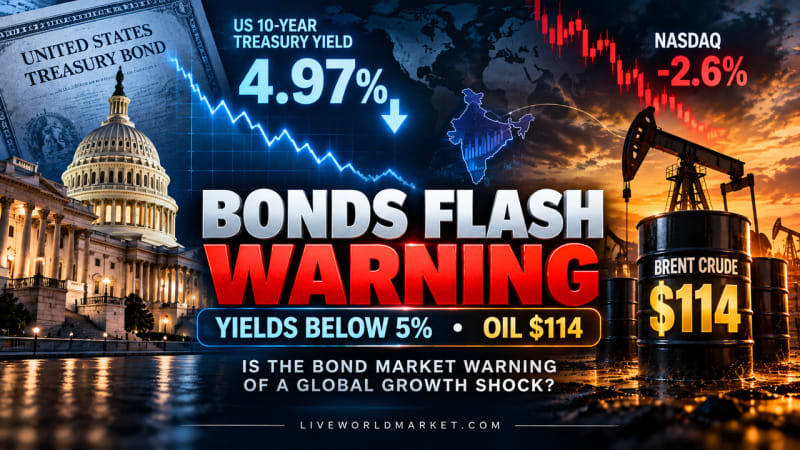
US 10-Year Treasury Yield Below 5%: Growth Shock Warning?
Central Banks & Rates · Oct 23, 2026 · 17 min read
US 10-Year Treasury Yield Falls Below 5% Despite $114 Oil: Is the Bond Market Warning of a Global Growth Shock? Something unusual is happening across global financial markets. The yield on the benchmark U.S. 10-year Treasury has fallen sharply below the psychologically important 5% level, even as Brent crude oil has surged toward $114 per barrel and technology stocks have…
Read more...
Brent Crude Tops $110: Impact on Indian Stocks & Earnings
Global Markets & Economy · Oct 22, 2026 · 14 min read
Brent Crude Tops $110: Why Indian Airlines, Paints and Tyre Stocks Face a Hidden Earnings Risk Brent crude oil has climbed above $110 per barrel, intensifying concerns that rising global energy prices could squeeze corporate profit margins, increase India's import costs and create further volatility in domestic equities. On October 22, Brent futures traded above $111 after…
Read more...