

Fed Signals Rates Could Stay Around 4% Through 2027: Is ‘Higher for Longer’ Becoming a Bigger Risk Than Another Rate Hike?
The Federal Reserve has raised interest rates again, but the latest quarter-point increase may not be the most important message for global financial markets.
The bigger issue is how long borrowing costs could remain elevated.
On September 16, 2026, the Federal Reserve raised the federal funds target range by 25 basis points to 3.75%–4.00%, marking its first rate increase since 2023.
For investors, this raises a more important question:
What happens to global stocks if interest rates remain around 4% for much longer than markets previously expected?
That could make the duration of high interest rates—not simply the next Fed decision—one of the most important risks facing global markets.
Why Did the Federal Reserve Raise Interest Rates?
The Fed's decision comes against a complicated economic backdrop.
Inflation remains above the central bank's 2% objective, while higher energy prices have added another source of inflationary pressure.
At the same time, the US economy has remained relatively resilient.
A stronger-than-expected economy gives the Federal Reserve more room to keep monetary policy restrictive while attempting to bring inflation under control.
The basic policy challenge can be summarized as:
Strong demand + persistent inflation + elevated energy prices = less room for lower interest rates.
That equation could remain important well beyond a single Federal Reserve meeting.
The Bigger Story Is “Higher for Longer”
Markets frequently focus on whether the Federal Reserve will raise rates by another 25 basis points.
But investors may increasingly need to focus on something different:
How long will rates remain high?
There is a significant difference between a temporary tightening cycle and an environment where interest rates remain around 4% for an extended period.
Businesses eventually refinance debt. Home buyers need mortgages. Governments issue new bonds. Consumers borrow through credit cards and auto loans.
And investors continuously compare the potential returns from stocks with the yields available from bonds.
The longer rates remain elevated, the more those higher financing costs work their way through the economy.
This is why duration may ultimately matter more than another individual 25-basis-point hike.
Treasury Yields Are Sending the Same Message
The bond market has already been warning investors about this changing environment.
The US 10-year Treasury yield has recently tested the important 5% area, while shorter-term Treasury yields have also moved higher.
This matters because Treasury yields influence financing costs and asset valuations throughout the global financial system.
When government bonds offer yields near 5%, investors have a more attractive alternative to equities than they did during the ultra-low-rate era.
For more on the interaction between high bond yields and equities, read Oil Above $100 & US Yields Near 5%: Impact on India & Global Markets.
Why Higher-for-Longer Rates Matter for Stock Valuations
Stock valuations are partly based on the present value of future corporate cash flows.
When interest rates rise, the discount rate applied to those future cash flows generally increases.
In simplified terms:
Higher interest rates → higher discount rates → lower present value of future earnings → greater pressure on high valuations.
This effect can be particularly important for companies whose valuations depend heavily on profits expected many years into the future.
That makes growth and technology stocks an important area to watch.
Readers can monitor major US and international index futures through LiveWorldMarket's Global Index & Futures Hub.
Could AI and Technology Stocks Face a Valuation Test?
Artificial-intelligence investment remains one of the strongest structural themes supporting parts of the US technology sector.
But even companies benefiting from strong long-term growth trends are not completely insulated from interest rates.
If Treasury yields remain high, investors may demand stronger earnings growth to justify elevated valuation multiples.
This creates an interesting tension:
AI-driven earnings growth
versus
higher discount rates and more attractive bond yields.
The result does not necessarily have to be a broad technology selloff.
Instead, markets could become increasingly selective, rewarding companies that can convert AI investment into measurable revenue, margins and free cash flow.
For a deeper look at this relationship, read AI Stocks vs 5% Treasury Yields: Can the Global Tech Rally Continue?.
The Stronger Dollar Adds Another Layer
A higher-for-longer US interest-rate environment can also support the dollar by increasing the relative attractiveness of dollar-denominated assets.
A stronger dollar can affect global markets in several ways.
US multinational companies may see overseas earnings translated into fewer dollars.
Emerging-market currencies can come under pressure.
Dollar-denominated borrowing becomes more expensive for some international borrowers.
Commodity markets can also be affected because many globally traded commodities are priced in dollars.
This means restrictive Federal Reserve policy can travel far beyond US borders.
Read the related analysis: US Dollar at a Two-Week High: Why a Strong Dollar Could Become the Next Risk for Global Stocks.
What Does This Mean for India?
India is particularly sensitive to the current combination of global forces:
High US interest rates + strong dollar + elevated crude oil prices.
Higher US yields can make American fixed-income assets relatively more attractive, potentially affecting international capital flows into emerging markets.
A stronger dollar can put pressure on the rupee.
And because India imports a significant share of its crude-oil requirements, elevated energy prices can increase inflation and external-account pressures.
For Indian equity investors, Federal Reserve policy therefore matters well beyond Wall Street.
Investors can also use LiveWorldMarket's Global Index & Futures Hub to track GIFT Nifty alongside Dow, S&P 500, Nasdaq, Nikkei, Hang Seng and European index futures.
Could Lower Oil Provide Some Relief?
Not every development has to be negative for equities.
If crude oil prices retreat and remain lower, some inflation pressure could eventually ease.
That creates an important potential offset:
Lower oil → softer inflation pressure → less need for aggressive monetary tightening → potential relief for bonds and equities.
The critical word, however, is sustained.
A temporary decline in crude would have a limited impact if energy prices remain structurally elevated.
For more background on why the $100 level matters, read Crude Oil Above $100 a Barrel: What It Means for the Global Economy.
The Fed Is Not Acting Alone
Another reason investors should pay attention is that monetary tightening is not exclusively an American story.
Global markets are also watching the Bank of Japan, while bond yields across other developed economies have become increasingly important to global asset allocation.
Japan is particularly significant because decades of very low interest rates made the yen an important funding currency for global carry trades.
If Japanese rates continue rising while US rates remain high, global liquidity conditions could become more complicated.
Read LiveWorldMarket's detailed explainer: Bank of Japan Rate Hike & Yen Carry Trade: Global Market Impact.
Three Scenarios Global Investors Should Watch
Scenario 1: Inflation Falls and the Fed Stops Tightening
If energy prices stabilize and inflation moves convincingly lower, the Fed could eventually stop raising rates.
Treasury yields could ease and some pressure on equity valuations could diminish.
Scenario 2: Rates Remain Around 4% for an Extended Period
This may be the most interesting scenario.
Markets could continue functioning relatively normally, but investors may become increasingly selective.
Companies with strong cash flows, manageable debt and genuine earnings growth could command a premium, while highly leveraged or expensive businesses could face greater scrutiny.
In this environment, earnings growth becomes more important than valuation expansion.
Scenario 3: Inflation Forces Additional Tightening
This would create a more challenging environment.
Additional rate increases combined with elevated long-term Treasury yields could tighten financial conditions further.
The risk would then shift from valuation pressure toward potential economic slowdown.
What Investors Should Watch Next
Rather than focusing only on the next Federal Reserve meeting, investors may want to monitor the relationship between:
- US inflation data
- Federal Reserve guidance
- US 2-year and 10-year Treasury yields
- Brent and WTI crude oil
- US Dollar Index
- US employment and consumer-spending data
- S&P 500 and Nasdaq earnings expectations
- USD/INR
- foreign institutional flows into India
- monetary-policy decisions from other major central banks
For a live cross-market view, visit the LiveWorldMarket Global Index & Futures Hub.
The Bigger Picture
The latest Federal Reserve rate hike matters.
But the next 25 basis points may matter less than what happens over the next 12 to 18 months.
If inflation remains persistent and interest rates stay around 4% while long-term Treasury yields remain elevated, businesses and investors will gradually have to adapt to a fundamentally different cost-of-capital environment.
That does not automatically mean global stocks must fall.
Strong economic growth and corporate earnings can offset some of the pressure from higher rates.
But the investment environment changes when government bonds offer relatively attractive yields and companies must refinance debt at substantially higher costs.
The central question for global markets is therefore shifting from:
“Will the Fed hike again?”
to:
“How long can the global economy and equity valuations comfortably operate with interest rates this high?”
That may ultimately be the more important question for global stocks heading into 2027.
Related LiveWorldMarket Insights
AI Stocks vs 5% Treasury Yields: Can the Global Tech Rally Continue?
Oil Above $100 & US Yields Near 5%: Impact on India & Global Markets
Crude Oil Above $100 a Barrel: What It Means for the Global Economy
US Dollar at a Two-Week High: Why a Strong Dollar Could Become the Next Risk for Global Stocks
Bank of Japan Rate Hike & Yen Carry Trade: Global Market Impact
Track Global Index Futures — US, Asia, Europe & GIFT Nifty
LiveWorldMarket Perspective
The Federal Reserve's latest decision should not be interpreted as a standalone signal to buy or sell equities.
Investors may find it more useful to monitor the interaction between inflation, Treasury yields, the US dollar, crude oil, corporate earnings and global liquidity conditions.
Together, these indicators will help determine whether higher-for-longer interest rates become a manageable adjustment or a more significant challenge for global equity markets.
Disclaimer: This article is for informational and educational purposes only. Market conditions can change rapidly. Nothing in this article constitutes investment advice, a recommendation, or a solicitation to buy or sell any security or financial instrument.
Comments (0)
Be the first to comment.
About the author

NISM-Series-X-A Investment Adviser Level 1 examination completed
Amit writes about Indian equity markets, technical analysis, macro themes and the day-to-day mechanics of trading, with a focus on making the flow of global markets legible for retail investors. He has completed the NISM-Series-X-A Investment Adviser Level 1 examination.
You May Also Like
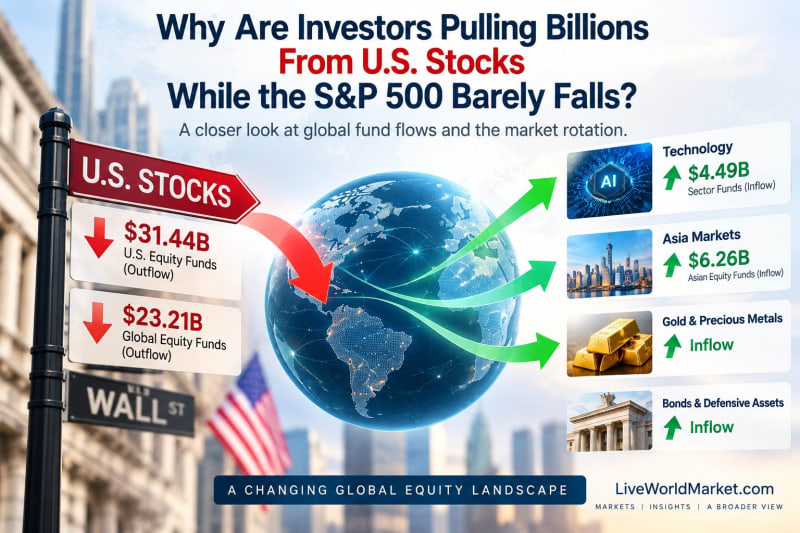
Why Are Investors Pulling Billions From U.S. Stocks While the S&P 500 Barely Falls?
Fundamental · Sep 20, 2026 · 11 min read
Something unusual is happening underneath global stock markets. Investors withdrew $23.21 billion from global equity funds during the week ended September 16, the largest weekly outflow in nine months. The move was even more dramatic in the United States. U.S. equity funds recorded approximately $31.44 billion in withdrawals, marking a fourth consecutive week of outflows. Yet…
Read more...
AI Stocks Rebound After a Brutal Week: Is the Semiconductor Rally Strong Enough to Overcome 5% Treasury Yields?
Fundamental · Sep 19, 2026 · 12 min read
Key Takeaways AI and semiconductor stocks are rebounding, helping support the S&P 500 and Nasdaq after a volatile week. The U.S. 10-year Treasury yield recently crossed 5%, creating a much higher valuation hurdle for growth and technology stocks. AI infrastructure spending remains a major support for chip demand, extending beyond processors into memory, storage, networking and…
Read more...Gold Near $4,400 Despite Fed Rate Hikes: Why Is Gold Rising When Interest Rates Are Going Up?
Commodities & Energy · Sep 18, 2026 · 11 min read
Gold is doing something that may look unusual at first glance. The Federal Reserve has raised interest rates. U.S. Treasury yields remain historically elevated. The U.S. dollar has also been relatively strong. Normally, all three conditions can create pressure on gold. Yet gold has rebounded toward the $4,400-per-ounce area, keeping the precious metal close to historically…
Read more...US 10-Year Treasury Yield Hits 5%: Why Rising Bond Yields Could Be the Next Risk for Global Stocks
Global Markets & Economy · Sep 15, 2026 · 8 min read
The U.S. 10-year Treasury yield has crossed the psychologically important 5% level, putting global bond markets—and increasingly equity investors—on alert. On September 15, the benchmark yield climbed to around 5.03%, its highest level since 2007. The move comes as investors confront a difficult combination of higher oil prices, renewed inflation concerns, expectations of…
Read more...China’s Yuan Near a Four-Year High While Credit Demand Weakens: What It Means for Global Stocks
Global Markets & Economy · Sep 14, 2026 · 13 min read
China is sending global investors two very different economic signals. On one side, the Chinese yuan has strengthened significantly, rising around 4.3% this year and trading close to a four-year high against the U.S. dollar. On the other, China’s latest lending data suggests households and businesses remain cautious about borrowing. Chinese banks extended only 60 billion yuan…
Read more...Europe’s Natural Gas Problem Is Returning: Could Higher Energy Prices Hit European Stocks Again?
News · Sep 14, 2026 · 14 min read
Europe’s energy story is becoming important for financial markets again. For much of the recent market discussion, investors have focused on crude oil, U.S. interest rates and artificial intelligence. But another energy market is quietly becoming more important for Europe: natural gas. European policymakers are becoming increasingly concerned that higher natural gas and…
Read more...US Dollar at a Two-Week High: Why a Strong Dollar Could Become the Next Risk for Global Stocks
News · Sep 14, 2026 · 14 min read
The U.S. dollar is strengthening again, adding another important variable to an already complicated global-market environment. On September 14, the dollar climbed to a two-week high as investors responded to higher inflation expectations, elevated bond yields, geopolitical uncertainty and growing expectations that the U.S. Federal Reserve will raise interest rates this week…
Read more...AI Safety Concerns Hit Global Tech Stocks: Is the AI Rally Entering a More Selective Phase?
News · Sep 14, 2026 · 14 min read
Artificial intelligence has been one of the most powerful investment themes driving global stock markets in recent years. Semiconductor companies, cloud providers, data-centre operators and large technology businesses have invested enormous amounts of capital in the expectation that AI will transform how businesses and consumers use technology. But global markets were reminded…
Read more...Saudi Oil Pipeline Disruption: What It Could Mean for Crude Oil, Inflation and Global Markets
News · Sep 14, 2026 · 12 min read
Global energy markets are facing a fresh supply concern after Saudi Arabia temporarily shut its strategically important East-West oil pipeline following a drone attack. The pipeline matters far beyond Saudi Arabia. It carries crude from the kingdom's eastern production areas across the country to the Red Sea port of Yanbu, giving Saudi Arabia an alternative export route when…
Read more...S&P 500 Near Record Highs While Oil Is Above $100 and Yields Near 5% — Why Aren’t Stocks Falling?
Fundamental · Sep 13, 2026 · 14 min read
On paper, the current environment does not look particularly friendly for stocks. Crude oil is above $100 per barrel. The U.S. 10-year Treasury yield has moved close to 5%. Inflation remains a concern. Markets are debating whether the Federal Reserve could raise interest rates again. Geopolitical uncertainty continues to affect global energy markets. Yet U.S. equities remain…
Read more...