
Vietnam Joins Emerging Markets: Could a $6 Billion FTSE Upgrade Trigger the Next Big Asian Stock-Market Re-Rating?

Vietnam has officially entered a new chapter in its stock-market development.
On September 21, Vietnamese equities joined FTSE Russell's emerging-market indexes, moving the country further into the global institutional investment universe after years of market reforms.
The change may appear technical, but its implications could be much larger.
FTSE Russell estimates that the upgrade could eventually redirect as much as $6 billion into Vietnamese equities as index-tracking funds adjust their portfolios.
And foreign investors are already paying attention.
Overseas investors purchased approximately $104 million of Vietnamese shares during the week before the upgrade, reversing some of the recent selling pressure.
The bigger question is therefore not simply whether Vietnam's stock market rises following the announcement.
It is:
Could Vietnam's upgrade become part of a broader shift in global capital toward Asian equity markets?
That question becomes particularly interesting at a time when investors are dealing with expensive U.S. equities, elevated Treasury yields, oil around $100 and increasingly selective global fund flows.
What Exactly Has Changed for Vietnam?
FTSE Russell has moved Vietnam from its frontier-market classification into its Secondary Emerging Market category.
This puts Vietnam into a broader investment universe alongside established emerging markets such as China and India.
For global investors, index classification matters because trillions of dollars are managed using international benchmarks.
When a country enters a widely followed benchmark, funds tracking that benchmark eventually need exposure to eligible companies in that market.
Vietnam's inclusion will not happen all at once.
FTSE Russell is implementing it in four stages:
September 2026 — 10%
March 2027 — additional 20%
June 2027 — additional 35%
September 2027 — final 35%
The gradual implementation is important.
Rather than creating one enormous inflow event, Vietnam could experience several periods of index-related buying over the next year.
Why Could the Upgrade Bring Billions Into Vietnam?
Consider how passive investing works.
An ETF or index fund attempting to replicate an FTSE emerging-market benchmark needs to hold securities in approximately the same proportions as the benchmark.
When Vietnam becomes part of that benchmark, qualifying Vietnamese companies become part of the investment universe.
This can create what might be described as structural demand.
The fund is not necessarily buying a Vietnamese company because its portfolio manager suddenly believes it is undervalued.
It may need to buy simply because the benchmark has changed.
That distinction is important.
FTSE Russell estimates the reclassification could eventually redirect as much as $6 billion into Vietnamese equities.
Vanguard has also indicated plans to increase its Vietnam exposure to around $2.5 billion over the next several years.
The potential flows therefore extend beyond the first day of index inclusion.
Which Vietnamese Stocks Could Benefit?
The upgrade does not mean every Vietnamese-listed company automatically receives foreign investment.
FTSE identified a group of eligible Vietnamese stocks for its Global All Cap Index.
These include major companies such as:
- Vingroup
- FPT
- Hoa Phat Group
- VPBank
- Vinhomes
Banks, technology companies, property developers and industrial businesses could therefore become increasingly visible to international investors.
But actual flows will depend on index weightings, free float, liquidity and foreign-ownership availability.
That means the upgrade could produce very different outcomes across individual companies.
Why This Story Matters Beyond Vietnam
Vietnam's upgrade arrives at an interesting moment for global asset allocation.
Investors recently pulled billions of dollars from broad U.S. equity funds while continuing to allocate capital toward selected technology sectors and Asian markets.
That suggests investors may be becoming more selective rather than simply abandoning equities.
Vietnam now provides another destination within the Asian investment universe.
Read Why Are Investors Pulling Billions From U.S. Stocks While the S&P 500 Barely Falls? for our analysis of the recent shift in global fund flows.
The combination raises an important possibility:
Could global investors gradually diversify away from concentrated U.S. equity exposure toward a broader range of Asian markets?
Asia Is Already Showing Relative Strength
Asian markets started the week on a positive note.
South Korea's technology-heavy market advanced strongly, while Chinese blue-chip stocks also gained.
The broader MSCI Asia-Pacific index outside Japan moved higher as well.
Artificial-intelligence demand continues to support semiconductor-related companies across the region.
That matters because Asia offers investors exposure to several different structural themes:
Taiwan and South Korea: semiconductors and AI hardware
China: manufacturing, technology and consumer markets
India: domestic growth and services
Vietnam: manufacturing expansion and emerging-market development
Singapore: financial services and regional capital
The region is therefore becoming more than simply a China investment story.
Investors can follow these markets through the LiveWorldMarket Global Indices & Futures Hub.
Vietnam vs India: Similar Classification, Very Different Markets
Vietnam's inclusion in an emerging-market benchmark places it in the same broad classification as India.
But the two markets are very different.
India has a much larger equity market, deeper institutional participation and substantially greater representation in global emerging-market benchmarks.
Vietnam remains considerably smaller and less liquid.
That difference could actually make incremental foreign flows more noticeable in Vietnam.
A few billion dollars entering a smaller market can potentially have a greater impact on liquidity and valuations than the same amount entering a much larger market.
However, smaller markets can also experience greater volatility when those flows reverse.
That makes Vietnam's transition particularly interesting to monitor.
Could Vietnam Become the Next Major Manufacturing Investment Story?
Vietnam's equity-market upgrade also reflects a broader economic transformation.
Over the past decade, the country has become increasingly integrated into global manufacturing supply chains.
Multinational companies have expanded production across electronics, consumer goods and other industries as businesses diversify supply chains across Asia.
This does not mean Vietnam will replace China.
A more realistic trend is the development of increasingly diversified Asian supply chains.
That can create opportunities across:
- manufacturing
- logistics
- industrial parks
- banking
- infrastructure
- technology
- consumer spending
An emerging-market classification could make those themes easier for international portfolio investors to access.
The Upgrade Does Not Remove Vietnam's Market Challenges
An index upgrade should not be interpreted as a guarantee of higher stock prices.
Vietnam still faces several structural challenges.
Foreign Ownership Limits
Some Vietnamese companies have restrictions on how much foreign investors can own.
If foreign ownership limits are already close to capacity, index-related demand may not translate easily into actual purchases.
Limited Free Float
Large shareholders can control substantial portions of certain companies.
That reduces the number of shares available for public trading.
Market Liquidity
Vietnam's market remains much smaller than those of China, India, South Korea or Taiwan.
Large institutional investors need sufficient liquidity to enter and exit positions efficiently.
Market Infrastructure
Vietnam is continuing to modernize its trading, settlement and clearing infrastructure.
A central counterparty clearing mechanism expected in 2027 could become an important next step.
Could MSCI Be the Bigger Prize?
FTSE inclusion may not be the end of Vietnam's market-development story.
Attention could eventually shift toward another major global index provider: MSCI.
An MSCI emerging-market upgrade could potentially have even broader implications because many large international funds benchmark portfolios against MSCI indexes.
However, further reforms would likely be necessary.
Market accessibility, clearing infrastructure, foreign ownership and liquidity remain important considerations.
This creates an interesting longer-term sequence:
FTSE upgrade → increased foreign participation → market reforms → potential MSCI consideration
If Vietnam continues moving through that process, the current upgrade could eventually be viewed as the beginning rather than the end of its global-market integration.
Could Vietnam Challenge Other Asian Markets for Global Capital?
Global investors have limited capital.
Increasing allocations to one market can sometimes reduce allocations elsewhere.
Vietnam will therefore increasingly compete with established Asian destinations including:
- India
- China
- Taiwan
- South Korea
- Indonesia
- Thailand
- Malaysia
Investors will compare these markets using several factors:
Economic growth
Corporate earnings
Valuations
Currency stability
Political and regulatory risk
Market liquidity
Foreign ownership rules
Interest rates
Vietnam does not need to become the largest Asian market to attract meaningful capital.
It only needs to become large and accessible enough to earn a greater allocation within global portfolios.
High U.S. Treasury Yields Could Still Complicate the Story
There is another important factor.
U.S. Treasury yields remain elevated.
When investors can earn attractive yields from relatively low-risk U.S. government bonds, emerging markets need to offer a compelling risk-adjusted return.
This means Vietnam's upgrade is happening in a much more demanding global investment environment.
Read U.S. 10-Year Treasury Yield Hits 5%: Why Rising Bond Yields Could Be the Next Risk for Global Stocks for more on why elevated bond yields are changing global asset allocation.
The competition is no longer simply:
Vietnam vs India vs China.
It can also be:
Emerging-market equities vs U.S. Treasuries yielding around 5%.
That raises the bar for emerging markets.
AI Could Strengthen Asia's Investment Case
Asia also remains central to the global AI supply chain.
South Korea and Taiwan dominate important parts of semiconductor manufacturing and memory.
China is investing heavily in domestic semiconductor capabilities.
Vietnam has been developing its electronics and technology manufacturing ecosystem.
This means global investors considering Asia are increasingly gaining exposure not just to economic growth but also to the physical infrastructure behind the AI boom.
Read AI Stocks vs 5% Treasury Yields: Can the Global Tech Rally Continue? for our analysis of the battle between AI earnings growth and higher interest rates.
Three Scenarios for Vietnam After the Upgrade
Scenario 1: Foreign Capital Accelerates
Index-linked funds enter as scheduled.
Active global investors follow.
Liquidity improves and valuations expand.
Vietnam becomes a more important allocation within Asian and emerging-market portfolios.
Scenario 2: Passive Money Arrives but Active Investors Remain Cautious
Index funds buy because they must follow benchmarks.
But active managers remain concerned about valuations, liquidity, foreign ownership or market infrastructure.
The upgrade generates steady inflows without producing a dramatic re-rating.
Scenario 3: Global Risk Appetite Weakens
If U.S. yields rise further, geopolitical risks increase or global equities enter a significant correction, investors could reduce emerging-market exposure.
In that environment, Vietnam's structural upgrade would remain important, but the immediate market impact could be limited.
What Global Investors Should Watch Next
Vietnam's index level alone will not tell the full story.
The more important indicators include:
- foreign institutional flows into Vietnam
- FTSE implementation tranches
- trading liquidity
- foreign ownership availability
- Vietnamese corporate earnings
- central counterparty clearing reforms
- progress toward possible MSCI inclusion
- Asian equity fund flows
- U.S. Treasury yields
- semiconductor and technology investment across Asia
These indicators should help show whether Vietnam's upgrade is producing a temporary index effect or a more durable change in global capital allocation.
The Bigger Picture: Asia's Investment Map Is Expanding
Vietnam's FTSE upgrade matters because global markets are becoming increasingly fragmented.
Investors are simultaneously dealing with:
expensive U.S. equities
AI-driven technology investment
elevated bond yields
high energy prices
and
shifting global supply chains.
Against that backdrop, investors are searching for new combinations of growth and valuation.
Vietnam now has something it did not previously possess:
formal inclusion in a major emerging-market investment universe.
That does not guarantee a bull market.
But it can change who is able—or required—to own Vietnamese stocks.
And that could ultimately be more important than the market's reaction on the first day.
The real question for global investors is therefore:
Is Vietnam's FTSE upgrade simply an index event, or the beginning of a broader re-rating of one of Asia's fastest-developing equity markets?
The answer will emerge over the next several FTSE inclusion stages through 2027.
Disclaimer: This article is for informational and educational purposes only and does not constitute investment advice or a recommendation to buy or sell any security. Markets, index composition and fund flows can change rapidly.
Comments (0)
Be the first to comment.
About the author

NISM-Series-X-A Investment Adviser Level 1 examination completed
Amit writes about Indian equity markets, technical analysis, macro themes and the day-to-day mechanics of trading, with a focus on making the flow of global markets legible for retail investors. He has completed the NISM-Series-X-A Investment Adviser Level 1 examination.
You May Also Like
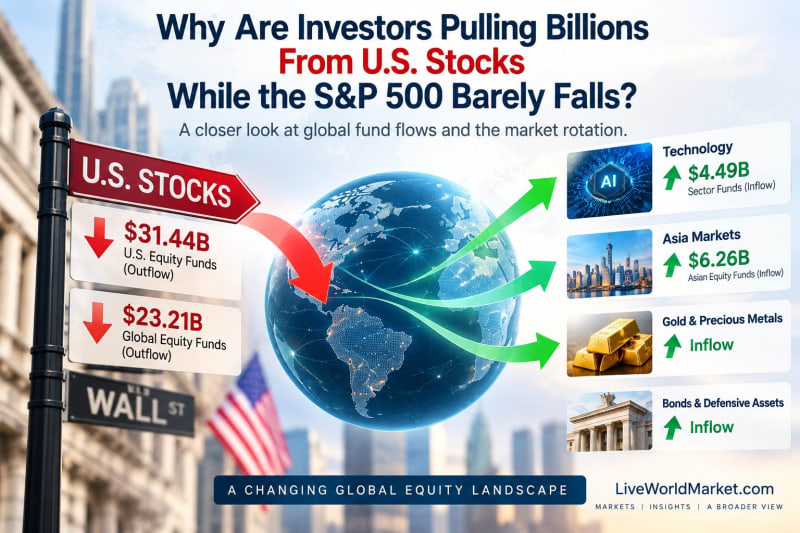
Why Are Investors Pulling Billions From U.S. Stocks While the S&P 500 Barely Falls?
Fundamental · Sep 20, 2026 · 11 min read
Something unusual is happening underneath global stock markets. Investors withdrew $23.21 billion from global equity funds during the week ended September 16, the largest weekly outflow in nine months. The move was even more dramatic in the United States. U.S. equity funds recorded approximately $31.44 billion in withdrawals, marking a fourth consecutive week of outflows. Yet…
Read more...
AI Stocks Rebound After a Brutal Week: Is the Semiconductor Rally Strong Enough to Overcome 5% Treasury Yields?
Fundamental · Sep 19, 2026 · 12 min read
Key Takeaways AI and semiconductor stocks are rebounding, helping support the S&P 500 and Nasdaq after a volatile week. The U.S. 10-year Treasury yield recently crossed 5%, creating a much higher valuation hurdle for growth and technology stocks. AI infrastructure spending remains a major support for chip demand, extending beyond processors into memory, storage, networking and…
Read more...Gold Near $4,400 Despite Fed Rate Hikes: Why Is Gold Rising When Interest Rates Are Going Up?
Commodities & Energy · Sep 18, 2026 · 11 min read
Gold is doing something that may look unusual at first glance. The Federal Reserve has raised interest rates. U.S. Treasury yields remain historically elevated. The U.S. dollar has also been relatively strong. Normally, all three conditions can create pressure on gold. Yet gold has rebounded toward the $4,400-per-ounce area, keeping the precious metal close to historically…
Read more...Fed Signals Rates Could Stay Around 4% Through 2027: Is ‘Higher for Longer’ Becoming a Bigger Risk Than Another Rate Hike?
Central Banks & Rates · Sep 17, 2026 · 8 min read
The Federal Reserve has raised interest rates again, but the latest quarter-point increase may not be the most important message for global financial markets. The bigger issue is how long borrowing costs could remain elevated. On September 16, 2026, the Federal Reserve raised the federal funds target range by 25 basis points to 3.75%–4.00%, marking its first rate increase…
Read more...US 10-Year Treasury Yield Hits 5%: Why Rising Bond Yields Could Be the Next Risk for Global Stocks
Global Markets & Economy · Sep 15, 2026 · 8 min read
The U.S. 10-year Treasury yield has crossed the psychologically important 5% level, putting global bond markets—and increasingly equity investors—on alert. On September 15, the benchmark yield climbed to around 5.03%, its highest level since 2007. The move comes as investors confront a difficult combination of higher oil prices, renewed inflation concerns, expectations of…
Read more...China’s Yuan Near a Four-Year High While Credit Demand Weakens: What It Means for Global Stocks
Global Markets & Economy · Sep 14, 2026 · 13 min read
China is sending global investors two very different economic signals. On one side, the Chinese yuan has strengthened significantly, rising around 4.3% this year and trading close to a four-year high against the U.S. dollar. On the other, China’s latest lending data suggests households and businesses remain cautious about borrowing. Chinese banks extended only 60 billion yuan…
Read more...Europe’s Natural Gas Problem Is Returning: Could Higher Energy Prices Hit European Stocks Again?
News · Sep 14, 2026 · 14 min read
Europe’s energy story is becoming important for financial markets again. For much of the recent market discussion, investors have focused on crude oil, U.S. interest rates and artificial intelligence. But another energy market is quietly becoming more important for Europe: natural gas. European policymakers are becoming increasingly concerned that higher natural gas and…
Read more...US Dollar at a Two-Week High: Why a Strong Dollar Could Become the Next Risk for Global Stocks
News · Sep 14, 2026 · 14 min read
The U.S. dollar is strengthening again, adding another important variable to an already complicated global-market environment. On September 14, the dollar climbed to a two-week high as investors responded to higher inflation expectations, elevated bond yields, geopolitical uncertainty and growing expectations that the U.S. Federal Reserve will raise interest rates this week…
Read more...AI Safety Concerns Hit Global Tech Stocks: Is the AI Rally Entering a More Selective Phase?
News · Sep 14, 2026 · 14 min read
Artificial intelligence has been one of the most powerful investment themes driving global stock markets in recent years. Semiconductor companies, cloud providers, data-centre operators and large technology businesses have invested enormous amounts of capital in the expectation that AI will transform how businesses and consumers use technology. But global markets were reminded…
Read more...Saudi Oil Pipeline Disruption: What It Could Mean for Crude Oil, Inflation and Global Markets
News · Sep 14, 2026 · 12 min read
Global energy markets are facing a fresh supply concern after Saudi Arabia temporarily shut its strategically important East-West oil pipeline following a drone attack. The pipeline matters far beyond Saudi Arabia. It carries crude from the kingdom's eastern production areas across the country to the Red Sea port of Yanbu, giving Saudi Arabia an alternative export route when…
Read more...