
U.S. 10-Year Yield Back Above 5%: Why Strong Growth Is Now a Risk for Stocks
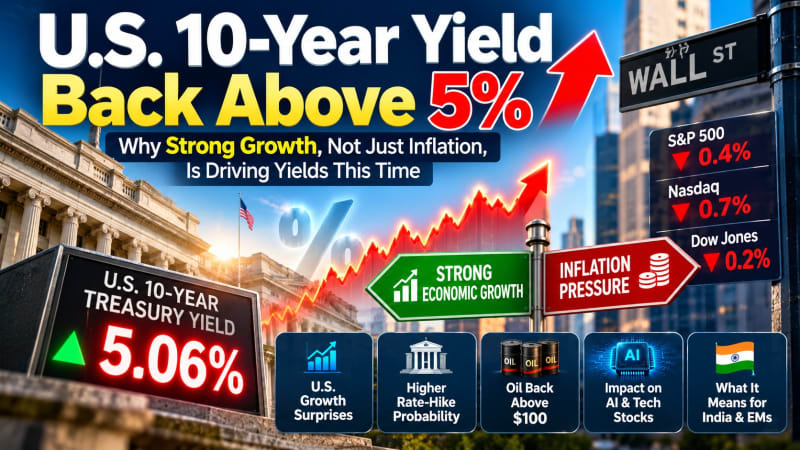
U.S. 10-Year Yield Is Back Above 5%—But This Time Strong Growth Is Driving It: Why That Matters for Stocks
The U.S. 10-year Treasury yield is back above 5%.
Normally, that headline alone would be enough to make equity investors nervous.
But something important is different this time.
Treasury yields are not rising only because investors are worried about inflation, oil prices or government borrowing.
They are also rising because the U.S. economy appears much stronger than expected.
Fresh business-activity data showed the American private sector expanding at its fastest pace in more than five years, while new orders surged and price pressures remained elevated.
That creates an unusual problem for financial markets.
Strong economic growth is normally good for stocks.
But if growth is strong enough to keep inflation elevated and force the Federal Reserve to raise interest rates further, that same economic strength can push bond yields higher and pressure equity valuations.
The key question for investors is therefore changing:
Is a 5% Treasury yield still automatically bad for stocks if strong economic growth is one of the main reasons yields are rising?
The answer could become one of the most important questions for global markets heading into the final quarter of 2026.
Why Did the U.S. 10-Year Treasury Yield Move Above 5% Again?
The latest move followed surprisingly strong U.S. economic data.
The S&P Global Flash U.S. Composite PMI rose to 58.4 in September, up from 56.0 in August.
That was the strongest reading since July 2021.
A reading above 50 indicates economic expansion.
But the details were even more important.
New orders increased sharply across manufacturing and services.
Business backlogs climbed.
Supply constraints became more visible.
And input-price pressures increased.
S&P Global said the survey was consistent with the U.S. economy growing at roughly a 5% annualized pace.
That is an unusually strong growth signal for an economy already dealing with elevated inflation.
The bond market reacted quickly.
The benchmark U.S. 10-year Treasury yield climbed to around 5.05%, reaching its highest level since 2007.
Strong Growth Is Normally Good News. Why Are Stocks Falling?
This is where the current market becomes interesting.
Strong economic activity usually supports:
- consumer spending
- corporate revenue
- employment
- business investment
- earnings growth
All of those can be positive for stocks.
But today's environment is different because inflation remains elevated.
If the economy continues growing rapidly while inflation stays above the Federal Reserve's target, policymakers may conclude that monetary policy is still not restrictive enough.
That creates the following chain:
Strong economic growth
↓
Strong consumer and business demand
↓
Persistent inflation
↓
Higher probability of additional Fed tightening
↓
Higher Treasury yields
↓
Higher discount rates for stocks
So the same economic strength supporting corporate earnings can simultaneously create a valuation problem.
The Difference Between a “Good” and “Bad” Rise in Bond Yields
Not every increase in Treasury yields sends the same message.
This distinction is increasingly important.
A Growth-Driven Yield Increase
Suppose investors expect:
stronger economic growth + higher corporate earnings + resilient employment.
Treasury yields may rise because investors expect the economy to remain strong and interest rates to stay elevated.
This can be uncomfortable for stocks, but stronger earnings can potentially offset some valuation pressure.
An Inflation-Driven Yield Increase
Now imagine:
weak growth + persistent inflation + high oil prices.
Bond yields rise because investors demand compensation for inflation.
This is considerably more difficult for equities because companies face both higher financing costs and weaker economic growth.
A Fiscal-Risk Yield Increase
There is also a third possibility.
Investors could demand higher yields because of concerns about government borrowing, deficits or Treasury supply.
This type of yield increase may offer less benefit to corporate earnings.
Understanding why yields are rising can therefore matter almost as much as the yield itself.
Why 5% Still Matters for Stock Valuations
Even when yields rise for relatively constructive economic reasons, 5% remains an important threshold.
Investors constantly compare potential returns across assets.
When U.S. government bonds offer yields around 5%, the hurdle for owning expensive equities becomes higher.
The choice begins to look like:
Treasury bonds: around 5% yield with comparatively low credit risk
versus
Stocks: potentially greater returns but considerably greater volatility.
Stocks therefore need to offer enough earnings growth to justify the additional risk.
This is particularly important for expensive growth companies.
For the broader mechanics, read U.S. 10-Year Treasury Yield Hits 5%: Why Rising Bond Yields Could Be the Next Risk for Global Stocks.
Why Technology and AI Stocks Are Back in Focus
Technology stocks may be particularly sensitive to another sustained move above 5%.
Many growth companies are valued partly on earnings expected years into the future.
When Treasury yields rise, investors apply a higher discount rate to those future profits.
In simplified terms:
Higher yields → higher discount rate → lower present value of future earnings.
That is normally negative for high-valuation growth stocks.
But AI creates an unusual counterforce.
AI-related companies are producing some of the strongest growth expectations in the global equity market.
The battle therefore becomes:
Higher Treasury yields
versus
Exceptional AI earnings growth.
Read AI Stocks vs 5% Treasury Yields: Can the Global Tech Rally Continue? for our detailed analysis of this relationship.
AI Investment May Actually Be Contributing to Stronger Growth
There is another fascinating part of this story.
AI may not simply be surviving higher interest rates.
The AI investment boom may itself be contributing to the economic strength that is keeping rates high.
Technology companies are spending heavily on:
- data centers
- AI processors
- memory
- networking
- electricity infrastructure
- cooling
- construction
- cloud capacity
That investment creates economic activity.
Chicago Fed President Austan Goolsbee has recently suggested that strong demand—including booming AI investment—could be contributing to broader inflation pressure.
That creates an unusual feedback loop:
AI boom
↓
Higher business investment
↓
Stronger economic growth
↓
More demand and inflation pressure
↓
Higher Fed rates
↓
Higher Treasury yields
↓
Pressure on AI valuations
In other words, the strength of the AI investment boom could indirectly create the higher-rate environment that challenges technology-stock valuations.
AI Agents Could Make This Dynamic Even Stronger
Consumer AI adoption adds another layer.
If AI agents become widely used for search, shopping, travel, productivity and transactions, inference demand could rise sharply.
That would require more computing infrastructure.
The chain becomes:
More AI users → more inference → more data centers → more chips and memory → more capital expenditure.
Read AI Agents Are Becoming the New Catalyst for Chip Stocks: Why Consumer Adoption Could Matter More Than the Next Nvidia Earnings for the consumer-AI side of the story.
The irony is that stronger AI adoption could simultaneously support semiconductor earnings and contribute to an investment boom that keeps economic demand unusually strong.
The Fed Now Faces a Different Inflation Problem
Earlier inflation pressure was heavily associated with supply shocks.
Tariffs increased some import costs.
Higher oil prices increased transportation and energy costs.
Central banks can sometimes look through temporary supply shocks.
But demand-driven inflation is different.
If consumers and businesses are spending too aggressively, higher interest rates are one of the central bank's primary tools for cooling demand.
That is why exceptionally strong economic data can sometimes be bad news for financial markets.
Investors may see strong growth and immediately think:
The Fed may need to do more.
Another Fed Rate Hike Is Back in Focus
The latest economic data has increased expectations that the Federal Reserve could tighten policy again.
Markets are now assigning a substantially higher probability to another rate increase.
That matters because the Federal Reserve has already returned to monetary tightening.
The question is increasingly not simply:
How high will rates go?
It is:
How much economic strength will the Fed tolerate before deciding demand needs to cool?
If the economy continues producing exceptionally strong activity readings while inflation remains elevated, policymakers may have less flexibility to stop tightening.
Oil Above $100 Complicates the Picture
The strong-growth story is not occurring in isolation.
Brent crude has moved back above $100 a barrel as geopolitical uncertainty continues to affect energy markets.
This creates another inflation channel.
The Fed may therefore be dealing with:
Strong domestic demand
plus
High energy costs.
That is more difficult than either problem individually.
Strong demand can keep services inflation elevated.
High oil can raise transportation and production costs.
Together, they can make inflation more persistent.
Read Crude Oil Above $100 a Barrel: What It Means for the Global Economy for the energy side of the inflation story.
Europe Is Seeing a Similar Surprise
The United States is not the only economy showing unexpected resilience.
Euro-zone business activity also accelerated in September.
The region's Composite PMI rose to 53.1, its fastest expansion in more than three years.
That was stronger than economists expected.
But European businesses also reported higher input costs.
This creates a similar dilemma:
Better growth
but also
more inflation pressure.
That could reinforce expectations that the European Central Bank may need to keep monetary policy restrictive.
The broader global story may therefore be changing from:
“Will high rates cause a recession?”
to:
“What happens if economies remain too strong for central banks to cut rates?”
Why This Matters for India and Emerging Markets
A sustained U.S. 10-year yield above 5% has implications far beyond Wall Street.
Global investors compare expected returns across countries.
When U.S. government bonds offer attractive yields, international capital has less incentive to take additional risk in emerging markets.
That can potentially affect:
- foreign institutional flows
- emerging-market currencies
- equity valuations
- borrowing costs
- dollar-denominated debt
India faces another complication.
Oil above $100 can increase India's import bill and inflation pressure.
So India can simultaneously face:
High U.S. yields → competition for global capital
and
High crude oil → pressure on inflation and the rupee.
That makes movements in U.S. Treasury yields particularly important for Indian investors.
A Stronger Dollar Could Become Another Headwind
Higher U.S. yields can also support the dollar.
If investors can earn higher returns on dollar-denominated assets, demand for dollars may increase.
A stronger dollar can create pressure across emerging markets and commodities.
It can also affect U.S. multinational companies by reducing the dollar value of overseas earnings.
This means a strong U.S. economy can transmit tighter financial conditions internationally through both:
Treasury yields
and
the dollar.
Which Stocks Could Handle 5% Yields Better?
Not all companies react equally to high interest rates.
Companies with:
- strong free cash flow
- low debt
- high margins
- pricing power
- reliable earnings growth
may be better positioned to operate in a higher-rate environment.
Highly leveraged companies can face greater pressure because refinancing becomes more expensive.
Similarly, companies valued primarily on profits expected many years in the future can be more sensitive to higher discount rates.
This could make stock selection increasingly important.
The market may gradually shift from:
“Buy growth at almost any valuation”
toward:
“Show me the earnings and cash flow.”
What Does This Mean for the S&P 500?
The S&P 500 now faces two competing forces.
Positive
Strong economic growth can support corporate revenue and earnings.
Negative
Higher Treasury yields can compress valuation multiples.
The outcome depends on which force dominates.
If earnings grow rapidly enough, the market may be able to tolerate yields around 5%.
But if yields continue rising while earnings expectations stop improving, valuations could become harder to justify.
This is why the earnings yield versus Treasury yield comparison may become increasingly important.
Three Scenarios for Global Stocks
Scenario 1: Strong Growth, Inflation Gradually Cools
This would arguably be the most constructive outcome.
Economic growth remains healthy.
Corporate earnings rise.
Inflation gradually declines.
The Fed eventually stops tightening.
Treasury yields stabilize.
Under this scenario, equities could potentially absorb relatively high bond yields.
Scenario 2: Strong Growth Keeps Inflation High
This appears to be the risk markets are increasingly considering.
Demand remains exceptionally strong.
Inflation stays elevated.
The Fed raises rates further.
Treasury yields remain above 5%.
Stocks could continue producing strong earnings but face persistent valuation pressure.
Scenario 3: High Rates Eventually Break Growth
The third scenario is delayed economic weakness.
The Fed continues tightening.
Financing costs rise.
Consumers and businesses eventually reduce spending.
Economic growth slows.
In that environment, Treasury yields could eventually fall—but corporate earnings could weaken as well.
That would create a different challenge for equities.
What Investors Should Watch Next
The 10-year Treasury yield alone does not tell the whole story.
Investors should increasingly watch:
- U.S. Composite PMI
- manufacturing and services activity
- new orders
- inflation data
- Federal Reserve guidance
- U.S. 2-year Treasury yield
- U.S. 10-year Treasury yield
- oil prices
- U.S. Dollar Index
- corporate earnings revisions
- AI capital expenditure
- unemployment
- consumer spending
Together, these indicators can help answer the more important question:
Are yields rising because the economy is healthy—or because inflation and financial risk are becoming more difficult to control?
Readers can track major U.S., Asian, European and Indian markets through the LiveWorldMarket Global Indices & Futures Hub.
The Bigger Picture: Good Economic News Can Become Bad Market News
For years, investors worried that high interest rates would eventually push the U.S. economy into recession.
The latest data presents almost the opposite problem.
The economy may be proving too resilient.
Business activity is expanding rapidly.
AI investment remains strong.
Demand remains robust.
But that strength can keep inflation elevated and reduce the Federal Reserve's ability to stop tightening.
That is why the latest move above 5% in the U.S. 10-year Treasury yield deserves to be viewed differently from previous episodes.
The important question is no longer simply:
“Are 5% Treasury yields bad for stocks?”
It is:
“Can corporate earnings grow fast enough to offset the valuation pressure created by an economy that may be too strong for interest rates to fall?”
If the answer is yes, equities may prove surprisingly resilient.
If the answer is no, strong economic data could continue producing one of the strangest market reactions of the current cycle:
Good news for the economy becoming bad news for stocks.
Related LiveWorldMarket Analysis
U.S. 10-Year Treasury Yield Hits 5%: Why Rising Bond Yields Could Be the Next Risk for Global Stocks
AI Stocks vs 5% Treasury Yields: Can the Global Tech Rally Continue?
AI Agents Are Becoming the New Catalyst for Chip Stocks
Crude Oil Above $100 a Barrel: What It Means for the Global Economy
Disclaimer: This article is for informational and educational purposes only. It does not constitute investment advice or a recommendation to buy or sell any security or financial instrument. Economic data, interest rates and financial markets can change rapidly.
Comments (0)
Be the first to comment.
About the author

NISM-Series-X-A Investment Adviser Level 1 examination completed
Amit writes about Indian equity markets, technical analysis, macro themes and the day-to-day mechanics of trading, with a focus on making the flow of global markets legible for retail investors. He has completed the NISM-Series-X-A Investment Adviser Level 1 examination.
You May Also Like

AI Agents Could Be the Next Catalyst for Semiconductor and Chip Stocks
Technology & Sectors · Sep 23, 2026 · 12 min read
AI Agents Are Becoming the New Catalyst for Chip Stocks: Why Consumer Adoption Could Matter More Than the Next Nvidia Earnings For most of the artificial-intelligence boom, investors have focused on one question: How much will technology companies spend on AI? That question helped drive enormous investment into GPUs, data centers, high-bandwidth memory, networking equipment…
Read more...
Trump-Xi Meeting: What It Could Mean for AI and Semiconductor Stocks
News · Sep 22, 2026 · 11 min read
Trump-Xi Meeting Could Be the Next Big Catalyst for AI and Semiconductor Stocks: What Global Markets Are Watching Artificial intelligence stocks are surging again. The Nasdaq has reached a record closing high, semiconductor stocks have jumped sharply, and enthusiasm around the next wave of AI investment is once again driving global technology markets. But the next major…
Read more...
Vietnam Joins Emerging Markets: Could a $6 Billion FTSE Upgrade Trigger the Next Big Asian Stock-Market Re-Rating?
Global Markets & Economy · Sep 21, 2026 · 9 min read
Vietnam has officially entered a new chapter in its stock-market development. On September 21, Vietnamese equities joined FTSE Russell's emerging-market indexes, moving the country further into the global institutional investment universe after years of market reforms. The change may appear technical, but its implications could be much larger. FTSE Russell estimates that the…
Read more...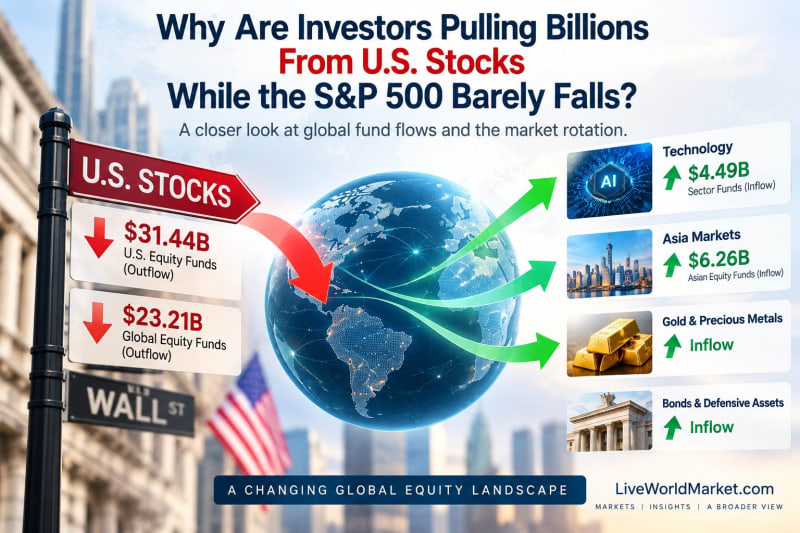
Why Are Investors Pulling Billions From U.S. Stocks While the S&P 500 Barely Falls?
Fundamental · Sep 20, 2026 · 11 min read
Something unusual is happening underneath global stock markets. Investors withdrew $23.21 billion from global equity funds during the week ended September 16, the largest weekly outflow in nine months. The move was even more dramatic in the United States. U.S. equity funds recorded approximately $31.44 billion in withdrawals, marking a fourth consecutive week of outflows. Yet…
Read more...
AI Stocks Rebound After a Brutal Week: Is the Semiconductor Rally Strong Enough to Overcome 5% Treasury Yields?
Fundamental · Sep 19, 2026 · 12 min read
Key Takeaways AI and semiconductor stocks are rebounding, helping support the S&P 500 and Nasdaq after a volatile week. The U.S. 10-year Treasury yield recently crossed 5%, creating a much higher valuation hurdle for growth and technology stocks. AI infrastructure spending remains a major support for chip demand, extending beyond processors into memory, storage, networking and…
Read more...Gold Near $4,400 Despite Fed Rate Hikes: Why Is Gold Rising When Interest Rates Are Going Up?
Commodities & Energy · Sep 18, 2026 · 11 min read
Gold is doing something that may look unusual at first glance. The Federal Reserve has raised interest rates. U.S. Treasury yields remain historically elevated. The U.S. dollar has also been relatively strong. Normally, all three conditions can create pressure on gold. Yet gold has rebounded toward the $4,400-per-ounce area, keeping the precious metal close to historically…
Read more...Fed Signals Rates Could Stay Around 4% Through 2027: Is ‘Higher for Longer’ Becoming a Bigger Risk Than Another Rate Hike?
Central Banks & Rates · Sep 17, 2026 · 8 min read
The Federal Reserve has raised interest rates again, but the latest quarter-point increase may not be the most important message for global financial markets. The bigger issue is how long borrowing costs could remain elevated. On September 16, 2026, the Federal Reserve raised the federal funds target range by 25 basis points to 3.75%–4.00%, marking its first rate increase…
Read more...US 10-Year Treasury Yield Hits 5%: Why Rising Bond Yields Could Be the Next Risk for Global Stocks
Global Markets & Economy · Sep 15, 2026 · 8 min read
The U.S. 10-year Treasury yield has crossed the psychologically important 5% level, putting global bond markets—and increasingly equity investors—on alert. On September 15, the benchmark yield climbed to around 5.03%, its highest level since 2007. The move comes as investors confront a difficult combination of higher oil prices, renewed inflation concerns, expectations of…
Read more...China’s Yuan Near a Four-Year High While Credit Demand Weakens: What It Means for Global Stocks
Global Markets & Economy · Sep 14, 2026 · 13 min read
China is sending global investors two very different economic signals. On one side, the Chinese yuan has strengthened significantly, rising around 4.3% this year and trading close to a four-year high against the U.S. dollar. On the other, China’s latest lending data suggests households and businesses remain cautious about borrowing. Chinese banks extended only 60 billion yuan…
Read more...Europe’s Natural Gas Problem Is Returning: Could Higher Energy Prices Hit European Stocks Again?
News · Sep 14, 2026 · 14 min read
Europe’s energy story is becoming important for financial markets again. For much of the recent market discussion, investors have focused on crude oil, U.S. interest rates and artificial intelligence. But another energy market is quietly becoming more important for Europe: natural gas. European policymakers are becoming increasingly concerned that higher natural gas and…
Read more...