
AI Agents Could Be the Next Catalyst for Semiconductor and Chip Stocks
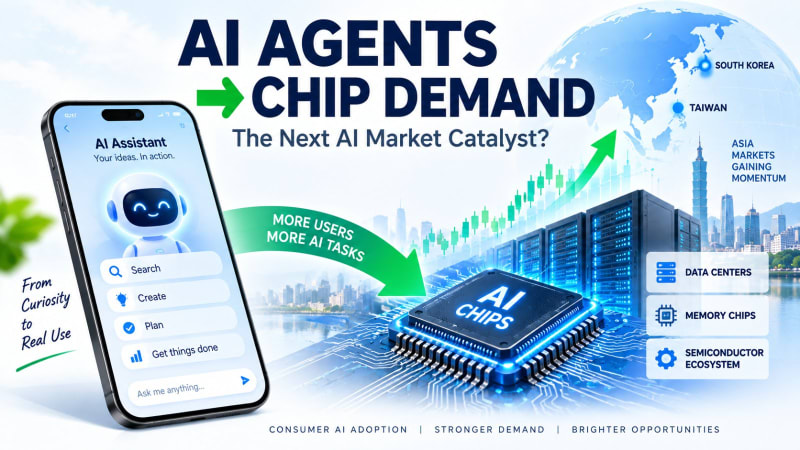
AI Agents Are Becoming the New Catalyst for Chip Stocks: Why Consumer Adoption Could Matter More Than the Next Nvidia Earnings
For most of the artificial-intelligence boom, investors have focused on one question:
How much will technology companies spend on AI?
That question helped drive enormous investment into GPUs, data centers, high-bandwidth memory, networking equipment and cloud infrastructure.
But the AI investment story may now be entering a different phase.
Instead of asking how much companies are spending to build AI, investors are beginning to ask:
How many people will actually use it?
The rapid adoption of a new generation of AI agents is providing an early answer.
Meta's recently launched AI assistant Muse has attracted roughly 2.8 million downloads within its first 12 days, helping renew investor enthusiasm around consumer AI.
The significance goes far beyond Meta.
If millions—or eventually billions—of consumers begin asking AI agents to search, shop, book travel, send emails, make payments and perform everyday tasks, the amount of computing required to run AI could increase dramatically.
That creates a potentially powerful chain:
More AI users → More AI tasks → More inference → More data centers → More AI chips → More memory → More semiconductor investment.
And that may become the next major catalyst for global technology stocks.
AI Is Moving From Curiosity to Everyday Use
Generative AI initially attracted users through relatively simple interactions.
Ask a question.
Generate an image.
Summarize a document.
Write some code.
AI agents represent a potentially much larger shift.
Instead of simply answering questions, agents are increasingly designed to perform tasks on behalf of users.
An AI agent could potentially:
- book flights
- reserve hotels
- purchase products
- send emails
- schedule meetings
- research purchases
- communicate with businesses
- manage repetitive workflows
- complete transactions
That changes the economics of AI.
A chatbot might receive several prompts from a user.
An AI agent completing a complex task may need to execute multiple AI operations behind the scenes.
That potentially means considerably more computing demand per user.
Meta's Muse Is Providing an Early Test
Meta launched its Muse AI assistant on September 8.
The early adoption numbers have attracted Wall Street's attention.
Muse reportedly accumulated approximately 2.8 million downloads in its first 12 days.
The application offers a free version alongside paid subscription tiers for heavier users.
More importantly, Muse is designed to do more than answer questions.
It can perform tasks including sending emails, arranging travel and helping execute transactions.
Meta is also experimenting with capabilities allowing the agent to make phone calls on behalf of users.
That moves AI much closer to the concept of a genuine digital assistant.
The market reaction has been significant.
Meta shares have risen more than 20% since Muse launched, adding roughly $200 billion in market value.
But the bigger question for global markets is not whether Meta's share price continues rising.
It is whether Muse represents the beginning of mass consumer adoption of AI agents.
Why AI Agents Could Matter More Than Another Model Upgrade
For investors, the difference between better AI models and broader AI usage is important.
A more powerful model demonstrates technological progress.
But widespread usage creates economic demand.
Consider smartphones.
The investment opportunity did not come simply from building better mobile processors.
It came from billions of people using smartphones every day.
That created demand across:
- processors
- memory
- displays
- mobile networks
- cloud infrastructure
- software
- payments
- digital advertising
- e-commerce
AI agents could potentially create a similar ecosystem.
The more frequently consumers delegate tasks to AI, the greater the amount of computing infrastructure required behind those services.
That is why consumer adoption could ultimately matter more to semiconductor demand than another benchmark showing that an AI model has become slightly more capable.
The AI Investment Story Is Moving From Training to Inference
This distinction is critical.
Training
AI companies require enormous computing resources to train large models.
This drove the first major wave of demand for advanced GPUs.
Inference
Inference happens when users actually interact with those trained models.
Every question, generated image, AI search and agentic task requires computing resources.
As AI adoption expands, inference could become an increasingly important driver of infrastructure demand.
AI agents could accelerate this transition because they may perform multiple steps for a single user request.
For example:
“Plan and book my business trip.”
That apparently simple instruction could require the AI to:
- understand the user's preferences
- search flight options
- compare hotels
- evaluate schedules
- check prices
- complete transactions
- update calendars
- send confirmations
One consumer request could therefore create many individual AI operations.
Multiply that by hundreds of millions of users and the infrastructure implications become much larger.
Why This Matters for AI Chip Stocks
AI applications ultimately run on physical infrastructure.
Behind every AI assistant sits a chain of technology:
AI applications
↓
cloud computing
↓
data centers
↓
GPUs and AI accelerators
↓
high-bandwidth memory
↓
networking
↓
semiconductor manufacturing
That means strong consumer AI adoption could support demand across the semiconductor ecosystem.
The beneficiaries may extend far beyond one company.
Potentially affected areas include:
- AI accelerators
- GPUs
- CPUs
- high-bandwidth memory
- DRAM
- networking chips
- storage
- semiconductor equipment
- advanced packaging
This helps explain why consumer AI enthusiasm can quickly translate into higher semiconductor stocks.
South Korea Is Becoming One of the Biggest AI Infrastructure Winners
One of the clearest examples is South Korea.
South Korea is home to Samsung Electronics and SK hynix, two of the world's most important memory-chip manufacturers.
SK hynix has become particularly important because of high-bandwidth memory, or HBM.
HBM allows enormous amounts of data to move rapidly between memory and AI processors.
That makes it critical for advanced AI computing.
As AI workloads increase, demand for HBM can increase as well.
On September 23, both Samsung Electronics and SK hynix gained more than 2% as Asian technology stocks extended their rally.
South Korea's KOSPI also advanced as investors continued increasing exposure to AI-linked companies.
Read AI Stocks Rebound After a Brutal Week: Is the Semiconductor Rally Strong Enough to Overcome 5% Treasury Yields? for our analysis of the semiconductor side of the AI investment cycle.
Taiwan Remains Critical to the AI Supply Chain
Taiwan is another major beneficiary of the AI infrastructure boom.
The island occupies a critical position in advanced semiconductor manufacturing.
As demand for AI computing increases, advanced manufacturing capacity becomes increasingly valuable.
This is why the AI investment story extends far beyond Silicon Valley.
A consumer using an AI agent in New York or London could indirectly create demand across a global technology chain involving:
U.S. AI companies
→ Taiwanese chip manufacturing
→ South Korean memory
→ global semiconductor equipment
→ data centers around the world.
Investors can follow Taiwan, South Korea, Japan, China, the United States and other major markets through the LiveWorldMarket Global Indices & Futures Hub.
Memory Could Become One of the Most Important AI Trades
GPUs receive most of the attention in the AI boom.
Memory may become increasingly important.
AI systems need enormous amounts of memory to process data efficiently.
The growing demand for AI servers has already changed the economics of the memory industry.
SK hynix's early investment in HBM helped transform the company into one of the biggest beneficiaries of the AI boom.
China is also expanding its memory ambitions.
Chinese semiconductor manufacturer CXMT is reportedly exploring expansion into NAND flash memory as AI-server demand tightens global memory supply.
That suggests AI is increasingly affecting multiple parts of the semiconductor industry rather than just advanced processors.
Consumer AI Could Help Answer the $1 Trillion Question
AI infrastructure spending has reached extraordinary levels.
Technology companies are investing heavily in:
- AI chips
- data centers
- electricity
- networking
- cloud capacity
- memory
Investors have repeatedly asked whether those enormous expenditures will eventually generate sufficient returns.
Consumer AI adoption could provide part of the answer.
If billions of consumers eventually use AI assistants every day, companies may have multiple opportunities to monetize those interactions.
Potential revenue models include:
Subscriptions
Premium AI assistants could charge monthly fees.
Advertising
AI recommendations could become another channel for targeted advertising.
Commerce
Agents could earn transaction or referral fees when consumers purchase products.
Enterprise services
Businesses could pay for agents that automate workflows.
Payments
AI agents could become intermediaries between consumers, banks and merchants.
That is why the next phase of the AI rally may depend less on how much companies spend and more on whether AI produces sustainable revenue.
The AI Monetization Chain
The emerging investment thesis can be summarized as:
Consumer adoption
↓
AI engagement
↓
Subscriptions + commerce + advertising
↓
More inference workloads
↓
Greater cloud demand
↓
More data-center capacity
↓
More GPUs + memory + networking
↓
Higher semiconductor demand
If this chain develops successfully, the AI infrastructure boom could have a much stronger economic foundation.
If consumer adoption stalls, questions about excessive AI capital spending could return quickly.
Why This Is Different From the First AI Rally
The first phase of the AI rally was largely driven by expectations.
Investors believed generative AI would transform technology.
The second phase was driven by infrastructure.
Technology companies began spending hundreds of billions of dollars building AI capacity.
The third phase may increasingly be about usage and monetization.
That is a much more demanding test.
Investors will want evidence that consumers and businesses are actually using AI enough to justify enormous infrastructure spending.
Muse's rapid early adoption is therefore interesting not simply because it benefits Meta.
It could provide an early indication that AI agents are becoming mainstream consumer products.
Google, OpenAI and Others Could Accelerate the Agent Race
Meta will not have the consumer AI-agent market to itself.
Major technology companies are developing increasingly capable AI assistants and agentic systems.
Competition could accelerate adoption.
Each company will attempt to make AI more useful for everyday tasks.
That could produce a cycle similar to previous technology-platform battles:
Better agents → more users → more AI tasks → more infrastructure demand.
The winners may not necessarily be limited to whichever company builds the most popular assistant.
The companies providing the underlying computing infrastructure could benefit regardless of which consumer platform ultimately leads.
This is one reason semiconductor companies remain central to the AI investment story.
But AI Agents Introduce New Risks
Rapid adoption does not eliminate risk.
AI agents potentially interact with much more sensitive information than traditional chatbots.
They may access:
- payment details
- travel information
- shopping histories
- personal preferences
- calendars
- financial accounts
Banks are already raising concerns about AI shopping agents and the potential for fraud, scams and privacy problems.
If an AI agent purchases something incorrectly, exposes personal information or makes a fraudulent transaction, responsibility may not always be clear.
These issues could eventually lead to greater regulation.
That creates an important counterweight to the bullish adoption story.
Higher Interest Rates Still Matter
The AI rally is also taking place against an unusual macroeconomic backdrop.
The U.S. two-year Treasury yield has moved toward 4.8%, while markets continue to consider the possibility of another Federal Reserve rate increase.
Higher rates matter because they increase the discount rate applied to future technology earnings.
They also give investors an alternative to expensive growth stocks.
This creates a continuing battle:
AI growth expectations vs high interest rates.
Read AI Stocks vs 5% Treasury Yields: Can the Global Tech Rally Continue? for a deeper look at that valuation challenge.
Oil Below $100 Removes One Pressure—For Now
Another factor has recently become slightly more supportive.
Brent crude has moved below the $100-per-barrel level as investors assess the possibility of additional Middle Eastern supply.
Lower oil prices can reduce inflation pressure.
That can help bond markets and growth-stock valuations.
But the geopolitical situation remains uncertain, meaning energy prices could remain volatile.
The combination of softer oil and continued AI enthusiasm has helped technology remain one of the strongest areas of global equity markets.
The Trump-Xi Meeting Adds Another Layer
AI investors also need to watch geopolitics.
The upcoming meeting between U.S. President Donald Trump and Chinese President Xi Jinping could influence the outlook for semiconductor export restrictions, AI policy and global technology supply chains.
Read Trump-Xi Meeting Could Be the Next Big Catalyst for AI and Semiconductor Stocks: What Global Markets Are Watching for our detailed analysis.
This means the AI market is currently being influenced by three major forces simultaneously:
Consumer adoption
Interest rates
Geopolitics
The interaction between those forces could determine the next stage of the technology rally.
Three Scenarios for the AI-Agent Boom
Scenario 1: AI Agents Become Mainstream
Consumer adoption accelerates rapidly.
AI agents become part of everyday search, shopping, communication and productivity.
Inference demand increases dramatically.
Potential implication: data-center, semiconductor, memory and networking investment remains strong.
Scenario 2: Adoption Grows but Monetization Is Slow
Consumers use AI agents, but most remain on free services.
Technology companies struggle to convert usage into meaningful profits.
Potential implication: chip demand could remain strong initially, but investors may become more skeptical about long-term AI capital expenditure.
Scenario 3: Privacy and Trust Slow Adoption
Security problems, fraud, inaccurate transactions or regulatory restrictions reduce consumer confidence.
AI agents remain useful but fail to achieve mass adoption.
Potential implication: infrastructure expectations could eventually be revised lower.
What Investors Should Watch Next
The most important AI indicators may therefore begin changing.
Instead of watching only GPU shipments and data-center spending, investors should increasingly monitor:
- AI-agent downloads
- monthly active users
- paid subscriptions
- AI-generated transactions
- inference volumes
- data-center utilization
- HBM demand
- memory pricing
- semiconductor capital expenditure
- cloud revenue growth
- AI-related advertising and commerce revenue
These indicators could reveal whether AI infrastructure investment is translating into real consumer economic activity.
The Bigger Picture: AI Needs Users, Not Just Chips
The AI boom has already demonstrated that technology companies are willing to spend enormous amounts of money building artificial-intelligence infrastructure.
The next challenge is proving that people will use it.
That is why the rapid rise of consumer AI agents could represent an important turning point.
If AI moves from something people occasionally experiment with to something they rely on every day, the infrastructure requirements could be enormous.
More users mean more queries.
More complex agents mean more computing.
More computing means more data centers.
More data centers mean more processors, memory and networking.
The next major semiconductor catalyst therefore may not come from the next Nvidia earnings report.
It may come from something much simpler:
Millions of ordinary people deciding that AI agents are useful enough to become part of everyday life.
And if that adoption continues accelerating, the AI chip boom could have a much longer runway than markets currently expect.
Related LiveWorldMarket Analysis
AI Stocks vs 5% Treasury Yields: Can the Global Tech Rally Continue?
AI Stocks Rebound: Is the Semiconductor Rally Strong Enough to Overcome 5% Treasury Yields?
Trump-Xi Meeting: What Global AI and Semiconductor Investors Are Watching
Disclaimer: This article is for informational and educational purposes only. It does not constitute investment advice or a recommendation to buy or sell any security. Technology trends, company performance and financial markets can change rapidly.
Comments (0)
Be the first to comment.
About the author

NISM-Series-X-A Investment Adviser Level 1 examination completed
Amit writes about Indian equity markets, technical analysis, macro themes and the day-to-day mechanics of trading, with a focus on making the flow of global markets legible for retail investors. He has completed the NISM-Series-X-A Investment Adviser Level 1 examination.
You May Also Like

U.S. 10-Year Yield Back Above 5%: Why Strong Growth Is Now a Risk for Stocks
Fundamental · Sep 24, 2026 · 12 min read
U.S. 10-Year Yield Is Back Above 5%—But This Time Strong Growth Is Driving It: Why That Matters for Stocks The U.S. 10-year Treasury yield is back above 5%. Normally, that headline alone would be enough to make equity investors nervous. But something important is different this time. Treasury yields are not rising only because investors are worried about inflation, oil prices…
Read more...
Trump-Xi Meeting: What It Could Mean for AI and Semiconductor Stocks
News · Sep 22, 2026 · 11 min read
Trump-Xi Meeting Could Be the Next Big Catalyst for AI and Semiconductor Stocks: What Global Markets Are Watching Artificial intelligence stocks are surging again. The Nasdaq has reached a record closing high, semiconductor stocks have jumped sharply, and enthusiasm around the next wave of AI investment is once again driving global technology markets. But the next major…
Read more...
Vietnam Joins Emerging Markets: Could a $6 Billion FTSE Upgrade Trigger the Next Big Asian Stock-Market Re-Rating?
Global Markets & Economy · Sep 21, 2026 · 9 min read
Vietnam has officially entered a new chapter in its stock-market development. On September 21, Vietnamese equities joined FTSE Russell's emerging-market indexes, moving the country further into the global institutional investment universe after years of market reforms. The change may appear technical, but its implications could be much larger. FTSE Russell estimates that the…
Read more...
Why Are Investors Pulling Billions From U.S. Stocks While the S&P 500 Barely Falls?
Fundamental · Sep 20, 2026 · 11 min read
Something unusual is happening underneath global stock markets. Investors withdrew $23.21 billion from global equity funds during the week ended September 16, the largest weekly outflow in nine months. The move was even more dramatic in the United States. U.S. equity funds recorded approximately $31.44 billion in withdrawals, marking a fourth consecutive week of outflows. Yet…
Read more...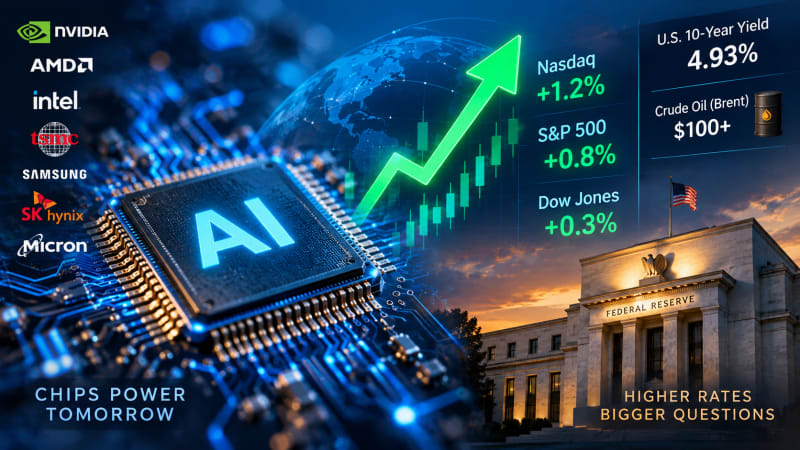
AI Stocks Rebound After a Brutal Week: Is the Semiconductor Rally Strong Enough to Overcome 5% Treasury Yields?
Fundamental · Sep 19, 2026 · 12 min read
Key Takeaways AI and semiconductor stocks are rebounding, helping support the S&P 500 and Nasdaq after a volatile week. The U.S. 10-year Treasury yield recently crossed 5%, creating a much higher valuation hurdle for growth and technology stocks. AI infrastructure spending remains a major support for chip demand, extending beyond processors into memory, storage, networking and…
Read more...Gold Near $4,400 Despite Fed Rate Hikes: Why Is Gold Rising When Interest Rates Are Going Up?
Commodities & Energy · Sep 18, 2026 · 11 min read
Gold is doing something that may look unusual at first glance. The Federal Reserve has raised interest rates. U.S. Treasury yields remain historically elevated. The U.S. dollar has also been relatively strong. Normally, all three conditions can create pressure on gold. Yet gold has rebounded toward the $4,400-per-ounce area, keeping the precious metal close to historically…
Read more...Fed Signals Rates Could Stay Around 4% Through 2027: Is ‘Higher for Longer’ Becoming a Bigger Risk Than Another Rate Hike?
Central Banks & Rates · Sep 17, 2026 · 8 min read
The Federal Reserve has raised interest rates again, but the latest quarter-point increase may not be the most important message for global financial markets. The bigger issue is how long borrowing costs could remain elevated. On September 16, 2026, the Federal Reserve raised the federal funds target range by 25 basis points to 3.75%–4.00%, marking its first rate increase…
Read more...US 10-Year Treasury Yield Hits 5%: Why Rising Bond Yields Could Be the Next Risk for Global Stocks
Global Markets & Economy · Sep 15, 2026 · 8 min read
The U.S. 10-year Treasury yield has crossed the psychologically important 5% level, putting global bond markets—and increasingly equity investors—on alert. On September 15, the benchmark yield climbed to around 5.03%, its highest level since 2007. The move comes as investors confront a difficult combination of higher oil prices, renewed inflation concerns, expectations of…
Read more...China’s Yuan Near a Four-Year High While Credit Demand Weakens: What It Means for Global Stocks
Global Markets & Economy · Sep 14, 2026 · 13 min read
China is sending global investors two very different economic signals. On one side, the Chinese yuan has strengthened significantly, rising around 4.3% this year and trading close to a four-year high against the U.S. dollar. On the other, China’s latest lending data suggests households and businesses remain cautious about borrowing. Chinese banks extended only 60 billion yuan…
Read more...Europe’s Natural Gas Problem Is Returning: Could Higher Energy Prices Hit European Stocks Again?
News · Sep 14, 2026 · 14 min read
Europe’s energy story is becoming important for financial markets again. For much of the recent market discussion, investors have focused on crude oil, U.S. interest rates and artificial intelligence. But another energy market is quietly becoming more important for Europe: natural gas. European policymakers are becoming increasingly concerned that higher natural gas and…
Read more...