
AI Is Reviving Asia's Factories: Is Global Manufacturing Finally Turning?
AI Is Reviving Asia’s Factories: Is the Global Manufacturing Cycle Finally Turning?
For the past few years, artificial intelligence has primarily been viewed as a technology and stock-market story.
AI stocks surged. Semiconductor companies expanded production. Technology giants committed hundreds of billions of dollars to data centres and computing infrastructure.
Now something more important may be happening.
AI demand is beginning to appear in the real manufacturing economy.
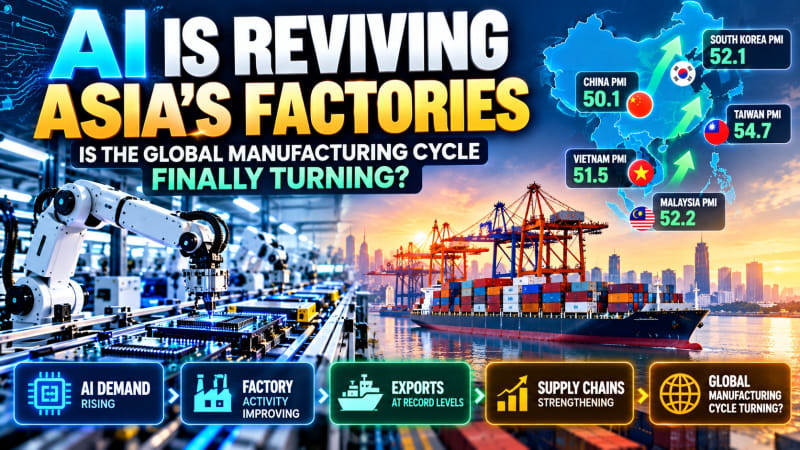
Fresh September manufacturing data across Asia show improving factory activity in several of the world's most important technology-exporting economies. South Korea and Taiwan are particularly notable, while China, Vietnam and Malaysia are also showing signs of stronger manufacturing activity.
At the same time, South Korea has reported record exports supported by extraordinary semiconductor demand.
The emerging chain is becoming increasingly visible:
AI adoption → data-centre investment → chip and memory demand → Asian factory production → exports → electricity and infrastructure investment.
That raises a much bigger question:
Could the AI boom become powerful enough to help start a new global manufacturing cycle?
Asia's Factories Are Starting to Accelerate
September manufacturing surveys provide an encouraging signal.
Several important Asian manufacturing economies reported purchasing managers' indices above the crucial 50 level, which generally separates expansion from contraction.
South Korea's manufacturing PMI climbed to around 52.1, its strongest level since early 2022.
Taiwan's manufacturing PMI reached approximately 54.7, also its strongest reading in several years.
Manufacturing conditions also improved across other parts of Asia.
This matters because Asia sits at the centre of the global technology supply chain.
South Korea supplies advanced memory.
Taiwan manufactures leading-edge semiconductors.
Japan produces critical semiconductor equipment and materials.
China has enormous electronics and industrial manufacturing capacity.
Vietnam and Malaysia are increasingly important electronics and supply-chain hubs.
When factory activity improves simultaneously across several of these economies, it can provide an early signal that the broader technology-manufacturing cycle is strengthening.
AI Is Becoming a Real-Economy Story
The AI boom initially appeared in financial markets.
Investors bought semiconductor and technology stocks based on expectations of enormous future AI demand.
Then came the second phase:
Capital expenditure.
Technology companies began spending enormous amounts on:
- AI processors
- data centres
- cloud infrastructure
- high-bandwidth memory
- networking
- electricity infrastructure
Now the third phase is becoming increasingly visible:
physical production.
Factories need to manufacture the chips.
Memory needs to be produced.
Servers need to be assembled.
Data centres need to be constructed.
Electricity infrastructure needs to be expanded.
AI therefore increasingly looks less like a purely digital revolution and more like a global industrial investment cycle.
South Korea Is Providing Some of the Strongest Evidence
South Korea has become one of the clearest indicators of the physical AI economy.
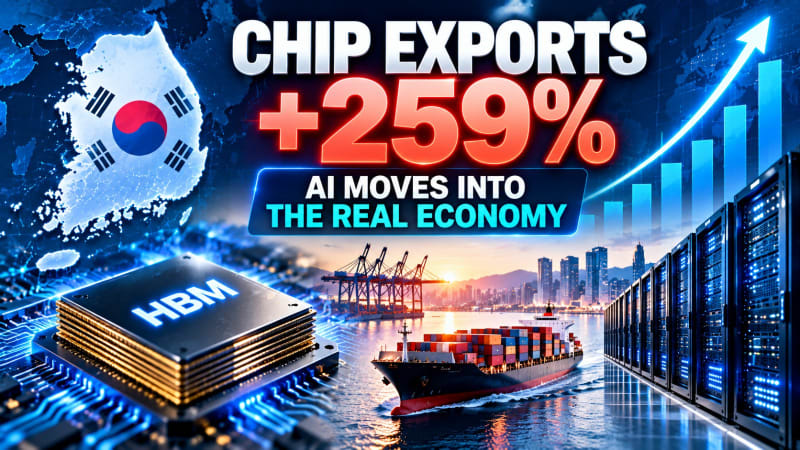
Official September trade data show exports reaching record levels, with semiconductor shipments playing a major role.
This follows extraordinary preliminary data showing semiconductor exports surging during the first 20 days of September.
South Korea matters because it is home to two of the world's most important memory manufacturers:
Samsung Electronics and SK hynix.
Both companies are deeply connected to the AI infrastructure boom.
SK hynix has become particularly important because of high-bandwidth memory, or HBM.
HBM sits next to advanced AI processors and allows huge amounts of data to move rapidly through AI computing systems.
Without sufficiently fast memory, increasingly powerful AI processors cannot operate efficiently.
That means every new wave of AI computing demand can create additional demand for Korean memory production.
Read our detailed analysis: South Korea's Chip Exports Are Surging 259%: Is the AI Boom Finally Spreading From Stock Prices Into the Real Economy?
Taiwan Is Another Critical Signal
Taiwan's improving manufacturing activity is equally important.
Taiwan sits at the centre of global advanced semiconductor manufacturing.
Many of the world's most sophisticated AI processors ultimately depend on Taiwanese manufacturing capacity.
That means stronger Taiwanese factory activity can provide another clue about the health of the global electronics cycle.
The AI supply chain increasingly looks like this:
U.S. AI platforms and chip designers
↓
Taiwan advanced semiconductor manufacturing
↓
South Korean HBM and memory
↓
Japanese semiconductor equipment
↓
Asian electronics manufacturing
↓
Global data centres
The extraordinary feature of AI is that a software application used by someone in the United States, India or Europe can ultimately create manufacturing demand across multiple Asian economies.
Memory Demand Is Becoming a Critical AI Indicator
One of the clearest signs that demand is real comes from the memory industry.
AI computing requires enormous amounts of high-performance memory.
The more powerful AI systems become, the more important memory becomes.
This is creating tight supply conditions across parts of the industry.
Memory producers are increasingly securing long-term supply agreements with major customers.
That matters because long-term commitments suggest customers are not simply ordering chips for short-term inventory.
They are attempting to secure future capacity.
That provides stronger evidence that companies expect AI infrastructure demand to remain elevated.
AI Is Creating a New Manufacturing Chain
The traditional manufacturing cycle was often driven by products such as:
smartphones → PCs → automobiles → consumer electronics.
AI adds a completely new source of demand.
Consider what happens when millions of additional consumers begin using AI services.
More AI users create more inference requests.
More inference requires additional computing.
Additional computing requires more processors.
Those processors require more memory.
More processors and memory require more servers.
More servers require more data centres.
More data centres require more electricity.
The chain becomes:
AI USERS
↓
AI INFERENCE
↓
COMPUTING DEMAND
↓
SEMICONDUCTORS
↓
SERVERS
↓
DATA CENTRES
↓
ELECTRICITY
↓
FACTORY & INFRASTRUCTURE INVESTMENT
That is why AI could potentially influence manufacturing far beyond the semiconductor sector.
The $126 Billion AI Infrastructure Boom Supports the Thesis
Capital markets are already financing this physical expansion.
Asia-Pacific high-technology companies have raised roughly $126 billion through equity and convertible-bond transactions this year.
Capital is increasingly being directed toward:
- semiconductors
- memory
- data centres
- networking
- cloud infrastructure
- electricity systems
This suggests investors are financing the physical infrastructure required to support future AI demand.
Read The AI Boom Is Entering a New Phase: $126 Billion Is Pouring Into Chips, Data Centres and Power for our deeper analysis.
The connection between the two stories is important.
Capital raised today becomes factories and infrastructure tomorrow.
Those factories create production.
Production becomes exports.
Exports support economic activity.
The AI capital cycle is therefore beginning to feed into the manufacturing cycle.
China Adds Another Dimension
China's latest manufacturing data also deserve attention.
The country's manufacturing activity has shown signs of stabilization even while the broader economy remains uneven.
This reinforces the idea that China increasingly has two different economic stories occurring simultaneously.
Traditional sectors such as property continue facing significant challenges.
Meanwhile, AI, electronics, advanced manufacturing and technology investment remain considerably stronger.
That creates a potential new source of industrial demand inside Asia.
China is investing heavily in:
- domestic AI processors
- semiconductor manufacturing
- memory
- cloud computing
- robotics
- data centres
- advanced manufacturing
Read China's Economy Is Splitting in Two: AI Profits Are Surging While Traditional Industries Struggle for our analysis of this structural shift.
Vietnam and Malaysia Could Benefit From Supply-Chain Diversification
AI manufacturing is not limited to the region's largest economies.
Vietnam and Malaysia have become increasingly important components of the global electronics supply chain.
Multinational companies have spent years diversifying production beyond China.
This strategy is often described as China+1.
Vietnam has attracted investment in electronics assembly and manufacturing.
Malaysia already plays an important role in semiconductor assembly, testing and data-centre infrastructure.
If the global electronics cycle continues strengthening, these economies could benefit from both:
AI demand
and
supply-chain diversification.
That means the AI manufacturing cycle could become geographically broader than previous semiconductor booms.
Could AI Start a New Global Manufacturing Cycle?
This is the central question.
Manufacturing cycles typically strengthen when businesses need to rebuild inventories and invest in new capacity.
AI potentially provides both.
Technology companies need enormous amounts of computing equipment.
Data-centre operators need servers.
Semiconductor companies need new fabrication capacity.
Utilities need additional generation and grid infrastructure.
This creates a powerful investment loop:
Strong AI demand
↓
More equipment orders
↓
Higher factory utilisation
↓
More capital expenditure
↓
More manufacturing
↓
Higher exports
↓
Additional industrial investment
If that cycle becomes self-reinforcing, AI could help drive a broader manufacturing recovery.
But This Is Not Yet a Full Global Manufacturing Boom
There is an important distinction.
Evidence of improvement across Asian technology manufacturing does not necessarily mean the entire global industrial economy has entered a new boom.
Several traditional industries remain weak.
Property remains a significant problem in China.
European manufacturing continues facing structural challenges.
High interest rates are raising financing costs.
Energy prices remain elevated.
Consumer demand is uneven.
The current evidence therefore points more clearly toward:
an AI-led manufacturing recovery
rather than
a broad global manufacturing boom.
That distinction is important.
AI Could Create a Two-Speed Global Manufacturing Economy
Something similar to China's two-speed economy could eventually emerge globally.
AI-linked industries
Potentially stronger:
- semiconductors
- memory
- data centres
- networking
- electrical equipment
- cooling systems
- advanced manufacturing
Traditional industries
Potentially weaker:
- property-linked manufacturing
- selected consumer goods
- industries facing excess capacity
- highly interest-rate-sensitive sectors
This means headline manufacturing numbers may become increasingly difficult to interpret.
Investors may need to look beneath the aggregate data.
Electricity Could Become the Next Manufacturing Bottleneck
The AI manufacturing boom does not end with semiconductors.
Every data centre needs electricity.
And electricity infrastructure is much slower to build than computing infrastructure.
AI therefore creates demand for:
- transformers
- switchgear
- transmission equipment
- generators
- battery storage
- renewable energy
- natural gas infrastructure
- nuclear power
This could transform AI from a technology-manufacturing story into a much broader industrial cycle.
The next major AI bottleneck may therefore not be processors.
It could be power availability.
Why This Matters for Commodities
A stronger AI infrastructure cycle could also change commodity demand.
Traditional Chinese industrial growth was closely associated with steel, iron ore and construction materials.
The AI infrastructure economy has a different commodity profile.
It requires substantial amounts of:
- copper
- aluminium
- electricity
- specialised metals
- construction materials
Copper could be particularly important because data centres and power-grid upgrades require large amounts of electrical infrastructure.
That means AI could eventually become an important marginal source of demand for industrial commodities.
Why This Matters for India
India could benefit from several parts of this cycle.
The country is rapidly expanding:
- data centres
- cloud computing
- electronics manufacturing
- digital infrastructure
- power generation
- transmission capacity
- semiconductor assembly ambitions
India may not yet manufacture advanced AI processors at the scale of Taiwan or memory at the scale of South Korea.
But it does not need to dominate those industries to participate in the AI infrastructure cycle.
India's opportunity could sit in:
Data centres
Power infrastructure
Electronics manufacturing
Cloud services
Semiconductor packaging
Enterprise AI
If AI continues spreading into the physical economy, India could become increasingly important as both a consumer and builder of AI infrastructure.
High Bond Yields Remain the Biggest Macro Test
There is still a major obstacle.
The global manufacturing recovery is developing while interest rates remain unusually high.
U.S. Treasury yields are near multi-decade highs.
Higher rates increase financing costs for:
- factories
- data centres
- utilities
- semiconductor plants
- infrastructure projects
That means AI demand needs to be strong enough to justify investment despite expensive capital.
Read U.S. 10-Year Yield Back Above 5%: Why Strong Growth Is Now a Risk for Stocks for our analysis of the high-rate environment.
This creates one of the most important macroeconomic tensions:
AI is encouraging companies to invest more.
At the same time:
high interest rates are making investment more expensive.
Which force wins could determine how far the manufacturing recovery extends.
What Would Confirm a Real Manufacturing Turn?
One month of strong data is not enough.
A sustainable global manufacturing recovery would require confirmation from several indicators.
Investors should watch:
- South Korea semiconductor exports
- Taiwan manufacturing PMI
- global semiconductor sales
- memory prices
- semiconductor equipment orders
- Asian export growth
- China manufacturing PMI
- European manufacturing PMI
- U.S. ISM manufacturing
- new export orders
- global freight volumes
- data-centre construction
- industrial electricity demand
If these indicators begin strengthening simultaneously, the case for a broader manufacturing recovery would become much stronger.
Three Possible Scenarios
Scenario 1: AI Starts a Broader Manufacturing Upswing
AI demand remains strong.
Semiconductor exports continue rising.
Data-centre investment accelerates.
Factory utilisation increases.
Other industrial sectors begin benefiting.
Under this scenario, AI becomes a catalyst for a wider global manufacturing recovery.
Scenario 2: The Recovery Remains AI-Centric
Semiconductors, memory and data-centre equipment remain strong.
Traditional manufacturing stays weak.
Asian technology exporters outperform broader industrial economies.
This would create a two-speed manufacturing cycle.
Scenario 3: AI Investment Slows
AI infrastructure gets ahead of actual demand.
Technology companies reduce capital expenditure.
Chip orders weaken.
Factory activity slows again.
Under this scenario, the current improvement would prove cyclical rather than structural.
What Investors Should Watch Next
The next few months could determine whether this is merely another semiconductor upcycle or something much larger.
The most important chain to watch is:
AI adoption
→ AI revenue
→ Technology capex
→ Chip demand
→ Asian exports
→ Factory activity
→ Industrial investment
If every link continues strengthening, the AI boom will increasingly become a macroeconomic story rather than simply a technology-market story.
Readers can monitor South Korea, Taiwan, Japan, China, India and other major markets through the LiveWorldMarket Global Indices & Futures Hub.
The Bigger Picture: AI May Be Starting an Industrial Cycle
Artificial intelligence began as a software revolution.
Then it became a stock-market phenomenon.
Next came the semiconductor boom.
Then the data-centre investment wave.
Now the effects are increasingly appearing in:
factories, exports, manufacturing surveys and electricity demand.
That progression matters.
It suggests the enormous amounts of capital being committed to AI are beginning to travel through the physical economy.
South Korea's semiconductor exports provide one signal.
Taiwan's stronger manufacturing activity provides another.
China's technology manufacturing provides another.
Rising infrastructure investment adds further evidence.
But the key question remains unanswered:
Is AI simply creating an extraordinary technology-manufacturing cycle—or is it powerful enough to help turn the entire global manufacturing cycle?
The next several months of factory orders, semiconductor exports, manufacturing PMIs and AI capital expenditure should provide the answer.
If the improvement broadens beyond technology, AI may ultimately prove to be not just one of the largest technology investment cycles in decades—but one of the most important industrial cycles as well.
Related LiveWorldMarket Analysis
South Korea's Chip Exports Are Surging 259%: Is the AI Boom Finally Spreading Into the Real Economy?
The AI Boom Is Entering a New Phase: $126 Billion Is Pouring Into Chips, Data Centres and Power
China's Economy Is Splitting in Two: AI Profits Are Surging While Traditional Industries Struggle
AI Agents Are Becoming the New Catalyst for Chip Stocks
AI Stocks Keep Rising While Bond Yields Hit Multi-Decade Highs
Disclaimer: This article is for informational and educational purposes only. It does not constitute investment advice or a recommendation to buy or sell any security or financial instrument. Economic data, semiconductor demand and financial-market conditions can change rapidly.
Comments (0)
Be the first to comment.
About the author

NISM-Series-X-A Investment Adviser Level 1 examination completed
Amit writes about Indian equity markets, technical analysis, macro themes and the day-to-day mechanics of trading, with a focus on making the flow of global markets legible for retail investors. He has completed the NISM-Series-X-A Investment Adviser Level 1 examination.
You May Also Like
South Korea Chip Exports Surge 259% as AI Demand Hits the Real Economy
Trend · Sep 30, 2026 · 12 min read
South Korea’s Chip Exports Are Surging 259%: Is the AI Boom Finally Spreading From Stock Prices Into the Real Economy? For much of the artificial-intelligence boom, the most visible evidence has been in financial markets. AI-related stocks surged. Semiconductor valuations climbed. Technology companies announced hundreds of billions of dollars of data-centre investment. But…
Read more...
AI Infrastructure Boom: $126 Billion Flows Into Chips, Data Centres and Power
Trend · Sep 30, 2026 · 13 min read
The AI Boom Is Entering a New Phase: $126 Billion Is Pouring Into Chips, Data Centres and Power For the past several years, the artificial-intelligence investment story has largely revolved around one question: Which company will build the most powerful AI chips and models? That question helped fuel enormous gains across semiconductor and technology stocks. But the AI…
Read more...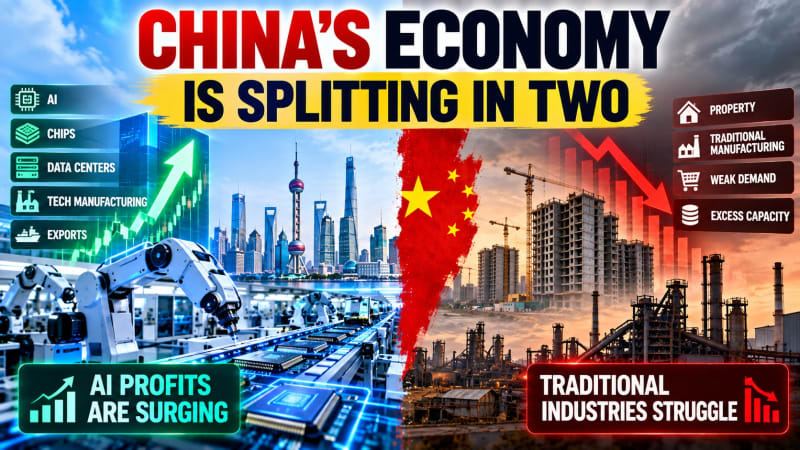
China’s Economy Is Splitting in Two: AI Booms as Traditional Industries Struggle
Fundamental · Sep 28, 2026 · 12 min read
China’s Economy Is Splitting in Two: AI Profits Are Surging While Traditional Industries Struggle China’s economy is becoming increasingly difficult to describe with a single word such as “strong” or “weak.” Underneath the headline growth numbers, two very different economies appear to be developing. On one side are artificial intelligence, semiconductors, advanced…
Read more...
Investors Pour $44 Billion Into Stocks Despite 5% Bond Yields
Global Markets & Economy · Sep 27, 2026 · 11 min read
AI Stocks Keep Rising While Bond Yields Hit Multi-Decade Highs: Is the Stock Market Becoming Too Dependent on AI? Something unusual is happening across global financial markets. Bond investors are confronting some of the highest yields seen in decades. The U.S. 10-year Treasury yield has moved above 5%, longer-dated yields have climbed even further, and Japanese government…
Read more...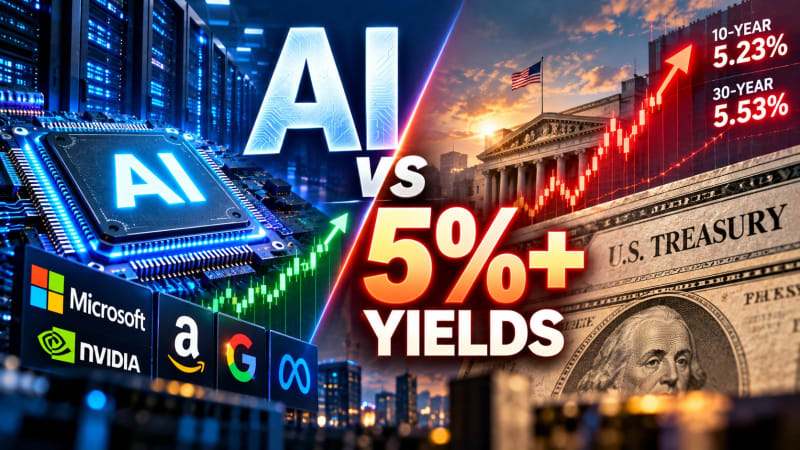
AI Stocks vs 5.2% Treasury Yields: Is the S&P 500 Too Dependent on AI?
Technology & Sectors · Sep 26, 2026 · 11 min read
AI Stocks Keep Rising While Bond Yields Hit Multi-Decade Highs: Is the Stock Market Becoming Too Dependent on AI? Something unusual is happening across global financial markets. Bond investors are confronting some of the highest yields seen in decades. The U.S. 10-year Treasury yield has moved above 5%, longer-dated yields have climbed even further, and Japanese government…
Read more...
Japan Bond Yields Surge: Could Japanese Money Leave Global Markets?
Fundamental · Sep 25, 2026 · 12 min read
Japan’s Bond Yields Are Surging: Could Trillions in Japanese Money Start Coming Home? For decades, Japan played an unusual but enormously important role in global financial markets. Interest rates at home were exceptionally low. Japanese banks, insurers, pension funds and other institutional investors therefore searched overseas for better returns. That helped direct enormous…
Read more...
U.S. 10-Year Yield Back Above 5%: Why Strong Growth Is Now a Risk for Stocks
Fundamental · Sep 24, 2026 · 12 min read
U.S. 10-Year Yield Is Back Above 5%—But This Time Strong Growth Is Driving It: Why That Matters for Stocks The U.S. 10-year Treasury yield is back above 5%. Normally, that headline alone would be enough to make equity investors nervous. But something important is different this time. Treasury yields are not rising only because investors are worried about inflation, oil prices…
Read more...
AI Agents Could Be the Next Catalyst for Semiconductor and Chip Stocks
Technology & Sectors · Sep 23, 2026 · 12 min read
AI Agents Are Becoming the New Catalyst for Chip Stocks: Why Consumer Adoption Could Matter More Than the Next Nvidia Earnings For most of the artificial-intelligence boom, investors have focused on one question: How much will technology companies spend on AI? That question helped drive enormous investment into GPUs, data centers, high-bandwidth memory, networking equipment…
Read more...
Trump-Xi Meeting: What It Could Mean for AI and Semiconductor Stocks
News · Sep 22, 2026 · 11 min read
Trump-Xi Meeting Could Be the Next Big Catalyst for AI and Semiconductor Stocks: What Global Markets Are Watching Artificial intelligence stocks are surging again. The Nasdaq has reached a record closing high, semiconductor stocks have jumped sharply, and enthusiasm around the next wave of AI investment is once again driving global technology markets. But the next major…
Read more...
Vietnam Joins Emerging Markets: Could a $6 Billion FTSE Upgrade Trigger the Next Big Asian Stock-Market Re-Rating?
Global Markets & Economy · Sep 21, 2026 · 9 min read
Vietnam has officially entered a new chapter in its stock-market development. On September 21, Vietnamese equities joined FTSE Russell's emerging-market indexes, moving the country further into the global institutional investment universe after years of market reforms. The change may appear technical, but its implications could be much larger. FTSE Russell estimates that the…
Read more...