
China’s Economy Is Splitting in Two: AI Booms as Traditional Industries Struggle
China’s Economy Is Splitting in Two: AI Profits Are Surging While Traditional Industries Struggle
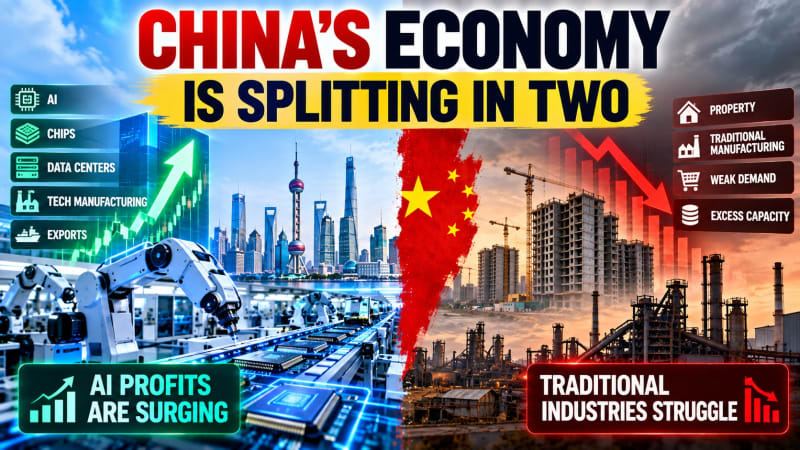
China’s economy is becoming increasingly difficult to describe with a single word such as “strong” or “weak.”
Underneath the headline growth numbers, two very different economies appear to be developing.
On one side are artificial intelligence, semiconductors, advanced manufacturing, data centres, robotics and technology exports.
On the other are property, parts of traditional manufacturing and businesses exposed to weak domestic demand and excess capacity.
This divergence raises a much more important question for global investors:
Is China becoming a two-speed economy where AI and advanced manufacturing continue expanding even while the traditional economy struggles?
If so, the implications could extend far beyond Chinese stocks.
The shift could affect semiconductor companies in Taiwan and South Korea, European manufacturers, commodity markets, global AI infrastructure spending and even the competitive position of U.S. technology companies.
China’s Industrial Profits Are Sending a Mixed Signal
At first glance, China’s industrial economy still looks resilient.
But headline numbers increasingly hide large differences between sectors.
Technology-oriented manufacturers are benefiting from investment in artificial intelligence, computing infrastructure, electronics and advanced manufacturing.
Meanwhile, several traditional industries continue dealing with weaker demand, pricing pressure and excess production capacity.
This means investors may need to stop asking:
“Is China’s economy recovering?”
A more useful question could be:
“Which parts of China’s economy are recovering?”
That distinction could become increasingly important for global markets.
China’s AI Economy Is Accelerating
China is investing heavily across the artificial-intelligence ecosystem.
The investment extends far beyond AI software.
It includes:
- AI processors
- semiconductor manufacturing
- data centres
- cloud computing
- networking equipment
- robotics
- advanced manufacturing
- power infrastructure
- AI models
This is creating a new industrial investment cycle.
One of the clearest recent examples is Alibaba.
The company has unveiled a new AI chip while also outlining plans for a much larger next-generation AI model and a substantial expansion of data-centre capacity.
Alibaba wants to build an increasingly complete AI technology stack spanning:
AI models → semiconductors → cloud computing → data centres.
That illustrates how China’s AI strategy is evolving from simply developing software into building the physical infrastructure required to support an AI economy.
China Wants More of the AI Supply Chain at Home
China’s technology strategy also has a geopolitical dimension.
U.S. restrictions on advanced semiconductor technology have increased the incentive for China to develop domestic alternatives.
That includes investment in:
- AI accelerators
- semiconductor manufacturing equipment
- memory
- advanced packaging
- optical networking
- cloud infrastructure
The result could be a much more self-contained Chinese technology ecosystem.
Instead of relying heavily on imported technology, China is attempting to control more stages of the AI supply chain domestically.
That has important implications for global semiconductor companies.
Read Trump-Xi Meeting Could Be the Next Big Catalyst for AI and Semiconductor Stocks for our analysis of how U.S.-China technology policy is reshaping the semiconductor industry.
AI Data Centres Are Becoming a New Industrial Growth Engine
Artificial intelligence requires enormous physical infrastructure.
Behind every AI application sits a chain of investment:
AI models
↓
Cloud computing
↓
Data centres
↓
AI processors
↓
High-bandwidth memory
↓
Networking
↓
Electricity
↓
Cooling infrastructure
This means China’s AI push can create economic activity across multiple industries.
Building data centres requires construction.
Running them requires electricity.
AI servers require semiconductors.
Those semiconductors require manufacturing equipment.
Large AI clusters require advanced networking.
The AI boom therefore increasingly resembles an industrial investment cycle, not simply a software trend.
AI Infrastructure Companies Are Already Attracting Investors
The strength of this theme is becoming visible in capital markets.
Chinese fibre-optic communications equipment maker Ligent Technologies recently completed its Hong Kong listing after raising roughly $723 million.
Investor demand was strong partly because optical networking equipment is increasingly important for AI data centres.
The company plans to use a large portion of the proceeds for research, development and additional production capacity.
That tells investors something important.
Capital is increasingly moving toward the companies providing the physical infrastructure behind AI.
This mirrors a trend already visible in the United States, Taiwan and South Korea.
The AI investment opportunity is expanding beyond model developers toward the companies providing the hardware required to run those models.
Why China’s Traditional Economy Still Looks Much Weaker
The strength in technology should not obscure the problems elsewhere.
China continues to face structural challenges including:
- weak property activity
- cautious household spending
- excess industrial capacity
- pricing pressure
- weak demand in selected industries
- local-government debt concerns
The property sector is particularly important.
For years, real estate played an enormous role in Chinese household wealth and economic activity.
Property development supported:
- construction
- steel
- cement
- appliances
- furniture
- local-government revenue
- household investment
Weakness in property therefore spreads into other parts of the economy.
AI investment can create new economic activity, but replacing the economic importance of property is a much larger challenge.
China May Be Moving From Property-Led Growth to Technology-Led Growth
This could be the bigger structural transformation.
China’s previous growth model relied heavily on:
Property + infrastructure + exports.
The emerging model may increasingly emphasize:
Advanced manufacturing + AI + semiconductors + robotics + clean technology + exports.
That would represent a major change in how the Chinese economy generates growth.
But transitions of this scale rarely happen smoothly.
The old economy does not disappear immediately.
Instead, both systems coexist.
That is why China increasingly resembles a two-speed economy.
One part is attempting to build the industries of the future.
Another is still dealing with the consequences of the previous growth model.
China’s AI Boom Could Intensify Competition With Europe
The implications extend beyond China.
European manufacturers are already facing stronger competition from Chinese companies in advanced industrial sectors.
China is no longer competing primarily through low-cost consumer manufacturing.
Its companies increasingly compete in:
- industrial machinery
- electric vehicles
- batteries
- renewable energy
- electronics
- telecommunications
- advanced manufacturing
The European Central Bank has highlighted how China’s industrial expansion is putting pressure on European manufacturers, with Germany particularly exposed because of similarities between the two countries’ export structures.
This means China’s technology transformation could create a difficult situation for Europe:
Weak Chinese consumer demand can reduce European exports to China.
At the same time:
Stronger Chinese manufacturing can increase competition for European companies in global markets.
That combination could become a significant challenge for Europe’s industrial economy.
Germany Could Be Particularly Exposed
Germany built much of its economic model around high-value manufacturing and exports.
China was historically both:
a major customer
and
a manufacturing partner.
Increasingly, China is becoming a competitor.
Chinese companies now compete more directly with German businesses across machinery, vehicles and industrial technology.
If China continues moving rapidly into advanced manufacturing, German companies could face pressure both inside China and in third-country export markets.
That makes China’s AI and industrial strategy important for European stock investors as well.
Taiwan and South Korea Could Benefit—and Face New Competition
China’s AI boom has different implications for other Asian economies.
Taiwan remains central to advanced semiconductor manufacturing.
South Korea remains crucial for memory, particularly high-bandwidth memory used in AI systems.
In the short term, stronger AI infrastructure investment can support demand throughout the Asian semiconductor supply chain.
But China is also investing aggressively in domestic semiconductor capacity.
The longer-term picture is therefore more complicated.
Taiwan and South Korea could benefit from expanding global AI demand while simultaneously facing stronger Chinese competition.
That makes the Asian semiconductor cycle one of the most important areas to monitor.
China’s AI Boom Connects Directly to the Global Chip Rally
The global AI investment cycle increasingly operates across borders.
A simplified supply chain might look like:
U.S. AI platforms
↓
Taiwan semiconductor manufacturing
↓
South Korean memory
↓
Japanese semiconductor equipment
↓
Chinese AI infrastructure
Different countries dominate different parts of the ecosystem.
China’s attempt to localize more of that supply chain could gradually change these relationships.
That is why investors should view Chinese AI development as part of the global semiconductor story rather than an isolated domestic trend.
Read AI Stocks vs 5.2% Treasury Yields: Is the S&P 500 Too Dependent on AI? for our analysis of how AI has become increasingly important to global equity-market performance.
Could AI Eventually Help China’s Weak Consumer Economy?
This is one of the most interesting long-term questions.
AI investment initially benefits infrastructure providers.
But the economic effect could eventually broaden.
AI could potentially improve productivity across:
- manufacturing
- logistics
- financial services
- healthcare
- e-commerce
- transportation
- enterprise software
If those productivity gains translate into higher wages and stronger corporate profitability, they could eventually support domestic consumption.
But that transition is uncertain.
China’s immediate challenge remains rebuilding household confidence.
Technology investment alone cannot instantly solve problems in property or consumer sentiment.
The Risk: AI Investment Could Create Another Capacity Problem
There is also a less optimistic possibility.
China already faces concerns about excess capacity in several industries.
If enormous amounts of capital flow into AI infrastructure without sufficient demand, the country could eventually create overcapacity there as well.
The risk would look something like:
Government support
↓
Rapid investment
↓
Large production expansion
↓
Intense competition
↓
Falling prices
↓
Lower profit margins
China has experienced versions of this cycle in other industries.
Investors therefore need to distinguish between:
rapid production growth
and
sustainable profitability.
The two are not necessarily the same.
China’s AI Push Could Keep Global Technology Prices Lower
There is another potential global effect.
If China expands semiconductor, AI-server and networking capacity aggressively, greater supply could eventually reduce technology costs.
That could benefit AI adoption globally.
Cheaper computing could allow more businesses to deploy AI.
Lower infrastructure costs could increase inference demand.
That creates another possible chain:
More Chinese technology supply
↓
Lower AI infrastructure costs
↓
More AI adoption
↓
More inference
↓
More data-centre demand
This would make China both a competitor and an accelerator of the global AI economy.
What Does This Mean for Commodities?
China remains one of the world’s largest commodity consumers.
Historically, Chinese growth was closely associated with:
- steel
- iron ore
- cement
- copper
- energy
A technology-led economy changes the commodity mix.
AI and electrification require substantial amounts of:
- copper
- aluminium
- electricity
- grid infrastructure
- specialised materials
Property weakness may reduce demand for some traditional construction commodities.
Meanwhile, data-centre and electrical infrastructure investment could increase demand for others.
This means investors may eventually need to rethink what “China demand” means for commodity markets.
It may become less about apartments and more about electricity, data centres and advanced manufacturing.
What Does the Two-Speed Economy Mean for Chinese Stocks?
The biggest mistake may be treating the Chinese stock market as one homogeneous investment.
Different sectors increasingly face completely different economic environments.
Potential beneficiaries of the new economy
- AI infrastructure
- cloud computing
- semiconductors
- networking
- robotics
- advanced manufacturing
- technology exporters
Areas facing greater structural pressure
- property developers
- construction-related businesses
- traditional industries with excess capacity
- businesses heavily dependent on weak domestic demand
This makes sector selection increasingly important.
A weak Chinese economy does not automatically mean every Chinese company is weak.
Likewise, strong AI investment does not mean the entire economy is healthy.
What Does This Mean for India?
India could experience both opportunities and challenges from China’s industrial transformation.
One potential opportunity is supply-chain diversification.
Global companies continue exploring manufacturing alternatives across Asia.
India could potentially attract investment in:
- electronics manufacturing
- semiconductor assembly
- data centres
- cloud infrastructure
- enterprise technology
But China’s rapidly improving manufacturing capabilities also create competition.
Indian manufacturers increasingly need to compete not simply with low-cost Chinese production but with increasingly sophisticated Chinese technology companies.
For investors, the India-China comparison may therefore evolve from:
low-cost manufacturing competition
toward
technology and advanced-manufacturing competition.
Three Possible Scenarios for China’s Two-Speed Economy
Scenario 1: Technology Growth Spreads to the Broader Economy
AI and advanced manufacturing continue expanding.
Investment creates jobs.
Productivity improves.
Household confidence gradually recovers.
Property stabilises.
Under this scenario, technology becomes the engine that eventually helps lift the broader economy.
Scenario 2: The Two-Speed Economy Persists
AI and advanced manufacturing remain strong.
Property stays weak.
Consumers remain cautious.
Traditional industries struggle.
China continues growing, but economic performance becomes increasingly uneven.
This may be the most important scenario for global investors to monitor.
Scenario 3: Technology Investment Also Slows
AI infrastructure spending becomes excessive.
Profitability weakens.
Exports slow.
Technology investment loses momentum before the traditional economy fully recovers.
Under this scenario, China would lose one of its strongest remaining growth engines.
What Global Investors Should Watch Next
Instead of focusing only on China’s headline GDP growth, investors may want to monitor:
- technology manufacturing profits
- semiconductor production
- AI data-centre investment
- cloud revenue
- industrial profits
- property sales
- home prices
- retail sales
- household confidence
- exports
- manufacturing PMI
- commodity demand
- Chinese technology IPOs
- foreign investment flows
Readers can track the Shanghai Composite, Hang Seng, China A50, Asian indices and major global markets through the LiveWorldMarket Global Indices & Futures Hub.
For a broader cross-market comparison, see Global Market Performance.
The Bigger Picture: “China Is Slowing” May Be the Wrong Story
For years, global investors have asked whether China’s economy is slowing.
That question may now be too simplistic.
China appears to be undergoing something more structural.
Its property-driven economic model is struggling.
Domestic consumption remains uneven.
Parts of traditional manufacturing face excess capacity and weak profitability.
At the same time, China is investing aggressively in artificial intelligence, semiconductors, robotics, cloud infrastructure and advanced manufacturing.
Those two realities can exist simultaneously.
China can have a weak property sector and a booming AI infrastructure industry.
It can have cautious consumers and rapidly expanding advanced manufacturing.
It can experience slower traditional growth while becoming a more formidable technology competitor.
That is why the next phase of China’s economy may not be defined simply by whether growth accelerates or slows.
The more important question is:
Can China’s new AI and advanced-manufacturing economy become powerful enough to replace the growth once generated by property and traditional industry?
If the answer is yes, China’s economic model could look very different by the end of this decade.
If the answer is no, the divide between its technology boom and traditional economy could become increasingly difficult to bridge.
Either way, the emergence of a two-speed China is becoming a global market story—not merely a Chinese one.
Related LiveWorldMarket Analysis
AI Stocks vs 5.2% Treasury Yields: Is the S&P 500 Too Dependent on AI?
Trump-Xi Meeting Could Be the Next Big Catalyst for AI and Semiconductor Stocks
Disclaimer: This article is for informational and educational purposes only. It does not constitute investment advice or a recommendation to buy or sell securities. Economic conditions, government policies and financial markets can change rapidly.
Comments (0)
Be the first to comment.
About the author

NISM-Series-X-A Investment Adviser Level 1 examination completed
Amit writes about Indian equity markets, technical analysis, macro themes and the day-to-day mechanics of trading, with a focus on making the flow of global markets legible for retail investors. He has completed the NISM-Series-X-A Investment Adviser Level 1 examination.
You May Also Like
AI Is Reviving Asia's Factories: Is Global Manufacturing Finally Turning?
Global Markets & Economy · Oct 1, 2026 · 12 min read
AI Is Reviving Asia’s Factories: Is the Global Manufacturing Cycle Finally Turning? For the past few years, artificial intelligence has primarily been viewed as a technology and stock-market story. AI stocks surged. Semiconductor companies expanded production. Technology giants committed hundreds of billions of dollars to data centres and computing infrastructure. Now…
Read more...
South Korea Chip Exports Surge 259% as AI Demand Hits the Real Economy
Trend · Sep 30, 2026 · 12 min read
South Korea’s Chip Exports Are Surging 259%: Is the AI Boom Finally Spreading From Stock Prices Into the Real Economy? For much of the artificial-intelligence boom, the most visible evidence has been in financial markets. AI-related stocks surged. Semiconductor valuations climbed. Technology companies announced hundreds of billions of dollars of data-centre investment. But…
Read more...
AI Infrastructure Boom: $126 Billion Flows Into Chips, Data Centres and Power
Trend · Sep 30, 2026 · 13 min read
The AI Boom Is Entering a New Phase: $126 Billion Is Pouring Into Chips, Data Centres and Power For the past several years, the artificial-intelligence investment story has largely revolved around one question: Which company will build the most powerful AI chips and models? That question helped fuel enormous gains across semiconductor and technology stocks. But the AI…
Read more...
Investors Pour $44 Billion Into Stocks Despite 5% Bond Yields
Global Markets & Economy · Sep 27, 2026 · 11 min read
AI Stocks Keep Rising While Bond Yields Hit Multi-Decade Highs: Is the Stock Market Becoming Too Dependent on AI? Something unusual is happening across global financial markets. Bond investors are confronting some of the highest yields seen in decades. The U.S. 10-year Treasury yield has moved above 5%, longer-dated yields have climbed even further, and Japanese government…
Read more...
AI Stocks vs 5.2% Treasury Yields: Is the S&P 500 Too Dependent on AI?
Technology & Sectors · Sep 26, 2026 · 11 min read
AI Stocks Keep Rising While Bond Yields Hit Multi-Decade Highs: Is the Stock Market Becoming Too Dependent on AI? Something unusual is happening across global financial markets. Bond investors are confronting some of the highest yields seen in decades. The U.S. 10-year Treasury yield has moved above 5%, longer-dated yields have climbed even further, and Japanese government…
Read more...
Japan Bond Yields Surge: Could Japanese Money Leave Global Markets?
Fundamental · Sep 25, 2026 · 12 min read
Japan’s Bond Yields Are Surging: Could Trillions in Japanese Money Start Coming Home? For decades, Japan played an unusual but enormously important role in global financial markets. Interest rates at home were exceptionally low. Japanese banks, insurers, pension funds and other institutional investors therefore searched overseas for better returns. That helped direct enormous…
Read more...
U.S. 10-Year Yield Back Above 5%: Why Strong Growth Is Now a Risk for Stocks
Fundamental · Sep 24, 2026 · 12 min read
U.S. 10-Year Yield Is Back Above 5%—But This Time Strong Growth Is Driving It: Why That Matters for Stocks The U.S. 10-year Treasury yield is back above 5%. Normally, that headline alone would be enough to make equity investors nervous. But something important is different this time. Treasury yields are not rising only because investors are worried about inflation, oil prices…
Read more...
AI Agents Could Be the Next Catalyst for Semiconductor and Chip Stocks
Technology & Sectors · Sep 23, 2026 · 12 min read
AI Agents Are Becoming the New Catalyst for Chip Stocks: Why Consumer Adoption Could Matter More Than the Next Nvidia Earnings For most of the artificial-intelligence boom, investors have focused on one question: How much will technology companies spend on AI? That question helped drive enormous investment into GPUs, data centers, high-bandwidth memory, networking equipment…
Read more...
Trump-Xi Meeting: What It Could Mean for AI and Semiconductor Stocks
News · Sep 22, 2026 · 11 min read
Trump-Xi Meeting Could Be the Next Big Catalyst for AI and Semiconductor Stocks: What Global Markets Are Watching Artificial intelligence stocks are surging again. The Nasdaq has reached a record closing high, semiconductor stocks have jumped sharply, and enthusiasm around the next wave of AI investment is once again driving global technology markets. But the next major…
Read more...
Vietnam Joins Emerging Markets: Could a $6 Billion FTSE Upgrade Trigger the Next Big Asian Stock-Market Re-Rating?
Global Markets & Economy · Sep 21, 2026 · 9 min read
Vietnam has officially entered a new chapter in its stock-market development. On September 21, Vietnamese equities joined FTSE Russell's emerging-market indexes, moving the country further into the global institutional investment universe after years of market reforms. The change may appear technical, but its implications could be much larger. FTSE Russell estimates that the…
Read more...