South Korea Chip Exports Surge 259% as AI Demand Hits the Real Economy
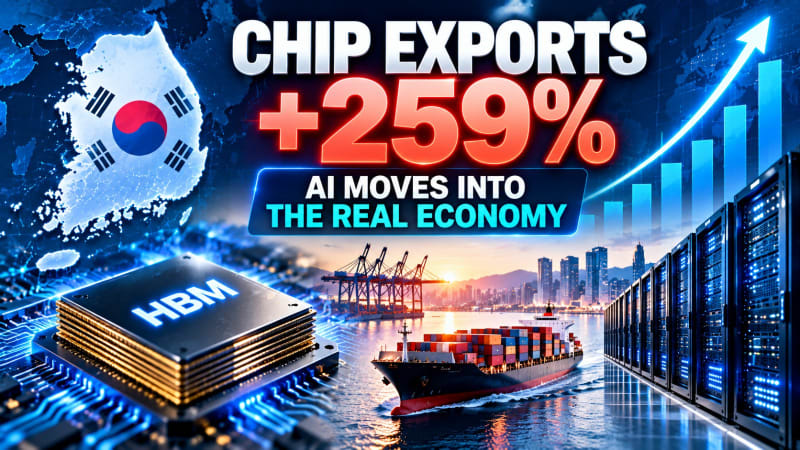
South Korea’s Chip Exports Are Surging 259%: Is the AI Boom Finally Spreading From Stock Prices Into the Real Economy?
For much of the artificial-intelligence boom, the most visible evidence has been in financial markets.
AI-related stocks surged.
Semiconductor valuations climbed.
Technology companies announced hundreds of billions of dollars of data-centre investment.
But investors have repeatedly asked an important question:
Is the AI boom actually generating enough real economic activity to justify the extraordinary enthusiasm in financial markets?
South Korea may be providing one of the clearest answers yet.
During the first 20 days of September, South Korean exports surged 78.3% from a year earlier, reaching a record for the period.
But one number stands out even more:
Semiconductor exports jumped 259.4%.
That is an extraordinary increase for one of the world's most important chip-producing economies.
And it suggests something significant may be happening beneath the AI stock-market rally.
Artificial intelligence is increasingly moving beyond share prices and valuations into factories, exports, memory production, data centres and global trade.
The AI boom may finally be showing up clearly in the real economy.
Why South Korea Matters to the Global AI Story
South Korea is not simply another exporting economy.
It occupies a critical position in the global semiconductor supply chain.
The country is home to Samsung Electronics and SK hynix, two of the world's largest memory manufacturers.
SK hynix has become particularly important because of high-bandwidth memory, or HBM.
HBM is essential for advanced AI computing because it allows enormous quantities of data to move rapidly between memory and AI processors.
The global AI ecosystem therefore increasingly depends on a chain that looks something like:
AI models
↓
AI processors
↓
High-bandwidth memory
↓
Advanced semiconductor manufacturing
↓
AI servers
↓
Data centres
↓
AI applications
South Korea sits near the centre of that chain.
That makes Korean semiconductor exports a useful real-world indicator of global AI infrastructure demand.
Semiconductor Exports Just Surged 259%
The latest numbers are difficult to ignore.
During the first 20 days of September:
South Korean exports: +78.3%
Semiconductor exports: +259.4%
Adjusted for the number of working days, overall exports increased approximately 89.8%.
Economists surveyed by Reuters expect South Korean exports to have risen around 62% for the full month of September, despite fewer working days because of the Chuseok holiday.
If confirmed, September would mark the 16th consecutive month of export growth.
The country's monthly trade surplus is also forecast at a record $38.15 billion.
Those figures suggest AI infrastructure investment is translating into actual physical demand.
This Is Why the 259% Number Matters
AI optimism initially appeared mostly in stock prices.
Investors bought companies expected to benefit from artificial intelligence.
Then technology companies announced enormous capital-expenditure programmes.
Now we are beginning to see the next stage:
Physical products are actually moving through the global economy.
Memory chips are being manufactured.
Semiconductors are being exported.
AI servers are being assembled.
Data centres are being constructed.
Electricity infrastructure is being expanded.
That makes the AI story considerably more tangible.
The investment cycle can increasingly be described as:
AI expectations
↓
Technology capital expenditure
↓
Chip orders
↓
Factory production
↓
Exports
↓
Data-centre construction
↓
Electricity demand
↓
Economic activity
The AI boom is no longer confined to Wall Street.
HBM Is Becoming the Oil of the AI Computing Boom
One of the most important technologies behind South Korea's export surge is high-bandwidth memory.
Traditional memory stores data.
HBM is designed to move enormous quantities of data extremely quickly.
That is essential for AI.
Large AI processors constantly need access to massive datasets.
Without sufficiently fast memory, expensive AI processors cannot operate efficiently.
HBM therefore acts as a critical supporting technology for GPUs and other AI accelerators.
Samsung now expects HBM to account for nearly 30% of global DRAM wafer capacity next year, up from around 20% currently.
That is a remarkable shift in the memory industry.
Why More HBM Could Mean Less Conventional Memory
There is another important consequence.
HBM and standard DRAM compete for semiconductor wafer capacity.
If manufacturers dedicate more production capacity to HBM, they may have less capacity available for conventional memory.
That creates the possibility of:
More AI demand
↓
More HBM production
↓
Less capacity for conventional DRAM
↓
Tighter memory supply
↓
Higher memory prices
This means the AI boom could affect the price of memory used far beyond AI servers.
PCs, smartphones, enterprise servers and other electronics could eventually feel the impact.
That would make AI demand an increasingly important force across the broader technology supply chain.
SK Hynix Has Become a Critical AI Supplier
SK hynix has emerged as one of the biggest beneficiaries of the AI infrastructure cycle.
The company is a leading supplier of HBM used alongside advanced AI processors.
Demand has become so strong that global technology companies are increasingly concerned about securing sufficient memory supply.
SK hynix is even discussing potential U.S. manufacturing arrangements.
The company has held talks with Intel about potentially producing memory chips in the United States.
Its Solidigm subsidiary is separately considering options for additional NAND manufacturing capacity in America.
No final decisions have been announced.
But the discussions reveal how strategically important memory supply has become.
AI is changing not only semiconductor demand.
It is changing where semiconductor factories may eventually be built.
Samsung Is Also Seeing AI Demand Tighten Capacity
Samsung Electronics is experiencing a similar shift.
The company has increased prices for some advanced foundry services as AI-related demand tightens production capacity.
Samsung has also reported record profits supported by strong demand and pricing for memory used in AI systems.
That means the AI boom is now influencing several layers of Samsung's semiconductor operations:
Foundry
Memory
HBM
Advanced manufacturing
This is another sign that AI demand is becoming an industrial phenomenon rather than simply an investment narrative.
AI Is Creating a Global Memory Shortage
One of the strongest indications of real demand is tightening supply.
AI data centres require enormous amounts of memory.
As technology companies expand computing capacity, competition for memory increases.
This has become significant enough that companies are exploring ways to lock in future supply.
The semiconductor market is therefore shifting from the oversupply problems seen during earlier memory cycles toward a very different environment.
AI infrastructure spending is absorbing increasing quantities of advanced memory.
That could potentially keep the semiconductor cycle stronger for longer than previous consumer-electronics-driven booms.
South Korea Is Becoming a Real-Economy AI Barometer
This is why South Korea deserves more attention from global investors.
South Korea is highly exposed to international trade.
Its exports include:
- semiconductors
- electronics
- automobiles
- machinery
- chemicals
- batteries
- ships
Changes in Korean exports can therefore provide clues about the health of global manufacturing.
But the latest data show something more specific.
The AI hardware cycle appears to be strong enough to produce extraordinary growth in one of South Korea's most important export industries.
That makes Korean chip exports a potential AI real-economy indicator.
Investors may increasingly want to monitor them alongside:
- AI stock prices
- hyperscaler capital expenditure
- cloud revenue
- semiconductor orders
- data-centre construction
AI Is Moving From Training to Inference
The next stage could make the demand story even larger.
The first AI infrastructure boom was driven primarily by training.
Companies needed enormous computing clusters to build increasingly powerful AI models.
But the next phase is increasingly about inference.
Inference occurs whenever someone actually uses AI.
Every AI search, chatbot conversation, generated image, coding request or agentic task requires computing resources.
That means consumer and enterprise adoption can create recurring infrastructure demand.
The chain becomes:
More AI users
↓
More inference
↓
More computing
↓
More GPUs
↓
More HBM
↓
More data centres
↓
More electricity
That could turn AI infrastructure from a one-time buildout into a much longer investment cycle.
Read AI Agents Are Becoming the New Catalyst for Chip Stocks for our analysis of how consumer AI adoption could drive the next phase of semiconductor demand.
The AI Boom Is Expanding Into Data Centres and Power
Semiconductors may be only the beginning.
Asia-Pacific high-technology companies have raised roughly $125.8 billion through equity and convertible-bond deals in 2026, according to LSEG data.
The money is increasingly financing:
- chips
- data centres
- networking
- AI infrastructure
- power systems
That suggests the AI capital cycle is becoming significantly broader.
Read The AI Boom Is Entering a New Phase: $126 Billion Is Pouring Into Chips, Data Centres and Power for our detailed analysis of this next phase.
The connection with South Korea is direct.
More data centres require more AI processors.
More AI processors require more HBM.
More HBM means more demand for South Korean memory production.
The infrastructure boom and the export boom are two sides of the same AI investment cycle.
Taiwan Is the Other Critical AI Manufacturing Hub
South Korea does not operate in isolation.
Taiwan remains central to advanced semiconductor manufacturing.
A simplified Asian AI supply chain looks like:
U.S. AI companies
↓
Taiwanese advanced chip manufacturing
↓
South Korean HBM and memory
↓
Japanese semiconductor equipment
↓
Asian data-centre infrastructure
This illustrates why the AI boom has become a global industrial cycle.
A new AI application launched in the United States can ultimately create demand for factories across several Asian economies.
China Adds Both Demand and Competition
China creates another layer.
Chinese companies are investing heavily in:
- AI models
- domestic semiconductors
- memory
- cloud computing
- data centres
- advanced manufacturing
That can create additional demand for the Asian technology supply chain.
But China is also rapidly developing domestic semiconductor alternatives.
Chinese memory producer CXMT is preparing to expand into NAND flash memory, potentially increasing competition with Samsung, SK hynix and other established suppliers.
This creates a complicated long-term picture.
China can simultaneously be:
a major source of AI demand
and
an emerging semiconductor competitor.
Read China's Economy Is Splitting in Two: AI Profits Are Surging While Traditional Industries Struggle for our analysis of China's technology-led economic transformation.
Could AI Reshape Global Trade?
This may become one of the most important consequences.
For decades, global trade cycles were heavily influenced by:
- consumer electronics
- automobiles
- construction
- commodities
- industrial machinery
AI could add another major engine.
The new trade cycle increasingly includes:
HBM
AI processors
advanced packaging
optical networking
servers
cooling systems
electrical equipment
The physical AI economy is creating entirely new flows of goods across borders.
South Korea's 259% semiconductor-export surge may therefore be an early example of how AI could reshape global trade patterns.
AI Could Become More Important Than Smartphones for Memory
Previous semiconductor cycles were heavily influenced by smartphones and PCs.
AI servers are different.
They require dramatically more memory per system.
That means even relatively small numbers of AI servers can consume enormous amounts of semiconductor capacity.
If inference demand continues expanding, AI could become one of the dominant forces determining global memory pricing and production decisions.
That would represent a structural change for the semiconductor industry.
What Does This Mean for Global Stocks?
The data provide investors with something AI valuations alone cannot:
evidence of underlying economic demand.
If chip exports, memory prices, data-centre construction and semiconductor orders continue accelerating, investors have stronger evidence that AI earnings expectations are connected to real activity.
That does not automatically mean AI stocks are cheap.
Valuation still matters.
Interest rates still matter.
Competition still matters.
But strong physical demand makes the AI investment thesis more substantial than one based purely on expectations.
5%+ Bond Yields Still Create a Difficult Test
The AI boom is occurring while global borrowing costs remain unusually high.
The U.S. 10-year Treasury yield has recently traded above 5%.
That increases the hurdle for technology valuations.
Investors can earn attractive returns from government bonds without accepting equity-market risk.
AI companies therefore need to produce sufficiently strong earnings growth to justify higher valuations.
South Korea's export numbers matter because they provide evidence that at least part of the AI demand story is translating into actual orders.
Read AI Stocks Keep Rising While Bond Yields Hit Multi-Decade Highs: Is the Stock Market Becoming Too Dependent on AI? for our analysis of the tension between AI growth and high bond yields.
Why This Matters for India
India is not currently a major producer of advanced AI memory on South Korea's scale.
But the implications still matter.
India is rapidly expanding:
- data centres
- cloud infrastructure
- electronics manufacturing
- semiconductor ambitions
- digital services
- electricity infrastructure
If AI demand continues spreading into the physical economy, India could participate in several parts of the infrastructure cycle even without becoming an immediate leader in advanced memory.
The opportunity could include:
Data centres
Power infrastructure
Electronics manufacturing
Semiconductor assembly and packaging
Cloud services
Enterprise AI
South Korea therefore provides a useful example of how digital AI demand can eventually translate into physical industrial activity.
Three Scenarios for the AI Semiconductor Cycle
Scenario 1: AI Demand Keeps Accelerating
Hyperscalers continue investing aggressively.
AI agents increase inference demand.
HBM supply remains tight.
Semiconductor exports stay strong.
Under this scenario, the AI hardware cycle could remain powerful well into 2027.
Scenario 2: Growth Continues but Normalises
AI demand remains healthy, but extraordinary year-on-year comparisons become harder.
Export growth slows from triple-digit rates.
Memory supply gradually catches up.
The semiconductor cycle remains positive but becomes less explosive.
Scenario 3: AI Infrastructure Gets Ahead of Demand
Companies build too much data-centre capacity.
AI revenue fails to justify capital expenditure.
Hyperscalers reduce spending.
Memory demand weakens.
Semiconductor exports slow.
This is the key downside risk investors should monitor.
What Investors Should Watch Next
The next phase of the AI story requires watching the physical economy, not just stock prices.
Important indicators include:
- South Korean semiconductor exports
- HBM capacity
- memory pricing
- Taiwan semiconductor exports
- semiconductor-equipment orders
- hyperscaler capital expenditure
- data-centre construction
- cloud revenue
- AI inference demand
- electricity consumption
- semiconductor inventories
- Korean trade surplus
South Korea's official September trade figures are scheduled for October 1, making them an important confirmation point for the extraordinary preliminary numbers.
Readers can monitor South Korea, Taiwan, Japan, China, the United States and other major markets through the LiveWorldMarket Global Indices & Futures Hub.
The Bigger Picture: AI Is Becoming a Real Economy Story
The first stage of the AI boom happened in laboratories.
The second happened in stock markets.
The third happened in corporate capital expenditure.
Now the fourth may be appearing in factories, exports, data centres and electricity demand.
South Korea's extraordinary semiconductor numbers provide an important piece of evidence.
A 259% surge in chip exports is not a stock-market valuation.
It represents physical products moving across borders.
It represents factories producing memory.
It represents technology companies purchasing computing infrastructure.
And it suggests that the billions being invested in artificial intelligence are increasingly flowing through the real global economy.
That does not eliminate the risks surrounding AI valuations.
But it changes the debate.
The question is no longer simply:
“Is the AI stock rally justified?”
A more important question is emerging:
“How large could the real-world AI industrial cycle become if chip exports, data centres, memory demand and electricity investment continue accelerating together?”
South Korea may be giving global investors one of the clearest answers yet.
Related LiveWorldMarket Analysis
The AI Boom Is Entering a New Phase: $126 Billion Is Pouring Into Chips, Data Centres and Power
AI Agents Are Becoming the New Catalyst for Chip Stocks
China's Economy Is Splitting in Two: AI Profits Are Surging While Traditional Industries Struggle
AI Stocks Keep Rising While Bond Yields Hit Multi-Decade Highs
Trump-Xi Meeting Could Be the Next Big Catalyst for AI and Semiconductor Stocks
Disclaimer: This article is for informational and educational purposes only. It does not constitute investment advice or a recommendation to buy or sell any security. Semiconductor demand, exports, AI investment and financial markets can change rapidly.
Comments (0)
Be the first to comment.
About the author

NISM-Series-X-A Investment Adviser Level 1 examination completed
Amit writes about Indian equity markets, technical analysis, macro themes and the day-to-day mechanics of trading, with a focus on making the flow of global markets legible for retail investors. He has completed the NISM-Series-X-A Investment Adviser Level 1 examination.
You May Also Like
AI Is Reviving Asia's Factories: Is Global Manufacturing Finally Turning?
Global Markets & Economy · Oct 1, 2026 · 12 min read
AI Is Reviving Asia’s Factories: Is the Global Manufacturing Cycle Finally Turning? For the past few years, artificial intelligence has primarily been viewed as a technology and stock-market story. AI stocks surged. Semiconductor companies expanded production. Technology giants committed hundreds of billions of dollars to data centres and computing infrastructure. Now…
Read more...
AI Infrastructure Boom: $126 Billion Flows Into Chips, Data Centres and Power
Trend · Sep 30, 2026 · 13 min read
The AI Boom Is Entering a New Phase: $126 Billion Is Pouring Into Chips, Data Centres and Power For the past several years, the artificial-intelligence investment story has largely revolved around one question: Which company will build the most powerful AI chips and models? That question helped fuel enormous gains across semiconductor and technology stocks. But the AI…
Read more...
China’s Economy Is Splitting in Two: AI Booms as Traditional Industries Struggle
Fundamental · Sep 28, 2026 · 12 min read
China’s Economy Is Splitting in Two: AI Profits Are Surging While Traditional Industries Struggle China’s economy is becoming increasingly difficult to describe with a single word such as “strong” or “weak.” Underneath the headline growth numbers, two very different economies appear to be developing. On one side are artificial intelligence, semiconductors, advanced…
Read more...
Investors Pour $44 Billion Into Stocks Despite 5% Bond Yields
Global Markets & Economy · Sep 27, 2026 · 11 min read
AI Stocks Keep Rising While Bond Yields Hit Multi-Decade Highs: Is the Stock Market Becoming Too Dependent on AI? Something unusual is happening across global financial markets. Bond investors are confronting some of the highest yields seen in decades. The U.S. 10-year Treasury yield has moved above 5%, longer-dated yields have climbed even further, and Japanese government…
Read more...
AI Stocks vs 5.2% Treasury Yields: Is the S&P 500 Too Dependent on AI?
Technology & Sectors · Sep 26, 2026 · 11 min read
AI Stocks Keep Rising While Bond Yields Hit Multi-Decade Highs: Is the Stock Market Becoming Too Dependent on AI? Something unusual is happening across global financial markets. Bond investors are confronting some of the highest yields seen in decades. The U.S. 10-year Treasury yield has moved above 5%, longer-dated yields have climbed even further, and Japanese government…
Read more...
Japan Bond Yields Surge: Could Japanese Money Leave Global Markets?
Fundamental · Sep 25, 2026 · 12 min read
Japan’s Bond Yields Are Surging: Could Trillions in Japanese Money Start Coming Home? For decades, Japan played an unusual but enormously important role in global financial markets. Interest rates at home were exceptionally low. Japanese banks, insurers, pension funds and other institutional investors therefore searched overseas for better returns. That helped direct enormous…
Read more...
U.S. 10-Year Yield Back Above 5%: Why Strong Growth Is Now a Risk for Stocks
Fundamental · Sep 24, 2026 · 12 min read
U.S. 10-Year Yield Is Back Above 5%—But This Time Strong Growth Is Driving It: Why That Matters for Stocks The U.S. 10-year Treasury yield is back above 5%. Normally, that headline alone would be enough to make equity investors nervous. But something important is different this time. Treasury yields are not rising only because investors are worried about inflation, oil prices…
Read more...
AI Agents Could Be the Next Catalyst for Semiconductor and Chip Stocks
Technology & Sectors · Sep 23, 2026 · 12 min read
AI Agents Are Becoming the New Catalyst for Chip Stocks: Why Consumer Adoption Could Matter More Than the Next Nvidia Earnings For most of the artificial-intelligence boom, investors have focused on one question: How much will technology companies spend on AI? That question helped drive enormous investment into GPUs, data centers, high-bandwidth memory, networking equipment…
Read more...
Trump-Xi Meeting: What It Could Mean for AI and Semiconductor Stocks
News · Sep 22, 2026 · 11 min read
Trump-Xi Meeting Could Be the Next Big Catalyst for AI and Semiconductor Stocks: What Global Markets Are Watching Artificial intelligence stocks are surging again. The Nasdaq has reached a record closing high, semiconductor stocks have jumped sharply, and enthusiasm around the next wave of AI investment is once again driving global technology markets. But the next major…
Read more...
Vietnam Joins Emerging Markets: Could a $6 Billion FTSE Upgrade Trigger the Next Big Asian Stock-Market Re-Rating?
Global Markets & Economy · Sep 21, 2026 · 9 min read
Vietnam has officially entered a new chapter in its stock-market development. On September 21, Vietnamese equities joined FTSE Russell's emerging-market indexes, moving the country further into the global institutional investment universe after years of market reforms. The change may appear technical, but its implications could be much larger. FTSE Russell estimates that the…
Read more...