
Why Are Defense Stocks Falling Despite Rising Global Military Spending?
Global military spending is rising. Weapons inventories are being rebuilt. Major defense contractors are receiving some of the largest multiyear orders in years.
Yet U.S. defense stocks have been falling.
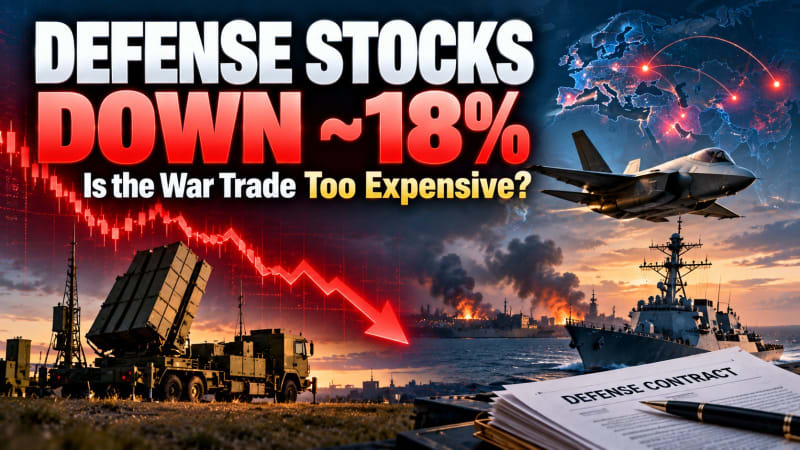
The iShares U.S. Aerospace & Defense ETF has declined by as much as 18.2% from its August 14 record high and has posted seven consecutive weekly losses, its longest such losing streak since 2006.
That creates an unusual market contradiction:
If geopolitical risk remains high and defense spending continues to rise, why are defense stocks falling?
The answer may be less about deteriorating fundamentals and more about something investors often underestimate:
valuation, expectations and timing.
Defense companies can have strong order books, expanding budgets and rising geopolitical importance—and their stocks can still fall if the market had already priced in too much good news.
The Defense Trade Looked Almost Unstoppable
For several years, the investment case for defense companies appeared unusually strong.
Wars and geopolitical tensions increased demand for:
- missiles
- air-defense systems
- drones
- radar
- electronic warfare
- ammunition
- naval systems
- military aircraft
Governments also discovered an uncomfortable reality: many weapons stockpiles were not large enough for a prolonged period of conflict.
That created pressure to replenish inventories while simultaneously expanding future production capacity.
For investors, the logic seemed straightforward:
Higher geopolitical risk → higher defense spending → larger order books → stronger defense earnings.
But stock markets do not price only what is happening today.
They price what investors expect tomorrow.
And that may explain why the defense trade has suddenly become much more difficult.
U.S. Defense Stocks Have Fallen Sharply
The recent pullback has been significant.
The iShares U.S. Aerospace & Defense ETF fell as much as 18.2% from its August record.
The decline has brought the sector close to the traditional 20% threshold associated with a bear market.
More importantly, it has occurred while the fundamental defense backdrop still appears strong.
That is the contradiction investors need to understand.
A sector does not need bad news to decline.
Sometimes it simply needs the news to be less good than the market had already assumed.
A $24.4 Billion Missile Contract Shows Demand Is Still Real
The weakness in defense stocks is not happening because military demand has disappeared.
The U.S. Navy recently awarded RTX's Raytheon division a multiyear contract worth up to $24.4 billion for Standard Missile-6 interceptors.
The agreement runs for five years and includes two additional option years.
The SM-6 can perform several missions, including:
- air defense
- ballistic-missile defense
- anti-surface warfare
- offensive strike missions
The contract is part of a broader Pentagon effort to rebuild weapons inventories depleted by conflicts and increase production capacity.
It follows other enormous agreements, including a provisional $20.7 billion AMRAAM missile deal and a $58.6 billion Patriot interceptor agreement involving Lockheed Martin.
These numbers show that defense demand is not theoretical.
It is turning into actual multiyear procurement.
So why are investors selling?
Reason 1: Defense Stocks May Simply Have Become Too Expensive
The first explanation is valuation.
A powerful investment narrative can drive stock prices much faster than underlying earnings.
Investors initially buy because fundamentals are improving.
Then more investors notice the trend.
Eventually, optimism itself becomes part of the valuation.
The sequence can look like this:
Geopolitical risk rises
↓
Defense spending increases
↓
Stocks rally
↓
Valuation multiples expand
↓
Expectations become extremely high
↓
Stocks become vulnerable even if fundamentals remain strong
This is one of the most important lessons in investing:
A good company is not automatically a good stock at every price.
Defense stocks may now be experiencing the same valuation problem that occasionally appears in high-growth technology sectors.
Reason 2: A Large Contract Does Not Become Revenue Overnight
A headline such as “$24.4 billion defense contract” sounds immediately transformational.
But multiyear procurement does not work that way.
Revenue is recognized as weapons are produced and delivered over time.
Companies must also:
- expand factories
- hire skilled employees
- secure components
- negotiate supplier agreements
- invest in automation
- increase testing capacity
That takes time.
So there can be a large gap between:
contract announcement
and
earnings realization.
Stock markets may initially price in years of future revenue very quickly.
Later, investors begin asking harder questions:
How fast can production actually increase?
What are the margins?
How much capital expenditure is required?
When will the cash arrive?
Those questions can pressure valuations even while order books remain strong.
Reason 3: Production Capacity Is the Real Bottleneck
The modern defense industry faces an unusual challenge.
Governments increasingly want weapons faster than manufacturers can produce them.
That means the constraint may not be demand.
It may be supply.
Defense manufacturing requires highly specialized:
- factories
- machinery
- engineers
- components
- electronics
- explosives
- rocket motors
- certification processes
Increasing missile production is very different from increasing production of ordinary consumer goods.
Some supply chains can take years to expand.
This is why the Pentagon has been pushing contractors to increase output.
For investors, however, this creates a dilemma.
More production capacity requires more investment.
That can temporarily pressure free cash flow.
So rising defense budgets can simultaneously create:
stronger long-term revenue opportunities
and
higher near-term capital requirements.
Reason 4: Congressional Funding Still Matters
Even large Pentagon plans depend on political funding.
Defense contractors can receive long-term procurement signals, but appropriations still matter.
Companies need confidence that government funding will be available before committing billions of dollars to factories and production lines.
RTX has already been investing in:
- workforce expansion
- supplier relationships
- automation
- manufacturing capacity
But defense companies remain exposed to political decisions about budgets and appropriations.
That creates another difference between:
headline contract value
and
certainty of future cash flow.
Markets dislike uncertainty.
And when valuations are already elevated, even moderate funding uncertainty can produce a significant stock-price correction.
Russia Is Increasing Military Spending by 27%
The global defense-spending backdrop remains powerful.
Russia plans to raise 2027 military spending to approximately 17.1 trillion roubles, or about $202.6 billion.
That represents a 27% increase from the amount originally budgeted.
Total Russian defense spending over the next three years is projected at around 50 trillion roubles.
This reinforces the broader global picture:
The world is not moving toward materially lower military expenditure.
If anything, strategic competition continues encouraging governments to increase defense budgets.
But again, investors need to separate:
higher government spending
from
guaranteed stock-market returns.
The two are connected, but they are not identical.
Defense Spending Can Rise While Defense Stocks Fall
This is the central lesson of the current correction.
Consider a hypothetical company.
Its annual earnings are expected to rise from $10 billion to $12 billion.
That sounds positive.
But suppose its share price had previously risen on expectations earnings would reach $15 billion.
Even though the company is still growing, the stock may fall because reality did not match the market's expectations.
The same principle can apply across an entire sector.
Defense spending may keep increasing.
Order books may remain enormous.
But if investors had already priced in years of exceptional growth, the market needs increasingly strong results to justify the valuation.
High Bond Yields Make the Valuation Problem Harder
There is another major pressure on defense valuations:
global interest rates.
The U.S. 10-year Treasury yield recently moved above 5%.
Higher government-bond yields create competition for equities.
Investors can potentially earn attractive returns from government securities without accepting corporate earnings risk.
That raises the valuation hurdle for every stock market sector.
Defense companies are not immune.
The comparison increasingly becomes:
5%+ government bond yield
versus
defense stock with execution, political and valuation risk.
If a company's expected earnings return is not sufficiently attractive, investors may prefer bonds.
This broader repricing is explained in Global Bond Selloff: Why Government Debt Is Becoming a Bigger Risk Than the Fed.
The Defense Correction Looks Similar to Other Crowded Trades
The pattern is familiar.
A powerful narrative attracts capital.
The strongest stocks outperform.
More investors chase the theme.
Valuations rise.
Eventually the trade becomes crowded.
Then even small disappointments cause unusually large moves.
Artificial-intelligence stocks have faced similar questions.
AI remains transformative.
But high valuations mean investors continuously need stronger earnings and capital-spending evidence.
Read AI Stocks vs 5.2% Treasury Yields: Is the S&P 500 Too Dependent on AI? for our analysis of the same valuation-versus-fundamentals tension in technology.
The defense sector may now be experiencing its own version of that reset.
Is the Defense Selloff Becoming Technically Oversold?
The correction has become large enough to create an interesting technical signal.
The aerospace and defense ETF's nine-week Relative Strength Index recently fell to around 30.2.
An RSI near 30 is commonly interpreted as approaching technically oversold territory.
Historically, readings around this area have sometimes appeared near meaningful market lows.
But investors should be careful.
Oversold does not mean guaranteed rebound.
A security can remain oversold for an extended period if fundamentals, valuations or investor sentiment continue deteriorating.
The technical signal simply suggests the pace of selling has become unusually intense.
What Could Trigger a Defense-Stock Rebound?
Several developments could improve sentiment.
1. Clearer government funding
Greater certainty around U.S. defense appropriations could encourage investors to place more value on large multiyear contracts.
2. Stronger production growth
If contractors demonstrate that missile and interceptor output is accelerating, markets may become more confident that large order books can translate into earnings.
3. Valuation normalization
A large correction naturally reduces valuation multiples.
Strong companies can become more attractive even if earnings expectations remain unchanged.
4. Additional geopolitical spending commitments
Further defense-budget increases could reinforce the long-term demand story.
5. Lower Treasury yields
If long-term interest rates fall, equity valuations across capital-intensive sectors could receive support.
What Could Push Defense Stocks Lower?
The risks work in the opposite direction.
Budget delays
Contracts may exist, but actual funding and delivery schedules can still move.
Production problems
Defense supply chains remain complex.
Margin pressure
Rising labor and material costs can reduce profitability even when revenue increases.
Valuation compression
If investors demand lower multiples, stocks can fall even without weaker earnings.
Rotation into other sectors
Capital may move toward AI, financials, commodities or other areas offering stronger near-term growth.
This is why simply saying “wars are continuing, therefore defense stocks must rise” is too simplistic.
The Defense Industry Is Becoming an Industrial-Capacity Story
Perhaps the most interesting long-term development is that defense is becoming less about individual weapons contracts and more about industrial capacity.
Western governments want the ability to produce:
- more missiles
- more interceptors
- more drones
- more ammunition
- more air-defense systems
And they want them faster.
That means investment in:
factories → suppliers → automation → skilled labor → materials → electronics.
The defense boom increasingly resembles a manufacturing investment cycle.
This has similarities with the AI infrastructure buildout.
AI requires chips, data centers and electricity.
Defense requires weapons factories, supply chains and industrial capacity.
Both themes ultimately depend on how quickly the physical economy can expand.
Why This Matters Beyond U.S. Defense Stocks
Higher military spending has implications across global markets.
It can support:
- aerospace manufacturers
- electronics suppliers
- cybersecurity firms
- shipbuilders
- engineering companies
- specialized materials producers
It can also influence government finances.
Higher defense spending adds another expenditure pressure at a time when many governments are already dealing with large fiscal deficits.
That connects the defense story directly to the global bond market.
Governments may want to spend more on security.
Bond investors may simultaneously demand greater fiscal discipline.
Those two forces can conflict.
The Fiscal Connection Could Become Important
Consider the sequence:
Defense spending increases
↓
Government expenditure rises
↓
Budget deficits may widen
↓
More government borrowing is required
↓
Bond supply increases
↓
Yields face upward pressure
Higher yields can then increase the government's own interest expense.
This does not mean defense spending alone causes bond-market stress.
But in heavily indebted economies, every major spending commitment increasingly needs to be considered alongside fiscal capacity.
That is why defense, government debt and bond yields may become more closely connected market themes.
What Does This Mean for Indian Investors?
India is also expanding defense manufacturing and pursuing greater domestic production.
That makes the global defense cycle relevant for Indian investors even if they do not own U.S. defense companies.
A sustained global increase in military procurement could support demand for:
- aerospace components
- electronics
- missiles
- drones
- naval systems
- defense manufacturing
But the U.S. correction offers an important lesson for Indian defense stocks as well:
Strong industry growth does not eliminate valuation risk.
If a sector becomes extremely popular, share prices can move much faster than earnings.
The eventual correction can therefore be significant even when the long-term story remains attractive.
Three Scenarios for Defense Stocks
Scenario 1: The Correction Becomes a Buying Reset
Defense spending remains strong.
Production increases.
Contracts convert into revenue.
Valuations become more reasonable.
Potential outcome: the sector stabilizes and resumes its longer-term trend.
Scenario 2: Fundamentals Stay Strong but Stocks Move Sideways
Military budgets continue growing, but much of the good news is already priced in.
Earnings rise while valuation multiples decline.
Potential outcome: stocks consolidate for an extended period while fundamentals catch up with prices.
Scenario 3: Expectations Were Too High
Production bottlenecks persist.
Funding is delayed.
Margins disappoint.
High bond yields compress equity valuations further.
Potential outcome: defense stocks fall even though government spending remains historically strong.
What Investors Should Watch Next
The most useful indicators now include:
- U.S. defense appropriations
- Pentagon multiyear contracts
- missile-production targets
- contractor backlogs
- production capacity
- free cash flow
- capital expenditure
- operating margins
- European defense budgets
- Russian military spending
- geopolitical developments
- U.S. Treasury yields
- defense-sector valuation multiples
Readers can monitor U.S., European, Asian and Indian equity markets through the LiveWorldMarket Global Index & Futures Hub.
The Bigger Picture: Great Fundamentals Can Still Produce Bad Stocks
The defense-sector correction contains a broader investing lesson.
Markets are forward-looking.
They do not simply reward companies for receiving large contracts.
They reward companies when reality is better than what investors already expected.
Today's defense environment remains extraordinary.
Military budgets are rising.
Munitions inventories need rebuilding.
Russia is increasing defense spending.
The Pentagon is issuing huge multiyear procurement contracts.
But defense stocks had already experienced a powerful rally.
That raised the bar.
The question facing investors is no longer:
“Will governments spend more on defense?”
That appears increasingly clear.
The more difficult question is:
“Will defense-company earnings grow quickly enough to justify the valuations investors were willing to pay at the peak?”
That distinction explains why wars can escalate while defense stocks fall.
And it is why the current correction may ultimately prove more useful as a lesson about expectations and valuation than as a verdict on the long-term future of the defense industry.
Related LiveWorldMarket Analysis
Global Bond Selloff: Why Government Debt Is Becoming a Bigger Risk Than the Fed
AI Stocks vs 5.2% Treasury Yields: Is the S&P 500 Too Dependent on AI?
Disclaimer: This article is for informational and educational purposes only. It does not constitute investment advice or a recommendation to buy or sell any security. Defense budgets, contracts, geopolitical conditions, valuations and financial markets can change rapidly.
Comments (0)
Be the first to comment.
About the author

NISM-Series-X-A Investment Adviser Level 1 examination completed
Amit writes about Indian equity markets, technical analysis, macro themes and the day-to-day mechanics of trading, with a focus on making the flow of global markets legible for retail investors. He has completed the NISM-Series-X-A Investment Adviser Level 1 examination.
You May Also Like

Stocks Hit Record Highs While Bond Yields Flash a Warning: Which Market Is Right?
Global Markets & Economy · Oct 6, 2026 · 9 min read
Stocks Are Hitting Records While Bonds Flash a Warning: Which Market Is Right? Something unusual is happening across global financial markets. Stocks are celebrating. Bonds are warning. On October 6, global equities climbed to their highest level in roughly two weeks. The S&P 500 reached another record, while the technology-heavy Nasdaq extended its run of all-time highs. The…
Read more...
France Bond Spread Hits 2011-Era Extreme: Is Europe’s Debt Risk Returning?
Global Markets & Economy · Oct 6, 2026 · 9 min read
France’s Bond Spread Just Hit a 2011-Era Extreme: Is Europe Quietly Re-Entering a Sovereign-Debt Risk Trade? For much of 2026, investors have been focused on the Federal Reserve, oil, inflation and the extraordinary resilience of AI-driven equity markets. But another risk is quietly emerging in Europe. The gap between France’s 10-year government bond yield and Germany’s…
Read more...
U.S. Jobs Fall to 29,000 as Nasdaq Hits Record: Why Weak Data Is Lifting Stocks
Trend · Oct 4, 2026 · 11 min read
U.S. Jobs Just Fell to 29,000—So Why Did the Nasdaq Hit a Record High? The ‘Bad News Is Good News’ Trade Is Back The latest U.S. jobs report delivered what would normally look like bad news for the economy. The United States added only 29,000 jobs in September, far below expectations. The unemployment rate increased to 4.2%. Annual wage growth slowed to 3.0%. And employment…
Read more...
China’s Fuel Export Squeeze: Could Asia’s $50 Refining Margins Become the Next Inflation Shock?
Commodities & Energy · Oct 3, 2026 · 10 min read
China’s Fuel Export Squeeze: Could Asia’s $50 Refining Margins Become the Next Inflation Shock? Global investors have spent much of 2026 watching crude oil. But another part of the energy market may now deserve just as much attention: the cost of refining crude oil into the fuels that households and businesses actually use. Tightening Chinese fuel exports and constrained…
Read more...
Global Bond Selloff: Why Government Debt Is Becoming a Bigger Risk Than the Fed
Global Markets & Economy · Oct 2, 2026 · 12 min read
The Fed Isn't the Biggest Problem Anymore: Why the Global Bond Market Is Suddenly Worried About Government Debt For years, investors trying to understand bond markets focused on one question: What will the Federal Reserve do next? Will the Fed raise interest rates? Will it pause? When will it cut? That framework still matters. But something more fundamental is beginning to…
Read more...
AI Is Reviving Asia's Factories: Is Global Manufacturing Finally Turning?
Global Markets & Economy · Oct 1, 2026 · 12 min read
AI Is Reviving Asia’s Factories: Is the Global Manufacturing Cycle Finally Turning? For the past few years, artificial intelligence has primarily been viewed as a technology and stock-market story. AI stocks surged. Semiconductor companies expanded production. Technology giants committed hundreds of billions of dollars to data centres and computing infrastructure. Now…
Read more...
South Korea Chip Exports Surge 259% as AI Demand Hits the Real Economy
Trend · Sep 30, 2026 · 12 min read
South Korea’s Chip Exports Are Surging 259%: Is the AI Boom Finally Spreading From Stock Prices Into the Real Economy? For much of the artificial-intelligence boom, the most visible evidence has been in financial markets. AI-related stocks surged. Semiconductor valuations climbed. Technology companies announced hundreds of billions of dollars of data-centre investment. But…
Read more...
AI Infrastructure Boom: $126 Billion Flows Into Chips, Data Centres and Power
Trend · Sep 30, 2026 · 13 min read
The AI Boom Is Entering a New Phase: $126 Billion Is Pouring Into Chips, Data Centres and Power For the past several years, the artificial-intelligence investment story has largely revolved around one question: Which company will build the most powerful AI chips and models? That question helped fuel enormous gains across semiconductor and technology stocks. But the AI…
Read more...
China’s Economy Is Splitting in Two: AI Booms as Traditional Industries Struggle
Fundamental · Sep 28, 2026 · 12 min read
China’s Economy Is Splitting in Two: AI Profits Are Surging While Traditional Industries Struggle China’s economy is becoming increasingly difficult to describe with a single word such as “strong” or “weak.” Underneath the headline growth numbers, two very different economies appear to be developing. On one side are artificial intelligence, semiconductors, advanced…
Read more...
Investors Pour $44 Billion Into Stocks Despite 5% Bond Yields
Global Markets & Economy · Sep 27, 2026 · 11 min read
AI Stocks Keep Rising While Bond Yields Hit Multi-Decade Highs: Is the Stock Market Becoming Too Dependent on AI? Something unusual is happening across global financial markets. Bond investors are confronting some of the highest yields seen in decades. The U.S. 10-year Treasury yield has moved above 5%, longer-dated yields have climbed even further, and Japanese government…
Read more...