
France Bond Spread Hits 2011-Era Extreme: Is Europe’s Debt Risk Returning?
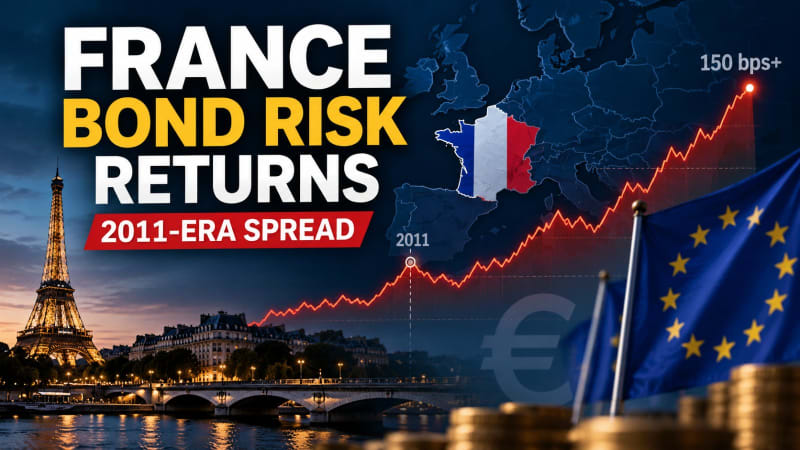
France’s Bond Spread Just Hit a 2011-Era Extreme: Is Europe Quietly Re-Entering a Sovereign-Debt Risk Trade?
For much of 2026, investors have been focused on the Federal Reserve, oil, inflation and the extraordinary resilience of AI-driven equity markets.
But another risk is quietly emerging in Europe.
The gap between France’s 10-year government bond yield and Germany’s benchmark Bund yield recently surged above 150 basis points, reaching levels not seen since the euro-area sovereign-debt crisis era in 2011.
That matters because this spread is much more than a technical bond-market indicator.
It represents the additional return investors demand to lend to France rather than Germany — and therefore acts as a real-time measure of how markets perceive French fiscal and political risk.
At the same time, the euro recently fell to a 17-month low against the U.S. dollar, while investors increasingly sought safety in German government bonds and the Swiss franc.
The immediate market pressure has eased somewhat on October 6, with French yields retreating and European equities recovering. But the larger question remains:
Is France experiencing a temporary political-risk premium — or is Europe beginning to price sovereign-debt risk again?
Why France’s Bond Spread Suddenly Matters
Germany is generally treated as the euro area's sovereign benchmark.
When investors become more worried about another euro-area country's finances, they can demand a higher yield for holding that country's government bonds.
The France-Germany 10-year spread therefore provides a useful snapshot of changing perceptions of French risk.
A simplified example:
German 10-Year Bund Yield: 3.5%
French 10-Year Yield: 5.0%
France-Germany Spread: 1.5 percentage points, or 150 basis points
The wider the spread becomes, the larger the risk premium investors are demanding.
That does not automatically mean France is facing a debt crisis.
But a move toward levels last associated with the European sovereign-debt crisis deserves attention — particularly because France is one of the euro area's largest economies and sovereign bond markets.
Why Is the Market Worried About France?
The problem is not one single economic indicator.
It is the combination of high debt, a large fiscal deficit, rising borrowing costs and political difficulty in delivering fiscal consolidation.
France's government is seeking approximately €54 billion in savings in its proposed 2027 budget, while political divisions are making those adjustments difficult to implement.
The timing is particularly uncomfortable.
Government bond yields around the world have already risen sharply as investors demand greater compensation for inflation, fiscal deficits and enormous sovereign borrowing requirements.
The U.S. 10-year Treasury yield recently reached its highest level since 2002, demonstrating that France is not operating in isolation.
France's challenge is therefore occurring during a period when global bond investors are already becoming much more sensitive to government finances.
That changes the market equation.
For years, extremely low interest rates allowed governments to carry large debt loads relatively cheaply.
When borrowing costs remain elevated, refinancing that debt gradually becomes more expensive.
The Bigger Risk: France Is Not Greece
At first glance, that sounds reassuring.
France has a much larger, more diversified economy and deeper capital markets than the countries at the centre of the 2010–2012 euro-area debt crisis.
But its size creates another issue.
France is too important to the euro-area financial system for its bond market to be treated as an isolated peripheral-market problem.
If investors simply demand a modestly higher premium for French debt, markets can absorb it.
The more dangerous scenario would be a persistent widening in French spreads that begins influencing the borrowing costs of other European governments.
That is when a domestic fiscal story starts becoming a euro-area fragmentation story.
Reuters reports that concerns about France have already spilled into wider European sovereign markets, with investors watching countries including Italy and Spain.
The Contagion Chain Investors Should Watch
The potential transmission mechanism is relatively straightforward:
French fiscal uncertainty
↓
French government bonds sell off
↓
France-Germany yield spread widens
↓
Investors seek German Bunds and Swiss francs
↓
Euro comes under pressure
↓
Other high-debt European sovereign spreads are tested
↓
European banks and equities face higher risk premiums
↓
Pressure builds on the ECB to respond
This is why movements in French bonds matter even to investors who never directly own French government debt.
The Euro Is Becoming an Important Warning Signal
The foreign-exchange market may provide one of the clearest signals of whether the problem remains contained.
The euro recently dropped below $1.12 and reached a 17-month low as concerns about France's fiscal position intensified.
Bank of America strategists cited by Reuters estimate that a 10-basis-point widening in the France-Germany spread could potentially reduce EUR/USD by around 0.4%.
That relationship is important.
A falling euro can help European exporters by making their products more competitive internationally.
But if the currency is falling because investors are questioning fiscal stability, the interpretation becomes very different.
It becomes a measure of capital confidence.
That is why investors should watch the euro alongside sovereign spreads rather than looking at either market independently.
Could the ECB Be Forced to Step In?
This may eventually become the most important question.
The European Central Bank does not only manage interest rates. It must also ensure that monetary policy can be transmitted reasonably consistently across the euro area.
If government borrowing costs diverge dramatically because markets begin questioning individual countries' fiscal sustainability, monetary policy becomes much harder to implement.
The ECB has a tool specifically designed for this type of situation:
Transmission Protection Instrument — TPI
The TPI was created to allow the ECB to purchase securities when it believes disorderly market dynamics threaten monetary-policy transmission.
It has never been activated.
France therefore creates an interesting test.
At what point does a widening sovereign spread represent legitimate market pricing of fiscal risk — and at what point does it become the type of fragmentation the ECB believes requires intervention?
That distinction could become one of Europe's most important market debates.
The situation is particularly complicated because the ECB is simultaneously fighting inflation. On September 10, it raised its three key policy rates by 25 basis points, while its latest projections put average euro-area inflation at 3.0% in 2026.
The central bank therefore faces potentially conflicting pressures:
Fight inflation → keep monetary policy restrictive
versus
Contain financial fragmentation → prevent sovereign borrowing costs from becoming destabilising
That is not an easy policy combination.
Europe’s Fiscal Problem Is Bigger Than France
France may be today's focal point, but the broader European fiscal picture also deserves attention.
The ECB currently projects the euro-area government deficit at approximately 3.6% of GDP in 2026, rising to 3.7% in 2027.
Euro-area government debt is projected to rise from 87.1% of GDP in 2025 to 89.4% by 2028.
Europe is simultaneously trying to fund defence, infrastructure, energy security and other strategic priorities.
Higher bond yields make all of those ambitions more expensive.
This is why France could become part of a much larger global investment theme:
Governments are competing for capital again.
For more than a decade after the global financial crisis, investors worried primarily about insufficient economic growth and extremely low inflation.
The environment today looks very different.
Governments need enormous amounts of capital while investors are increasingly demanding higher yields to provide it.
Related LiveWorldMarket Insight: The Fed Isn't the Biggest Problem Anymore: Why the Global Bond Market Is Suddenly Worried About Government Debt
Why Equity Investors Should Care
Bond-market stress rarely remains confined to bonds if it persists.
Higher sovereign yields can influence:
- Bank funding costs
- Corporate borrowing costs
- Mortgage rates
- Government spending capacity
- Equity valuation multiples
- Currency movements
- Investor risk appetite
European banks deserve particular attention.
Banks hold substantial quantities of government securities and operate within economies whose financing conditions are influenced by sovereign yields.
A persistent increase in sovereign risk premiums can therefore create a feedback loop:
Government risk → bank risk → tighter credit → weaker growth → greater fiscal pressure.
That is one of the mechanisms that made Europe's previous sovereign-debt crisis so difficult to contain.
Today's situation is nowhere near that stage.
But the transmission mechanism has not disappeared.
Track European markets: Europe Market Dashboard
Why October 6 Matters: The Market Is Stabilising, Not Necessarily Solving the Problem
There is an important distinction between market stress easing and the underlying issue disappearing.
On October 6, French 10-year yields retreated by roughly 9 basis points after the previous week's surge, while the broader STOXX 600 gained around 1%. French risk premiums over Germany also narrowed.
That is encouraging.
But France's fiscal challenges, budget negotiations and political uncertainty have not suddenly vanished.
Investors should therefore avoid interpreting one session of falling yields as evidence that the sovereign-risk story is over.
The more useful question is whether spreads continue normalising over the coming weeks.
Five Indicators Investors Should Watch Next
1. France-Germany 10-Year Spread
This is the primary stress indicator.
A sustained decline would suggest confidence is returning.
A renewed move beyond recent extremes would indicate that markets remain concerned.
2. Italy-Germany and Spain-Germany Spreads
These help answer the crucial question:
Is the problem still France-specific, or is it spreading?
3. EUR/USD
Further euro weakness alongside widening sovereign spreads would strengthen the argument that fiscal concerns are affecting international capital flows.
4. European Bank Stocks
Banks can become an important transmission channel between sovereign stress and the real economy.
5. ECB Communication
Any discussion of fragmentation, transmission risks or the TPI would deserve close attention.
This Is Not 2011 — At Least Not Yet
The headline comparison with 2011 is powerful, but investors should use it carefully.
Today's euro area has institutional safeguards that did not exist in the same form during the previous sovereign-debt crisis.
Banks are generally better capitalised, the ECB has accumulated extensive crisis-management experience, and mechanisms now exist to respond to severe market fragmentation.
The current situation therefore should not automatically be described as another European debt crisis.
A better description is:
The market has started charging France a significantly larger fiscal-risk premium.
Whether that remains a French political story or develops into a broader European sovereign-risk trade is what investors now need to determine.
The Bigger Global Message
France's bond-market turbulence fits into something much larger.
The United States is dealing with rising Treasury yields.
Japan is confronting higher government borrowing costs.
Britain has seen renewed pressure at the long end of its government bond market.
And now France has become the centre of Europe's fiscal-risk debate.
The common thread is increasingly clear:
The bond market is becoming less willing to ignore government debt.
For equity investors accustomed to focusing almost exclusively on central-bank policy, AI earnings and economic growth, that could represent an important regime change.
The next global market shock may not begin with a central bank.
It may begin when bond investors decide a government must pay substantially more for their capital.
For now, France is one of the clearest places to watch that transition.
LiveWorldMarket View
The widening France-Germany bond spread does not mean Europe has entered another sovereign-debt crisis.
But dismissing the move simply because European equities remain relatively resilient could also be a mistake.
The key question is contagion.
If French spreads stabilise while Italian and Spanish spreads remain contained, the episode may ultimately be remembered primarily as a repricing of French political and fiscal risk.
If spreads begin widening simultaneously across multiple euro-area sovereigns while the euro weakens and European banks underperform, the narrative changes.
At that point, investors would no longer be trading France.
They would be trading European sovereign risk.
That is the threshold global investors should be watching.
Explore More on LiveWorldMarket
Disclaimer: This article is for informational and educational purposes only and should not be considered investment advice.
Comments (0)
Be the first to comment.
About the author

NISM-Series-X-A Investment Adviser Level 1 examination completed
Amit writes about Indian equity markets, technical analysis, macro themes and the day-to-day mechanics of trading, with a focus on making the flow of global markets legible for retail investors. He has completed the NISM-Series-X-A Investment Adviser Level 1 examination.
You May Also Like

STOXX 600 Rises 2% as Nasdaq Falls 4.5%: Is Europe Taking the Lead?
Global Markets & Economy · Oct 18, 2026 · 13 min read
Europe’s STOXX 600 Gains Over 2% as Nasdaq Falls 4.5%: Is Global Stock Market Leadership Shifting? Europe's stock markets delivered their strongest week since June while U.S. technology shares suffered their worst weekly decline in months. The divergence raises a critical question for global investors: Is the market beginning to reward diversified earnings growth instead of…
Read more...
CoreWeave Bond Yields Hit 16%: AI Data Center Debt Risks
Technology & Sectors · Oct 17, 2026 · 13 min read
CoreWeave Bond Yields Hit 16%: Is AI Data-Center Debt Becoming the Next Big Risk for Global Stocks? The artificial intelligence boom has entered a new phase. Investors are no longer asking only how much money AI companies can earn. They are increasingly questioning how much it costs to finance the infrastructure supporting that growth. This week, CoreWeave, a U.S.-based AI…
Read more...
Indonesia Stocks Crash 11.57%: Will MSCI Downgrade Benefit India?
India & Global Connections · Oct 16, 2026 · 12 min read
Indonesia Stocks Plunge 11% as MSCI Proposes Downgrade: Could India and Other Emerging Markets Benefit? Indonesia's stock market has suffered its sharpest one-day decline in nearly three decades, but the bigger story extends far beyond Jakarta. A proposed MSCI downgrade could eventually force global index funds to remove Indonesian equities from their portfolios, potentially…
Read more...
IMF Asia Growth 4.4%, US CPI 3.7%: Which Stocks Are at Risk?
News · Oct 15, 2026 · 12 min read
IMF Sees Asia Growth Slowing to 4.4% as U.S. Inflation Hits 3.7%: Which Stock Markets Are Most Vulnerable? Asia's stock markets are facing a critical test as two major economic developments collide: the International Monetary Fund's warning about slower regional growth and an unexpected rise in U.S. inflation. The IMF's October Asia-Pacific outlook projects regional economic…
Read more...
China Exports Surge 36.3%, PPI Hits 5%: Stock Winners & Losers
Geopolitics & Trade · Oct 14, 2026 · 11 min read
China's Exports Surge 36.3% as Factory Inflation Hits 5%: Which Global Stocks Could Win or Lose? China's factories are shipping more goods overseas than expected, but a sharp rise in producer prices is raising a new question about the profitability of the world's manufacturing powerhouse. Official data released on October 14 showed that China's exports surged 36.3%…
Read more...
CXMT DRAM Breakthrough: Samsung, SK Hynix & Micron at Risk?
Technology & Sectors · Oct 13, 2026 · 11 min read
China's CXMT DRAM Breakthrough: Could a Memory Price War Threaten Samsung, SK Hynix and Micron? The global semiconductor industry is confronting a new question: Could China's progress in memory-chip technology eventually undermine the pricing power of the world's largest DRAM manufacturers? Chinese chipmaker ChangXin Memory Technologies (CXMT) has reportedly made progress in a…
Read more...
RBI Dollar Window: Can Rupee Near ₹97 Survive $100 Oil?
Central Banks & Rates · Oct 12, 2026 · 9 min read
RBI Opens Special Dollar Window as Rupee Nears ₹97: Can India Protect Its Stock Market From $100 Oil? India's central bank has introduced a new defense against rupee weakness at a time when crude oil prices remain above $100 per barrel. The Reserve Bank of India (RBI) has announced a special dollar facility for three government-owned oil marketing companies, beginning October…
Read more...
Firmus $5B IPO Cancelled: AI Data Center Valuations at Risk
Technology & Sectors · Oct 11, 2026 · 9 min read
Nvidia-Backed Firmus Cancels $5 Billion IPO: Is Wall Street Finally Questioning AI Data Center Valuations? The global artificial intelligence investment boom has encountered a revealing reality check. Firmus Technologies, an Australian AI data center developer backed by Nvidia, has withdrawn its planned multibillion-dollar stock market listing after struggling to attract…
Read more...
Starlink $8B Spectrum Deal: Telecom Stocks Fall, Towers Rise
Technology & Sectors · Oct 10, 2026 · 10 min read
Starlink's $8 Billion Spectrum Deal: Why Telecom Stocks Fell While Tower Shares Surged A single spectrum deal has sent shockwaves through the global telecommunications industry. On October 8, SpaceX announced an agreement to acquire nationwide 800 MHz wireless spectrum from Grain Management, marking a significant step toward expanding its Starlink Mobile business. The…
Read more...
Two-Thirds of S&P 500 Stocks Rose—Why Did the Index Fall? AI Warning
Technology & Sectors · Oct 9, 2026 · 11 min read
The AI Boom Is Turning Into a $100 Billion Debt Race: Could Borrowing Costs Become the Next Risk for Tech Stocks? For the past three years, artificial intelligence has been one of the biggest forces driving global stock markets. From Nvidia's extraordinary rise to the massive expansion of AI data centres, investors have rewarded companies promising to build the infrastructure…
Read more...