
IMF Asia Growth 4.4%, US CPI 3.7%: Which Stocks Are at Risk?
IMF Sees Asia Growth Slowing to 4.4% as U.S. Inflation Hits 3.7%: Which Stock Markets Are Most Vulnerable?
Asia's stock markets are facing a critical test as two major economic developments collide: the International Monetary Fund's warning about slower regional growth and an unexpected rise in U.S. inflation.
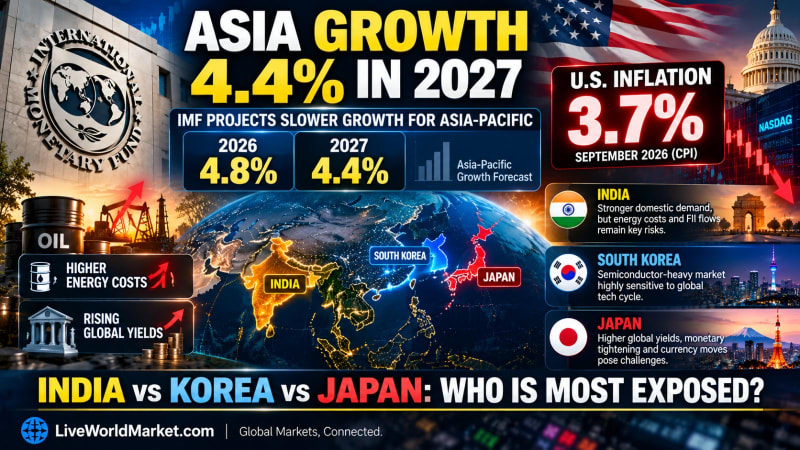
The IMF's October Asia-Pacific outlook projects regional economic growth of 4.8% in 2026 and 4.4% in 2027, down from 5.0% in 2025.
Meanwhile, U.S. consumer inflation accelerated to 3.7% in September, above the market's 3.6% expectation, increasing concerns that the Federal Reserve may need to maintain tighter monetary policy.
The combination has intensified pressure on Asian equities, particularly technology-heavy markets.
But not every Asian economy faces the same risks.
South Korea is highly exposed to semiconductor and AI investment cycles. Japan faces a combination of global bond-yield pressures, currency volatility and technology-sector weakness. India benefits from a more domestically oriented economy but remains vulnerable to expensive energy imports and foreign capital outflows.
The central investment question is whether Asia's fastest-growing economies can continue supporting equity valuations when global borrowing costs are rising and the AI investment boom is becoming more volatile.
1. What Did the IMF Actually Say About Asia's Economy?
The IMF's latest Asia-Pacific Regional Economic Outlook presents a mixed picture.
The region remains an important engine of global economic growth, but expansion is expected to moderate over the coming year.
IMF Asia-Pacific Growth Outlook

Important context: The IMF has revised its forecasts upward compared with April 2026. Therefore, its latest report does not indicate a sudden collapse in Asian economic activity.
Instead, it suggests that Asia remains resilient while facing increasing risks from energy prices, global interest rates and dependence on AI-related investment.
The IMF identifies three major threats.
Energy shock: Higher oil and gas prices are increasing costs for import-dependent Asian economies.
Rising global bond yields: Higher borrowing costs could affect government finances, corporate investment and financial-market valuations.
Potential AI-sector correction: A slowdown in AI investment could disproportionately affect Asian economies closely connected to semiconductor production.
These risks are interconnected.
Higher energy prices can increase inflation, which can encourage tighter monetary policy, while higher interest rates can reduce the valuations of growth-oriented companies.
2. Why U.S. Inflation at 3.7% Matters for Asian Stocks
The U.S. Bureau of Labor Statistics reported that September consumer prices rose 3.7% year-on-year, compared with 3.4% in August.
Monthly headline inflation reached 0.6%.
Energy prices were an important contributor, with gasoline prices rising 9.1% during September.
Core inflation, which excludes food and energy, increased 2.6% year-on-year.
The figures indicate that inflation remains a challenge for the Federal Reserve.
For global markets, the concern is not limited to American consumers.
How U.S. Inflation Reaches Asian Equity Markets
The transmission mechanism works through several channels.
Higher U.S. inflation → Expectations of tighter Federal Reserve policy → Higher U.S. Treasury yields → Greater pressure on Asian currencies and equity valuations.
When U.S. bond yields rise, dollar-denominated investments can become relatively more attractive.
That can encourage some international investors to reduce exposure to emerging-market assets.
Higher yields can also increase financing costs and reduce the present value investors assign to future corporate earnings.
This effect can be particularly important for technology companies whose valuations depend heavily on expected future growth.
However, currency and equity-market responses are not automatic. They also depend on local earnings, central-bank policies, valuations and investor positioning.
Related: Track U.S. equity-market trends and global technology stocks.
3. Why South Korea May Be the Most Sensitive to an AI Correction
South Korea's equity market is closely connected to the global semiconductor industry.
Samsung Electronics and SK Hynix are among the world's most important memory-chip manufacturers.
Their businesses are influenced by global demand for data centers, AI accelerators, smartphones, servers and electronic devices.
Strong AI infrastructure investment has supported demand for advanced memory products, particularly high-bandwidth memory.
But the same exposure can create vulnerability when investors question the sustainability of AI spending.
On October 15, South Korea's KOSPI experienced a sharp technology-led selloff, briefly falling more than 8% during trading and triggering a temporary trading halt.
The weakness illustrates how quickly changes in global technology sentiment can affect a semiconductor-heavy stock market.
Why the Korean Market Is Vulnerable
First, major semiconductor companies carry substantial influence within the country's benchmark indices.
Second, memory-chip earnings are sensitive to product prices, capacity investment and technology cycles.
Third, foreign institutional investment can amplify market movements during periods of global risk aversion.
Fourth, higher global borrowing costs may affect valuations even when underlying chip demand remains strong.
What Investors Should Monitor in South Korea
- Samsung Electronics and SK Hynix earnings expectations
- High-bandwidth memory demand and pricing
- Global AI infrastructure capital expenditure
- Foreign institutional equity flows
- Korean won movements against the U.S. dollar
- KOSPI market breadth and volatility
Investment implication: South Korea may have greater direct exposure to a global AI and semiconductor valuation correction than more domestically diversified Asian markets.
That does not mean its long-term technology fundamentals have necessarily deteriorated. It means the market may be more sensitive to changes in expectations.
4. Japan: A Different Combination of Risks
Japan's stock market faces a more complicated set of pressures.
Japanese equities include globally competitive exporters, industrial manufacturers, banks, technology businesses and semiconductor-related companies.
These industries do not respond uniformly to higher interest rates or currency movements.
Risk One: Rising Global Bond Yields
Higher international yields can place upward pressure on Japanese borrowing costs and influence domestic financial conditions.
Companies with large financing requirements may face greater pressure.
Risk Two: Currency Volatility
The Japanese yen plays a major role in global currency markets.
A weaker yen can support the translated earnings of exporters, but it can also increase the domestic cost of imported energy and other commodities.
A stronger yen may have the opposite effect.
Risk Three: Technology and AI Valuations
Japanese semiconductor equipment manufacturers, electronics businesses and technology investment companies are exposed to global capital-expenditure expectations.
If AI infrastructure spending slows, some of these companies could face lower growth expectations.
Japan's Nikkei 225 fell nearly 5% on October 15 as technology-related selling intensified.
Are Japanese Banks Potential Beneficiaries?
Banks can sometimes benefit from higher interest rates through improved lending margins.
However, rapidly rising bond yields can also create valuation losses on bond holdings and increase credit risks.
The net effect depends on each bank's balance sheet and interest-rate exposure.
Investment implication: Japan's vulnerability is more diversified than South Korea's. Currency movements, bond yields, exporters and technology valuations can pull the market in different directions.
5. India: Can Domestic Demand Provide Greater Resilience?
India's equity market differs structurally from the semiconductor-heavy markets of South Korea and Taiwan.
Its major listed sectors include financial services, information technology, consumer businesses, industrial companies, energy and pharmaceuticals.
Domestic consumption, infrastructure investment and services activity provide important sources of economic demand.
This can offer some diversification when global technology stocks weaken.
However, India is not insulated from international financial conditions.
India's First Risk: Higher Crude Oil Prices
India imports a substantial share of its crude oil requirements.
Sustained increases in energy prices can raise the import bill, create inflationary pressure and affect corporate margins.
Airlines, chemicals, paints, logistics and other energy-sensitive businesses may face higher costs.
India's Second Risk: Foreign Portfolio Outflows
When U.S. yields rise, international investors may reassess allocations to emerging markets.
Foreign institutional selling can pressure Indian equity valuations, particularly in widely held large-cap stocks.
Domestic institutional investment may provide an offset, but its effectiveness varies.
India's Third Risk: Currency Pressure
A weaker rupee can increase the local-currency cost of imported commodities and equipment.
At the same time, some exporters may benefit from favorable currency translation.
The effect differs significantly across industries.
India's Fourth Risk: Valuations
Even when economic growth remains comparatively strong, stocks can decline if valuations are high or earnings fail to meet expectations.
This is an important distinction.
A resilient economy does not guarantee a resilient stock market at every price.
Which Indian Sectors Deserve Attention?
Banks and consumer businesses may benefit from domestic demand, although they remain sensitive to inflation and financing conditions.
IT exporters depend heavily on global technology spending and client budgets.
Oil-sensitive sectors may face margin pressure if energy prices remain elevated.
Pharmaceutical exporters may have different demand drivers, but they are still exposed to currency and regulatory developments.
Related: LiveWorldMarket India Stock Market Dashboard.
6. India vs South Korea vs Japan: Which Market Is Most Vulnerable?
The answer depends on the type of global shock.

This is a qualitative risk comparison, not a numerical ranking or forecast of index returns.
Which Market Looks Most Exposed?
To an AI-led correction: South Korea appears particularly sensitive because of its concentrated semiconductor exposure.
To rising global yields and currency instability: Japan faces a complex interaction between monetary conditions, the yen and equity valuations.
To prolonged high oil prices and foreign capital outflows: India remains vulnerable despite its relatively strong domestic demand base.
The important conclusion is that no single Asian market is automatically the safest across every economic scenario.
7. Why Higher Bond Yields Could Become Asia's Bigger Problem
The IMF's warning about global bond yields deserves special attention.
Investors often focus on daily equity-market declines, but sustained increases in borrowing costs can have broader economic consequences.
Governments may face higher debt-servicing expenses.
Companies may delay expansion projects because financing becomes more expensive.
Consumers may encounter higher loan rates.
Equity investors may demand greater returns to compensate for risk.
These effects can reinforce one another.
The Global Yield Transmission Mechanism
Persistent U.S. inflation → Higher Treasury yields → Pressure on Asian bond markets → Higher financing costs → Potential earnings and valuation pressure.
The impact is likely to be greatest where borrowing requirements are high, financing conditions are fragile or equity valuations already assume rapid earnings growth.
This is why a bond-market shock can affect multiple countries even when their economic growth rates differ.
Related: Explore global macroeconomic and market Insights.
8. Is the AI Boom Becoming a Risk for Asian Economic Growth?
The IMF acknowledges that AI investment has supported growth in advanced Asian economies.
Demand for advanced semiconductors, memory chips, computing equipment and technology infrastructure has helped strengthen activity across important regional supply chains.
But dependence on a fast-growing investment theme creates concentration risk.
If companies begin reducing AI infrastructure spending, the effects could spread beyond stock valuations.
Semiconductor manufacturers may face weaker orders.
Equipment suppliers may experience slower demand.
Capital investment plans could be revised.
Technology-related exports could lose momentum.
However, a decline in AI-related share prices does not necessarily mean actual AI demand has collapsed.
Stock markets can reprice expectations before a measurable slowdown appears in corporate orders.
Investors should distinguish between a valuation correction and an earnings deterioration.
9. Global Sector Impact: Potential Winners and Losers

The objective is not to assume every technology stock will fall or every defensive stock will rise.
Investors should examine earnings sensitivity, debt levels, cash flows and valuation expectations.
10. Three Scenarios for Asian Stock Markets
Scenario One: Inflation Eases and Bond Yields Stabilize
If U.S. inflation moderates and energy prices decline, global financial conditions could become more supportive.
Asian currencies may stabilize, foreign investment flows could improve and technology valuations may recover.
This would generally be more favorable for risk assets.
Scenario Two: Inflation Remains Elevated but Economic Growth Holds Up
In this scenario, corporate earnings may continue growing, but higher borrowing costs limit equity valuations.
Markets could experience sharp sector rotation.
Companies with pricing power, strong balance sheets and predictable cash flows may be relatively better positioned.
Scenario Three: Energy Prices Remain High and AI Spending Slows
This would be the more difficult scenario.
High input costs could pressure margins while slower technology investment weakens demand for semiconductors and related equipment.
Asian economies could face simultaneous inflation and growth pressures.
Markets with concentrated technology exposure or high dependence on imported energy may experience greater volatility.
11. Five Indicators Investors Should Watch Next
U.S. Treasury Yields
Higher yields can influence global equity valuations and international capital flows.
Brent Crude Oil
Energy prices are central to inflation and external-balance risks across much of Asia.
Asian Currency Movements
USD/INR, USD/KRW and USD/JPY can provide useful signals about currency pressures, although each pair responds to different domestic conditions.
Semiconductor Earnings and AI Spending
Results and capital-expenditure guidance from major technology companies can help distinguish short-term market volatility from changes in underlying demand.
Foreign Institutional Investment
Cross-border equity and bond flows can indicate whether global investors are reducing or rebuilding exposure to Asian markets.
Indian investors should also monitor Nifty 50, Bank Nifty, India VIX and domestic institutional flows.
Related: Follow global markets and regional dashboards.
LiveWorldMarket View: Asia's Growth Is Resilient, but Its Stock Markets Face Different Risks
The IMF's latest outlook does not suggest that Asia is entering an economic collapse.
Regional growth is still expected to remain substantial, and the IMF has upgraded its projections compared with earlier estimates.
But the combination of 3.7% U.S. inflation, rising global borrowing costs, expensive energy and uncertainty around AI valuations creates a challenging environment for equities.
South Korea is particularly exposed to shifts in semiconductor sentiment.
Japan faces a combination of currency, bond-yield and technology risks.
India has greater domestic-demand support but remains vulnerable to oil prices, foreign portfolio flows and valuations.
For investors, the central lesson is that economic growth, corporate earnings and stock-market performance are three different things.
A country can deliver strong GDP growth while its stock market struggles if earnings expectations are too optimistic or valuations are too expensive.
Equally, a market facing slower economic growth can perform well if valuations already reflect the risks and companies deliver better-than-expected profits.
The key takeaway: Asia's next market winners may not be the countries with the fastest GDP growth, but the companies and markets best positioned to withstand higher borrowing costs, energy inflation and changing AI investment expectations.
For more analysis, visit LiveWorldMarket.com and explore our latest global market Insights.
Sources and further reading
- IMF — Asia and Pacific economic outlook
- U.S. Bureau of Labor Statistics — September 2026 CPI release
- Reuters — IMF warns of slowing Asian growth, October 15, 2026
- Associated Press — U.S. stock-market performance, October 14, 2026
- IMF — Asia-Pacific Department press briefing, October 15, 2026
Disclaimer: This article is for educational and informational purposes only. It does not constitute personalized investment advice or a recommendation to buy or sell securities. Market conditions, economic forecasts and investment risks can change rapidly.
Comments (0)
Be the first to comment.
About the author

NISM-Series-X-A Investment Adviser Level 1 examination completed
Amit writes about Indian equity markets, technical analysis, macro themes and the day-to-day mechanics of trading, with a focus on making the flow of global markets legible for retail investors. He has completed the NISM-Series-X-A Investment Adviser Level 1 examination.
You May Also Like
China Exports Surge 36.3%, PPI Hits 5%: Stock Winners & Losers
Geopolitics & Trade · Oct 14, 2026 · 11 min read
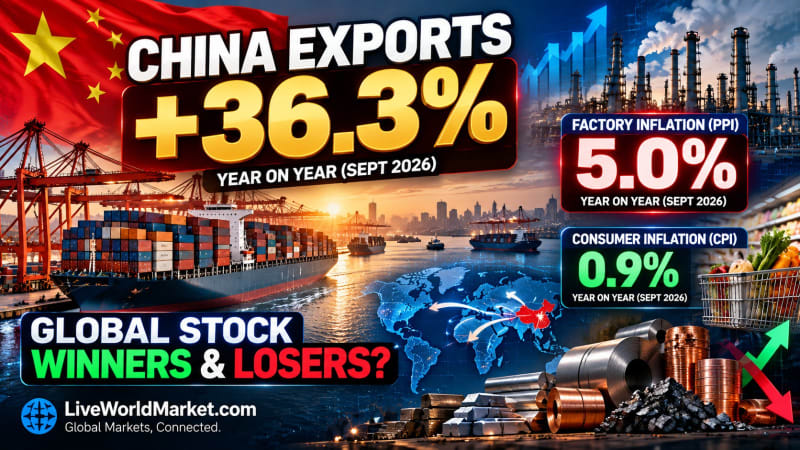
China's Exports Surge 36.3% as Factory Inflation Hits 5%: Which Global Stocks Could Win or Lose? China's factories are shipping more goods overseas than expected, but a sharp rise in producer prices is raising a new question about the profitability of the world's manufacturing powerhouse. Official data released on October 14 showed that China's exports surged 36.3%…
Read more...
CXMT DRAM Breakthrough: Samsung, SK Hynix & Micron at Risk?
Technology & Sectors · Oct 13, 2026 · 11 min read
China's CXMT DRAM Breakthrough: Could a Memory Price War Threaten Samsung, SK Hynix and Micron? The global semiconductor industry is confronting a new question: Could China's progress in memory-chip technology eventually undermine the pricing power of the world's largest DRAM manufacturers? Chinese chipmaker ChangXin Memory Technologies (CXMT) has reportedly made progress in a…
Read more...
RBI Dollar Window: Can Rupee Near ₹97 Survive $100 Oil?
Central Banks & Rates · Oct 12, 2026 · 9 min read
RBI Opens Special Dollar Window as Rupee Nears ₹97: Can India Protect Its Stock Market From $100 Oil? India's central bank has introduced a new defense against rupee weakness at a time when crude oil prices remain above $100 per barrel. The Reserve Bank of India (RBI) has announced a special dollar facility for three government-owned oil marketing companies, beginning October…
Read more...
Firmus $5B IPO Cancelled: AI Data Center Valuations at Risk
Technology & Sectors · Oct 11, 2026 · 9 min read
Nvidia-Backed Firmus Cancels $5 Billion IPO: Is Wall Street Finally Questioning AI Data Center Valuations? The global artificial intelligence investment boom has encountered a revealing reality check. Firmus Technologies, an Australian AI data center developer backed by Nvidia, has withdrawn its planned multibillion-dollar stock market listing after struggling to attract…
Read more...
Starlink $8B Spectrum Deal: Telecom Stocks Fall, Towers Rise
Technology & Sectors · Oct 10, 2026 · 10 min read
Starlink's $8 Billion Spectrum Deal: Why Telecom Stocks Fell While Tower Shares Surged A single spectrum deal has sent shockwaves through the global telecommunications industry. On October 8, SpaceX announced an agreement to acquire nationwide 800 MHz wireless spectrum from Grain Management, marking a significant step toward expanding its Starlink Mobile business. The…
Read more...
Two-Thirds of S&P 500 Stocks Rose—Why Did the Index Fall? AI Warning
Technology & Sectors · Oct 9, 2026 · 11 min read
The AI Boom Is Turning Into a $100 Billion Debt Race: Could Borrowing Costs Become the Next Risk for Tech Stocks? For the past three years, artificial intelligence has been one of the biggest forces driving global stock markets. From Nvidia's extraordinary rise to the massive expansion of AI data centres, investors have rewarded companies promising to build the infrastructure…
Read more...
AI Debt Boom 2026: Could Borrowing Costs Hit Tech Stocks?
News · Oct 8, 2026 · 11 min read
The AI Boom Is Turning Into a $100 Billion Debt Race: Could Borrowing Costs Become the Next Risk for Tech Stocks? For the past three years, artificial intelligence has been one of the biggest forces driving global stock markets. From Nvidia's extraordinary rise to the massive expansion of AI data centres, investors have rewarded companies promising to build the infrastructure…
Read more...
$100 Oil Is Back: Which Stock Markets and Sectors Are Most Exposed?
Commodities & Energy · Oct 7, 2026 · 12 min read
The $100 Oil Test Has Arrived: Which Global Stock Markets and Sectors Are Most Exposed If Crude Stays Above Triple Digits? Oil above $100 is no longer a hypothetical risk for global markets. Brent crude traded above $101 a barrel on October 7, while U.S. West Texas Intermediate hovered near $90 as investors confronted a combination of Middle East supply risks, attacks on…
Read more...
Stocks Hit Record Highs While Bond Yields Flash a Warning: Which Market Is Right?
Global Markets & Economy · Oct 6, 2026 · 9 min read
Stocks Are Hitting Records While Bonds Flash a Warning: Which Market Is Right? Something unusual is happening across global financial markets. Stocks are celebrating. Bonds are warning. On October 6, global equities climbed to their highest level in roughly two weeks. The S&P 500 reached another record, while the technology-heavy Nasdaq extended its run of all-time highs. The…
Read more...
France Bond Spread Hits 2011-Era Extreme: Is Europe’s Debt Risk Returning?
Global Markets & Economy · Oct 6, 2026 · 9 min read
France’s Bond Spread Just Hit a 2011-Era Extreme: Is Europe Quietly Re-Entering a Sovereign-Debt Risk Trade? For much of 2026, investors have been focused on the Federal Reserve, oil, inflation and the extraordinary resilience of AI-driven equity markets. But another risk is quietly emerging in Europe. The gap between France’s 10-year government bond yield and Germany’s…
Read more...