
Firmus $5B IPO Cancelled: AI Data Center Valuations at Risk
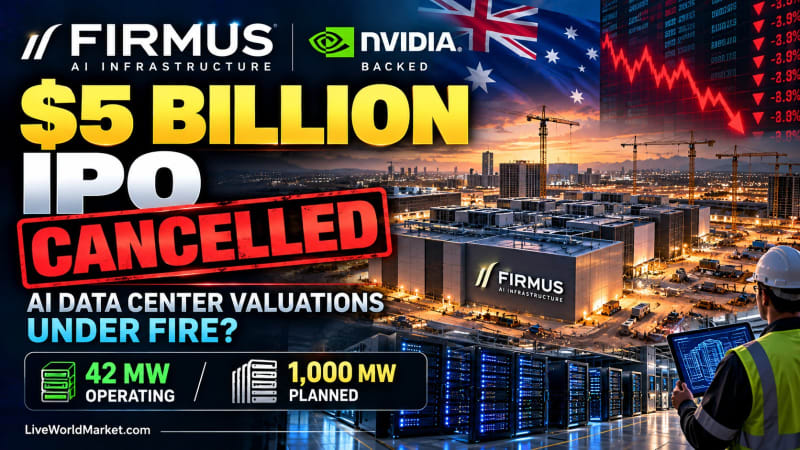
Nvidia-Backed Firmus Cancels $5 Billion IPO: Is Wall Street Finally Questioning AI Data Center Valuations?
The global artificial intelligence investment boom has encountered a revealing reality check. Firmus Technologies, an Australian AI data center developer backed by Nvidia, has withdrawn its planned multibillion-dollar stock market listing after struggling to attract sufficient investor demand at its proposed valuation.
The cancellation matters far beyond Australia.
For several years, investors have rewarded companies promising to build the computing infrastructure required for generative AI. Data centers, advanced chips, power generation and high-speed networks have become central investment themes.
But Firmus raises a different question: What happens when investors are asked to pay tomorrow's valuation for infrastructure that largely exists only in development plans today?
That distinction could become increasingly important for AI infrastructure stocks across the United States, Europe and Asia.
What Happened to the Firmus IPO?
Firmus had planned to list on the Australian Securities Exchange in one of the country's largest initial public offerings in decades.
The transaction initially targeted approximately US$5 billion in fundraising and a company valuation approaching US$31 billion.
However, demand proved weaker than anticipated.
After considering lower pricing, Firmus withdrew the IPO on October 9, citing volatile market conditions and concerns that the available terms did not reflect its long-term prospects.
The company said it would pursue alternative fundraising opportunities, including private-market capital.
The withdrawal does not mean Firmus has stopped operating or that its AI projects have been cancelled. It means the company could not complete the proposed public offering on acceptable terms.
For global investors, that is an important distinction.
Related: Explore global equity-market developments.
The Most Important Number: 42 MW Versus 1,000 MW
One of the biggest questions surrounding the proposed listing concerned the gap between Firmus's existing infrastructure and its expansion ambitions.
Reuters Breakingviews reported that Firmus had approximately 42 megawatts of operating capacity against a planned 1,000 megawatts.
That means only about 4.2% of the targeted capacity was operating at the time of the report.
AI Infrastructure: Operating Capacity Versus Ambition

Source: Reuters Breakingviews. The comparison uses reported operating capacity and targeted capacity, not a complete assessment of contracted or financed projects.
This gap does not automatically make the business unattractive. Infrastructure companies often invest heavily before new facilities generate revenue.
However, it introduces several risks that investors must evaluate:
- Can construction be completed on schedule?
- Will sufficient electricity and grid connections be available?
- Are customer commitments binding and economically attractive?
- How much additional capital will be needed?
- Will future operating margins justify the initial investment?
The larger the difference between planned capacity and operational capacity, the more important these questions become.
Why Nvidia's Backing Wasn't Enough
Nvidia has become one of the most influential companies in the global AI ecosystem.
Its processors power much of the advanced computing infrastructure used to train and operate AI models. Association with Nvidia can therefore strengthen a company's credibility and growth narrative.
Yet Nvidia's involvement does not eliminate construction, financing or valuation risk.
An AI data center developer must still secure land, electricity, cooling systems, equipment, customers and capital.
Even strong projected demand for AI computing does not guarantee that every project will achieve attractive returns.
This is the central lesson from Firmus: A powerful technology partner can support a business model, but cannot substitute for evidence that the economics work.
Are Investors Beginning to Reject AI Hype?
The Firmus cancellation could represent an early sign of greater selectivity in AI infrastructure financing.
During periods of strong enthusiasm, investors often prioritize market opportunity and future growth.
But when valuations rise, financing becomes more expensive or markets become volatile, attention tends to shift toward execution and profitability.
For AI infrastructure businesses, that means investors may increasingly distinguish between three categories:
Established operators: Companies with functioning facilities, paying customers and observable operating cash flow.
Developers with secured expansion: Companies building new facilities backed by credible financing, power arrangements and customer commitments.
Speculative expansion stories: Companies whose valuations depend heavily on infrastructure that is still planned, unfinanced or subject to major execution risks.
The important development is not that investors have stopped believing in AI.
It is that some may be demanding stronger evidence before paying premium prices.
Why Higher Bond Yields Matter for AI Data Centers
AI infrastructure is extremely capital-intensive.
Building modern data centers can require large investments in land, electrical systems, cooling equipment, networking hardware and high-performance processors.
Projects may take years to reach full utilization.
This creates a direct connection between AI valuations and global borrowing costs.
When bond yields rise, companies can face higher financing expenses. Investors may also apply higher discount rates to future earnings, reducing the present value of businesses whose profits are expected far into the future.
For a company with substantial operating cash flow today, this pressure may be manageable.
For a developer dependent on repeated funding rounds, the effect can be much greater.
The Financing Risk Chain
Higher borrowing costs → More expensive construction financing → Greater pressure on project returns → Lower acceptable valuations → Potential delays or additional equity dilution
This is why AI infrastructure should be analyzed not only as a technology investment, but also as an interest-rate-sensitive infrastructure business.
Related reading: LiveWorldMarket Insight articles on global markets, technology and borrowing costs.
What Does the Firmus IPO Failure Mean for U.S. AI Stocks?
The United States remains central to the AI infrastructure investment cycle.
Investors closely follow Nvidia, hyperscale cloud providers, data center operators, electrical-equipment suppliers and energy companies involved in supporting AI computing.
Firmus's experience raises different questions for each group.
1. AI Chipmakers
Chip suppliers benefit when customers purchase processors and networking equipment.
However, investors should watch whether infrastructure developers can continue securing financing for future orders.
A financing slowdown among developers could affect the timing of equipment purchases, even if underlying AI demand remains strong.
That is a potential risk, not evidence of an immediate decline in Nvidia's orders.
2. Data Center Operators
Operators with completed facilities, stable customer contracts and manageable debt may become more attractive relative to businesses relying on aggressive expansion assumptions.
Investors may place greater weight on utilization rates, contracted revenue and operating margins.
3. Cloud and AI Infrastructure Providers
Companies providing AI computing capacity must demonstrate that revenue growth can translate into sustainable cash generation.
Important questions include the cost of GPUs, customer concentration, equipment replacement cycles and the amount of debt required to fund expansion.
4. Utilities and Electrical Infrastructure Companies
AI data centers need dependable electricity.
That can create long-term opportunities for power producers, transmission providers and equipment manufacturers.
But infrastructure projects remain vulnerable to permitting delays, grid constraints and funding uncertainty.
The broader takeaway is that a growing AI market does not necessarily mean every AI-related stock deserves a premium valuation.
Australia: Why the Fallout Matters Beyond Firmus
The proposed Firmus listing was significant for Australia's equity market because of its unusually large size and its exposure to a globally popular investment theme.
The IPO withdrawal also affected perceptions of businesses financially connected to Firmus.
Australian construction and infrastructure company Maas Group, which has an investment exposure to Firmus, experienced selling pressure following the cancellation.
That illustrates how private-market valuations can influence publicly traded companies through equity stakes, construction contracts and expected future business.
Investors assessing such companies should distinguish between existing contracted cash flows and the assumed value of investments in privately held AI developers.
Could Asian AI Infrastructure Face Similar Scrutiny?
Asia is increasingly important to the global AI infrastructure expansion.
Countries across the region are competing to attract data centers, cloud investment, semiconductor manufacturing and related electrical infrastructure.
However, large planned investments do not automatically translate into completed facilities or profitable operations.
Projects may encounter constraints involving:
- Electricity availability and grid reliability
- Land acquisition and environmental approvals
- Cooling and water requirements
- Construction costs
- Customer concentration
- Foreign-exchange and financing exposure
Firmus is especially relevant because its reported strategy increasingly included Asian expansion.
If investors become more selective, developers throughout the region may need to demonstrate stronger project economics before securing capital.
What About India?
India's expanding digital economy creates potential opportunities across data centers, power infrastructure, electrical equipment, cooling systems and networking.
Demand for cloud computing and AI services could support long-term investment.
Nevertheless, Indian investors should avoid treating every company associated with data centers or AI infrastructure as a direct beneficiary of the same growth opportunity.
A listed engineering company building data centers has a different risk profile from a heavily leveraged data center developer.
A utility supplying electricity has different economics from a technology company renting AI computing capacity.
For Indian equities, the relevant questions include order-book quality, project margins, debt levels, working-capital requirements and the likelihood of timely execution.
Related: Track Indian stock market developments.
Five Indicators Investors Should Watch Next
The Firmus episode provides a practical framework for assessing the next phase of AI infrastructure investment.
1. Operating Capacity
How much infrastructure is already functioning compared with what has been announced?
2. Customer Commitments
Are customer agreements binding, and do they provide sufficient revenue visibility?
3. Funding Requirements
How much additional debt or equity is required before the project becomes self-sustaining?
4. Power Availability
Are electricity supply, grid connections and required approvals secured?
5. Cash Flow and Returns
Can the business generate acceptable returns after financing costs, depreciation and equipment replacement?
These indicators can help investors separate credible infrastructure growth from valuations that depend on optimistic assumptions.
Is This the Beginning of an AI Bubble Burst?
One cancelled IPO is not sufficient evidence that the global AI investment cycle has ended.
AI adoption may continue expanding, and the need for computing capacity could remain substantial.
But the cancellation does challenge the assumption that strong AI demand automatically supports almost any valuation.
A healthier investment environment may emerge if capital increasingly flows toward businesses with demonstrable operating performance rather than the most ambitious projections.
That could produce a market in which some AI infrastructure companies continue growing while others face valuation reductions, slower expansion or more expensive funding.
In other words, the AI investment boom could continue even as investors become much more selective about its winners.
LiveWorldMarket View: From AI Excitement to AI Economics
The most important lesson from the Firmus IPO withdrawal is not that artificial intelligence has lost its potential.
It is that financial markets may be starting to draw a sharper distinction between technological opportunity and investment returns.
The next phase of AI infrastructure investing could be defined by operational delivery, financing discipline and cash-flow generation.
For global investors, the critical question is changing.
It is no longer simply, How much AI infrastructure will the world need?
It is increasingly, Which companies can build that infrastructure profitably without requiring investors to accept excessive financial risk?
That question deserves close attention across U.S. technology stocks, Australian infrastructure businesses and emerging Asian data center markets.
For ongoing coverage, explore LiveWorldMarket's global market dashboards and market Insights.
Sources and further reading
- Reuters Breakingviews — Failed AI IPO puts fear before FOMO
- Reuters Breakingviews — Shaky $4 Billion Neocloud IPO Pricks AI Bubble
- ABC News Australia — Firmus Pulls Blockbuster ASX Float
- Data Center Dynamics — Firmus Cancels IPO
Disclaimer: This article is for educational and informational purposes only and does not constitute investment advice. Financial figures are based on reported information available as of October 11, 2026. Market conditions and company plans may change.
Comments (0)
Be the first to comment.
About the author

NISM-Series-X-A Investment Adviser Level 1 examination completed
Amit writes about Indian equity markets, technical analysis, macro themes and the day-to-day mechanics of trading, with a focus on making the flow of global markets legible for retail investors. He has completed the NISM-Series-X-A Investment Adviser Level 1 examination.
You May Also Like

Starlink $8B Spectrum Deal: Telecom Stocks Fall, Towers Rise
Technology & Sectors · Oct 10, 2026 · 10 min read
Starlink's $8 Billion Spectrum Deal: Why Telecom Stocks Fell While Tower Shares Surged A single spectrum deal has sent shockwaves through the global telecommunications industry. On October 8, SpaceX announced an agreement to acquire nationwide 800 MHz wireless spectrum from Grain Management, marking a significant step toward expanding its Starlink Mobile business. The…
Read more...
Two-Thirds of S&P 500 Stocks Rose—Why Did the Index Fall? AI Warning
Technology & Sectors · Oct 9, 2026 · 11 min read
The AI Boom Is Turning Into a $100 Billion Debt Race: Could Borrowing Costs Become the Next Risk for Tech Stocks? For the past three years, artificial intelligence has been one of the biggest forces driving global stock markets. From Nvidia's extraordinary rise to the massive expansion of AI data centres, investors have rewarded companies promising to build the infrastructure…
Read more...
AI Debt Boom 2026: Could Borrowing Costs Hit Tech Stocks?
News · Oct 8, 2026 · 11 min read
The AI Boom Is Turning Into a $100 Billion Debt Race: Could Borrowing Costs Become the Next Risk for Tech Stocks? For the past three years, artificial intelligence has been one of the biggest forces driving global stock markets. From Nvidia's extraordinary rise to the massive expansion of AI data centres, investors have rewarded companies promising to build the infrastructure…
Read more...
$100 Oil Is Back: Which Stock Markets and Sectors Are Most Exposed?
Commodities & Energy · Oct 7, 2026 · 12 min read
The $100 Oil Test Has Arrived: Which Global Stock Markets and Sectors Are Most Exposed If Crude Stays Above Triple Digits? Oil above $100 is no longer a hypothetical risk for global markets. Brent crude traded above $101 a barrel on October 7, while U.S. West Texas Intermediate hovered near $90 as investors confronted a combination of Middle East supply risks, attacks on…
Read more...
Stocks Hit Record Highs While Bond Yields Flash a Warning: Which Market Is Right?
Global Markets & Economy · Oct 6, 2026 · 9 min read
Stocks Are Hitting Records While Bonds Flash a Warning: Which Market Is Right? Something unusual is happening across global financial markets. Stocks are celebrating. Bonds are warning. On October 6, global equities climbed to their highest level in roughly two weeks. The S&P 500 reached another record, while the technology-heavy Nasdaq extended its run of all-time highs. The…
Read more...
France Bond Spread Hits 2011-Era Extreme: Is Europe’s Debt Risk Returning?
Global Markets & Economy · Oct 6, 2026 · 9 min read
France’s Bond Spread Just Hit a 2011-Era Extreme: Is Europe Quietly Re-Entering a Sovereign-Debt Risk Trade? For much of 2026, investors have been focused on the Federal Reserve, oil, inflation and the extraordinary resilience of AI-driven equity markets. But another risk is quietly emerging in Europe. The gap between France’s 10-year government bond yield and Germany’s…
Read more...
Why Are Defense Stocks Falling Despite Rising Global Military Spending?
Geopolitics & Trade · Oct 5, 2026 · 12 min read
Global military spending is rising. Weapons inventories are being rebuilt. Major defense contractors are receiving some of the largest multiyear orders in years. Yet U.S. defense stocks have been falling. The iShares U.S. Aerospace & Defense ETF has declined by as much as 18.2% from its August 14 record high and has posted seven consecutive weekly losses, its longest such…
Read more...
U.S. Jobs Fall to 29,000 as Nasdaq Hits Record: Why Weak Data Is Lifting Stocks
Trend · Oct 4, 2026 · 11 min read
U.S. Jobs Just Fell to 29,000—So Why Did the Nasdaq Hit a Record High? The ‘Bad News Is Good News’ Trade Is Back The latest U.S. jobs report delivered what would normally look like bad news for the economy. The United States added only 29,000 jobs in September, far below expectations. The unemployment rate increased to 4.2%. Annual wage growth slowed to 3.0%. And employment…
Read more...
China’s Fuel Export Squeeze: Could Asia’s $50 Refining Margins Become the Next Inflation Shock?
Commodities & Energy · Oct 3, 2026 · 10 min read
China’s Fuel Export Squeeze: Could Asia’s $50 Refining Margins Become the Next Inflation Shock? Global investors have spent much of 2026 watching crude oil. But another part of the energy market may now deserve just as much attention: the cost of refining crude oil into the fuels that households and businesses actually use. Tightening Chinese fuel exports and constrained…
Read more...
Global Bond Selloff: Why Government Debt Is Becoming a Bigger Risk Than the Fed
Global Markets & Economy · Oct 2, 2026 · 12 min read
The Fed Isn't the Biggest Problem Anymore: Why the Global Bond Market Is Suddenly Worried About Government Debt For years, investors trying to understand bond markets focused on one question: What will the Federal Reserve do next? Will the Fed raise interest rates? Will it pause? When will it cut? That framework still matters. But something more fundamental is beginning to…
Read more...