
AI Debt Boom 2026: Could Borrowing Costs Hit Tech Stocks?

The AI Boom Is Turning Into a $100 Billion Debt Race: Could Borrowing Costs Become the Next Risk for Tech Stocks?
For the past three years, artificial intelligence has been one of the biggest forces driving global stock markets.
From Nvidia's extraordinary rise to the massive expansion of AI data centres, investors have rewarded companies promising to build the infrastructure behind the next technological revolution.
But the AI investment story may be entering a new phase.
The next big question is not simply how much companies will spend on AI. It is how they will finance that spending — and whether the returns will justify the borrowing.
Recent reports of large financing plans linked to AI chips and infrastructure have drawn attention to a growing issue: the AI boom could become increasingly dependent on debt markets.
That matters because global borrowing costs are already elevated.
If technology companies begin relying more heavily on loans and bonds to fund AI expansion, the consequences could extend far beyond Silicon Valley.
Banks, corporate bondholders, semiconductor manufacturers and global equity investors could all become exposed to the same investment cycle.
The critical question is:
Could the next risk to technology stocks emerge from the bond market rather than disappointing AI earnings?
1. AI Is Becoming One of the World's Biggest Capital-Spending Stories
Artificial intelligence requires much more than sophisticated software.
Building advanced AI systems requires enormous physical infrastructure:
- High-performance GPUs and AI accelerators
- Data centres and server facilities
- Electricity generation and grid connections
- Cooling infrastructure
- Networking equipment and fibre-optic connections
- Advanced semiconductor manufacturing
Each component requires substantial investment.
And unlike traditional software businesses, AI infrastructure can involve significant upfront capital expenditure before companies generate sufficient revenue.
That creates a financing challenge.
For cash-rich technology companies, some investment can be funded internally.
For companies expanding faster than their operating cash flow allows, external financing may become necessary.
This is where the AI story begins intersecting with global credit markets.
2. Why the Reported Financing Plans Matter
Reports circulating in October have highlighted potential financing transactions involving major technology and AI infrastructure participants.
Reported plans involving SpaceX and Broadcom have been discussed in the context of tens of billions of dollars of AI-related financing.
These figures require confirmation of their structure, purpose and completion status. Proposed financing should not be confused with debt already issued or money already spent.
Nevertheless, the broader investment question is important.
What happens when the AI infrastructure race requires companies to borrow at scale?
A company funding expansion from existing cash reserves faces a different financial risk from one using debt.
Debt introduces fixed obligations.
Interest must be paid regardless of whether AI demand meets expectations.
Principal eventually needs to be repaid or refinanced.
And if the market environment changes, refinancing could become more expensive.
That is why the financing structure behind the AI boom deserves as much attention as the headline investment commitments.
3. The Hidden Risk: AI Revenue May Arrive Later Than Debt Payments
The most important mismatch is between spending today and generating returns tomorrow.
Imagine a company investing $20 billion in AI infrastructure.
The facilities may require years of construction, equipment installation and customer adoption before producing their expected returns.
But interest payments begin according to the financing agreement.
If revenue develops more slowly than anticipated, the company may face pressure on cash flow.
This does not automatically mean the investment will fail.
It means investors must distinguish between three things:
AI demand
AI revenue
AI free cash flow
They are not interchangeable.
Strong demand can coexist with weak near-term cash flow when capital expenditure is growing rapidly.
And strong revenue growth does not guarantee attractive returns on invested capital.
The market may increasingly reward companies that demonstrate not only AI growth but also disciplined financing and sustainable cash generation.
4. Higher Bond Yields Make the AI Debt Race More Expensive
The financing environment matters enormously.
When government bond yields rise, companies generally face a higher benchmark cost of borrowing.
Corporate debt is typically priced using a risk-free reference rate plus compensation for credit risk.
For example:
Government bond yield: 5%
Corporate credit spread: 2%
Illustrative corporate borrowing yield: 7%
For a company borrowing $10 billion, a 7% annual interest rate represents approximately $700 million in yearly interest before considering fees, repayment schedules or other financing terms.
That is a significant recurring financial obligation.
And the cost becomes much larger as borrowing scales.
The important question is whether the additional AI infrastructure generates returns above its cost of capital.
If it does, borrowing can create shareholder value.
If it does not, debt can amplify financial risk.
Related LiveWorldMarket coverage: Explore global bond-market and macroeconomic insights.
5. Could the AI Boom Create a Corporate Credit Problem?
It is too early to describe AI financing as a corporate debt crisis.
Many of the largest AI investors have substantial cash generation, diversified businesses and strong balance sheets.
But risks can emerge in less visible parts of the investment ecosystem.
Consider the businesses financing specialised data centres, purchasing AI accelerators or leasing computing infrastructure to a relatively small number of customers.
Their financial performance may depend on:
- Continued demand for AI computing
- High utilisation of expensive equipment
- Long-term customer contracts
- Access to affordable electricity
- Reliable refinancing
- Stable semiconductor resale values
A slowdown in AI demand could affect several of these variables simultaneously.
The most vulnerable participants may not necessarily be the largest technology companies.
They may be highly leveraged infrastructure developers, smaller AI service providers or companies dependent on a limited customer base.
This is where credit analysis becomes particularly important.
6. Nvidia and Chipmakers Could Benefit Even as Customers Take More Risk
There is an important distinction between the companies supplying AI infrastructure and those financing its purchase.
Semiconductor manufacturers and equipment suppliers can benefit from rising orders.
Their customers, however, must generate enough future revenue to justify those purchases.
This creates a potential divergence.
Chip suppliers may enjoy strong near-term sales while some infrastructure buyers accumulate long-term financial obligations.
For Nvidia and other AI semiconductor businesses, investors should monitor not only demand growth but also the financial health of major customers.
If customers remain profitable and well financed, demand could remain resilient.
But if borrowing becomes difficult or investment returns disappoint, future orders could slow.
The AI supply chain is therefore increasingly connected to credit conditions.
7. Why Banks and Bond Investors Are Becoming Part of the AI Story
AI investment is often discussed as a technology-sector issue.
But when projects are funded through debt, the financial sector becomes involved.
Banks may provide loans, underwriting services and credit facilities.
Institutional investors may purchase corporate bonds.
Private-credit funds may finance infrastructure projects.
Asset managers and pension funds may gain exposure through debt securities.
This creates a broader financial transmission mechanism:
AI infrastructure expansion
↓
Corporate borrowing increases
↓
Banks and bond investors provide capital
↓
Interest and refinancing obligations grow
↓
AI project returns become critical
↓
Credit spreads and financing conditions influence future investment
If AI revenues disappoint, the consequences could spread beyond technology equities into corporate credit markets.
However, the scale of any systemic risk would depend on actual leverage, lender concentration, loan protections and the ability of borrowers to generate cash.
8. The Most Important Indicator May Be Free Cash Flow
For years, investors have focused heavily on AI revenue growth.
That will remain important.
But as capital spending expands, free cash flow may become an increasingly valuable indicator.
Free cash flow represents the cash remaining after operating expenses and capital expenditure.
A company can report strong earnings while simultaneously investing enormous sums in infrastructure.
That may be entirely rational if future returns justify the investment.
But investors should examine whether cash generation is keeping pace with capital commitments.
Four questions deserve attention:
- Is AI-related revenue growing faster than capital expenditure?
- Are operating margins improving as AI infrastructure scales?
- Is debt increasing faster than cash flow?
- Are investments generating returns above the company's cost of capital?
These questions may eventually become more important than the total number of GPUs purchased.
9. What Could Happen to Global Technology Stocks?
There are three broad scenarios.
Scenario A: AI Revenue Justifies the Investment
AI adoption accelerates.
Infrastructure utilisation rises.
Corporate customers generate meaningful productivity improvements.
Cash flow expands sufficiently to support borrowing.
Under this scenario, AI-related investment could continue driving technology earnings and global equity markets.
Scenario B: Investment Grows Faster Than Returns
Companies continue expanding infrastructure, but revenue takes longer to materialise.
Capital expenditure remains high.
Interest obligations increase.
Investors become more selective about valuations.
This could lead to pressure on highly leveraged AI businesses even if the underlying technology continues advancing.
Scenario C: Credit Conditions Tighten
Bond yields rise or corporate credit spreads widen.
Borrowing becomes more expensive.
Some infrastructure projects are delayed or cancelled.
Semiconductor orders slow.
Investors reassess earnings expectations across the AI supply chain.
This would represent a more significant risk to global technology equities.
The distinction matters: a slowdown in AI infrastructure financing would not necessarily mean AI technology itself has failed.
It would mean the market is reassessing the economics of its deployment.
10. What Does This Mean for Asian Stock Markets?
Asia plays a central role in the AI supply chain.
Taiwan is critical to advanced semiconductor manufacturing.
South Korea supplies important memory technologies.
Japan provides semiconductor equipment, industrial components and specialised materials.
These markets have benefited from rising AI infrastructure demand.
But they are also exposed to changes in the capital-spending plans of global technology customers.
If financing remains available and AI demand continues expanding, Asian semiconductor and equipment businesses could benefit.
If companies begin delaying infrastructure projects because of borrowing costs or weaker returns, orders across the supply chain could slow.
Investors should therefore monitor both semiconductor earnings and the financing conditions of major AI infrastructure buyers.
Explore global market indices and futures.
11. What Does the AI Debt Boom Mean for India?
India's exposure is different from that of Taiwan or South Korea.
Indian listed companies are not uniformly dependent on AI semiconductor manufacturing.
However, several areas could be affected.
IT Services
Indian technology service providers may benefit as global businesses invest in AI integration, automation and enterprise transformation.
But tighter corporate budgets could delay discretionary technology spending.
Data Centres
India's expanding digital infrastructure market could attract investment in AI computing facilities.
Financing costs, electricity availability and utilisation rates will be important determinants of project profitability.
Power and Infrastructure
AI data centres require reliable electricity, transmission capacity and cooling infrastructure.
Companies involved in power generation, electrical equipment and infrastructure development may see opportunities.
Global Capital Flows
If rising corporate borrowing contributes to higher global yields or weaker risk appetite, emerging markets could experience more selective foreign investment flows.
That makes AI financing relevant even to investors who do not directly own U.S. technology stocks.
Track Indian markets: India Stock Market Dashboard
Follow institutional flows: LiveWorldMarket FII/DII Data and Analysis
12. Five Indicators Investors Should Watch Next
Corporate Bond Spreads
Widening credit spreads among technology and infrastructure borrowers could signal that lenders are becoming more cautious.
AI Capital Expenditure Guidance
Watch whether major technology companies continue raising infrastructure investment forecasts.
Free Cash Flow
Rising revenue alongside declining free cash flow may indicate that expansion is becoming more capital intensive.
Data Centre Utilisation
Higher utilisation supports returns on infrastructure investment. Underutilised capacity increases financial pressure.
Semiconductor Order Growth
Changes in AI accelerator and memory-chip demand can reveal whether customers are accelerating or delaying infrastructure spending.
These indicators together provide a more complete picture than technology-stock prices alone.
13. Is This Another Technology Bubble?
The comparison with previous technology investment booms is understandable.
But it should not be taken too far.
AI already has commercial applications, substantial enterprise investment and significant revenue generation.
The question is not whether AI has economic value.
The question is whether every investment made during the expansion will earn an adequate financial return.
History shows that transformative technologies can generate enormous long-term economic benefits while individual investors and companies experience losses along the way.
Railways, telecommunications and the internet all required major infrastructure investment.
Not every company financing those expansions succeeded.
AI could follow a similar pattern: substantial technological progress accompanied by uneven financial outcomes.
That is why the balance sheet deserves increasing attention.
LiveWorldMarket View: The Next AI Risk May Be Financial, Not Technological
The global AI boom is entering a phase in which financial discipline could become as important as technological leadership.
Strong demand for chips, computing capacity and data centres may continue.
But as infrastructure spending grows, investors need to examine how expansion is funded and whether future returns justify the capital committed.
The biggest risk is not simply that companies borrow money.
Debt can be an efficient source of financing when used responsibly.
The risk emerges when investment expectations, borrowing obligations and actual cash generation begin moving in different directions.
For global stock markets, that creates a new set of questions.
Can AI companies generate sufficient returns on their infrastructure investments?
Can their customers continue financing expansion at elevated interest rates?
And will the bond market remain willing to support the next wave of AI spending?
The next phase of the AI investment story may be decided as much by balance sheets and credit markets as by breakthroughs in artificial intelligence.
Explore More on LiveWorldMarket
- Global Market Dashboard
- U.S. Stock Market
- India Stock Market
- Global Indices and Futures
- Market Insights and Analysis
Disclaimer: This article is for informational and educational purposes only. It does not constitute investment advice or a recommendation to buy or sell securities.
Comments (0)
Be the first to comment.
About the author

NISM-Series-X-A Investment Adviser Level 1 examination completed
Amit writes about Indian equity markets, technical analysis, macro themes and the day-to-day mechanics of trading, with a focus on making the flow of global markets legible for retail investors. He has completed the NISM-Series-X-A Investment Adviser Level 1 examination.
You May Also Like
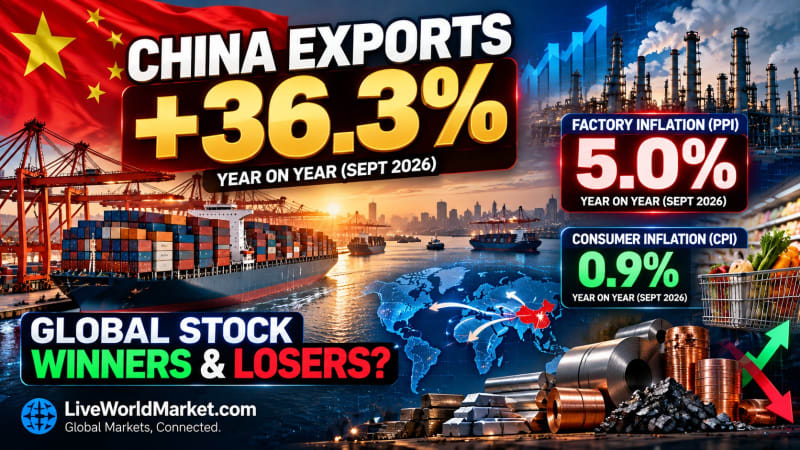
China Exports Surge 36.3%, PPI Hits 5%: Stock Winners & Losers
Geopolitics & Trade · Oct 14, 2026 · 11 min read
China's Exports Surge 36.3% as Factory Inflation Hits 5%: Which Global Stocks Could Win or Lose? China's factories are shipping more goods overseas than expected, but a sharp rise in producer prices is raising a new question about the profitability of the world's manufacturing powerhouse. Official data released on October 14 showed that China's exports surged 36.3%…
Read more...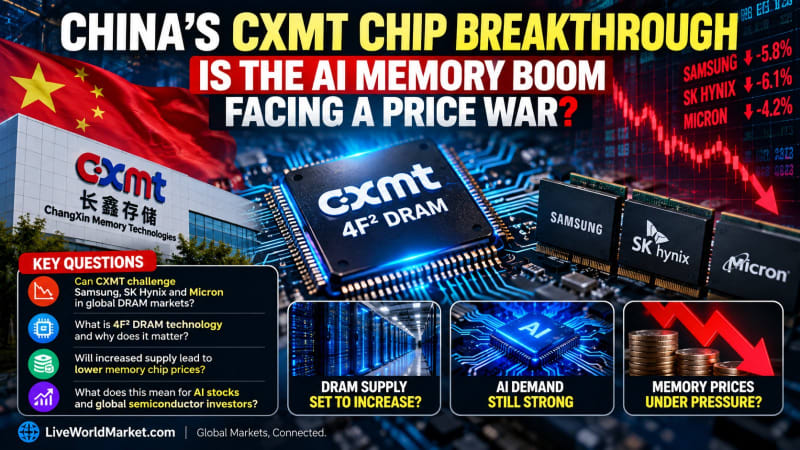
CXMT DRAM Breakthrough: Samsung, SK Hynix & Micron at Risk?
Technology & Sectors · Oct 13, 2026 · 11 min read
Learn EngineeringChina's CXMT DRAM Breakthrough: Could a Memory Price War Threaten Samsung, SK Hynix and Micron? The global semiconductor industry is confronting a new question: Could China's progress in memory-chip technology eventually undermine the pricing power of the world's largest DRAM manufacturers? Chinese chipmaker ChangXin Memory Technologies (CXMT) has reportedly made progress in a…
Read more...
RBI Dollar Window: Can Rupee Near ₹97 Survive $100 Oil?
Central Banks & Rates · Oct 12, 2026 · 9 min read
RBI Opens Special Dollar Window as Rupee Nears ₹97: Can India Protect Its Stock Market From $100 Oil? India's central bank has introduced a new defense against rupee weakness at a time when crude oil prices remain above $100 per barrel. The Reserve Bank of India (RBI) has announced a special dollar facility for three government-owned oil marketing companies, beginning October…
Read more...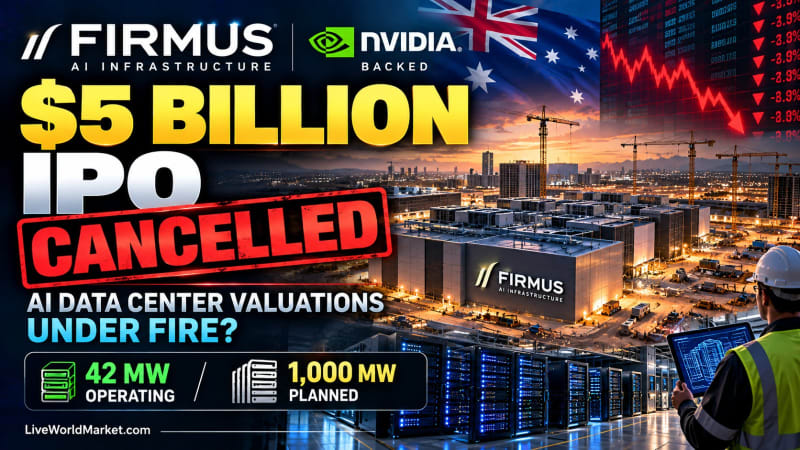
Firmus $5B IPO Cancelled: AI Data Center Valuations at Risk
Technology & Sectors · Oct 11, 2026 · 9 min read
Nvidia-Backed Firmus Cancels $5 Billion IPO: Is Wall Street Finally Questioning AI Data Center Valuations? The global artificial intelligence investment boom has encountered a revealing reality check. Firmus Technologies, an Australian AI data center developer backed by Nvidia, has withdrawn its planned multibillion-dollar stock market listing after struggling to attract…
Read more...Learn AI Tools
Starlink $8B Spectrum Deal: Telecom Stocks Fall, Towers Rise
Technology & Sectors · Oct 10, 2026 · 10 min read
Starlink's $8 Billion Spectrum Deal: Why Telecom Stocks Fell While Tower Shares Surged A single spectrum deal has sent shockwaves through the global telecommunications industry. On October 8, SpaceX announced an agreement to acquire nationwide 800 MHz wireless spectrum from Grain Management, marking a significant step toward expanding its Starlink Mobile business. The…
Read more...
Two-Thirds of S&P 500 Stocks Rose—Why Did the Index Fall? AI Warning
Technology & Sectors · Oct 9, 2026 · 11 min read
The AI Boom Is Turning Into a $100 Billion Debt Race: Could Borrowing Costs Become the Next Risk for Tech Stocks? For the past three years, artificial intelligence has been one of the biggest forces driving global stock markets. From Nvidia's extraordinary rise to the massive expansion of AI data centres, investors have rewarded companies promising to build the infrastructure…
Read more...
$100 Oil Is Back: Which Stock Markets and Sectors Are Most Exposed?
Commodities & Energy · Oct 7, 2026 · 12 min read
Track InvestmentsThe $100 Oil Test Has Arrived: Which Global Stock Markets and Sectors Are Most Exposed If Crude Stays Above Triple Digits? Oil above $100 is no longer a hypothetical risk for global markets. Brent crude traded above $101 a barrel on October 7, while U.S. West Texas Intermediate hovered near $90 as investors confronted a combination of Middle East supply risks, attacks on…
Read more...
Stocks Hit Record Highs While Bond Yields Flash a Warning: Which Market Is Right?
Global Markets & Economy · Oct 6, 2026 · 9 min read
Stocks Are Hitting Records While Bonds Flash a Warning: Which Market Is Right? Something unusual is happening across global financial markets. Stocks are celebrating. Bonds are warning. On October 6, global equities climbed to their highest level in roughly two weeks. The S&P 500 reached another record, while the technology-heavy Nasdaq extended its run of all-time highs. The…
Read more...
France Bond Spread Hits 2011-Era Extreme: Is Europe’s Debt Risk Returning?
Global Markets & Economy · Oct 6, 2026 · 9 min read
Invest in BondsFrance’s Bond Spread Just Hit a 2011-Era Extreme: Is Europe Quietly Re-Entering a Sovereign-Debt Risk Trade? For much of 2026, investors have been focused on the Federal Reserve, oil, inflation and the extraordinary resilience of AI-driven equity markets. But another risk is quietly emerging in Europe. The gap between France’s 10-year government bond yield and Germany’s…
Read more...
Why Are Defense Stocks Falling Despite Rising Global Military Spending?
Geopolitics & Trade · Oct 5, 2026 · 12 min read
Global military spending is rising. Weapons inventories are being rebuilt. Major defense contractors are receiving some of the largest multiyear orders in years. Yet U.S. defense stocks have been falling. The iShares U.S. Aerospace & Defense ETF has declined by as much as 18.2% from its August 14 record high and has posted seven consecutive weekly losses, its longest such…
Read more...