
Stocks Hit Record Highs While Bond Yields Flash a Warning: Which Market Is Right?

Stocks Are Hitting Records While Bonds Flash a Warning: Which Market Is Right?
Something unusual is happening across global financial markets. Stocks are celebrating. Bonds are warning.
On October 6, global equities climbed to their highest level in roughly two weeks. The S&P 500 reached another record, while the technology-heavy Nasdaq extended its run of all-time highs.
The enthusiasm is easy to understand.
Artificial intelligence remains one of the strongest investment themes in the world. Nvidia is approaching a staggering $6 trillion market valuation, while investors are preparing for another earnings season expected to show powerful profit growth from AI-related companies.
But underneath the stock-market optimism sits a very different signal.
Long-term U.S. government bond yields have recently reached levels not seen since 2002.
Normally, rapidly rising long-term interest rates create serious pressure on expensive growth stocks.
This time, investors appear willing to ignore the warning.
That creates one of the most important questions facing global markets:
Are stocks correctly pricing an AI-driven earnings boom — or is the bond market warning that today's record valuations are becoming increasingly difficult to sustain?
Two Markets Are Telling Two Different Stories
The equity market is effectively saying:
Growth is strong enough.
AI earnings will remain exceptional.
Corporate profits can absorb higher interest rates.
The next earnings cycle will justify today's valuations.
The bond market is delivering a different message.
Long-term yields are saying:
Inflation risk has not disappeared.
Government borrowing is enormous.
Investors want more compensation for holding long-duration debt.
Interest rates may remain structurally higher than markets became accustomed to after the global financial crisis.
Both views cannot diverge indefinitely.
Eventually, earnings growth must justify stock valuations — or higher bond yields must begin affecting equity prices.
Why AI Is Overpowering the Bond Market—for Now
The answer begins with earnings.
AI is no longer being valued purely as a distant technological promise.
Investors increasingly expect AI infrastructure spending to translate into enormous revenues and profits across semiconductors, data centres, cloud computing and software.
That expectation has allowed technology stocks to withstand an interest-rate environment that would normally be considered hostile to high-growth equities.
Nvidia illustrates the scale of the enthusiasm.
Its shares have continued climbing toward a market capitalization of approximately $6 trillion, making the company an increasingly powerful influence on major U.S. equity indices.
And Nvidia is not alone.
Microsoft, Meta and other technology giants have helped drive the broader market higher.
The result is unusual:
Bond yields are historically high.
Technology valuations are historically high.
Major stock indices are also at records.
Markets are effectively betting that extraordinary earnings growth can overpower extraordinarily expensive money.
Why 5%+ Treasury Yields Change the Equation
Government bond yields provide the foundation for financial asset pricing.
When investors can earn attractive returns from relatively low-risk government securities, equities must offer a compelling reason to accept additional risk.
This is particularly important for growth stocks.
A large part of a growth company's theoretical valuation comes from profits expected many years into the future.
Higher interest rates reduce the present value of those future earnings.
Consider the basic choice facing a global investor.
If government bonds yield 2%, paying a high valuation for a company growing rapidly may look attractive.
If government bonds yield around 5%, the hurdle becomes substantially higher.
The company must deliver enough earnings growth to compensate investors for taking additional equity risk.
That is why the bond market matters even when stock prices appear to ignore it.
The S&P 500 Record Is Hiding an Important Detail
A market index can rise even when the entire market is not equally strong.
Large technology companies now carry enormous weights in major U.S. indices.
When companies such as Nvidia, Microsoft, Apple and other mega-cap technology names rise sharply, they can pull the S&P 500 and Nasdaq higher even if other parts of the market are performing less impressively.
This creates an important distinction between:
Index strength
and
market breadth.
Investors should therefore watch whether the rally expands beyond AI and mega-cap technology.
If banks, industrial companies, consumer businesses, small caps and other economically sensitive sectors begin participating more strongly, the rally becomes healthier.
If record highs increasingly depend on a small group of enormous AI companies, market concentration becomes a bigger risk.
Track the major U.S. indices and futures:
Falling Oil Just Gave Stocks Some Breathing Room
One important development helped markets on October 6.
Oil prices declined.
Brent crude fell toward approximately $98 per barrel, easing some of the inflation anxiety that had recently pressured global markets.
This matters because oil affects almost every major macro variable.
Higher oil can mean:
Higher inflation → higher bond yields → less room for rate cuts → pressure on equity valuations.
Lower oil can produce the opposite effect:
Lower inflation pressure → bond yields stabilise → financial conditions improve → stocks receive valuation support.
That helps explain why equities responded positively as oil and bond yields retreated on Tuesday.
But one day's decline in oil does not resolve the broader interest-rate problem.
The critical question is whether energy prices continue easing.
Follow commodities and global market developments:
LiveWorldMarket Global Markets
AI Earnings Are About to Face Their Biggest Test
The next major catalyst is earnings season.
This is where the market's AI optimism must confront actual financial results.
Investors will be watching several questions.
Are AI revenues still accelerating?
Are technology companies maintaining margins despite enormous infrastructure spending?
Are businesses outside technology beginning to generate measurable productivity gains from AI?
And perhaps most importantly:
Can earnings grow quickly enough to justify record stock prices when bond yields remain historically high?
This may matter more than whether the Federal Reserve cuts or raises rates by another 25 basis points.
At today's valuations, companies increasingly need to deliver.
Expectations alone become less powerful when the risk-free alternative available in the bond market becomes much more attractive.
Asia Shows How Global the AI Trade Has Become
The AI rally is no longer exclusively an American market story.
Japan, South Korea and Taiwan have become critical components of the global AI supply chain.
Japanese equities advanced again on October 6, with the Nikkei moving above the psychologically important 70,000 level.
Asian markets have increasingly benefited from demand for semiconductors, memory chips, advanced manufacturing equipment and AI infrastructure.
This creates a global chain:
AI spending in the U.S.
↓
Semiconductor demand
↓
Taiwanese chip manufacturing
↓
Korean memory demand
↓
Japanese semiconductor equipment
↓
Asian exports and industrial production
↓
Corporate earnings
This is why AI is increasingly becoming a global macroeconomic story rather than simply a Silicon Valley stock-market story.
Explore Asian markets:
But Europe Is Sending Another Warning
Europe presents another complication.
France has recently experienced significant bond-market pressure as investors question its fiscal trajectory.
The spread between French and German government bond yields surged to levels associated with the euro-area sovereign-debt crisis era before easing on October 6.
At the same time, the euro recently fell to a 17-month low against the dollar.
That means global investors are simultaneously dealing with three different market narratives:
United States
AI enthusiasm and record equities.
Europe
Fiscal concerns and sovereign-bond stress.
Asia
AI manufacturing and semiconductor-led momentum.
These differences are precisely why watching only the S&P 500 provides an incomplete picture of global risk.
Related LiveWorldMarket Insight:
The Real Question: What Breaks First?
There are several ways the current divergence can resolve.
Scenario 1 — Earnings Win
AI companies deliver another exceptional earnings season.
Corporate profits continue accelerating.
Oil falls.
Bond yields stabilise.
In this environment, stocks could justify current valuations and potentially extend their rally.
This is the bullish scenario.
Scenario 2 — Bond Yields Win
Long-term yields resume climbing.
Investors begin demanding higher returns from equities.
Price-to-earnings multiples contract.
Technology and other long-duration growth stocks become vulnerable.
In this scenario, earnings could remain strong while stock prices still correct because investors are no longer willing to pay the same valuation multiples.
Scenario 3 — Earnings Broaden Beyond AI
This may actually be the healthiest outcome.
Instead of Nvidia and a small collection of mega-cap technology companies carrying the market, earnings growth spreads into industrials, financials, consumer companies, healthcare and smaller businesses.
That would make the global equity rally considerably more durable.
Five Indicators Investors Should Watch Now
1. U.S. 10-Year Treasury Yield
This remains one of the most important numbers in global finance.
A sustained move higher would increase valuation pressure across global equities.
2. Nvidia and Semiconductor Stocks
These are effectively becoming gauges of global AI risk appetite.
3. Market Breadth
Watch whether more sectors participate in the rally rather than focusing only on index records.
4. Brent Crude
Oil moving sustainably below $100 would reduce inflation pressure.
A renewed surge would complicate the bond-market picture.
5. Earnings Guidance
Past earnings matter.
But what CEOs say about 2027 demand, AI investment and margins could matter even more.
Why This Matters for Indian Investors
India is not isolated from this divergence.
If U.S. yields remain elevated, global capital has a more attractive alternative to emerging-market assets.
That can affect foreign institutional flows, the dollar, USD/INR and Indian equity valuations.
But strong global risk appetite can work in the opposite direction.
If AI-driven optimism continues, oil declines and global equities remain strong, Indian equities could benefit from improved international sentiment.
For India, therefore, the combination to watch is:
U.S. yields + dollar + crude oil + foreign flows.
Not simply the Nasdaq.
Track the Indian market:
Follow institutional activity:
This Is the Market Divergence That Matters
Investors often search for a single narrative explaining financial markets.
Right now, there isn't one.
The stock market sees extraordinary technological growth.
The bond market sees persistent inflation, enormous government borrowing and structurally higher interest rates.
The oil market is providing temporary relief.
Europe is wrestling with fiscal risk.
And Asia is increasingly benefiting from the physical manufacturing infrastructure behind the AI boom.
The remarkable part is that all these forces are operating simultaneously.
That is why today's record stock prices should not simply be interpreted as evidence that macroeconomic risks have disappeared.
They haven't.
Investors are instead making a very specific bet:
AI-driven earnings growth will be powerful enough to overcome historically expensive capital.
If they are right, today's equity valuations may prove sustainable.
If they are wrong, the bond market may eventually force equities to reprice.
LiveWorldMarket View
The most important market signal today isn't simply that the S&P 500 and Nasdaq are reaching records.
It is that they are doing so despite extremely elevated long-term interest rates.
For now, AI earnings expectations are winning the argument.
But bond yields determine the cost of capital across the global economy.
The longer yields remain elevated, the more demanding the earnings test becomes.
That makes the coming earnings season unusually important.
Investors should therefore watch two screens simultaneously:
Corporate earnings
and
government bond yields.
One represents optimism about the future.
The other represents the price investors are demanding to finance it.
Eventually, those two stories must converge.
Continue Exploring LiveWorldMarket
Disclaimer: This article is for informational and educational purposes only and should not be considered investment advice.
Comments (0)
Be the first to comment.
About the author

NISM-Series-X-A Investment Adviser Level 1 examination completed
Amit writes about Indian equity markets, technical analysis, macro themes and the day-to-day mechanics of trading, with a focus on making the flow of global markets legible for retail investors. He has completed the NISM-Series-X-A Investment Adviser Level 1 examination.
You May Also Like

CoreWeave Bond Yields Hit 16%: AI Data Center Debt Risks
Technology & Sectors · Oct 17, 2026 · 13 min read
CoreWeave Bond Yields Hit 16%: Is AI Data-Center Debt Becoming the Next Big Risk for Global Stocks? The artificial intelligence boom has entered a new phase. Investors are no longer asking only how much money AI companies can earn. They are increasingly questioning how much it costs to finance the infrastructure supporting that growth. This week, CoreWeave, a U.S.-based AI…
Read more...
Indonesia Stocks Crash 11.57%: Will MSCI Downgrade Benefit India?
India & Global Connections · Oct 16, 2026 · 12 min read
Indonesia Stocks Plunge 11% as MSCI Proposes Downgrade: Could India and Other Emerging Markets Benefit? Indonesia's stock market has suffered its sharpest one-day decline in nearly three decades, but the bigger story extends far beyond Jakarta. A proposed MSCI downgrade could eventually force global index funds to remove Indonesian equities from their portfolios, potentially…
Read more...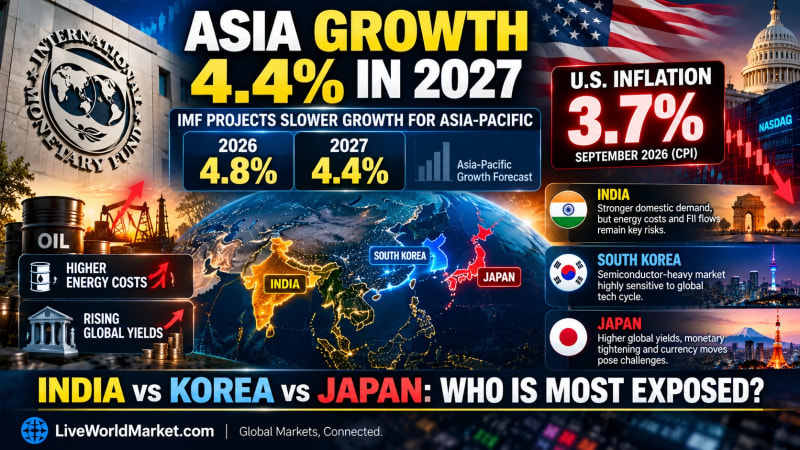
IMF Asia Growth 4.4%, US CPI 3.7%: Which Stocks Are at Risk?
News · Oct 15, 2026 · 12 min read
IMF Sees Asia Growth Slowing to 4.4% as U.S. Inflation Hits 3.7%: Which Stock Markets Are Most Vulnerable? Asia's stock markets are facing a critical test as two major economic developments collide: the International Monetary Fund's warning about slower regional growth and an unexpected rise in U.S. inflation. The IMF's October Asia-Pacific outlook projects regional economic…
Read more...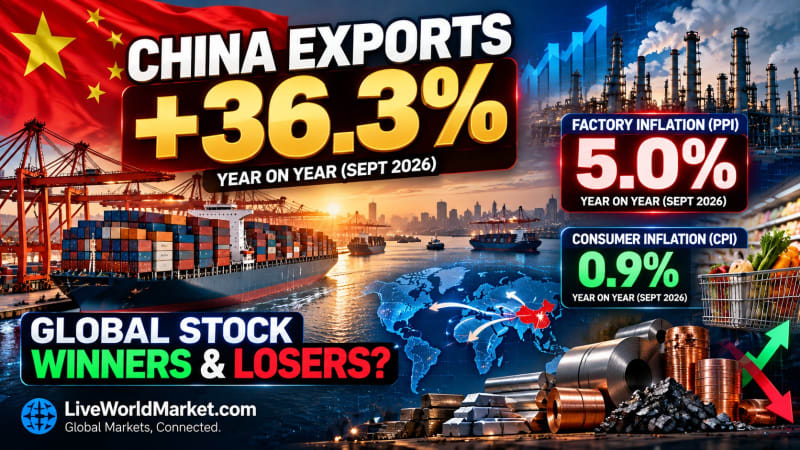
China Exports Surge 36.3%, PPI Hits 5%: Stock Winners & Losers
Geopolitics & Trade · Oct 14, 2026 · 11 min read
China's Exports Surge 36.3% as Factory Inflation Hits 5%: Which Global Stocks Could Win or Lose? China's factories are shipping more goods overseas than expected, but a sharp rise in producer prices is raising a new question about the profitability of the world's manufacturing powerhouse. Official data released on October 14 showed that China's exports surged 36.3%…
Read more...
CXMT DRAM Breakthrough: Samsung, SK Hynix & Micron at Risk?
Technology & Sectors · Oct 13, 2026 · 11 min read
China's CXMT DRAM Breakthrough: Could a Memory Price War Threaten Samsung, SK Hynix and Micron? The global semiconductor industry is confronting a new question: Could China's progress in memory-chip technology eventually undermine the pricing power of the world's largest DRAM manufacturers? Chinese chipmaker ChangXin Memory Technologies (CXMT) has reportedly made progress in a…
Read more...
RBI Dollar Window: Can Rupee Near ₹97 Survive $100 Oil?
Central Banks & Rates · Oct 12, 2026 · 9 min read
RBI Opens Special Dollar Window as Rupee Nears ₹97: Can India Protect Its Stock Market From $100 Oil? India's central bank has introduced a new defense against rupee weakness at a time when crude oil prices remain above $100 per barrel. The Reserve Bank of India (RBI) has announced a special dollar facility for three government-owned oil marketing companies, beginning October…
Read more...
Firmus $5B IPO Cancelled: AI Data Center Valuations at Risk
Technology & Sectors · Oct 11, 2026 · 9 min read
Nvidia-Backed Firmus Cancels $5 Billion IPO: Is Wall Street Finally Questioning AI Data Center Valuations? The global artificial intelligence investment boom has encountered a revealing reality check. Firmus Technologies, an Australian AI data center developer backed by Nvidia, has withdrawn its planned multibillion-dollar stock market listing after struggling to attract…
Read more...
Starlink $8B Spectrum Deal: Telecom Stocks Fall, Towers Rise
Technology & Sectors · Oct 10, 2026 · 10 min read
Starlink's $8 Billion Spectrum Deal: Why Telecom Stocks Fell While Tower Shares Surged A single spectrum deal has sent shockwaves through the global telecommunications industry. On October 8, SpaceX announced an agreement to acquire nationwide 800 MHz wireless spectrum from Grain Management, marking a significant step toward expanding its Starlink Mobile business. The…
Read more...
Two-Thirds of S&P 500 Stocks Rose—Why Did the Index Fall? AI Warning
Technology & Sectors · Oct 9, 2026 · 11 min read
The AI Boom Is Turning Into a $100 Billion Debt Race: Could Borrowing Costs Become the Next Risk for Tech Stocks? For the past three years, artificial intelligence has been one of the biggest forces driving global stock markets. From Nvidia's extraordinary rise to the massive expansion of AI data centres, investors have rewarded companies promising to build the infrastructure…
Read more...
AI Debt Boom 2026: Could Borrowing Costs Hit Tech Stocks?
News · Oct 8, 2026 · 11 min read
The AI Boom Is Turning Into a $100 Billion Debt Race: Could Borrowing Costs Become the Next Risk for Tech Stocks? For the past three years, artificial intelligence has been one of the biggest forces driving global stock markets. From Nvidia's extraordinary rise to the massive expansion of AI data centres, investors have rewarded companies promising to build the infrastructure…
Read more...