
Starlink $8B Spectrum Deal: Telecom Stocks Fall, Towers Rise
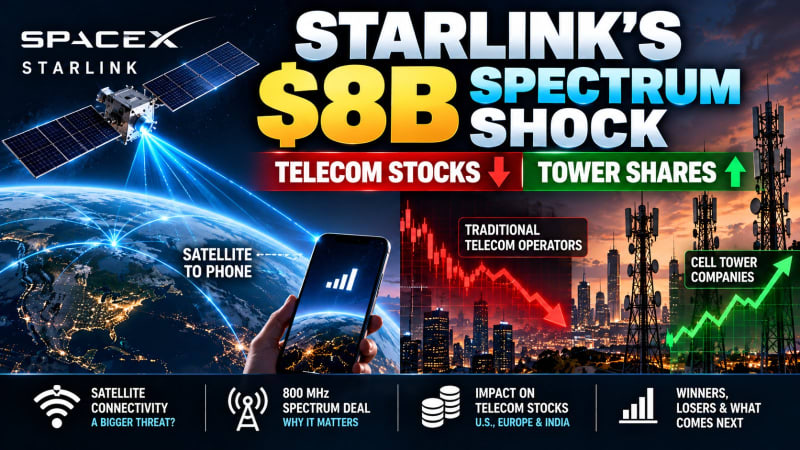
Starlink's $8 Billion Spectrum Deal: Why Telecom Stocks Fell While Tower Shares Surged
A single spectrum deal has sent shockwaves through the global telecommunications industry.
On October 8, SpaceX announced an agreement to acquire nationwide 800 MHz wireless spectrum from Grain Management, marking a significant step toward expanding its Starlink Mobile business.
The transaction is reportedly worth approximately $8 billion, although the companies have not publicly confirmed that price. Completion remains subject to regulatory approval.
The market reaction was dramatic.
On October 9, major U.S. telecom operators, including T-Mobile, Verizon and AT&T, experienced sharp stock-market declines. European telecom companies also came under pressure.
But another part of the industry moved in the opposite direction.
Cell-tower companies rallied as investors considered whether Starlink could become a new customer for terrestrial wireless infrastructure.
This raises a fascinating investment question:
Why would a satellite company threaten traditional telecom operators while potentially benefiting the companies that own their towers?
The answer could reveal how the next phase of mobile connectivity reshapes the global telecom industry.
1. What Happened in SpaceX's $8 Billion Spectrum Deal?
SpaceX has agreed to acquire Grain Management's nationwide portfolio of low-band wireless spectrum in the 800 MHz frequency range.
The portfolio includes up to 14 MHz of paired spectrum.
Wireless spectrum is a valuable asset because mobile networks need access to licensed radio frequencies to transmit information.
The lower the frequency, the better the signal generally travels over long distances and through physical obstacles.
That makes 800 MHz particularly useful for mobile coverage.
The transaction could help Starlink Mobile expand beyond satellite connectivity in remote locations toward a broader consumer mobile service.
But the acquisition is not yet complete, and the proposed transaction requires approval from the Federal Communications Commission.
The reported $8 billion valuation also remains subject to confirmation.
Nevertheless, the agreement has changed how investors assess Starlink's competitive ambitions.
2. Why Did Telecom Stocks Fall So Sharply?
Traditional telecom operators have spent decades investing in wireless networks.
Their businesses depend on expensive spectrum licences, cell towers, fibre networks, switching infrastructure and customer relationships.
These investments have historically created significant barriers to entry.
A new nationwide competitor would ordinarily need enormous financial resources to build comparable infrastructure.
Starlink could potentially approach the market differently.
By combining satellite connectivity with licensed terrestrial spectrum, SpaceX may eventually offer services that challenge parts of the traditional wireless business model.
Investors reacted quickly to that possibility.
Reported October 9 market reaction

Figures are approximate intraday observations reported on October 9, not necessarily official closing returns.
The selloff suggests investors were reassessing the long-term competitive position of established wireless carriers.
However, a large one-day stock decline does not prove that their underlying businesses have already deteriorated.
It reflects changing expectations about future competition.
3. Why Is 800 MHz Spectrum So Important?
Not all wireless frequencies behave the same way.
Higher-frequency spectrum can support substantial data capacity, particularly in dense urban environments.
But it generally covers shorter distances and faces greater difficulty penetrating buildings and other obstacles.
Low-band spectrum offers different advantages.
Wider geographical coverage
Lower-frequency signals can travel farther, making them useful for rural and suburban connectivity.
Better indoor penetration
Low-band frequencies generally penetrate walls and other obstacles more effectively than higher-frequency signals.
More efficient coverage
A network may require fewer transmission sites to provide broad geographical coverage.
These advantages make the 800 MHz spectrum strategically valuable.
But there is a critical limitation.
Coverage is not the same as capacity.
A relatively narrow spectrum allocation may improve connectivity without providing enough capacity to replace a major nationwide cellular network.
That distinction helps explain why the Starlink threat could be significant over time without immediately making traditional mobile infrastructure obsolete.
4. Why Did Cell-Tower Stocks Rise?
This is the most interesting part of the market reaction.
At first glance, satellite connectivity might appear to threaten cell towers.
If phones can communicate directly with satellites, why would wireless networks need as many ground-based transmission sites?
The answer is that modern mobile networks require both coverage and capacity.
Satellites can provide valuable connectivity across large geographical areas, especially where conventional infrastructure is limited.
But densely populated cities generate enormous volumes of mobile data traffic.
Terrestrial networks remain highly effective at supporting that demand.
A hybrid Starlink Mobile network could therefore combine:
Satellite connectivity for broad coverage
Terrestrial infrastructure for high-capacity service
That creates a potential opportunity for companies that own cell towers.
Instead of building every terrestrial site independently, Starlink could lease space on existing towers or enter infrastructure-sharing agreements.
For tower operators, a new nationwide wireless customer could increase demand for their assets.
This possibility helped drive sharp gains in tower-related stocks on October 9.
The important takeaway is that a technology disrupting one part of an industry can simultaneously create opportunities for another part of the same industry.
5. Could Starlink Become America's Fourth Major Mobile Operator?
This is the question investors are beginning to ask.
The United States is dominated by three large nationwide wireless carriers:
T-Mobile, Verizon and AT&T.
Starlink's expansion could eventually introduce a different competitive model.
Rather than relying exclusively on terrestrial infrastructure, it could integrate satellite coverage with conventional wireless technology.
Potential advantages include rural coverage, emergency connectivity, remote transportation services and connectivity in underserved regions.
But several obstacles remain.
Building a competitive nationwide mobile network requires much more than spectrum ownership.
Starlink would need sufficient network capacity, reliable service quality, compatible devices, distribution capabilities, customer support and potentially substantial terrestrial infrastructure.
Industry estimates suggest that building a genuinely competitive nationwide mobile network could require tens of billions of dollars beyond the spectrum purchase.
Therefore, Starlink's spectrum acquisition should be viewed as an important strategic step rather than evidence that it can immediately replace established carriers.
6. Why European Telecom Stocks Were Also Hit
The reaction was not limited to the United States.
European telecom companies also faced selling pressure.
Deutsche Telekom, Vodafone, Orange and Telefónica were among the operators affected.
There are two reasons why investors may have extended the concern to Europe.
First, some European telecom groups have direct exposure to U.S. wireless businesses.
Deutsche Telekom, for example, is the controlling shareholder of T-Mobile US.
Second, Starlink's broader technology strategy could eventually influence telecom competition outside the United States.
Satellite-to-phone services could become increasingly relevant in markets where terrestrial coverage remains incomplete.
However, international expansion would depend on country-specific spectrum rights, regulatory approvals and commercial partnerships.
The U.S. spectrum agreement does not automatically grant Starlink the same rights in Europe or other regions.
For investors, the distinction between a global technological opportunity and country-specific regulatory permission is essential.
Explore global market coverage on LiveWorldMarket.
7. What Does This Mean for India's Telecom Sector?
India represents a particularly interesting market for satellite connectivity.
The country has a large mobile subscriber base, extensive 4G and 5G infrastructure and significant geographical diversity.
While major cities have dense terrestrial networks, some remote and difficult-to-reach regions remain challenging to serve.
Satellite connectivity could help address those gaps.
Reliance Jio and Bharti Airtel
India's established telecom operators have invested heavily in nationwide mobile infrastructure.
Their extensive customer bases, spectrum holdings and terrestrial networks remain important competitive strengths.
Satellite services could potentially complement existing networks through partnerships.
But they could also introduce additional competition in selected customer segments over time.
Rural and remote connectivity
Satellite-to-phone technology could be particularly useful in mountainous regions, isolated communities, disaster-affected areas and other locations where conventional network expansion is expensive.
Regulatory considerations
India's licensing requirements, spectrum framework, security obligations and commercial arrangements will determine how satellite-based mobile services develop.
The SpaceX-Grain transaction concerns U.S. spectrum rights.
It does not itself change Starlink's regulatory position in India.
Infrastructure opportunities
India's telecom infrastructure providers could potentially benefit if hybrid satellite-terrestrial networks increase demand for tower sites, backhaul and associated equipment.
But such benefits would depend on actual deployment plans and commercial contracts.
For Indian investors, the key question is not whether Starlink will immediately replace Jio or Airtel. It is whether satellite connectivity changes the economics of serving customers at the edges of existing mobile networks.
Track India's stock market on LiveWorldMarket.
8. The Bigger Opportunity: Hybrid Satellite and Terrestrial Networks
The future of mobile connectivity may not be a simple competition between satellites and towers.
It could involve deeper integration between the two.
Consider three potential use cases.
Remote connectivity
Satellites could provide basic connectivity in locations where building conventional towers is economically unattractive.
Emergency communications
Satellite links could support communications when terrestrial networks are unavailable or disrupted.
Integrated mobile coverage
A hybrid network could use terrestrial infrastructure for high-capacity urban connectivity and satellite coverage in remote areas.
These use cases may expand the overall connectivity market rather than simply transfer customers from existing operators to Starlink.
That is one reason investors should be cautious about assuming every established telecom company will lose from satellite technology.
The outcome will depend on pricing, service quality, network economics and partnerships.
9. Which Companies Could Benefit or Face Pressure?
The investment implications differ across the telecom value chain.

These are potential longer-term effects, not guaranteed investment outcomes.
A company's actual performance will depend on its competitive position, valuation and ability to adapt.
10. Five Indicators Investors Should Watch Next
1. Regulatory approval
The FCC's review of the proposed spectrum transfer is a critical milestone.
2. Starlink's terrestrial network strategy
Will SpaceX build infrastructure, lease tower space or partner with established operators?
3. Commercial service capabilities
Can Starlink deliver sufficient data capacity, reliable indoor connectivity and competitive pricing?
4. Tower leasing agreements
New agreements with tower operators would provide tangible evidence of infrastructure demand.
5. Responses from existing carriers
T-Mobile, Verizon and AT&T may adjust pricing, partnerships, coverage strategies or investment plans in response to potential competition.
These developments will matter more over time than a single trading session's share-price movements.
11. Is the Telecom Selloff an Overreaction?
The October 9 market reaction was unusually sharp.
That raises an important question.
Have investors correctly anticipated a major structural disruption, or have they priced in competitive threats that could take years to materialise?
There are arguments on both sides.
The bearish case for traditional operators
Starlink could eventually reduce some barriers to entry, expand coverage and introduce new competition.
If it attracts customers or forces lower pricing, incumbent operators could face pressure on revenue growth and margins.
The more cautious case
Traditional telecom operators possess extensive infrastructure, established customer relationships and large amounts of network capacity.
A 14 MHz low-band spectrum portfolio alone does not replicate those advantages.
Satellite connectivity may initially be more complementary than substitutive.
The most reasonable conclusion is that Starlink has increased long-term competitive uncertainty, but the scale and timing of its eventual market impact remain unresolved.
That makes the sector worth monitoring rather than drawing definitive conclusions from one day's stock performance.
LiveWorldMarket View: The Market Is Pricing a New Telecom Future
SpaceX's proposed $8 billion spectrum transaction has highlighted an important shift in the telecommunications industry.
Investors are beginning to consider a future in which satellite connectivity and conventional mobile networks become increasingly integrated.
That possibility creates risks for established wireless operators, but it could also create opportunities for infrastructure owners, equipment suppliers and consumers.
The contrasting market reaction on October 9 captured that uncertainty.
Telecom operators fell because investors feared a new competitor.
Tower companies rose because that competitor might eventually need their infrastructure.
The lesson extends beyond telecommunications.
Technological disruption rarely affects every participant in an industry in the same way.
Sometimes the companies that own essential infrastructure benefit even when the businesses using that infrastructure face new competition.
For global investors, the most important development will not be the headline value of the spectrum transaction.
It will be how Starlink turns those frequencies into a commercially viable mobile service — and whether existing operators adapt through competition, cooperation or both.
The next chapter of the telecom industry may not be satellites versus towers. It may be satellites working with towers to reshape mobile connectivity.
Continue Exploring LiveWorldMarket
- Global Markets Dashboard
- U.S. Stock Market Dashboard
- India Stock Market Dashboard
- Market Insights and Analysis
- Global Indices and Futures
External References
- Reuters — U.S. and European telecom stocks slide after SpaceX spectrum deal
- Reuters — SpaceX takes aim at U.S. wireless carriers
- Reuters — What is low-band spectrum?
Disclaimer: This article is for educational and informational purposes only. It is not investment advice or a recommendation to buy or sell any security.
Follow at You tube on : https://www.youtube.com/watch?v=8-vvkx18dCQ
Comments (0)
Be the first to comment.
About the author

NISM-Series-X-A Investment Adviser Level 1 examination completed
Amit writes about Indian equity markets, technical analysis, macro themes and the day-to-day mechanics of trading, with a focus on making the flow of global markets legible for retail investors. He has completed the NISM-Series-X-A Investment Adviser Level 1 examination.
You May Also Like

Two-Thirds of S&P 500 Stocks Rose—Why Did the Index Fall? AI Warning
Technology & Sectors · Oct 9, 2026 · 11 min read
The AI Boom Is Turning Into a $100 Billion Debt Race: Could Borrowing Costs Become the Next Risk for Tech Stocks? For the past three years, artificial intelligence has been one of the biggest forces driving global stock markets. From Nvidia's extraordinary rise to the massive expansion of AI data centres, investors have rewarded companies promising to build the infrastructure…
Read more...
AI Debt Boom 2026: Could Borrowing Costs Hit Tech Stocks?
News · Oct 8, 2026 · 11 min read
The AI Boom Is Turning Into a $100 Billion Debt Race: Could Borrowing Costs Become the Next Risk for Tech Stocks? For the past three years, artificial intelligence has been one of the biggest forces driving global stock markets. From Nvidia's extraordinary rise to the massive expansion of AI data centres, investors have rewarded companies promising to build the infrastructure…
Read more...
$100 Oil Is Back: Which Stock Markets and Sectors Are Most Exposed?
Commodities & Energy · Oct 7, 2026 · 12 min read
The $100 Oil Test Has Arrived: Which Global Stock Markets and Sectors Are Most Exposed If Crude Stays Above Triple Digits? Oil above $100 is no longer a hypothetical risk for global markets. Brent crude traded above $101 a barrel on October 7, while U.S. West Texas Intermediate hovered near $90 as investors confronted a combination of Middle East supply risks, attacks on…
Read more...
Stocks Hit Record Highs While Bond Yields Flash a Warning: Which Market Is Right?
Global Markets & Economy · Oct 6, 2026 · 9 min read
Stocks Are Hitting Records While Bonds Flash a Warning: Which Market Is Right? Something unusual is happening across global financial markets. Stocks are celebrating. Bonds are warning. On October 6, global equities climbed to their highest level in roughly two weeks. The S&P 500 reached another record, while the technology-heavy Nasdaq extended its run of all-time highs. The…
Read more...
France Bond Spread Hits 2011-Era Extreme: Is Europe’s Debt Risk Returning?
Global Markets & Economy · Oct 6, 2026 · 9 min read
France’s Bond Spread Just Hit a 2011-Era Extreme: Is Europe Quietly Re-Entering a Sovereign-Debt Risk Trade? For much of 2026, investors have been focused on the Federal Reserve, oil, inflation and the extraordinary resilience of AI-driven equity markets. But another risk is quietly emerging in Europe. The gap between France’s 10-year government bond yield and Germany’s…
Read more...
Why Are Defense Stocks Falling Despite Rising Global Military Spending?
Geopolitics & Trade · Oct 5, 2026 · 12 min read
Global military spending is rising. Weapons inventories are being rebuilt. Major defense contractors are receiving some of the largest multiyear orders in years. Yet U.S. defense stocks have been falling. The iShares U.S. Aerospace & Defense ETF has declined by as much as 18.2% from its August 14 record high and has posted seven consecutive weekly losses, its longest such…
Read more...
U.S. Jobs Fall to 29,000 as Nasdaq Hits Record: Why Weak Data Is Lifting Stocks
Trend · Oct 4, 2026 · 11 min read
U.S. Jobs Just Fell to 29,000—So Why Did the Nasdaq Hit a Record High? The ‘Bad News Is Good News’ Trade Is Back The latest U.S. jobs report delivered what would normally look like bad news for the economy. The United States added only 29,000 jobs in September, far below expectations. The unemployment rate increased to 4.2%. Annual wage growth slowed to 3.0%. And employment…
Read more...
China’s Fuel Export Squeeze: Could Asia’s $50 Refining Margins Become the Next Inflation Shock?
Commodities & Energy · Oct 3, 2026 · 10 min read
China’s Fuel Export Squeeze: Could Asia’s $50 Refining Margins Become the Next Inflation Shock? Global investors have spent much of 2026 watching crude oil. But another part of the energy market may now deserve just as much attention: the cost of refining crude oil into the fuels that households and businesses actually use. Tightening Chinese fuel exports and constrained…
Read more...
Global Bond Selloff: Why Government Debt Is Becoming a Bigger Risk Than the Fed
Global Markets & Economy · Oct 2, 2026 · 12 min read
The Fed Isn't the Biggest Problem Anymore: Why the Global Bond Market Is Suddenly Worried About Government Debt For years, investors trying to understand bond markets focused on one question: What will the Federal Reserve do next? Will the Fed raise interest rates? Will it pause? When will it cut? That framework still matters. But something more fundamental is beginning to…
Read more...
AI Is Reviving Asia's Factories: Is Global Manufacturing Finally Turning?
Global Markets & Economy · Oct 1, 2026 · 12 min read
AI Is Reviving Asia’s Factories: Is the Global Manufacturing Cycle Finally Turning? For the past few years, artificial intelligence has primarily been viewed as a technology and stock-market story. AI stocks surged. Semiconductor companies expanded production. Technology giants committed hundreds of billions of dollars to data centres and computing infrastructure. Now…
Read more...