
China’s Fuel Export Squeeze: Could Asia’s $50 Refining Margins Become the Next Inflation Shock?
China’s Fuel Export Squeeze: Could Asia’s $50 Refining Margins Become the Next Inflation Shock?
Global investors have spent much of 2026 watching crude oil.
But another part of the energy market may now deserve just as much attention:
the cost of refining crude oil into the fuels that households and businesses actually use.
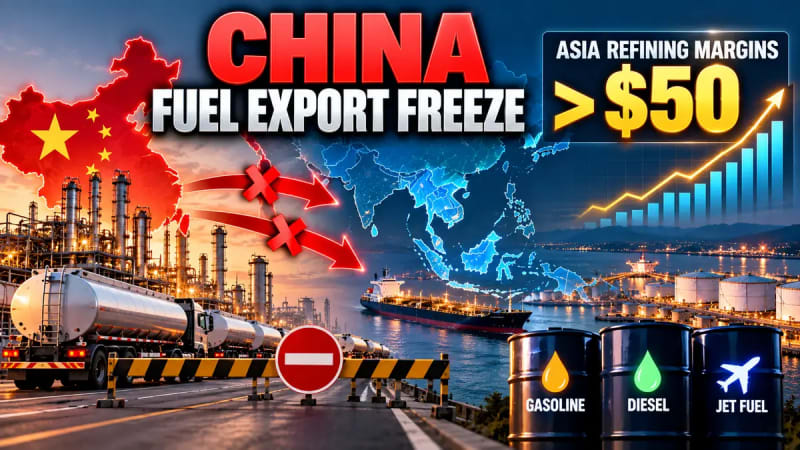
Tightening Chinese fuel exports and constrained regional supplies have pushed parts of Asia’s refining market into unusually strong territory, with gasoline refining margins moving above $50 per barrel over Brent during the recent squeeze.
That creates an important question for markets:
Could Asia experience another inflation shock even if crude oil itself stops rising?
The answer depends increasingly on gasoline, diesel and jet fuel—not just Brent.
Crude Oil Is Only Half the Inflation Story
When investors think about energy inflation, they usually look at Brent or WTI crude.
But consumers do not buy crude oil.
They buy:
- gasoline
- diesel
- jet fuel through airline tickets
- transportation and delivery services
- goods moved by trucks and ships
Between crude oil and the final consumer sits the refining industry.
Refineries convert crude into usable petroleum products.
When supplies of those products become tight, their prices can rise significantly faster than crude.
That is what makes today's Asian refining market important.
What Is a Refining Margin?
A refining margin measures, in simplified terms, the difference between the value of refined petroleum products and the crude oil used to produce them.
Traders often monitor crack spreads to understand refinery profitability and product-market tightness.
Imagine Brent crude remains broadly stable.
Normally, investors might conclude that the energy inflation threat is also stabilising.
But if gasoline supply suddenly becomes scarce, gasoline prices can continue rising.
The result can look like:
Crude oil stable
↓
Fuel supply tightens
↓
Refining margins rise
↓
Gasoline/diesel prices increase
↓
Transportation costs rise
↓
Inflation pressure persists
That is why refined-product markets can matter even when the crude-oil headline looks relatively calm.
Why China Matters So Much
China has enormous refining capacity and is an important participant in Asian petroleum-product markets.
Changes in Chinese export availability can therefore influence regional supply.
When fewer barrels of gasoline or diesel are available from China, buyers elsewhere in Asia may need to compete more aggressively for alternative supplies.
That can affect trading hubs and import-dependent economies throughout the region.
The market then becomes less about:
“How much crude oil is available?”
and more about:
“Where will the next barrel of gasoline or diesel come from?”
Why $50 Refining Margins Matter
A refining margin above $50 per barrel is significant because it indicates an unusually valuable gap between crude feedstock and the finished product.
That can signal severe tightness in parts of the product market.
It can also encourage refineries elsewhere to run harder.
But increasing supply is not always immediate.
Refineries have:
- capacity limits
- maintenance schedules
- logistical constraints
- different product configurations
- regional transportation costs
Even when high margins create an incentive to increase production, additional gasoline or diesel may take time to reach the market.
That delay is precisely when price spikes can become economically important.
Asia Could Face an Inflation Shock Without Another Oil Shock
This is the most important macroeconomic angle.
Suppose Brent stops climbing.
Normally, that should reduce concerns about additional energy inflation.
But suppose gasoline and diesel prices remain elevated because refining margins stay exceptionally high.
Then consumers and businesses can continue experiencing higher energy costs despite stable crude prices.
That creates a different type of inflation shock:
not a crude-supply shock, but a refined-product shock.
For central banks, the distinction matters less than consumers might think.
If transportation and fuel costs keep rising, they can still feed into headline inflation.
Diesel Could Matter Even More Than Gasoline
Gasoline gets enormous public attention because motorists see the price directly.
But economically, diesel can be even more important.
Diesel powers large parts of:
- trucking
- agriculture
- construction
- industrial equipment
- logistics
- backup power generation
Higher diesel prices can therefore spread through supply chains.
Consider a supermarket product.
Raw materials may travel by truck.
The finished product may travel to a warehouse.
It then travels again to a distribution centre and finally to a store.
Higher diesel costs can affect every stage.
The inflationary effect therefore extends beyond the fuel pump.
Jet Fuel Adds Another Risk for Airlines
Airlines are another obvious transmission channel.
Fuel is one of the industry's largest operating expenses.
If Asian jet-fuel markets tighten alongside gasoline and diesel, airlines may face higher costs.
They then have several choices:
Absorb the cost → margins fall
or
Increase fares → consumers pay more
or
Hedge successfully → impact is delayed
The effect will vary significantly between carriers.
But sustained high refining margins would create another challenge for an industry already sensitive to fuel prices, currencies and economic growth.
The Manufacturing Recovery Makes This More Important
The timing is particularly interesting because parts of Asian manufacturing are strengthening.
AI-related semiconductor and electronics demand has supported factory activity in several important Asian economies.
South Korea has reported extraordinary semiconductor export growth.
Taiwan remains central to advanced chip manufacturing.
China continues investing heavily in AI and advanced manufacturing.
That creates an unusual combination:
Manufacturing demand strengthening
while
transportation and energy costs remain elevated.
If industrial activity continues improving, demand for diesel, electricity and transportation could remain firm.
Read AI Is Reviving Asia’s Factories: Is the Global Manufacturing Cycle Finally Turning? for our analysis of the emerging Asian manufacturing cycle.
South Korea Shows How Quickly Asian Industry Is Accelerating
South Korea has become one of the clearest indicators of the AI-led manufacturing cycle.
Its semiconductor exports surged dramatically during September as demand for AI memory and computing infrastructure accelerated.
That is encouraging for manufacturing.
But stronger industrial production also means more:
- electricity consumption
- freight
- shipping
- industrial transportation
- energy demand
This illustrates why the fuel-market story and manufacturing story are connected.
Read South Korea’s Chip Exports Are Surging 259%: Is the AI Boom Finally Spreading Into the Real Economy?.
China Is Experiencing Its Own Two-Speed Economy
China itself presents an unusual contrast.
AI, semiconductors and advanced manufacturing are becoming stronger economic engines.
At the same time, property and parts of the traditional economy remain under pressure.
A fuel squeeze adds another variable.
High transportation and energy costs can put additional pressure on industries already operating with thin margins.
Meanwhile, advanced manufacturing sectors may be better positioned to absorb higher costs if demand remains strong.
Read China’s Economy Is Splitting in Two: AI Profits Are Surging While Traditional Industries Struggle.
The Bigger Risk Is the Inflation–Bond Market Connection
The fuel story becomes much more important when combined with today's bond environment.
Global government-bond yields have already risen sharply.
Investors are concerned about:
- persistent inflation
- large fiscal deficits
- heavy government borrowing
- elevated energy prices
- higher term premiums
Another energy-related inflation impulse would complicate that picture.
The chain could become:
Fuel prices rise
↓
Inflation expectations increase
↓
Rate-cut expectations weaken
↓
Bond yields remain elevated
↓
Financial conditions stay tight
↓
Equity valuations face pressure
That means a gasoline or diesel squeeze in Asia can eventually become relevant to global equity investors.
Read The Fed Isn't the Biggest Problem Anymore: Why the Global Bond Market Is Suddenly Worried About Government Debt for the broader bond-market story.
Why High Energy Prices and High Bond Yields Are a Difficult Combination
Either factor by itself can create problems.
Together, they are more challenging.
Higher energy prices can increase inflation.
Higher inflation can keep interest rates elevated.
Higher interest rates increase corporate financing costs.
Higher financing costs can reduce investment.
That produces a difficult macroeconomic combination:
Expensive energy + expensive money.
Companies then face pressure from both operating costs and financing costs.
This can be particularly difficult for highly leveraged businesses and industries with weak pricing power.
India Has a Particular Reason to Watch
For India, refined-product and crude-oil markets are especially important because the country remains a major energy importer.
Higher international energy prices can influence:
- inflation
- transportation costs
- corporate margins
- the trade balance
- USD/INR
- government fuel economics
- monetary-policy expectations
India also has substantial refining capacity, meaning the effect is more nuanced than simply “higher oil is bad.”
Refining companies can potentially benefit from stronger margins depending on their crude sourcing, product mix and domestic pricing environment.
But for the broader economy, sustained high fuel prices still represent an inflation risk.
Could Refiners Be the Winners?
There is another side to the story.
Exceptionally high refining margins can be positive for refiners able to purchase crude and sell finished products into strong markets.
In simplified form:
Crude input cost
versus
Finished-product selling price
determines the economic attractiveness of refining.
When that spread expands sharply, efficient refiners can potentially generate stronger margins.
But investors need to be careful.
Not every refinery receives the same benefit.
Results depend on:
- refinery configuration
- crude sourcing
- product mix
- government pricing rules
- export restrictions
- hedging
- maintenance schedules
A $50 regional crack spread should therefore not be interpreted as $50 of guaranteed profit for every refinery.
Could More Supply Solve the Problem?
High refining margins naturally encourage additional production.
That is one mechanism through which commodity markets eventually rebalance.
High margins encourage refiners to maximise output.
Additional cargoes are attracted from other regions.
Inventories begin rebuilding.
Margins then decline.
But the adjustment takes time.
And if Chinese exports remain constrained while Asian demand stays strong, the period of elevated margins could last longer than markets initially expect.
Three Scenarios for Asian Fuel Markets
Scenario 1: The Squeeze Quickly Eases
Chinese export availability improves.
Other refiners increase production.
Regional inventories rebuild.
Gasoline and diesel margins fall rapidly.
Under this scenario, the inflationary impact remains temporary.
Scenario 2: Refining Margins Stay Elevated
Chinese supply remains constrained.
Asian demand remains strong.
Inventories recover only slowly.
Fuel prices remain expensive even if crude stabilises.
This is the scenario global investors should probably monitor most closely because it could keep inflation pressure alive without another major crude-oil rally.
Scenario 3: Crude and Refined Products Rise Together
Geopolitical disruption pushes crude higher while product markets remain tight.
Then markets face both:
higher crude prices
and
high refining margins.
That would create the most serious inflation scenario.
What Investors Should Watch Next
Do not watch Brent alone.
The more complete energy dashboard now includes:
- Brent crude
- WTI crude
- Singapore gasoline cracks
- diesel/gasoil cracks
- jet-fuel margins
- Asian fuel inventories
- Chinese fuel exports
- refinery utilisation
- tanker movements
- regional gasoline prices
- inflation expectations
- bond yields
The relationship between these indicators may tell investors more about the next inflation impulse than crude oil alone.
Readers can follow major commodities, currencies and global equity markets through the LiveWorldMarket Global Indices & Futures Hub.
The Bigger Picture: The Next Oil Shock May Not Start With Oil
Markets have learned to watch crude prices whenever geopolitical tensions rise.
But today's Asian fuel market highlights an important lesson.
A crude-oil market and a fuel market are not the same thing.
A country can have enough crude.
Refineries can still be constrained.
Exports can fall.
Inventories can tighten.
Gasoline and diesel prices can rise.
And consumers can experience an energy shock even without Brent making another dramatic move higher.
That makes Asia's unusually high refining margins much more than an energy-trader story.
If they persist, they could affect:
inflation → central banks → bond yields → currencies → corporate margins → equities.
The key question for global markets is therefore changing.
Instead of asking only:
“Will oil go higher?”
Investors may also need to ask:
“What happens if oil stops rising—but the fuels businesses and consumers actually need remain extremely expensive?”
That could make Asia's refining squeeze one of the more underappreciated macro risks heading into the final quarter of 2026.
Related LiveWorldMarket Analysis
AI Is Reviving Asia’s Factories: Is the Global Manufacturing Cycle Finally Turning?
South Korea’s Chip Exports Are Surging 259%
China’s Economy Is Splitting in Two
Disclaimer: This article is for informational and educational purposes only and does not constitute investment advice. Commodity prices, refining margins, trade policies and financial markets can change rapidly.
Comments (0)
Be the first to comment.
About the author

NISM-Series-X-A Investment Adviser Level 1 examination completed
Amit writes about Indian equity markets, technical analysis, macro themes and the day-to-day mechanics of trading, with a focus on making the flow of global markets legible for retail investors. He has completed the NISM-Series-X-A Investment Adviser Level 1 examination.
You May Also Like

Global Bond Selloff: Why Government Debt Is Becoming a Bigger Risk Than the Fed
Global Markets & Economy · Oct 2, 2026 · 12 min read
The Fed Isn't the Biggest Problem Anymore: Why the Global Bond Market Is Suddenly Worried About Government Debt For years, investors trying to understand bond markets focused on one question: What will the Federal Reserve do next? Will the Fed raise interest rates? Will it pause? When will it cut? That framework still matters. But something more fundamental is beginning to…
Read more...
AI Is Reviving Asia's Factories: Is Global Manufacturing Finally Turning?
Global Markets & Economy · Oct 1, 2026 · 12 min read
AI Is Reviving Asia’s Factories: Is the Global Manufacturing Cycle Finally Turning? For the past few years, artificial intelligence has primarily been viewed as a technology and stock-market story. AI stocks surged. Semiconductor companies expanded production. Technology giants committed hundreds of billions of dollars to data centres and computing infrastructure. Now…
Read more...
South Korea Chip Exports Surge 259% as AI Demand Hits the Real Economy
Trend · Sep 30, 2026 · 12 min read
South Korea’s Chip Exports Are Surging 259%: Is the AI Boom Finally Spreading From Stock Prices Into the Real Economy? For much of the artificial-intelligence boom, the most visible evidence has been in financial markets. AI-related stocks surged. Semiconductor valuations climbed. Technology companies announced hundreds of billions of dollars of data-centre investment. But…
Read more...
AI Infrastructure Boom: $126 Billion Flows Into Chips, Data Centres and Power
Trend · Sep 30, 2026 · 13 min read
The AI Boom Is Entering a New Phase: $126 Billion Is Pouring Into Chips, Data Centres and Power For the past several years, the artificial-intelligence investment story has largely revolved around one question: Which company will build the most powerful AI chips and models? That question helped fuel enormous gains across semiconductor and technology stocks. But the AI…
Read more...
China’s Economy Is Splitting in Two: AI Booms as Traditional Industries Struggle
Fundamental · Sep 28, 2026 · 12 min read
China’s Economy Is Splitting in Two: AI Profits Are Surging While Traditional Industries Struggle China’s economy is becoming increasingly difficult to describe with a single word such as “strong” or “weak.” Underneath the headline growth numbers, two very different economies appear to be developing. On one side are artificial intelligence, semiconductors, advanced…
Read more...
Investors Pour $44 Billion Into Stocks Despite 5% Bond Yields
Global Markets & Economy · Sep 27, 2026 · 11 min read
AI Stocks Keep Rising While Bond Yields Hit Multi-Decade Highs: Is the Stock Market Becoming Too Dependent on AI? Something unusual is happening across global financial markets. Bond investors are confronting some of the highest yields seen in decades. The U.S. 10-year Treasury yield has moved above 5%, longer-dated yields have climbed even further, and Japanese government…
Read more...
AI Stocks vs 5.2% Treasury Yields: Is the S&P 500 Too Dependent on AI?
Technology & Sectors · Sep 26, 2026 · 11 min read
AI Stocks Keep Rising While Bond Yields Hit Multi-Decade Highs: Is the Stock Market Becoming Too Dependent on AI? Something unusual is happening across global financial markets. Bond investors are confronting some of the highest yields seen in decades. The U.S. 10-year Treasury yield has moved above 5%, longer-dated yields have climbed even further, and Japanese government…
Read more...
Japan Bond Yields Surge: Could Japanese Money Leave Global Markets?
Fundamental · Sep 25, 2026 · 12 min read
Japan’s Bond Yields Are Surging: Could Trillions in Japanese Money Start Coming Home? For decades, Japan played an unusual but enormously important role in global financial markets. Interest rates at home were exceptionally low. Japanese banks, insurers, pension funds and other institutional investors therefore searched overseas for better returns. That helped direct enormous…
Read more...
U.S. 10-Year Yield Back Above 5%: Why Strong Growth Is Now a Risk for Stocks
Fundamental · Sep 24, 2026 · 12 min read
U.S. 10-Year Yield Is Back Above 5%—But This Time Strong Growth Is Driving It: Why That Matters for Stocks The U.S. 10-year Treasury yield is back above 5%. Normally, that headline alone would be enough to make equity investors nervous. But something important is different this time. Treasury yields are not rising only because investors are worried about inflation, oil prices…
Read more...
AI Agents Could Be the Next Catalyst for Semiconductor and Chip Stocks
Technology & Sectors · Sep 23, 2026 · 12 min read
AI Agents Are Becoming the New Catalyst for Chip Stocks: Why Consumer Adoption Could Matter More Than the Next Nvidia Earnings For most of the artificial-intelligence boom, investors have focused on one question: How much will technology companies spend on AI? That question helped drive enormous investment into GPUs, data centers, high-bandwidth memory, networking equipment…
Read more...