
U.S. Jobs Fall to 29,000 as Nasdaq Hits Record: Why Weak Data Is Lifting Stocks
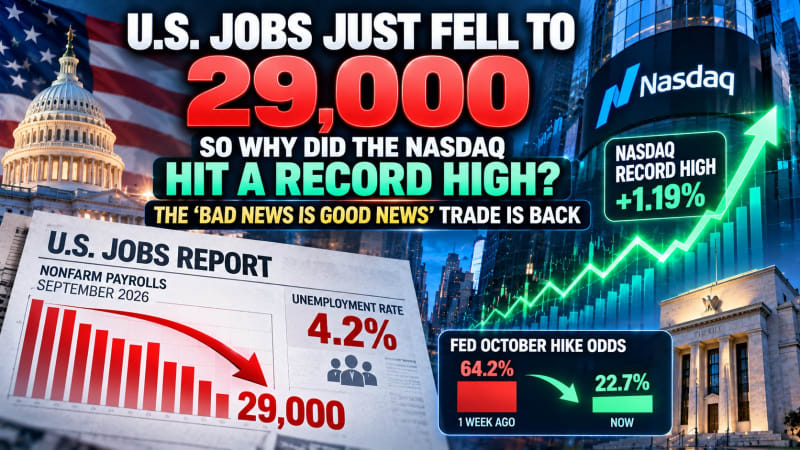
U.S. Jobs Just Fell to 29,000—So Why Did the Nasdaq Hit a Record High? The ‘Bad News Is Good News’ Trade Is Back
The latest U.S. jobs report delivered what would normally look like bad news for the economy.
The United States added only 29,000 jobs in September, far below expectations.
The unemployment rate increased to 4.2%.
Annual wage growth slowed to 3.0%.
And employment growth for July and August was revised lower by a combined 60,000 jobs.
Yet Wall Street rallied.
The Nasdaq Composite climbed 1.19% and briefly reached a record high. The S&P 500 advanced 0.73%, while the Dow Jones Industrial Average gained 0.49%.
Why would investors celebrate weaker employment?
Because the market is once again trading on one of Wall Street's strangest relationships:
Bad economic news can become good news for stocks—provided it is not bad enough to signal a recession.
The September jobs report reduced expectations that the Federal Reserve will raise interest rates again in October.
That immediately created relief for technology stocks and other rate-sensitive assets.
But the bigger question is more important:
Has the U.S. economy entered the stock market's perfect slowdown—weak enough to stop the Fed from tightening, but not weak enough to damage corporate earnings?
What Happened to the U.S. Labor Market?
September's payroll report showed a clear slowdown in hiring.
Nonfarm payrolls increased by just 29,000 jobs.
That was substantially below economists' expectations.
The previous two months were also weaker than previously reported.
July was revised to show a loss of jobs, while total employment growth for July and August was revised down by approximately 60,000.
Meanwhile, unemployment increased from 4.1% to 4.2%.
Wage pressure also eased.
Average hourly earnings rose only 0.1% during September, bringing annual wage growth down to 3.0%.
Taken together, these numbers suggest the U.S. labor market is cooling.
But importantly, it is not collapsing.
The U.S. Has Entered a “Low-Hire, Low-Fire” Economy
The unusual feature of today's labor market is that companies are hiring slowly—but they are not firing workers aggressively.
Initial unemployment claims remain historically low.
There is still little evidence of a broad layoff cycle.
That produces what economists increasingly describe as a:
Low-hire, low-fire labor market.
Businesses are cautious about expanding payrolls.
But they are also reluctant to let existing employees go.
That distinction is critical for financial markets.
A slowdown in hiring can reduce wage and inflation pressure.
A surge in layoffs would signal something much more dangerous.
For now, markets believe the U.S. remains closer to the first scenario.
Why Weak Jobs Sent Stocks Higher
The immediate explanation is interest rates.
Before the latest run of softer economic data, investors were considering another Federal Reserve rate increase in October.
That probability has now fallen dramatically.
The market's logic looks like this:
Hiring slows
↓
Wage pressure cools
↓
Inflation risk may ease
↓
Fed has less reason to hike again
↓
Interest-rate pressure decreases
↓
Growth stocks become more attractive
Technology companies benefit particularly strongly from this relationship.
That helps explain why the Nasdaq outperformed after the jobs report.
Why Interest Rates Matter So Much to Technology Stocks
Many technology companies are valued partly on profits they are expected to generate many years into the future.
When interest rates rise, investors apply a higher discount rate to those future earnings.
That reduces their present value.
The simplified relationship is:
Higher interest rates → higher discount rate → lower valuation
When expectations for additional rate increases fall, the reverse can happen.
This makes technology stocks particularly sensitive to changes in Fed expectations.
And today's technology market has another powerful force behind it:
artificial intelligence.
AI-related companies continue producing some of the strongest earnings and capital-investment expectations in the market.
That combination—
less Fed tightening + strong AI expectations
—helped drive the Nasdaq higher despite disappointing employment growth.
Read AI Stocks vs 5.2% Treasury Yields: Is the S&P 500 Too Dependent on AI? for our analysis of how AI leadership is helping major equity indices withstand historically high bond yields.
“Bad News Is Good News” Has Returned
The relationship between economic data and stock prices can become counterintuitive during inflationary periods.
Normally:
Strong economy = good for stocks.
But when inflation is too high and the Federal Reserve is tightening policy, strong economic data can create another reaction:
Strong economy
↓
Persistent inflation
↓
More Fed tightening
↓
Higher bond yields
↓
Pressure on stocks
In that environment, weaker data can provide relief.
That is why investors sometimes celebrate disappointing economic reports.
But this relationship only works up to a point.
Bad news is good news only while investors believe the economy can avoid recession.
Wall Street Is Betting on a “Perfect Slowdown”
The ideal scenario for financial markets looks something like this:
Job growth slows
↓
Layoffs remain low
↓
Wage growth moderates
↓
Inflation cools
↓
Fed stops tightening
↓
Economic growth remains positive
↓
Corporate profits keep rising
That would allow the Federal Reserve to stop raising rates without a recession destroying earnings.
It is essentially the market's version of a soft landing.
The September employment report supports that narrative.
But it does not guarantee it.
The Nasdaq Record Comes With an Important Warning
Headline index performance can hide weakness underneath the market.
The Nasdaq reached a record even though many individual stocks remained under pressure.
This is possible because the Nasdaq and S&P 500 are heavily influenced by their largest companies.
Mega-cap technology stocks can push the entire index higher even if hundreds of smaller companies are flat or falling.
That creates an important distinction:
A record index does not automatically mean a broadly healthy stock market.
Investors should therefore watch:
- market breadth
- advance-decline ratios
- new highs versus new lows
- equal-weight indices
- small-cap performance
- sector participation
If the rally broadens, the soft-landing story becomes more convincing.
If only mega-cap AI stocks continue rising, concentration risk remains.
AI Is Still Carrying a Large Part of the Market
Artificial intelligence remains one of the strongest earnings themes supporting U.S. equities.
Technology companies continue investing heavily in:
- AI processors
- data centres
- high-bandwidth memory
- cloud infrastructure
- networking
- electricity
That spending is supporting companies far beyond Silicon Valley.
The economic effects are increasingly appearing across manufacturing economies in Asia.
Read AI Is Reviving Asia's Factories: Is Global Manufacturing Finally Turning? for our analysis of how AI demand is moving from financial markets into factories, exports and industrial activity.
For the Nasdaq, this matters because AI provides an unusually strong earnings-growth narrative at precisely the moment when the wider economy is slowing.
But Long-Term Bond Yields Are Not Cooperating
There is one major problem with the bullish interpretation.
The jobs report reduced expectations for another near-term Fed hike.
But long-term U.S. Treasury yields remain exceptionally high.
The U.S. 10-year Treasury yield recently reached around 5.34%, its highest level in more than two decades.
That means investors are seeing two different interest-rate stories simultaneously.
Short-term rates
Weaker employment reduces the pressure on the Fed to raise rates again immediately.
Long-term rates
Government borrowing, inflation uncertainty, bond supply and fiscal concerns continue keeping yields elevated.
That distinction is extremely important.
Even if the Fed stops raising rates, borrowing costs for households and corporations may remain high.
Read Global Bond Selloff: Why Government Debt Is Becoming a Bigger Risk Than the Fed for our analysis of why long-term yields are increasingly being driven by forces beyond the central bank.
The New Market Paradox
Investors are therefore dealing with a strange combination:
Weak jobs → less Fed risk → good for stocks
but
High long-term yields → expensive capital → bad for valuations
This means the Fed can potentially pause without delivering the dramatic financial easing investors might normally expect.
Mortgage rates can remain high.
Corporate borrowing can remain expensive.
Government financing costs can continue rising.
And equity valuations can still face competition from Treasury bonds yielding around 5%.
The jobs report helped one part of the interest-rate problem.
It did not solve all of it.
When Does Bad News Stop Being Good News?
This is the crucial question.
Suppose next month's payroll report is also weak.
Markets may again celebrate because Fed tightening becomes even less likely.
But what if the weakness continues?
Eventually:
Hiring slows
↓
Consumers become nervous
↓
Spending slows
↓
Corporate revenue weakens
↓
Profits fall
↓
Layoffs increase
At that point, markets stop asking:
“Will the Fed hike?”
and start asking:
“Is the economy entering recession?”
Once that transition happens, bad news becomes bad news again.
Consumer Spending Is the Critical Link
The United States is heavily dependent on consumer spending.
As long as workers remain employed, households can continue spending even if companies are hiring fewer new employees.
But prolonged weak hiring can still affect confidence.
Workers may become less willing to:
- switch jobs
- make large purchases
- buy homes
- take on debt
- increase discretionary spending
That could eventually slow economic growth.
So one of the most important indicators is no longer simply payroll growth.
It is whether weaker hiring begins affecting household behavior.
Wage Growth Could Be Good News for Inflation
The slowdown in annual wage growth to approximately 3.0% could help the Federal Reserve.
Rapid wage growth can contribute to service-sector inflation because labor is one of the largest costs for many businesses.
Moderating wage growth can reduce that pressure.
The sequence could become:
Slower wages
↓
Lower services inflation
↓
Less need for additional Fed tightening
That is one reason markets reacted positively to the report.
But wages also support consumer spending.
If wage growth becomes too weak relative to inflation, household purchasing power can come under pressure.
Once again, the market needs moderation—not collapse.
Small Caps Could Reveal Whether the Rally Is Broadening
Small-cap stocks are particularly useful in this environment.
Smaller companies tend to be more sensitive to domestic economic conditions and borrowing costs.
They often rely more heavily on bank lending and refinancing than giant technology companies with huge cash balances.
If expectations for further Fed tightening continue falling and the economy remains stable, smaller companies could benefit.
A sustained small-cap rally would therefore strengthen the argument that markets are entering a broader risk-on phase.
If small caps remain weak while Nasdaq mega-caps keep setting records, market concentration remains a concern.
What Could Happen to the Dollar?
A less aggressive Federal Reserve can also affect currencies.
If investors expect U.S. interest rates to stop rising while other central banks remain restrictive, the dollar could lose some interest-rate support.
A softer dollar can sometimes help:
- emerging-market currencies
- commodities
- international equities
- U.S. multinational earnings
But the relationship is complicated because long-term Treasury yields remain elevated.
The dollar may therefore react less dramatically than it would during a traditional Fed easing cycle.
Why This Matters for India
The U.S. employment story matters directly to Indian markets.
If weaker jobs reduce expectations for another Fed hike, the pressure on global liquidity can ease.
That can potentially improve investor appetite for emerging-market assets.
India could benefit through:
- stronger foreign portfolio flows
- reduced dollar pressure
- better risk sentiment
But there is an important caveat.
If U.S. long-term yields remain above 5%, Treasuries still offer attractive returns compared with riskier assets.
So Indian equities continue competing against unusually high developed-market bond yields.
For India, the most supportive combination would be:
Fed tightening ends + U.S. yields fall + dollar stabilizes + oil eases.
If only the first condition occurs, the benefit may be much smaller.
Track the major U.S., Asian, European and Indian markets through the LiveWorldMarket Global Markets Dashboard.
Three Scenarios From Here
Scenario 1: The Perfect Slowdown
Payroll growth remains moderate.
Layoffs stay low.
Wage growth cools.
Inflation eases.
The Fed pauses.
Corporate earnings remain strong.
Market implication: potentially supportive for growth stocks, small caps and broader risk assets.
Scenario 2: The Economy Reaccelerates
Hiring strengthens again.
Wages remain sticky.
Inflation stops improving.
Markets restore expectations for another Fed hike.
Market implication: bond yields could rise again and expensive technology valuations would face another test.
Scenario 3: The Slowdown Becomes a Downturn
Payrolls turn negative.
Layoffs accelerate.
Unemployment rises quickly.
Consumer spending weakens.
Earnings estimates decline.
Market implication: the “bad news is good news” trade breaks down because recession risk becomes more important than Fed relief.
What Investors Should Watch Next
The most important indicators now include:
- nonfarm payrolls
- unemployment
- weekly jobless claims
- wage growth
- job openings
- hiring rates
- layoffs
- consumer confidence
- retail sales
- corporate earnings revisions
- Fed guidance
- U.S. 2-year Treasury yield
- U.S. 10-year Treasury yield
- market breadth
- small-cap performance
The relationship between these indicators will tell investors whether the labor market is achieving an orderly cooling—or moving toward something more dangerous.
The Bigger Picture: Bad News Is Good News—Until It Isn't
The market reaction to September's employment report captures the unusual position of the U.S. economy.
Only 29,000 jobs were added.
Unemployment rose.
Wage growth slowed.
Yet technology stocks rallied and the Nasdaq reached an intraday record.
For now, investors believe weaker hiring is solving a monetary-policy problem rather than creating an economic one.
That may prove correct.
The labor market still shows limited layoffs.
Corporate profits remain strong.
AI investment continues supporting technology earnings.
And expectations for another immediate Fed hike have fallen substantially.
But the path is narrow.
The economy needs to slow enough to cool inflation.
It cannot slow so much that unemployment accelerates.
The Fed needs to stop tightening.
But long-term bond yields also need to stop rising.
And corporate earnings must remain strong enough to justify high stock valuations.
That is why the real question is not simply:
Why did the Nasdaq rise after a weak jobs report?
It is:
How long can bad economic news remain good news before investors begin worrying that the slowdown has gone too far?
That could become one of the defining questions for global markets during the final quarter of 2026.
Related LiveWorldMarket Analysis
Global Bond Selloff: Why Government Debt Is Becoming a Bigger Risk Than the Fed
AI Stocks vs 5.2% Treasury Yields: Is the S&P 500 Too Dependent on AI?
AI Is Reviving Asia's Factories: Is Global Manufacturing Finally Turning?
LiveWorldMarket Global Markets Dashboard
Disclaimer: This article is for informational and educational purposes only. It does not constitute investment advice or a recommendation to buy or sell any security or financial instrument. Economic data, interest rates and financial markets can change rapidly.
Comments (0)
Be the first to comment.
About the author

NISM-Series-X-A Investment Adviser Level 1 examination completed
Amit writes about Indian equity markets, technical analysis, macro themes and the day-to-day mechanics of trading, with a focus on making the flow of global markets legible for retail investors. He has completed the NISM-Series-X-A Investment Adviser Level 1 examination.
You May Also Like
Stocks Hit Record Highs While Bond Yields Flash a Warning: Which Market Is Right?
Global Markets & Economy · Oct 6, 2026 · 9 min read
Stocks Are Hitting Records While Bonds Flash a Warning: Which Market Is Right? Something unusual is happening across global financial markets. Stocks are celebrating. Bonds are warning. On October 6, global equities climbed to their highest level in roughly two weeks. The S&P 500 reached another record, while the technology-heavy Nasdaq extended its run of all-time highs. The…
Read more...
France Bond Spread Hits 2011-Era Extreme: Is Europe’s Debt Risk Returning?
Global Markets & Economy · Oct 6, 2026 · 9 min read
France’s Bond Spread Just Hit a 2011-Era Extreme: Is Europe Quietly Re-Entering a Sovereign-Debt Risk Trade? For much of 2026, investors have been focused on the Federal Reserve, oil, inflation and the extraordinary resilience of AI-driven equity markets. But another risk is quietly emerging in Europe. The gap between France’s 10-year government bond yield and Germany’s…
Read more...
Why Are Defense Stocks Falling Despite Rising Global Military Spending?
Geopolitics & Trade · Oct 5, 2026 · 12 min read
Global military spending is rising. Weapons inventories are being rebuilt. Major defense contractors are receiving some of the largest multiyear orders in years. Yet U.S. defense stocks have been falling. The iShares U.S. Aerospace & Defense ETF has declined by as much as 18.2% from its August 14 record high and has posted seven consecutive weekly losses, its longest such…
Read more...
China’s Fuel Export Squeeze: Could Asia’s $50 Refining Margins Become the Next Inflation Shock?
Commodities & Energy · Oct 3, 2026 · 10 min read
China’s Fuel Export Squeeze: Could Asia’s $50 Refining Margins Become the Next Inflation Shock? Global investors have spent much of 2026 watching crude oil. But another part of the energy market may now deserve just as much attention: the cost of refining crude oil into the fuels that households and businesses actually use. Tightening Chinese fuel exports and constrained…
Read more...
Global Bond Selloff: Why Government Debt Is Becoming a Bigger Risk Than the Fed
Global Markets & Economy · Oct 2, 2026 · 12 min read
The Fed Isn't the Biggest Problem Anymore: Why the Global Bond Market Is Suddenly Worried About Government Debt For years, investors trying to understand bond markets focused on one question: What will the Federal Reserve do next? Will the Fed raise interest rates? Will it pause? When will it cut? That framework still matters. But something more fundamental is beginning to…
Read more...
AI Is Reviving Asia's Factories: Is Global Manufacturing Finally Turning?
Global Markets & Economy · Oct 1, 2026 · 12 min read
AI Is Reviving Asia’s Factories: Is the Global Manufacturing Cycle Finally Turning? For the past few years, artificial intelligence has primarily been viewed as a technology and stock-market story. AI stocks surged. Semiconductor companies expanded production. Technology giants committed hundreds of billions of dollars to data centres and computing infrastructure. Now…
Read more...
South Korea Chip Exports Surge 259% as AI Demand Hits the Real Economy
Trend · Sep 30, 2026 · 12 min read
South Korea’s Chip Exports Are Surging 259%: Is the AI Boom Finally Spreading From Stock Prices Into the Real Economy? For much of the artificial-intelligence boom, the most visible evidence has been in financial markets. AI-related stocks surged. Semiconductor valuations climbed. Technology companies announced hundreds of billions of dollars of data-centre investment. But…
Read more...
AI Infrastructure Boom: $126 Billion Flows Into Chips, Data Centres and Power
Trend · Sep 30, 2026 · 13 min read
The AI Boom Is Entering a New Phase: $126 Billion Is Pouring Into Chips, Data Centres and Power For the past several years, the artificial-intelligence investment story has largely revolved around one question: Which company will build the most powerful AI chips and models? That question helped fuel enormous gains across semiconductor and technology stocks. But the AI…
Read more...
China’s Economy Is Splitting in Two: AI Booms as Traditional Industries Struggle
Fundamental · Sep 28, 2026 · 12 min read
China’s Economy Is Splitting in Two: AI Profits Are Surging While Traditional Industries Struggle China’s economy is becoming increasingly difficult to describe with a single word such as “strong” or “weak.” Underneath the headline growth numbers, two very different economies appear to be developing. On one side are artificial intelligence, semiconductors, advanced…
Read more...
Investors Pour $44 Billion Into Stocks Despite 5% Bond Yields
Global Markets & Economy · Sep 27, 2026 · 11 min read
AI Stocks Keep Rising While Bond Yields Hit Multi-Decade Highs: Is the Stock Market Becoming Too Dependent on AI? Something unusual is happening across global financial markets. Bond investors are confronting some of the highest yields seen in decades. The U.S. 10-year Treasury yield has moved above 5%, longer-dated yields have climbed even further, and Japanese government…
Read more...