
RBI Dollar Window: Can Rupee Near ₹97 Survive $100 Oil?

RBI Opens Special Dollar Window as Rupee Nears ₹97: Can India Protect Its Stock Market From $100 Oil?
India's central bank has introduced a new defense against rupee weakness at a time when crude oil prices remain above $100 per barrel. The Reserve Bank of India (RBI) has announced a special dollar facility for three government-owned oil marketing companies, beginning October 12, alongside tighter rules for foreign-exchange derivatives.
The immediate objective is to reduce pressure on the currency market.
But for investors, the bigger question is whether stabilizing the rupee can also protect Indian equities from the economic consequences of expensive oil.
The answer is more complicated than it first appears.
The RBI can influence how dollars reach major oil importers. It cannot directly control global crude prices, eliminate India's oil-import costs or guarantee stronger corporate earnings.
That distinction could become central to the next phase of the Indian stock market.
What Did the RBI Announce?
On October 10, the RBI announced a special facility to meet the daily U.S. dollar requirements of three major state-owned oil marketing companies:
- Indian Oil Corporation (IOC)
- Bharat Petroleum Corporation (BPCL)
- Hindustan Petroleum Corporation (HPCL)
The facility becomes available on October 12 and will remain operational until further notice.
Under the arrangement, the RBI supplies dollars through designated banks rather than requiring these companies to meet their entire daily demand through the regular foreign-exchange market.
This could remove a significant source of recurring dollar demand from the spot market.
The RBI also introduced restrictions affecting certain foreign-exchange derivatives transactions, including tighter limits and requirements intended to discourage excessive speculative or unsupported positions.
Together, the measures aim to improve orderly market functioning and reduce currency volatility.
Related: Explore India's stock market dashboard.
Why Is the Rupee Under So Much Pressure?
The Indian rupee has faced a combination of domestic and international pressures.
On October 9, the currency closed around ₹96.73 per U.S. dollar, close to its previous record low of approximately ₹96.96.
Three major forces help explain the pressure.
1. Crude Oil Above $100
India imports a substantial share of the crude oil it consumes.
When international oil prices rise, refiners generally need more dollars to purchase the same quantity of crude.
That increases foreign-currency demand and can contribute to rupee depreciation.
2. A Strong U.S. Dollar
Geopolitical uncertainty, higher U.S. yields and expectations surrounding Federal Reserve policy can support demand for dollar-denominated assets.
A stronger dollar often creates additional pressure on emerging-market currencies.
3. Foreign Capital Flows
When overseas investors reduce exposure to Indian assets, their currency conversions can add to dollar demand.
However, FII and FPI flows are only one part of the exchange-rate picture. Trade payments, hedging demand, external debt servicing and broader capital movements also matter.
Related: Follow global markets and U.S. equities.
How Does the RBI's Special Dollar Window Work?
The mechanism is relatively straightforward.
Under normal circumstances, oil marketing companies obtain dollars through commercial banks and the foreign-exchange market to pay international suppliers.
When crude prices rise sharply, this recurring demand can place additional pressure on the rupee.
The RBI's special window changes the immediate route through which the companies obtain their dollars.
Before the Intervention
Oil company needs dollars → Purchases dollars through banks and the market → Additional spot-market dollar demand → Potential pressure on USD/INR
With the Special Window
Oil company needs dollars → Designated bank accesses RBI dollar facility → Oil company receives dollars → Less direct spot-market demand from these companies
This may help reduce short-term volatility.
However, it does not make the oil imports cheaper in dollar terms.
It also creates a potential trade-off: supplying dollars from official reserves can reduce the RBI's foreign-exchange reserve holdings, depending on how the intervention is managed.
The central bank is therefore managing currency-market pressure rather than removing the underlying demand for imported energy.
Why $100 Oil Remains the Bigger Economic Challenge
The impact of expensive crude extends well beyond the currency market.
Higher oil prices can affect transportation costs, industrial production, household purchasing power and corporate profitability.
For India, a prolonged period of elevated crude prices can influence several economic channels simultaneously.
Inflation
Higher fuel and transportation costs can eventually feed into consumer prices, depending on domestic pricing policies and how much of the increase is passed through.
Corporate Margins
Businesses that use fuel, petrochemicals or energy-intensive logistics may experience rising costs.
Their profitability depends on whether they can pass those increases on to customers.
Current Account Balance
A larger energy-import bill can increase India's import expenditure, all else equal.
This may place additional pressure on the current account and the currency.
Monetary Policy
If oil-driven inflation persists, the RBI may face less flexibility to ease interest rates, even if domestic growth slows.
That can influence borrowing costs and equity valuations.
Related: Read more global macroeconomic and commodity analysis.
Which Indian Stock Market Sectors Are Most Exposed?
The effects will not be uniform across the market.
Some companies may face higher input costs, while others could benefit from stronger energy prices or improved currency stability.

These are possible transmission effects, not predictions of individual stock returns.
Oil Marketing Companies: Relief Is Not the Same as Profitability
IOC, BPCL and HPCL are direct participants in the new dollar facility.
A more orderly process for obtaining foreign currency may help their treasury operations and reduce market-related uncertainty.
But the facility does not guarantee better refining or marketing margins.
Those depend on crude acquisition costs, product prices, refining performance and government policy.
Investors should distinguish between foreign-exchange liquidity support and improvements in underlying business profitability.
Airlines and Consumer-Facing Companies
Airlines are sensitive to aviation turbine fuel prices.
If energy costs remain elevated, profitability may depend on whether companies can raise fares without significantly weakening demand.
Paint manufacturers, chemical producers and transportation companies may face similar cost pressures.
Upstream Energy Producers
Oil producers can benefit from higher realized crude prices, although their final profitability also depends on production volumes, taxes, regulatory arrangements and operating costs.
A rise in crude prices does not benefit every energy company equally.
Can the RBI's Move Support Nifty 50 and Sensex?
The intervention could improve near-term sentiment if investors interpret it as evidence that the RBI is prepared to address disorderly currency movements.
A more stable rupee can reduce uncertainty around imported costs, overseas investment returns and corporate foreign-currency liabilities.
But a currency intervention does not automatically produce a sustained equity rally.
Indian equity valuations remain influenced by earnings expectations, bond yields, foreign investment flows and global risk appetite.
Three Possible Market Scenarios
Scenario 1: Rupee Stabilizes and Oil Prices Ease
This would provide the most supportive combination for Indian equities.
Lower energy costs could ease inflation and margin concerns, while currency stability could improve investor confidence.
Scenario 2: Rupee Stabilizes but Oil Remains Above $100
Currency volatility may decline, but cost pressures on businesses and households could persist.
In this environment, stock selection and sector-specific earnings resilience may matter more than broad index direction.
Scenario 3: Oil Rises Further and Dollar Strength Continues
This would be the more challenging scenario.
Even with RBI intervention, persistent external pressures could weigh on the currency, inflation expectations and equity-market valuations.
The RBI's measures may reduce volatility, but their effectiveness will depend partly on global conditions.
What Does This Mean for Foreign Investors?
Foreign portfolio investors evaluate Indian equities in both local-currency and foreign-currency terms.
A rising stock index does not necessarily translate into equally strong dollar returns if the rupee depreciates significantly.
For example, an overseas investor can earn a positive return on an Indian stock in rupees while experiencing a smaller gain—or even a loss—after currency conversion.
This makes USD/INR an important variable in international portfolio decisions.
A more stable rupee could reduce one source of uncertainty, but overseas investors will still assess valuations, earnings growth and global interest rates.
Could the Dollar Window Create New Risks?
Currency-market interventions involve trade-offs.
The most obvious is potential pressure on foreign-exchange reserves.
Another concern involves liquidity and hedging.
Tighter derivatives rules may discourage excessive positioning, but they can also increase costs or reduce flexibility for companies managing genuine foreign-exchange exposure.
Market participants will therefore watch whether the new rules reduce speculative demand without significantly impairing legitimate hedging and market-making activity.
The ultimate test is not simply whether USD/INR moves lower for one session.
It is whether the foreign-exchange market remains orderly and sufficiently liquid over time.
Five Indicators Investors Should Track This Week
1. USD/INR
Does the rupee stabilize after the special dollar window begins operating?
A sustained reduction in volatility would be more meaningful than a brief opening move.
2. Brent Crude
Does Brent remain above $100, rise further or begin to retreat?
The direction of crude will influence India's import costs and inflation outlook.
3. RBI Foreign-Exchange Reserves
How does the central bank's reserve position evolve as it supplies dollars to oil companies?
Weekly reserve data should be interpreted carefully because valuation changes and other transactions also affect reported balances.
4. FII/FPI Flows
Are overseas investors increasing or reducing their exposure to Indian equities?
Persistent outflows could offset some of the support from currency measures.
5. Nifty Sector Performance
Are energy-sensitive sectors stabilizing, or are higher input costs continuing to weigh on share prices?
Sector-level performance may provide a clearer picture than the headline index alone.
Related: LiveWorldMarket market dashboards and analysis.
The Global Connection: Oil, Dollar and Bond Yields
India's currency challenge is part of a broader global financial-market environment.
Higher crude prices can increase inflation risks.
Inflation concerns can influence bond yields and monetary-policy expectations.
Higher yields and global uncertainty can support demand for the U.S. dollar.
A stronger dollar can then add pressure to emerging-market currencies.
The chain is not automatic, but these forces can reinforce one another.
That is why developments in the U.S. bond market, Middle Eastern energy markets and Federal Reserve policy can have immediate consequences for Indian equities.
For investors, analyzing India's currency in isolation may miss the larger picture.
LiveWorldMarket View: The RBI Can Buy Stability, Not Cheap Oil
The RBI's special dollar window is a targeted response to an identifiable source of foreign-exchange demand.
By redirecting oil companies' dollar purchases away from the regular spot market, the central bank may reduce short-term pressure on the rupee.
That is meaningful.
But it is not a substitute for lower international crude prices, stronger capital inflows or improving external balances.
For the Indian stock market, the next question is whether reduced currency volatility translates into improved earnings expectations.
If crude prices ease, the intervention could help reinforce a broader improvement in sentiment.
If crude remains expensive, investors may continue to distinguish between companies with strong pricing power and those exposed to persistent input-cost inflation.
The key takeaway: India's currency defense can change how dollar demand reaches the market, but it cannot remove the economic cost of importing $100 oil.
For more analysis, visit LiveWorldMarket.com for global market developments, Indian equity dashboards and original market Insights.
Sources
- Reuters — India unveils tough curbs on dollar demand to defend rupee
- Reuters — Indian central bank curbs corporate hedging demand
- Moneycontrol — RBI opens special dollar window for three oil companies
- Reuters — Asian markets, earnings and oil developments
Disclaimer: This article is for educational and informational purposes only and does not constitute investment advice. Market figures reflect information reported around October 12, 2026, and may change during trading.
Comments (0)
Be the first to comment.
About the author

NISM-Series-X-A Investment Adviser Level 1 examination completed
Amit writes about Indian equity markets, technical analysis, macro themes and the day-to-day mechanics of trading, with a focus on making the flow of global markets legible for retail investors. He has completed the NISM-Series-X-A Investment Adviser Level 1 examination.
You May Also Like
IMF Asia Growth 4.4%, US CPI 3.7%: Which Stocks Are at Risk?
News · Oct 15, 2026 · 12 min read
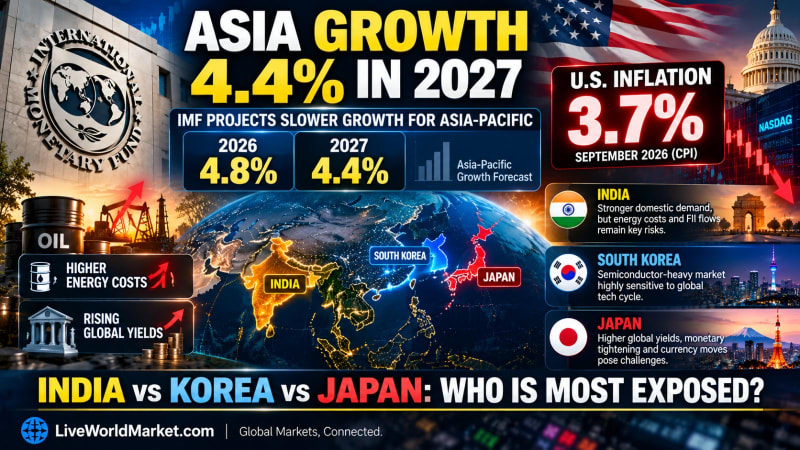
IMF Sees Asia Growth Slowing to 4.4% as U.S. Inflation Hits 3.7%: Which Stock Markets Are Most Vulnerable? Asia's stock markets are facing a critical test as two major economic developments collide: the International Monetary Fund's warning about slower regional growth and an unexpected rise in U.S. inflation. The IMF's October Asia-Pacific outlook projects regional economic…
Read more...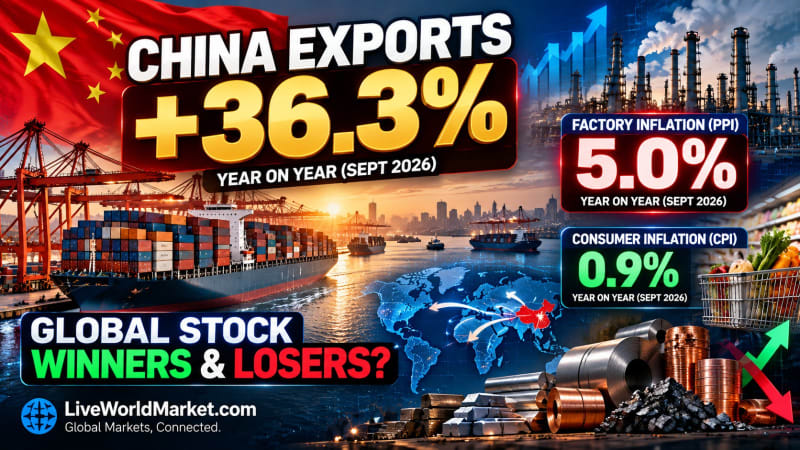
China Exports Surge 36.3%, PPI Hits 5%: Stock Winners & Losers
Geopolitics & Trade · Oct 14, 2026 · 11 min read
China's Exports Surge 36.3% as Factory Inflation Hits 5%: Which Global Stocks Could Win or Lose? China's factories are shipping more goods overseas than expected, but a sharp rise in producer prices is raising a new question about the profitability of the world's manufacturing powerhouse. Official data released on October 14 showed that China's exports surged 36.3%…
Read more...
CXMT DRAM Breakthrough: Samsung, SK Hynix & Micron at Risk?
Technology & Sectors · Oct 13, 2026 · 11 min read
China's CXMT DRAM Breakthrough: Could a Memory Price War Threaten Samsung, SK Hynix and Micron? The global semiconductor industry is confronting a new question: Could China's progress in memory-chip technology eventually undermine the pricing power of the world's largest DRAM manufacturers? Chinese chipmaker ChangXin Memory Technologies (CXMT) has reportedly made progress in a…
Read more...
Firmus $5B IPO Cancelled: AI Data Center Valuations at Risk
Technology & Sectors · Oct 11, 2026 · 9 min read
Nvidia-Backed Firmus Cancels $5 Billion IPO: Is Wall Street Finally Questioning AI Data Center Valuations? The global artificial intelligence investment boom has encountered a revealing reality check. Firmus Technologies, an Australian AI data center developer backed by Nvidia, has withdrawn its planned multibillion-dollar stock market listing after struggling to attract…
Read more...
Starlink $8B Spectrum Deal: Telecom Stocks Fall, Towers Rise
Technology & Sectors · Oct 10, 2026 · 10 min read
Starlink's $8 Billion Spectrum Deal: Why Telecom Stocks Fell While Tower Shares Surged A single spectrum deal has sent shockwaves through the global telecommunications industry. On October 8, SpaceX announced an agreement to acquire nationwide 800 MHz wireless spectrum from Grain Management, marking a significant step toward expanding its Starlink Mobile business. The…
Read more...
Two-Thirds of S&P 500 Stocks Rose—Why Did the Index Fall? AI Warning
Technology & Sectors · Oct 9, 2026 · 11 min read
The AI Boom Is Turning Into a $100 Billion Debt Race: Could Borrowing Costs Become the Next Risk for Tech Stocks? For the past three years, artificial intelligence has been one of the biggest forces driving global stock markets. From Nvidia's extraordinary rise to the massive expansion of AI data centres, investors have rewarded companies promising to build the infrastructure…
Read more...
AI Debt Boom 2026: Could Borrowing Costs Hit Tech Stocks?
News · Oct 8, 2026 · 11 min read
The AI Boom Is Turning Into a $100 Billion Debt Race: Could Borrowing Costs Become the Next Risk for Tech Stocks? For the past three years, artificial intelligence has been one of the biggest forces driving global stock markets. From Nvidia's extraordinary rise to the massive expansion of AI data centres, investors have rewarded companies promising to build the infrastructure…
Read more...
$100 Oil Is Back: Which Stock Markets and Sectors Are Most Exposed?
Commodities & Energy · Oct 7, 2026 · 12 min read
The $100 Oil Test Has Arrived: Which Global Stock Markets and Sectors Are Most Exposed If Crude Stays Above Triple Digits? Oil above $100 is no longer a hypothetical risk for global markets. Brent crude traded above $101 a barrel on October 7, while U.S. West Texas Intermediate hovered near $90 as investors confronted a combination of Middle East supply risks, attacks on…
Read more...
Stocks Hit Record Highs While Bond Yields Flash a Warning: Which Market Is Right?
Global Markets & Economy · Oct 6, 2026 · 9 min read
Stocks Are Hitting Records While Bonds Flash a Warning: Which Market Is Right? Something unusual is happening across global financial markets. Stocks are celebrating. Bonds are warning. On October 6, global equities climbed to their highest level in roughly two weeks. The S&P 500 reached another record, while the technology-heavy Nasdaq extended its run of all-time highs. The…
Read more...
France Bond Spread Hits 2011-Era Extreme: Is Europe’s Debt Risk Returning?
Global Markets & Economy · Oct 6, 2026 · 9 min read
France’s Bond Spread Just Hit a 2011-Era Extreme: Is Europe Quietly Re-Entering a Sovereign-Debt Risk Trade? For much of 2026, investors have been focused on the Federal Reserve, oil, inflation and the extraordinary resilience of AI-driven equity markets. But another risk is quietly emerging in Europe. The gap between France’s 10-year government bond yield and Germany’s…
Read more...