
Indonesia Stocks Crash 11.57%: Will MSCI Downgrade Benefit India?
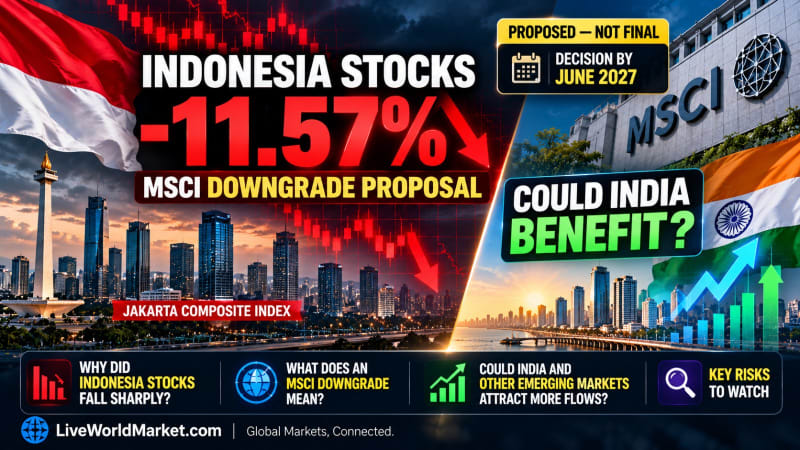
Indonesia Stocks Plunge 11% as MSCI Proposes Downgrade: Could India and Other Emerging Markets Benefit?
Indonesia's stock market has suffered its sharpest one-day decline in nearly three decades, but the bigger story extends far beyond Jakarta. A proposed MSCI downgrade could eventually force global index funds to remove Indonesian equities from their portfolios, potentially redistributing capital across other emerging markets.
On Friday, October 16, Indonesia's Jakarta Composite Index closed 11.57% lower after MSCI proposed reclassifying the country from Emerging Market to Standalone Market status.
The announcement triggered concerns about foreign investment outflows, market liquidity and the future international accessibility of Indonesia's equity market.
The Indonesian rupiah also weakened, touching approximately 18,070 against the U.S. dollar during trading.
For investors in India, Taiwan, South Korea and other emerging markets, the development raises an important question:
If Indonesia loses its place in major emerging-market indexes, could other countries receive a larger share of international investment?
The answer is potentially yes—but the mechanism is more complicated than simply transferring money from Indonesia to India.
1. What Happened to Indonesia's Stock Market?
Indonesia's benchmark stock index experienced an extraordinary selloff on October 16.
The Jakarta Composite opened approximately 8% lower, triggering a temporary trading halt. Selling pressure continued after trading resumed.
By the end of the session, the index had fallen 11.57%, its largest one-day percentage decline since January 1998.
The selloff followed MSCI's announcement that Indonesia's current emerging-market classification was no longer appropriate because of persistent concerns about market governance and investability.
Indonesia Market Shock: October 16, 2026

The market reaction reflects concern that a future reclassification could significantly reduce the pool of international investment funds eligible or willing to hold Indonesian equities.
However, the sharp selloff does not mean all foreign investors have already exited the market.
2. Why Is MSCI Considering Downgrading Indonesia?
MSCI is one of the world's most influential providers of equity indexes.
Its indexes are used by institutional investors, exchange-traded funds, pension funds and asset managers to measure performance and construct portfolios.
Countries are classified partly according to market accessibility, size, liquidity and economic development.
Indonesia has long been included in the emerging-market investment universe.
However, MSCI has raised concerns about the functioning and transparency of its stock market.
The Main Issues Identified by MSCI
Opaque ownership structures
Investors have expressed concerns about insufficient transparency surrounding the ultimate ownership of certain listed companies.
Concentrated shareholdings
When relatively few investors control a large percentage of available shares, reported market capitalization may overstate the amount of stock genuinely accessible to public investors.
Suspected coordinated trading
MSCI cited continuing concerns about potentially coordinated trading behavior and whether enforcement has been sufficiently effective.
Insufficient evidence of reform
Indonesian authorities have announced measures to improve disclosure and market transparency, but MSCI says investors have not yet observed consistent, meaningful improvements.
These concerns relate to the integrity and accessibility of the stock market—not simply Indonesia's economic growth prospects.
That distinction is essential.
A country can have a large economy and promising businesses while still failing to meet the requirements of an international equity-index provider.
3. What Is the Difference Between Emerging, Frontier and Standalone Markets?
MSCI broadly classifies equity markets into Developed, Emerging, Frontier and Standalone categories.
These classifications influence which countries are included in major international investment benchmarks.

MSCI had previously warned that Indonesia could face a downgrade to Frontier Market status.
The latest proposal goes further.
Moving directly to Standalone status would remove Indonesia from the principal emerging- and frontier-market benchmark universes.
This could have a more substantial impact on foreign portfolio investment than a conventional downgrade to Frontier status.
4. Why Can an Index Downgrade Trigger Such a Large Selloff?
To understand the market reaction, investors need to understand how index-linked investment works.
Many global funds do not select every country independently.
Instead, they track or benchmark their portfolios against indexes such as the MSCI Emerging Markets Index.
When a country is removed from an index, its benchmark weight can fall to zero.
Funds designed to replicate that index may then need to sell the excluded securities.
How the Capital-Flow Mechanism Works
MSCI announces a potential classification change
↓
Investors reassess future index eligibility
↓
Some active investors reduce exposure before implementation
↓
If the downgrade becomes final, passive funds rebalance according to index rules
↓
Other eligible markets receive proportionately higher benchmark weights
The key distinction is between anticipated selling and mandatory index-related rebalancing.
The October 16 announcement does not itself require every passive fund to immediately liquidate Indonesian shares.
That obligation would depend on the final decision, implementation timetable and each fund's mandate.
Nevertheless, markets often react in advance because investors anticipate future portfolio adjustments.
5. How Much Foreign Investment Could Indonesia Lose?
Analysts have begun estimating the potential impact of a full removal from MSCI's emerging-market benchmarks.
According to estimates reported by Reuters, UBS suggested that the proposed reclassification could lead to approximately:

These are analyst estimates, not confirmed future transactions.
Actual outflows would depend on index implementation, investor positioning, market prices, currency movements and the decisions of active portfolio managers.
The distinction between passive and active capital is important.
Passive funds generally follow an index methodology and may be required to rebalance when its composition changes.
Active funds can exercise greater discretion. Some may sell, others may retain exposure, and some could consider buying if valuations become sufficiently attractive.
Therefore, the potential $19 billion figure should not be treated as money that will automatically move into competing emerging markets.
6. Could India Benefit From Indonesia's Potential Downgrade?
India is already an important component of global emerging-market investment portfolios.
Its large listed equity market, broad sector representation and substantial institutional investment ecosystem make it a significant destination for international capital.
If Indonesia is eventually removed from an MSCI benchmark, the weights of the remaining constituents would increase proportionately, assuming other index inputs remain unchanged.
That means India's benchmark weight could rise mechanically.
However, the direct impact is likely to be relatively modest compared with the overall size of India's stock market.
Three Ways India Could Potentially Benefit
1. Higher relative benchmark weight
India's share of an emerging-market index could increase slightly following Indonesia's exclusion.
Funds replicating the revised index would need to reflect the new weights.
2. Greater interest from active investors
Some global investors reducing Indonesia exposure may consider alternative Asian markets with adequate liquidity and established regulatory frameworks.
India could be among the markets evaluated.
3. Relative attractiveness of market accessibility
The Indonesia episode may encourage investors to place greater emphasis on ownership transparency, liquidity and governance when choosing emerging-market exposure.
Countries perceived as offering more predictable market access may benefit from that reassessment.
Why the Benefit Should Not Be Exaggerated
India would not receive all the capital leaving Indonesia.
Any mechanical benchmark redistribution would be spread across remaining eligible constituents.
Active investment decisions would depend on valuations, earnings growth, currency expectations, liquidity and investor mandates.
India also faces its own risks, including elevated equity valuations in some segments, foreign capital-flow volatility, currency movements and energy import costs.
The investment conclusion: India's potential benefit is more likely to come through a small increase in benchmark allocation and improved relative investor interest than through an immediate, dramatic inflow of foreign capital.
Related: Track India's stock market, indices and sector performance.
7. Could Taiwan and South Korea Benefit More Than India?
Taiwan and South Korea are major destinations for international investors seeking exposure to semiconductor manufacturing, electronics and advanced technology.
Both markets could receive some mechanical benefit from the redistribution of emerging-market benchmark weights, subject to the index's constituent universe.
However, their equity-market performance is influenced heavily by the global technology cycle.
Taiwan
Taiwan's stock market has significant exposure to advanced semiconductor manufacturing and global technology supply chains.
Investors evaluating Taiwan would consider AI infrastructure demand, semiconductor earnings, geopolitical risks and valuations.
South Korea
South Korea has major semiconductor and electronics companies, including Samsung Electronics and SK Hynix.
Its market can be particularly sensitive to global memory-chip pricing and AI investment expectations.
Why Index Reweighting Is Not Everything
Even if both markets gain a small benchmark-weight advantage, a decline in semiconductor earnings expectations could outweigh that benefit.
Conversely, strong technology-sector performance could attract investment independently of Indonesia's classification.
The critical point is that benchmark weight changes and fundamental investment attractiveness are two different forces.
Related: Follow global technology and U.S. equity-market trends.
8. What About Thailand, Malaysia and Other ASEAN Markets?
Indonesia's potential downgrade could also change how international investors evaluate Southeast Asian equities.
Thailand and Malaysia may receive greater attention from investors who want to maintain regional exposure while reducing Indonesian risk.
However, neighboring markets differ significantly in liquidity, sector composition, governance and valuations.
Thailand has exposure to tourism, banking, energy and domestic consumption.
Malaysia offers exposure to banking, technology-related manufacturing, commodities and other industries.
Vietnam is another important regional market to monitor, although index eligibility and market classification must be assessed separately.
A country does not automatically become the preferred investment destination simply because another market loses its classification.
The more relevant question is whether it offers attractive companies, sufficient liquidity and acceptable investment risks.
9. Emerging-Market Impact: Potential Winners and Losers

These are conditional investment implications, not predictions of stock-market returns.
10. Could Indonesia's Downgrade Create Opportunities for Long-Term Investors?
A severe market selloff can create valuation opportunities, but falling prices alone do not establish that stocks are inexpensive.
Investors considering Indonesia would need to assess whether the governance concerns are being resolved and whether corporate fundamentals remain intact.
Some companies may have strong operating businesses even if the broader market faces classification risks.
However, weak liquidity, uncertain ownership structures and limited transparency can justify a higher required return.
The distinction between a temporary market shock and a persistent structural problem is crucial.
What Could Support a Recovery?
Clearer ownership disclosure, credible enforcement, improved free-float transparency and constructive engagement with MSCI could improve investor confidence.
A recovery would also depend on company earnings, currency stability and broader financial conditions.
What Could Prolong the Selloff?
Continued governance concerns, foreign portfolio selling, weak liquidity and uncertainty about the final index decision could sustain pressure.
Investors should not assume that the prospect of regulatory reform guarantees a rebound.
11. Why This Is a Warning for Every Emerging Market
The Indonesia episode highlights a risk that receives less attention than inflation, interest rates or GDP growth: index eligibility risk.
Global capital markets increasingly rely on benchmark providers to define investable markets.
A classification decision can influence which securities international funds can hold and how much capital they allocate.
This creates a connection between market governance and portfolio flows.
For emerging economies, attracting international investment requires more than economic expansion.
It also requires reliable trading systems, ownership transparency, adequate liquidity and consistent regulatory enforcement.
The broader lesson is that stock-market accessibility can influence capital allocation independently of economic fundamentals.
12. Three Scenarios for Indonesia and Global Investors
Scenario One: Indonesia Demonstrates Meaningful Reform
Authorities introduce and enforce changes that materially improve transparency and market functioning.
MSCI reassesses the evidence and decides not to proceed with the proposed reclassification.
Investor confidence could improve, although recovery would depend on broader market conditions.
Scenario Two: MSCI Confirms Standalone Status
Indonesia is removed from the relevant emerging- and frontier-market benchmark universes according to the implementation timetable.
Passive funds tracking affected indexes would need to rebalance.
Other eligible markets would receive higher relative index weights, while Indonesia could face additional selling pressure.
Scenario Three: Prolonged Uncertainty
Investors remain uncertain about the likely outcome while authorities continue implementing reforms.
Some active funds reduce exposure ahead of the final decision, potentially sustaining volatility.
In this scenario, capital-flow effects could emerge gradually rather than on a single implementation date.
13. Five Indicators Investors Should Watch Next
1. MSCI's consultation process
Watch for official updates, investor feedback and evidence of changes in MSCI's assessment.
2. Indonesian regulatory reforms
Focus on actual enforcement, ownership transparency and free-float improvements rather than announcements alone.
3. Foreign portfolio investment flows
Track whether foreign investors continue selling Indonesian equities and whether other Asian markets experience meaningful inflows.
4. Indonesian rupiah and bond markets
Currency and bond-market movements can help reveal whether concerns are spreading beyond equities.
5. Emerging-market index weights
Monitor the final index methodology, implementation dates and changes in country allocations if reclassification proceeds.
For Indian investors, FII/FPI flows, Nifty 50 valuations, currency movements and domestic institutional buying will remain important alongside any MSCI-related developments.
Related: Explore global market analysis and investment insights.
LiveWorldMarket View: Indonesia's Crisis Is About More Than One Stock Market
Indonesia's 11.57% stock-market plunge is a powerful reminder that international capital flows are influenced not only by earnings and economic growth but also by market structure and investor confidence.
MSCI's proposal has created the possibility of a significant future reduction in index-linked investment exposure to Indonesia.
But the downgrade is not final.
The consultation continues until April 30, 2027, with a decision expected by June 30, 2027.
If Indonesia is eventually removed from major emerging-market benchmarks, India and other eligible markets could receive modest mechanical increases in their relative index weights.
Some may also attract additional discretionary investor interest.
However, it would be misleading to assume that all Indonesian outflows will automatically become inflows into India.
For long-term investors, the larger lesson is that governance, liquidity and transparency are fundamental components of market attractiveness.
The key takeaway: Indonesia's potential MSCI downgrade could reshape emerging-market portfolio allocations, but the most durable beneficiaries will be markets offering a combination of accessibility, strong corporate fundamentals, reasonable valuations and investor confidence.
Explore more analysis at LiveWorldMarket.com and follow the latest global market Insights.
Sources and further reading
- MSCI — Official October 15, 2026 consultation announcement
- MSCI — Index consultations
- Reuters — Indonesia faces possible removal from global indexes, October 16, 2026
- Reuters — MSCI market classifications explained
- Indonesia Financial Services Authority — Capital-market transparency reforms
Disclaimer: This article is for educational and informational purposes only and does not constitute personalized investment advice. Market figures reflect October 16, 2026 reporting. Potential capital-flow effects are scenarios, not guaranteed outcomes.
Comments (0)
Be the first to comment.
About the author

NISM-Series-X-A Investment Adviser Level 1 examination completed
Amit writes about Indian equity markets, technical analysis, macro themes and the day-to-day mechanics of trading, with a focus on making the flow of global markets legible for retail investors. He has completed the NISM-Series-X-A Investment Adviser Level 1 examination.
You May Also Like

STOXX 600 Rises 2% as Nasdaq Falls 4.5%: Is Europe Taking the Lead?
Global Markets & Economy · Oct 18, 2026 · 13 min read
Europe’s STOXX 600 Gains Over 2% as Nasdaq Falls 4.5%: Is Global Stock Market Leadership Shifting? Europe's stock markets delivered their strongest week since June while U.S. technology shares suffered their worst weekly decline in months. The divergence raises a critical question for global investors: Is the market beginning to reward diversified earnings growth instead of…
Read more...
CoreWeave Bond Yields Hit 16%: AI Data Center Debt Risks
Technology & Sectors · Oct 17, 2026 · 13 min read
CoreWeave Bond Yields Hit 16%: Is AI Data-Center Debt Becoming the Next Big Risk for Global Stocks? The artificial intelligence boom has entered a new phase. Investors are no longer asking only how much money AI companies can earn. They are increasingly questioning how much it costs to finance the infrastructure supporting that growth. This week, CoreWeave, a U.S.-based AI…
Read more...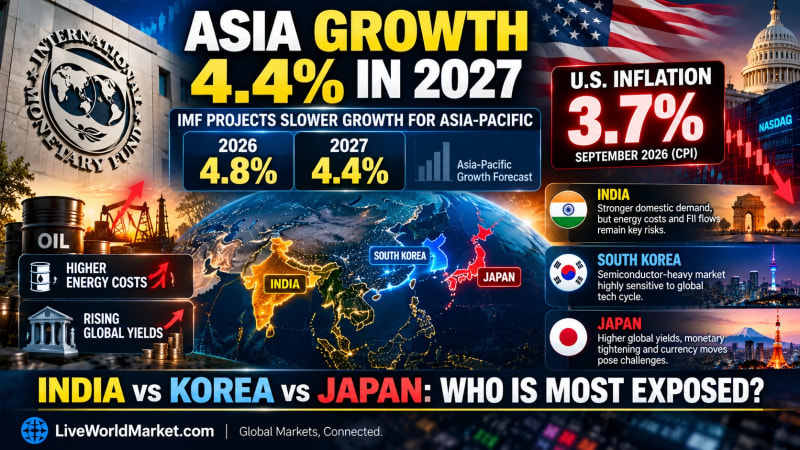
IMF Asia Growth 4.4%, US CPI 3.7%: Which Stocks Are at Risk?
News · Oct 15, 2026 · 12 min read
IMF Sees Asia Growth Slowing to 4.4% as U.S. Inflation Hits 3.7%: Which Stock Markets Are Most Vulnerable? Asia's stock markets are facing a critical test as two major economic developments collide: the International Monetary Fund's warning about slower regional growth and an unexpected rise in U.S. inflation. The IMF's October Asia-Pacific outlook projects regional economic…
Read more...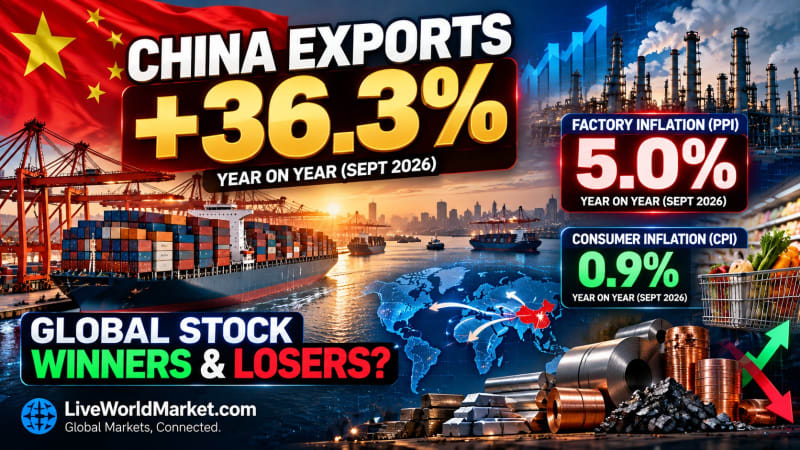
China Exports Surge 36.3%, PPI Hits 5%: Stock Winners & Losers
Geopolitics & Trade · Oct 14, 2026 · 11 min read
China's Exports Surge 36.3% as Factory Inflation Hits 5%: Which Global Stocks Could Win or Lose? China's factories are shipping more goods overseas than expected, but a sharp rise in producer prices is raising a new question about the profitability of the world's manufacturing powerhouse. Official data released on October 14 showed that China's exports surged 36.3%…
Read more...
CXMT DRAM Breakthrough: Samsung, SK Hynix & Micron at Risk?
Technology & Sectors · Oct 13, 2026 · 11 min read
China's CXMT DRAM Breakthrough: Could a Memory Price War Threaten Samsung, SK Hynix and Micron? The global semiconductor industry is confronting a new question: Could China's progress in memory-chip technology eventually undermine the pricing power of the world's largest DRAM manufacturers? Chinese chipmaker ChangXin Memory Technologies (CXMT) has reportedly made progress in a…
Read more...
RBI Dollar Window: Can Rupee Near ₹97 Survive $100 Oil?
Central Banks & Rates · Oct 12, 2026 · 9 min read
RBI Opens Special Dollar Window as Rupee Nears ₹97: Can India Protect Its Stock Market From $100 Oil? India's central bank has introduced a new defense against rupee weakness at a time when crude oil prices remain above $100 per barrel. The Reserve Bank of India (RBI) has announced a special dollar facility for three government-owned oil marketing companies, beginning October…
Read more...
Firmus $5B IPO Cancelled: AI Data Center Valuations at Risk
Technology & Sectors · Oct 11, 2026 · 9 min read
Nvidia-Backed Firmus Cancels $5 Billion IPO: Is Wall Street Finally Questioning AI Data Center Valuations? The global artificial intelligence investment boom has encountered a revealing reality check. Firmus Technologies, an Australian AI data center developer backed by Nvidia, has withdrawn its planned multibillion-dollar stock market listing after struggling to attract…
Read more...
Starlink $8B Spectrum Deal: Telecom Stocks Fall, Towers Rise
Technology & Sectors · Oct 10, 2026 · 10 min read
Starlink's $8 Billion Spectrum Deal: Why Telecom Stocks Fell While Tower Shares Surged A single spectrum deal has sent shockwaves through the global telecommunications industry. On October 8, SpaceX announced an agreement to acquire nationwide 800 MHz wireless spectrum from Grain Management, marking a significant step toward expanding its Starlink Mobile business. The…
Read more...
Two-Thirds of S&P 500 Stocks Rose—Why Did the Index Fall? AI Warning
Technology & Sectors · Oct 9, 2026 · 11 min read
The AI Boom Is Turning Into a $100 Billion Debt Race: Could Borrowing Costs Become the Next Risk for Tech Stocks? For the past three years, artificial intelligence has been one of the biggest forces driving global stock markets. From Nvidia's extraordinary rise to the massive expansion of AI data centres, investors have rewarded companies promising to build the infrastructure…
Read more...
AI Debt Boom 2026: Could Borrowing Costs Hit Tech Stocks?
News · Oct 8, 2026 · 11 min read
The AI Boom Is Turning Into a $100 Billion Debt Race: Could Borrowing Costs Become the Next Risk for Tech Stocks? For the past three years, artificial intelligence has been one of the biggest forces driving global stock markets. From Nvidia's extraordinary rise to the massive expansion of AI data centres, investors have rewarded companies promising to build the infrastructure…
Read more...