
CoreWeave Bond Yields Hit 16%: AI Data Center Debt Risks
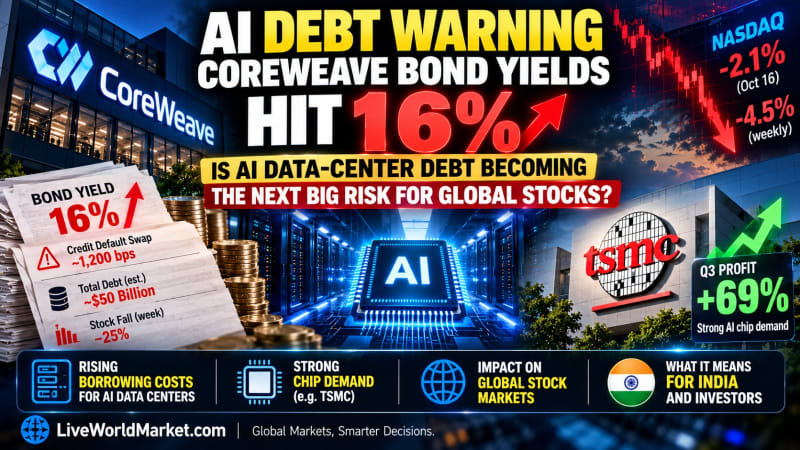
CoreWeave Bond Yields Hit 16%: Is AI Data-Center Debt Becoming the Next Big Risk for Global Stocks?
The artificial intelligence boom has entered a new phase. Investors are no longer asking only how much money AI companies can earn. They are increasingly questioning how much it costs to finance the infrastructure supporting that growth.
This week, CoreWeave, a U.S.-based AI cloud infrastructure provider backed by Nvidia, became a focal point of those concerns.
Yields on some CoreWeave bonds climbed to approximately 15–16%, while the cost of insuring its debt against default rose to around 1,200 basis points.
These are unusually elevated borrowing-risk indicators for a company at the center of the AI infrastructure expansion.
Meanwhile, Taiwan Semiconductor Manufacturing Company (TSMC) reported a 68.7% year-on-year increase in third-quarter net profit, supported by strong demand for advanced semiconductors.
The contrast is striking.
AI chip demand remains strong, but investors are increasingly questioning whether heavily indebted data-center operators can generate sufficient returns to justify their financing costs.
For global stock markets, this could become a defining investment issue: Is the next risk to the AI boom coming from credit markets rather than technology demand?
1. What Happened to CoreWeave?
CoreWeave provides specialized cloud-computing infrastructure, including access to high-performance GPUs used for artificial intelligence.
Its business model requires substantial upfront investment in computing equipment, data centers, networking and supporting infrastructure.
The company expects to recover those investments over time through contracts with customers requiring AI computing capacity.
That creates a financing challenge.
Infrastructure spending occurs before the associated customer revenue and cash flow are fully realized.
When borrowing costs increase, the economics of future projects can deteriorate.
During the week ending October 16, CoreWeave's shares and bonds experienced significant selling pressure as investors reassessed the sustainability of its debt-funded expansion.
Some bond yields approached 16%, a level associated with substantial credit risk.
This does not mean CoreWeave has defaulted or that bankruptcy is inevitable.
It means bond investors are demanding considerably higher returns to compensate for perceived risk.

2. Why Are 16% Bond Yields Such a Serious Warning?
A bond yield represents the return an investor would receive under specified assumptions, including holding the bond to maturity and receiving its promised payments.
When a bond's market price falls, its yield generally rises.
A sharp increase in yield often indicates that investors perceive greater risk.
For a company that needs substantial ongoing financing, higher market yields can make refinancing existing debt or raising new capital more expensive.
A Simple Financing Example
Consider a hypothetical company borrowing $1 billion.
At a 9% annual interest rate, the annual interest expense would be approximately $90 million.
At 16%, that cost would rise to $160 million.
The difference is $70 million annually.
This is an illustrative calculation, not CoreWeave's actual interest expense.
Existing fixed-rate debt does not automatically reset to the latest market yield. The pressure emerges when new debt is issued, existing obligations are refinanced or floating-rate financing becomes more expensive.
For capital-intensive businesses, these differences can materially affect project returns.
Why Investors Are Concerned
AI infrastructure operators must balance four financial requirements:
- Financing expensive computing hardware and data-center construction.
- Securing customers and converting contracts into revenue.
- Generating sufficient operating cash flow to service debt.
- Replacing or upgrading hardware as technology advances.
If financing costs rise faster than expected project returns, expansion can become less attractive even when customer demand remains healthy.
3. The $50 Billion Question: Debt, Liabilities and Financial Risk
Reuters reported approximately $50 billion of CoreWeave debt based on LSEG data, while other financial reporting distinguishes between financial borrowings and substantial lease obligations.
These measures should not be treated as interchangeable.
For investors, the important task is to examine the company's financial statements and understand its total contractual commitments.
Large infrastructure operators often use a combination of secured financing, corporate debt, equipment financing and long-term leases.
Each arrangement carries different repayment requirements, collateral terms and risks.
Why Debt Structure Matters
Two companies with similar total obligations may face very different levels of financial stress.
One may have long-term fixed-rate financing and predictable customer payments.
Another may face near-term maturities, floating interest rates or uncertain project completion dates.
Investors should therefore examine debt maturities, interest coverage, available liquidity, collateral requirements and the relationship between customer contracts and financing commitments.
A large revenue backlog can provide visibility into future business, but it does not automatically translate into immediate free cash flow.
Contracts still need to be fulfilled, customers must pay, and operating costs must remain manageable.
4. The AI Paradox: TSMC Reports Record Profits While Data-Center Debt Comes Under Pressure
One of the most revealing developments this week came from TSMC.
On October 15, the semiconductor manufacturer reported third-quarter net profit of approximately NT$763.1 billion, representing a 68.7% increase from the same period a year earlier.
Revenue increased 50.9% year-on-year.
The results demonstrate strong demand for advanced semiconductor manufacturing.
Yet the financing pressure affecting CoreWeave shows that the AI value chain does not operate under one uniform business model.
Three Different Parts of the AI Economy
Semiconductor manufacturers
Chip manufacturers can earn revenue as customers purchase advanced processors and related products.
Their profitability depends on production efficiency, capacity, pricing and customer demand.
AI cloud and data-center operators
These businesses invest heavily in computing infrastructure before collecting revenue over the life of customer contracts.
Their returns depend on utilization, contract economics, financing costs and equipment life cycles.
Banks, bondholders and private-credit investors
These institutions finance infrastructure development and receive interest or other contractual returns.
Their risks depend on borrower creditworthiness, collateral values, project execution and repayment capacity.

The critical distinction is that strong semiconductor sales do not automatically guarantee attractive returns for every company purchasing those chips.
Related: Explore U.S. stock market and technology-sector developments.
5. Why AI Data Centers Are Especially Sensitive to Financing Costs
AI data centers require significant upfront investment.
Their cost structure can include advanced GPUs, networking equipment, cooling systems, electrical infrastructure, land, construction and power supply.
Unlike many software businesses, infrastructure operators cannot expand capacity without substantial physical investment.
The Capital-Intensity Problem
An AI software company may be able to add customers without building an entirely new physical facility for each additional contract.
An infrastructure operator must purchase or finance computing capacity and supporting systems.
That creates a gap between investment and cash generation.
If demand materializes as expected, long-term contracts can help support the economics.
But if construction is delayed, utilization disappoints or financing becomes more expensive, projected returns may weaken.
The Hardware Replacement Challenge
Advanced computing hardware can become less competitive as new generations of processors arrive.
Operators must consider the useful economic life of GPUs and the possibility that newer systems will offer better performance or efficiency.
This creates a second risk beyond borrowing costs: capital invested today must generate sufficient returns before the equipment loses economic competitiveness.
6. Could High Bond Yields Slow the AI Infrastructure Boom?
Potentially, yes.
Rising financing costs do not necessarily eliminate AI demand.
Instead, they may change which projects can attract funding.
Lenders could become more selective, favoring facilities with completed construction, reliable power access, strong customer contracts and credible cash-flow projections.
Projects with uncertain delivery schedules or speculative demand assumptions may face greater difficulty.
How a Credit Tightening Cycle Could Develop
Bond yields rise → Financing becomes more expensive → Project returns come under pressure → Lenders tighten requirements → Some data-center projects are delayed or reduced.
Such a development could eventually affect companies supplying equipment and services to the AI infrastructure industry.
However, the effect would not be uniform.
Well-capitalized companies may continue investing while weaker borrowers scale back.
This is why investors should distinguish between the overall growth of AI computing demand and the financial viability of individual infrastructure operators.
7. What Does This Mean for Nvidia and Semiconductor Stocks?
Nvidia is closely connected to AI infrastructure investment because its GPUs are widely used in advanced computing systems.
Strong demand from cloud providers and AI developers can support semiconductor sales.
However, if some customers face financing constraints, future hardware purchasing plans could change.
This does not imply that Nvidia's existing demand has collapsed.
It highlights a potential second-order risk.
A chip supplier may report strong current orders while investors begin questioning the financial strength of customers funding future expansion.
For semiconductor investors, several indicators are especially important:
- AI-related revenue growth and customer concentration.
- Capital-expenditure guidance from major cloud providers.
- Customer financing conditions and credit spreads.
- Inventory trends and order cancellations.
- Advanced chip supply, pricing and margins.
The key question is whether AI demand remains supported by sustainable customer cash flows or increasingly depends on expensive external financing.
8. Why Private Credit and Banks Are Part of the Story
AI infrastructure expansion has attracted financing from banks, bond investors and private-credit institutions.
Private credit can provide customized funding arrangements for businesses and projects that may not fit conventional bank lending structures.
These arrangements can help finance rapid expansion.
But they also create exposure to project execution, collateral values and borrower liquidity.
When bond yields increase sharply, lenders may reassess whether they are receiving enough compensation for risk.
This can lead to wider credit spreads, tighter lending conditions and more demanding contractual protections.
What Credit Investors Should Monitor
Credit-default swap spreads, bond prices, debt maturities, borrower liquidity and the performance of underlying data-center projects can provide early warning signals.
However, elevated spreads indicate market concern; they do not independently establish that a default will occur.
A broad deterioration across multiple AI infrastructure borrowers would be more significant than isolated stress at one company.
9. Global Sector Impact: Potential Winners and Losers
The effects of tighter AI infrastructure financing could extend beyond technology stocks.
Global Sector Impact — Potential Winners and Losers

AI Cloud Infrastructure
Highly leveraged operators may face higher refinancing costs and greater scrutiny of their cash-flow forecasts.
Semiconductor Manufacturers
Strong demand can continue supporting earnings, but customer financing risks may eventually influence future orders.
Data-Center Construction
Developers may delay projects if financing costs rise or funding becomes more difficult to secure.
Power and Electrical Equipment
AI-related demand for transformers, switchgear, cooling and power infrastructure may remain substantial, but customers could become more selective about new projects.
Private Credit and Lenders
Financial institutions may face increased scrutiny of their exposure to leveraged AI projects.
Taiwan and South Korea
Semiconductor-heavy markets remain sensitive to changes in global AI investment expectations.
India
Indian data-center developers, power infrastructure businesses and electrical-equipment suppliers may experience changes in investment priorities if international financing conditions tighten.
These are potential transmission channels, not predictions of individual stock performance.
10. Why Rising Energy Prices Add Another Risk
Data centers consume substantial amounts of electricity.
The cost and reliability of power supply are important factors in determining operating economics.
Elevated oil and gas prices can influence energy markets, inflation expectations and borrowing costs.
However, data-center electricity prices are not directly determined by crude oil alone.
Their actual exposure depends on local power-generation mixes, electricity contracts, grid tariffs and energy hedging arrangements.
The broader risk is that expensive financing and rising operating costs could occur simultaneously.
For infrastructure operators, that combination may reduce the margin for error.
A project that looked attractive under lower interest rates and cheaper energy assumptions may require revised financial projections.
11. What Does This Mean for Indian Stock Market Investors?
India is expanding its digital infrastructure, including data centers, power networks, renewable energy and supporting electrical systems.
This creates investment opportunities across multiple industries.
But Indian businesses are not immune to global financing conditions.
Data-Center Developers
Companies building or operating data centers may face higher financing costs if global credit conditions tighten.
Project economics will depend on customer commitments, utilization, electricity prices and debt structures.
Power and Electrical Equipment
Demand for transformers, transmission equipment, cooling systems and related infrastructure could remain supported by digital expansion.
However, order books should be evaluated alongside customer financing strength and project execution.
IT Services
Indian IT services companies are generally less directly exposed to the ownership of GPU-heavy infrastructure.
Their performance depends more on enterprise technology budgets, client demand and service contracts.
Nevertheless, shifts in global AI investment priorities could influence client spending decisions.
Financial Institutions
Banks and other lenders with infrastructure exposure should be evaluated for concentration risk, underwriting standards and asset quality.
Related: Follow the Indian stock market and sector performance.
The key takeaway for Indian investors is that an AI-related business opportunity does not automatically translate into attractive shareholder returns.
Project financing, cash-flow generation and valuations remain critical.
12. Three Scenarios for AI Infrastructure and Global Stocks
Scenario One: Bond Markets Stabilize
Credit spreads narrow and financing remains available to companies with strong customer contracts.
AI infrastructure construction continues, while investors place greater emphasis on project economics.
This could reduce immediate pressure on leveraged operators.
Scenario Two: Financing Becomes More Selective
Lenders continue funding established projects but demand higher returns and stronger protections.
Some expansion plans are delayed or scaled back.
The result could be a more disciplined investment cycle rather than a collapse in AI demand.
Scenario Three: Credit Stress Spreads
Multiple infrastructure borrowers experience financing difficulties.
Project delays increase, refinancing becomes challenging and some companies reduce capital expenditure.
This could affect semiconductor orders, equipment suppliers and broader technology valuations.
The outcome will depend on the availability of capital, actual customer demand, project execution and the ability of infrastructure operators to generate cash flow.
13. Seven Indicators Investors Should Monitor Next
1. CoreWeave bond yields
Are yields stabilizing or continuing to rise?
2. Credit-default swap spreads
Are investors demanding greater protection against credit risk?
3. Free cash flow
Can infrastructure operators generate cash after capital expenditure?
4. Debt maturity schedules
How much borrowing must be refinanced over the next several years?
5. Customer commitments
Are contracted revenues translating into delivered services and collected cash?
6. Semiconductor order trends
Do chipmakers continue reporting strong demand, or are customers revising purchasing plans?
7. Energy prices and financing conditions
Are higher operating expenses and borrowing costs reducing expected project returns?
For a broader view of global risk, investors can also track U.S. Treasury yields, technology-sector valuations, crude oil and equity-market volatility.
Related: Explore LiveWorldMarket's latest global market Insights.
LiveWorldMarket View: The AI Boom Is Facing a Financial Reality Check
CoreWeave's bond-market stress highlights an important shift in the AI investment narrative.
Until recently, much of the market's attention focused on the scale of AI demand and the potential earnings growth of semiconductor companies.
That remains important.
TSMC's record quarterly profit demonstrates that demand for advanced chips is generating substantial revenue and earnings today.
But the economics of building and financing AI infrastructure are different.
A company can have strong customer demand and a large contracted backlog while still facing significant financial pressure if its capital expenditure, borrowing costs and repayment obligations are too high.
For global investors, this creates a distinction between companies earning profits from AI investment today and companies borrowing heavily against expected AI revenues tomorrow.
Neither business model is automatically good or bad.
What matters is the relationship between investment costs, cash generation, financing terms and long-term returns.
The next phase of the AI investment cycle may therefore be driven as much by credit discipline and balance-sheet strength as by technological innovation.
The key takeaway: The AI boom does not need to collapse for highly leveraged AI infrastructure stocks to struggle. Strong demand and weak financing economics can coexist—and investors must evaluate both.
For more global market analysis, visit LiveWorldMarket.com and explore our latest Insights.
Sources and Further Reading
- Reuters — Why CoreWeave is in the crosshairs of the AI scare, October 16, 2026
- Reuters — CoreWeave debt stress tests private credit's AI financing boom, October 16, 2026
- TSMC — Official third-quarter 2026 financial results
- Reuters — TSMC Q3 profit jumps 69% to record, October 15, 2026
- Reuters Breakingviews — Bonds once again have a license to hedge, October 16, 2026
Disclaimer: This article is for educational and informational purposes only. It does not constitute personalized investment advice or a recommendation to buy or sell securities. Bond yields, credit spreads and stock prices can change rapidly. Sector impacts are analytical scenarios, not guaranteed outcomes.
Comments (0)
Be the first to comment.
About the author

NISM-Series-X-A Investment Adviser Level 1 examination completed
Amit writes about Indian equity markets, technical analysis, macro themes and the day-to-day mechanics of trading, with a focus on making the flow of global markets legible for retail investors. He has completed the NISM-Series-X-A Investment Adviser Level 1 examination.
You May Also Like

Indonesia Stocks Crash 11.57%: Will MSCI Downgrade Benefit India?
India & Global Connections · Oct 16, 2026 · 12 min read
Indonesia Stocks Plunge 11% as MSCI Proposes Downgrade: Could India and Other Emerging Markets Benefit? Indonesia's stock market has suffered its sharpest one-day decline in nearly three decades, but the bigger story extends far beyond Jakarta. A proposed MSCI downgrade could eventually force global index funds to remove Indonesian equities from their portfolios, potentially…
Read more...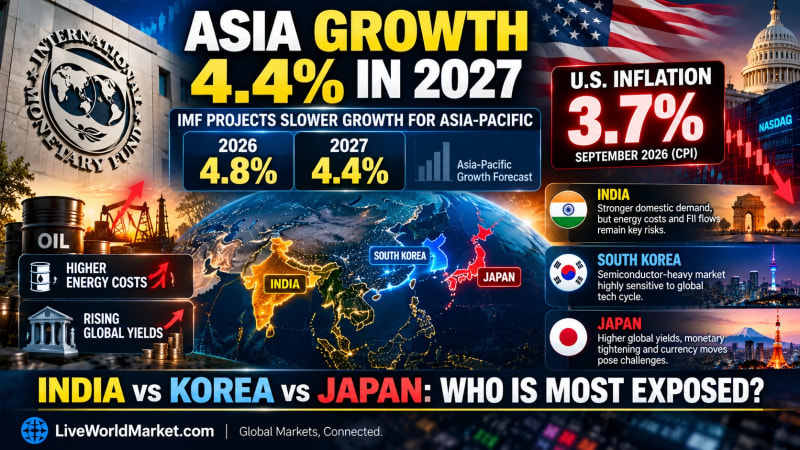
IMF Asia Growth 4.4%, US CPI 3.7%: Which Stocks Are at Risk?
News · Oct 15, 2026 · 12 min read
IMF Sees Asia Growth Slowing to 4.4% as U.S. Inflation Hits 3.7%: Which Stock Markets Are Most Vulnerable? Asia's stock markets are facing a critical test as two major economic developments collide: the International Monetary Fund's warning about slower regional growth and an unexpected rise in U.S. inflation. The IMF's October Asia-Pacific outlook projects regional economic…
Read more...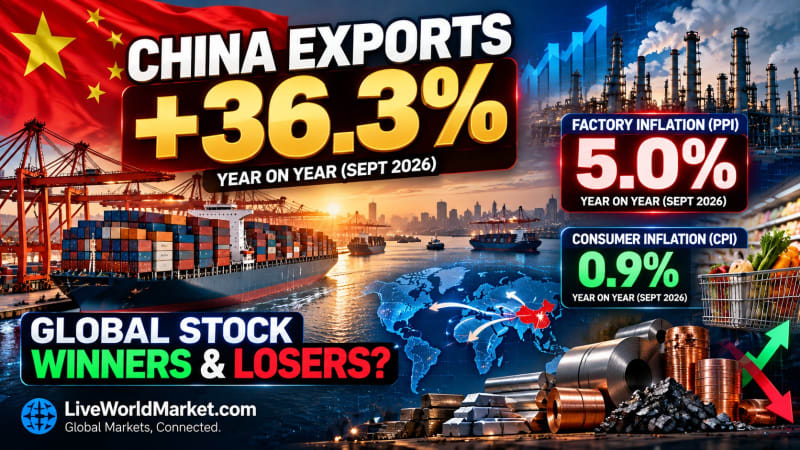
China Exports Surge 36.3%, PPI Hits 5%: Stock Winners & Losers
Geopolitics & Trade · Oct 14, 2026 · 11 min read
China's Exports Surge 36.3% as Factory Inflation Hits 5%: Which Global Stocks Could Win or Lose? China's factories are shipping more goods overseas than expected, but a sharp rise in producer prices is raising a new question about the profitability of the world's manufacturing powerhouse. Official data released on October 14 showed that China's exports surged 36.3%…
Read more...
CXMT DRAM Breakthrough: Samsung, SK Hynix & Micron at Risk?
Technology & Sectors · Oct 13, 2026 · 11 min read
China's CXMT DRAM Breakthrough: Could a Memory Price War Threaten Samsung, SK Hynix and Micron? The global semiconductor industry is confronting a new question: Could China's progress in memory-chip technology eventually undermine the pricing power of the world's largest DRAM manufacturers? Chinese chipmaker ChangXin Memory Technologies (CXMT) has reportedly made progress in a…
Read more...
RBI Dollar Window: Can Rupee Near ₹97 Survive $100 Oil?
Central Banks & Rates · Oct 12, 2026 · 9 min read
RBI Opens Special Dollar Window as Rupee Nears ₹97: Can India Protect Its Stock Market From $100 Oil? India's central bank has introduced a new defense against rupee weakness at a time when crude oil prices remain above $100 per barrel. The Reserve Bank of India (RBI) has announced a special dollar facility for three government-owned oil marketing companies, beginning October…
Read more...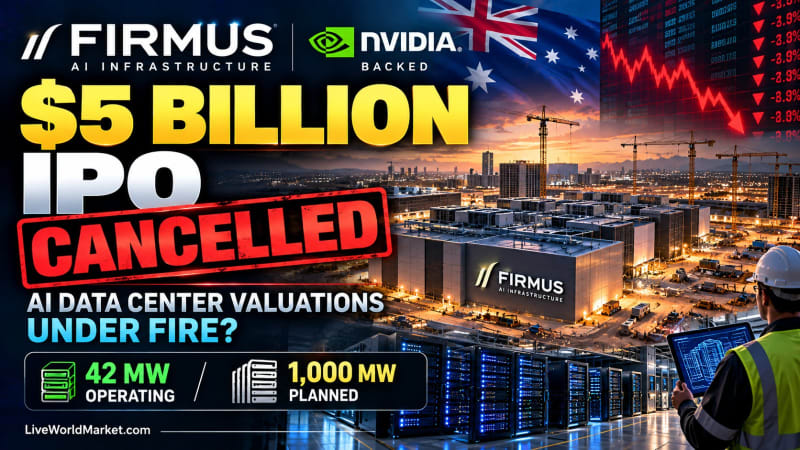
Firmus $5B IPO Cancelled: AI Data Center Valuations at Risk
Technology & Sectors · Oct 11, 2026 · 9 min read
Nvidia-Backed Firmus Cancels $5 Billion IPO: Is Wall Street Finally Questioning AI Data Center Valuations? The global artificial intelligence investment boom has encountered a revealing reality check. Firmus Technologies, an Australian AI data center developer backed by Nvidia, has withdrawn its planned multibillion-dollar stock market listing after struggling to attract…
Read more...
Starlink $8B Spectrum Deal: Telecom Stocks Fall, Towers Rise
Technology & Sectors · Oct 10, 2026 · 10 min read
Starlink's $8 Billion Spectrum Deal: Why Telecom Stocks Fell While Tower Shares Surged A single spectrum deal has sent shockwaves through the global telecommunications industry. On October 8, SpaceX announced an agreement to acquire nationwide 800 MHz wireless spectrum from Grain Management, marking a significant step toward expanding its Starlink Mobile business. The…
Read more...
Two-Thirds of S&P 500 Stocks Rose—Why Did the Index Fall? AI Warning
Technology & Sectors · Oct 9, 2026 · 11 min read
The AI Boom Is Turning Into a $100 Billion Debt Race: Could Borrowing Costs Become the Next Risk for Tech Stocks? For the past three years, artificial intelligence has been one of the biggest forces driving global stock markets. From Nvidia's extraordinary rise to the massive expansion of AI data centres, investors have rewarded companies promising to build the infrastructure…
Read more...
AI Debt Boom 2026: Could Borrowing Costs Hit Tech Stocks?
News · Oct 8, 2026 · 11 min read
The AI Boom Is Turning Into a $100 Billion Debt Race: Could Borrowing Costs Become the Next Risk for Tech Stocks? For the past three years, artificial intelligence has been one of the biggest forces driving global stock markets. From Nvidia's extraordinary rise to the massive expansion of AI data centres, investors have rewarded companies promising to build the infrastructure…
Read more...
$100 Oil Is Back: Which Stock Markets and Sectors Are Most Exposed?
Commodities & Energy · Oct 7, 2026 · 12 min read
The $100 Oil Test Has Arrived: Which Global Stock Markets and Sectors Are Most Exposed If Crude Stays Above Triple Digits? Oil above $100 is no longer a hypothetical risk for global markets. Brent crude traded above $101 a barrel on October 7, while U.S. West Texas Intermediate hovered near $90 as investors confronted a combination of Middle East supply risks, attacks on…
Read more...