
Rupee Hits 8-Month High: Can India Survive New US Tariffs?
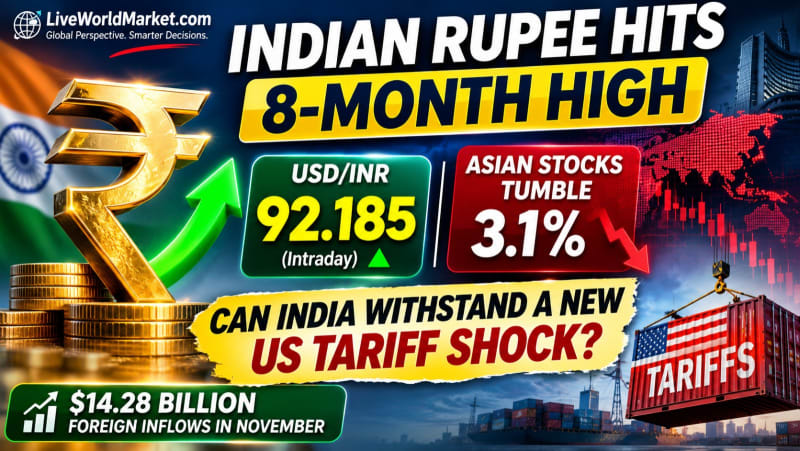
The Indian rupee staged an impressive recovery on November 25, 2026, touching an eight-month high of 92.185 against the US dollar, even as Asian financial markets experienced another sharp selloff amid renewed US tariff concerns.
The rupee closed at 92.23 per dollar, gaining approximately 0.7% during the session and extending its November appreciation to 2.9%.
Meanwhile, the MSCI Asia-Pacific index excluding Japan declined 3.1% at reported session levels as concerns over artificial intelligence valuations, US trade protectionism and elevated global interest rates weighed on investor sentiment.
The divergence raises an important question: Can India maintain its financial-market resilience when the world is facing another potential trade war?
1. Global Market Snapshot: November 25, 2026

Source: Reuters, November 25, 2026. International market figures represent reported session levels and may differ from final closing prices.
India's currency strength is particularly noteworthy because the dollar was firm against several other major currencies.
This suggests that domestic factors, including foreign investment and demand-supply conditions in the currency market, are currently providing meaningful support to the rupee.
2. Why Is the Indian Rupee Strengthening?
Several factors are contributing to the rupee's recent appreciation.
Record foreign investment in Indian equities
Foreign portfolio investors have invested approximately $14.28 billion in Indian equities during November, according to Reuters.
International investors purchasing Indian assets can increase demand for rupees when they convert foreign currency to fund their investments.
However, the impact depends on how those transactions are financed and hedged.
The recent inflows may also reflect a broader diversification of international portfolios away from concentrated AI-related investments toward emerging markets.
Softer crude oil prices
India is heavily dependent on imported crude oil. Consequently, changes in international energy prices have a significant impact on foreign-currency demand.
Lower crude prices can help India through:
- Reduced oil import expenditure.
- Lower demand for US dollars from energy importers.
- Reduced imported inflation.
- Improved current account conditions.
- Lower production and transportation costs.
Brent crude was trading around $91.87 at reported session levels, providing some relief compared with higher recent prices.
Nevertheless, oil at these levels still represents a meaningful economic cost for India.
Improved domestic currency-market conditions
A combination of foreign equity investment, exporter dollar sales and central-bank support can improve the availability of dollars in India's currency market.
These factors can help the rupee strengthen even during periods when global investors remain cautious.
Follow currency movements and international market developments at LiveWorldMarket.com.
3. Why Are Asian Stock Markets Falling?
Asia's latest selloff reflects multiple overlapping risks rather than a single economic development.
Technology-heavy markets remain vulnerable to changing expectations about AI investment returns. Renewed uncertainty over international trade has added another layer of pressure.
Early-session declines were particularly severe in several major Asian markets.

These figures include intraday declines and should not be interpreted as final closing returns.
South Korea and Taiwan have substantial exposure to semiconductor manufacturing and global technology supply chains.
Potential trade barriers, weaker technology valuations and uncertainty over future capital expenditure can therefore have an outsized impact on these markets.
India's benchmark equity indices have a different sector composition, with substantial representation from financial services, domestic consumption, energy and traditional businesses.
That difference may help explain why Indian assets can demonstrate relative resilience during a semiconductor-led global selloff.
However, India remains exposed to broader international economic and financial risks.
4. What Are the New US Tariffs?
The Trump administration has proposed another round of tariffs targeting 14 trading partners, including India, China, Japan and the European Union.
The measures follow a Section 301 investigation into alleged structural excess industrial capacity.
The US administration argues that certain manufacturing policies in overseas economies contribute to excessive production, distort international competition and disadvantage American businesses.
Proposed headline tariff rates range from 20% to 40%, although negotiated trade arrangements could limit the applicable duties.
China has rejected the allegations concerning industrial overcapacity.
Why this matters for India
India is directly included among the trading partners facing proposed additional duties.
However, the headline tariff range should not automatically be interpreted as the final effective tariff on every Indian product.
The actual impact will depend on:
- Product-specific tariff schedules.
- Existing bilateral trade commitments.
- Negotiated exemptions and rate caps.
- The implementation timeline.
- Subsequent trade negotiations.
The distinction between proposed and implemented tariffs is crucial when assessing the potential consequences for Indian companies.
5. How Could New US Tariffs Affect Indian Industries?
The United States is an important export destination for Indian businesses. Higher import duties could affect competitiveness, profitability and future investment decisions.

These are potential transmission channels, not confirmed sector-specific tariff liabilities.
Companies with strong pricing power, diversified export markets and flexible supply chains may be better positioned to manage trade disruptions.
Businesses operating with narrow margins and high dependence on American customers could face greater challenges.
6. The Strong Rupee Paradox: Good for India, Difficult for Exporters?
A strengthening rupee is often viewed positively because it reduces the domestic cost of imports.
However, currency appreciation creates different outcomes for different businesses.
Consider an Indian exporter earning $1 million in revenue.

At an exchange rate of 92.23 instead of 95, the exporter receives ₹27.7 lakh less in rupee terms, assuming unchanged dollar revenue and no currency hedging.
If tariffs simultaneously reduce demand or require exporters to lower their selling prices, profitability could face additional pressure.
Conversely, a company importing $1 million worth of goods would save the same amount on its unhedged import cost.
Potential beneficiaries of a stronger rupee
Import-dependent businesses, airlines, electronics distributors and companies with unhedged dollar liabilities may benefit from currency appreciation.
Potential challenges for exporters
IT services, textiles, jewellery and other export-oriented businesses may experience pressure on rupee-denominated earnings, depending on their hedging arrangements and cost structures.
A stronger currency is therefore not automatically positive for every company in the Nifty 50.
7. Can India Become a Beneficiary of Global Portfolio Diversification?
One of the most important developments in November has been the renewed international interest in Indian equities.
Global investors have become increasingly sensitive to the risks associated with expensive technology valuations and concentrated AI exposure.
India offers a different investment landscape, supported by domestic consumption, financial services, infrastructure development and manufacturing expansion.
International companies seeking to diversify production outside China may also consider India as an alternative manufacturing destination.
This is commonly referred to as the China Plus One strategy.
However, India's ability to benefit depends on several conditions, including competitive production costs, infrastructure quality, regulatory stability and favourable access to export markets.
If India faces comparable tariff barriers to competing manufacturing countries, the advantages of supply-chain diversification could become less pronounced.
Foreign investment can support the rupee and domestic equities, but it cannot completely shield India from a global economic slowdown.
8. Could US Tariffs Trigger Another Federal Reserve Rate Hike?
Higher tariffs can increase the cost of imported products for American businesses and households.
If businesses pass these additional costs on to consumers, US inflation could remain elevated.
Persistent inflation may encourage the Federal Reserve to maintain restrictive monetary policy or consider additional interest-rate increases.
The potential transmission mechanism is:
Higher US tariffs → Higher import costs → Inflation pressure → Restrictive Fed policy → Stronger dollar risk → Emerging-market volatility
This chain is not inevitable. The outcome also depends on consumer demand, business pricing decisions and whether tariffs weaken economic growth.
For India, higher US interest rates could reduce the relative attractiveness of emerging-market assets and increase pressure on foreign portfolio flows.
A stronger dollar could also reverse some of the rupee's recent appreciation.
Investors should therefore monitor US inflation releases, Treasury bond yields and Federal Reserve policy alongside tariff announcements.
9. What Does This Mean for Nifty 50 and Bank Nifty?
India's equity benchmarks have benefited from strong capital inflows during November.
Nevertheless, the recent volatility demonstrates that foreign investment does not eliminate short-term corrections.
Nifty 50 outlook
The broader market could receive support from lower import costs, stable domestic demand and continued foreign investment.
Export-sensitive sectors and companies with elevated valuations could remain vulnerable to renewed global trade uncertainty.
Bank Nifty outlook
Banks are generally less directly exposed to goods tariffs than manufacturing exporters.
However, a prolonged slowdown in exports and corporate investment could eventually affect credit demand, borrower profitability and asset quality.
The domestic interest-rate cycle and economic growth outlook will remain important drivers of banking-sector performance.
Nifty IT outlook
Indian IT companies could face competing forces.
A recovery in global technology spending may support revenue expectations, while a strengthening rupee could reduce the value of dollar-denominated earnings.
US corporate spending decisions will be particularly important if trade uncertainty begins to affect business confidence.
Track ongoing market developments through the LiveWorldMarket global markets dashboard.
10. USD/INR Outlook: Can the Rupee Strengthen Towards 90?
The rupee's appreciation towards 92.23 has raised questions about whether the currency could eventually approach the psychological level of 90 against the dollar.
Three potential scenarios deserve consideration.

These are conditional scenarios, not exchange-rate forecasts.
The Reserve Bank of India's currency-market operations and the global dollar environment could significantly influence near-term outcomes.
11. Global Indicators Investors Should Monitor
The coming weeks could be particularly important for Indian financial markets.

Monitoring these indicators together provides a more complete picture of India's exposure to external economic shocks.
Frequently Asked Questions
Why did the Indian rupee hit an eight-month high?
The rupee strengthened amid renewed foreign portfolio investment, softer crude oil prices and improved domestic currency-market conditions. It reached 92.185 intraday before closing at 92.23 on November 25.
How much foreign investment has India received in November 2026?
Reuters reported approximately $14.28 billion in foreign equity inflows during November through November 25. This figure represents cumulative monthly flows, not investment during a single session.
Why are Asian stock markets falling?
Asian markets are facing renewed US tariff uncertainty, volatility in semiconductor and AI-related stocks, and concerns about elevated global interest rates.
Will new US tariffs affect India?
India is among the trading partners included in the latest tariff proposals. The actual economic impact will depend on final tariff rates, exemptions, product coverage and bilateral trade negotiations.
Is a stronger rupee good for the Indian economy?
A stronger rupee can reduce import costs and imported inflation. However, it can also reduce the rupee-denominated earnings of exporters that have not hedged their foreign-currency revenues.
Can the Indian rupee reach 90 against the US dollar?
Further appreciation is possible if supportive economic conditions persist. However, the exchange rate remains sensitive to oil prices, capital flows, trade policy and US monetary conditions. Reaching 90 is not guaranteed.
Final Outlook: India's Resilience Faces a New Test
The Indian rupee's eight-month high comes at a time when global financial markets are confronting renewed trade uncertainty, technology-sector volatility and restrictive monetary policy.
Record foreign equity inflows and softer crude oil prices have provided India with an important source of near-term support.
However, currency appreciation alone cannot protect an economy from rising trade barriers.
The next major test will be whether India can preserve export competitiveness, sustain foreign investment and maintain domestic economic growth as global trade conditions evolve.
India's relative resilience is encouraging, but sustained performance will depend on economic fundamentals rather than temporary capital flows alone.
For global investors, the divergence between India's strengthening currency and falling Asian equities represents an important development worth monitoring.
The coming weeks may reveal whether India is experiencing a temporary period of relative outperformance or a more durable shift in international capital allocation.
Sources and References
- Reuters — Rupee scales eight-month high as foreign flows to Indian equities persist, November 25, 2026
- Reuters — World stocks fall as new US tariffs loom, November 25, 2026
- Reuters — US proposes new tariffs targeting excess industrial capacity, November 25, 2026
- Office of the United States Trade Representative
- Reserve Bank of India
Disclaimer: This article is provided for informational and educational purposes only and does not constitute investment advice. LiveWorldMarket.com is not a SEBI-registered investment adviser. Market prices, economic conditions and trade policies are subject to change.
LiveWorldMarket.com — Global Perspective. Smarter Decisions.
Comments (0)
Be the first to comment.
About the author

NISM-Series-X-A Investment Adviser Level 1 examination completed
Amit writes about Indian equity markets, technical analysis, macro themes and the day-to-day mechanics of trading, with a focus on making the flow of global markets legible for retail investors. He has completed the NISM-Series-X-A Investment Adviser Level 1 examination.
You May Also Like

Nasdaq Surges 2.3%: Is the AI Tech Stock Crash Over?
News · Nov 28, 2026 · 5 min read
Wall Street finally gave investors a reason to smile after weeks of uncertainty, sharp sell-offs and growing concerns about the artificial intelligence boom. The Nasdaq Composite surged 2.3% on Friday, November 27, as investors returned from the Thanksgiving holiday and started buying beaten-down technology stocks. The S&P 500 and Dow Jones also registered strong gains…
Read more...
Markets Shrug Off US Tariff Threats, but $95 Brent Creates a New Inflation Risk
Global Markets & Economy · Nov 26, 2026 · 3 min read
What Investors Should Watch Next Global markets have staged a relief rally, with Asian and European equities gaining as investors assessed the latest US tariff proposals as less disruptive than initially feared. But beneath that calm, a more consequential risk is building: Brent crude has moved above $95 a barrel, putting inflation back at the centre of the market…
Read more...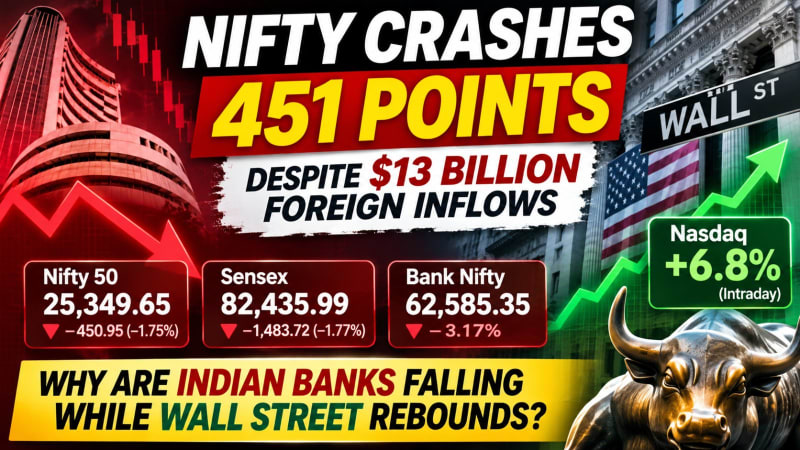
Nifty Crashes 451 Points Despite $13 Billion Foreign Inflows: Why Are Indian Banks Falling While Wall Street Rebounds?
Trend · Nov 23, 2026 · 11 min read
India's stock market suffered a sharp reversal on Monday, November 23, as heavy selling in banking and financial stocks dragged the Nifty 50 down nearly 451 points. The decline came despite approximately $13 billion in foreign equity inflows during November and a powerful rebound in US technology shares. The contrasting movements raise an important question: Why are Indian…
Read more...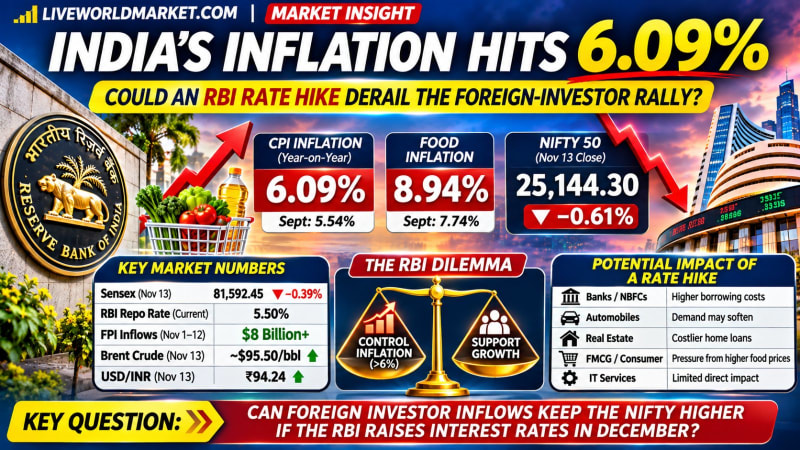
India Inflation Hits 6.09%: Will RBI Rate Hike Hurt Nifty?
News · Nov 14, 2026 · 13 min read
India's Inflation Hits 6.09% as Nifty Falls Below 25,150: Could an RBI Rate Hike Derail the Foreign-Investor Rally? India's retail inflation has breached the RBI's 6% tolerance ceiling, driven by rising food prices and renewed energy risks. With foreign investors pouring more than $8 billion into Indian equities this month, could higher interest rates interrupt the Nifty's…
Read more...
Why $6.4 Billion Is Flowing Into Indian Stocks Despite 5% US Yields
News · Nov 12, 2026 · 11 min read
Foreign Investors Pour $6.4 Billion Into Indian Stocks as US Treasury Yields Cross 5%: Why Is Global Money Returning to India? Key Takeaway: Foreign portfolio investors have poured approximately $6.43 billion into Indian equities in November, reversing a prolonged period of selling and helping the Nifty 50 and Sensex gain around 10% this month. The buying comes despite US…
Read more...
Brent Below $92: Can Cheaper Oil Lift Nifty Despite Fed Risks?
Commodities & Energy · Nov 10, 2026 · 12 min read
Brent Crude Falls Below $92 as Wall Street Surges: Could Cheaper Oil Offset the Fed Rate-Hike Threat to Indian Stocks? Key Takeaway: Brent crude's sharp decline has given global equity markets an unexpected source of support, even as investors prepare for the possibility of another US Federal Reserve interest-rate increase. For India, lower oil prices could ease inflation…
Read more...
Big Tech Gains $750B as AI Data Centre Stocks Crash
Global Markets & Economy · Nov 5, 2026 · 12 min read
Big Tech Gains $750 Billion After US Midterms, but AI Data-Centre Stocks Crash: Is Wall Street Rewarding Less AI Spending? Key Takeaway: Wall Street's reaction to the 2026 US midterm elections has exposed a surprising divide in the artificial intelligence investment boom. Established technology giants rallied, with five major companies on course to add more than $750 billion…
Read more...
US Midterm Elections 2026: Impact on Stocks, Dollar & India
Global Markets & Economy · Nov 4, 2026 · 10 min read
US Midterm Elections 2026: Why Treasury Yields, the Dollar and Indian Stocks Could React More Than Wall Street Key Takeaway: Democrats have won control of both chambers of the US Congress in the 2026 midterm elections, creating a divided government under President Donald Trump. The immediate market reaction has been revealing: US Treasury yields declined, the dollar weakened…
Read more...
Apple Overtakes Nvidia: Is Lower AI Spending Winning?
Technology & Sectors · Nov 2, 2026 · 9 min read
Apple Overtakes Nvidia as World's Most Valuable Company Ahead of Earnings: Is Spending Less on AI Becoming Wall Street's Winning Strategy? Key takeaway: Apple has reclaimed the title of the world's most valuable publicly traded company, overtaking Nvidia as investors reassess the enormous cost of artificial intelligence infrastructure. With Apple's upcoming earnings in focus…
Read more...
ExxonMobil Refining Profits Surge: Impact on Indian Oil Stocks
Commodities & Energy · Nov 1, 2026 · 8 min read
ExxonMobil's Refining Profits Overtake Oil Drilling for First Time in 6 Years: Why India's Oil Stocks May Miss the Windfall Key Takeaway: ExxonMobil's refining business has emerged as a bigger earnings contributor than oil production, highlighting an extraordinary shift in global energy markets. But Indian oil companies such as IOC, BPCL and HPCL face a different challenge…
Read more...