
India Inflation Hits 6.09%: Will RBI Rate Hike Hurt Nifty?
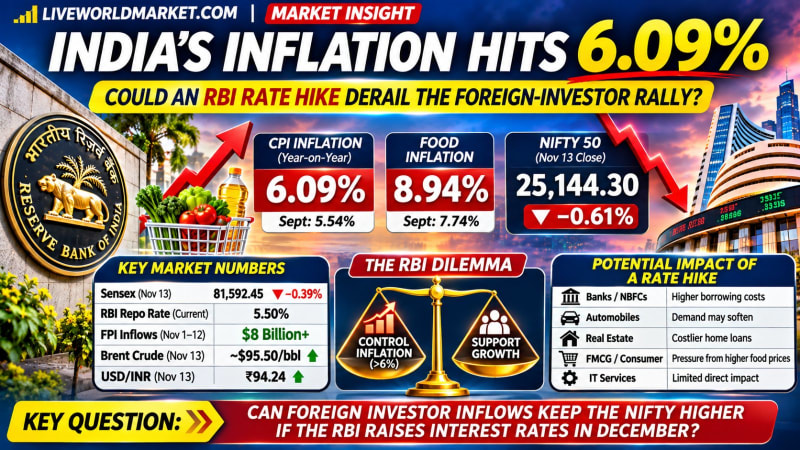
India's Inflation Hits 6.09% as Nifty Falls Below 25,150: Could an RBI Rate Hike Derail the Foreign-Investor Rally?
India's retail inflation has breached the RBI's 6% tolerance ceiling, driven by rising food prices and renewed energy risks. With foreign investors pouring more than $8 billion into Indian equities this month, could higher interest rates interrupt the Nifty's remarkable recovery?
Key Takeaways
- India's October 2026 consumer price inflation rose to 6.09%, compared with 5.54% in September.
- Food inflation accelerated to 8.94%, highlighting the pressure on household budgets.
- The Nifty 50 declined 0.61% to 25,144.30 on November 13, while the Sensex closed at 81,592.45.
- Foreign portfolio investors have purchased more than $8 billion of Indian equities in November through November 12.
- A potential RBI interest-rate increase in December could affect banking, automobiles, real estate and other rate-sensitive sectors.
The central question for investors is whether foreign capital inflows and India's domestic growth prospects can withstand a period of higher inflation and tighter monetary policy.
1. India's Inflation Crosses 6%: Why Markets Are Concerned
India's inflation outlook has taken an unexpected turn.
According to the Ministry of Statistics and Programme Implementation, the Consumer Price Index rose 6.09% year over year in October 2026, accelerating from September's 5.54%.
This pushed headline inflation above the Reserve Bank of India's upper tolerance limit of 6%.
The latest reading is particularly significant because the RBI aims to maintain inflation around 4%, within a tolerance band of 2% to 6%.
Although a single monthly breach does not automatically require an immediate rate increase, persistent inflation above the target range can strengthen the case for monetary tightening.
The latest report also shows that price pressures are not evenly distributed.

Source: MoSPI, Consumer Price Index release, November 12, 2026.
Food inflation is particularly concerning because food expenditure accounts for a substantial share of household budgets.
Higher food prices can reduce the amount households have available for discretionary purchases, potentially affecting consumption-oriented businesses.
The bigger concern is not merely that inflation has crossed 6%, but whether price pressures will remain elevated long enough to force further RBI tightening.
2. Why Food Inflation Is the Biggest Warning Signal
Food prices were the main contributor to India's October inflation increase.
The Consumer Food Price Index rose 8.94% year over year, compared with 7.74% in September.
Rural food inflation reached 9.09%, while urban food inflation stood at 8.68%.
Several agricultural commodities, including vegetables and commonly used cooking ingredients, experienced significant price pressure.
Why food inflation matters beyond groceries
Rising food prices can influence the economy in three important ways.
First, household purchasing power weakens.
When families spend more on essential food items, less money remains for discretionary consumption.
That can affect businesses selling apparel, consumer durables, electronics and other non-essential goods.
Second, inflation expectations may rise.
If consumers and businesses expect prices to remain elevated, wage negotiations and pricing decisions may begin reflecting those expectations.
Third, monetary policy becomes more complicated.
Higher interest rates cannot directly increase agricultural production or improve the monsoon.
However, the RBI may still need to manage broader demand and inflation expectations if food-price shocks begin spreading into other categories.
This creates a difficult balance between controlling inflation and supporting economic growth.
3. Nifty Falls Below 25,150: Is the Market Rally Losing Momentum?
Indian equities ended Friday, November 13, on a weaker note.
The Nifty 50 declined 0.61% to 25,144.30, while the BSE Sensex fell 0.39% to 81,592.45.
Financial and banking shares were among the major contributors to the decline.
The selloff came as investors assessed three simultaneous developments:
- Inflation moving above the RBI's tolerance ceiling.
- Rising crude oil prices renewing concerns about India's import costs.
- Higher global bond yields increasing pressure on emerging-market valuations.
However, the broader market picture remains more nuanced.
Despite Friday's decline, the Nifty and Sensex still recorded weekly gains of approximately 0.5% and 0.7%, respectively.
The recent correction therefore does not, by itself, establish that India's recovery has ended.
Instead, it suggests that investors are beginning to distinguish between the benefits of foreign inflows and the risks associated with inflation and interest rates.
Follow benchmark performance and sector trends on the LiveWorldMarket India Stock Market Dashboard.
4. Could the RBI Raise Interest Rates in December 2026?
The RBI raised its benchmark policy rate to 5.50% in October 2026.
With inflation now exceeding the upper tolerance limit, expectations of another increase have strengthened.
A 25-basis-point increase would take the policy rate to 5.75%.
However, the decision will depend on more than one inflation reading.
The RBI must evaluate the persistence of food inflation, underlying price pressures, growth conditions, the currency and global financial developments.
Why higher interest rates can affect stocks
Higher policy rates can influence equity markets through several channels.
Borrowing costs: Businesses may face more expensive financing for expansion, working capital and investment.
Consumer demand: Higher loan rates can affect purchases financed through housing, automobile and consumer loans.
Equity valuations: When interest rates rise, the present value investors assign to future corporate earnings may decline.
Bond-market competition: Higher yields on fixed-income securities can make equities relatively less attractive.
The effect is not identical across all sectors.
Some businesses have strong balance sheets and pricing power, allowing them to absorb higher financing costs more easily than heavily indebted companies.
Does inflation above 6% guarantee an RBI hike?
No.
The RBI's monetary policy decisions consider inflation persistence, economic growth and financial stability.
A single breach of the tolerance ceiling does not automatically determine the next policy decision.
The December meeting will therefore be an important event for Indian equity and bond investors.
5. Foreign Investors Have Bought More Than $8 Billion: Can the Rally Continue?
One of the most striking developments in November has been the return of foreign portfolio investors to Indian equities.
Reuters reported that overseas investors had purchased more than $8 billion of Indian shares during November through November 12.
This marked a substantial reversal after an extended period of foreign selling.
The inflows helped support a sharp recovery in Indian equities and renewed optimism toward domestic financial and consumption-oriented companies.
Why foreign investors returned
Several factors may have contributed.
Lower crude prices earlier in November: Falling oil prices initially improved expectations for India's import bill and inflation outlook.
Global portfolio diversification: Volatility in AI-related technology stocks encouraged investors to reassess concentrated exposure to certain overseas markets.
India's domestic growth exposure: Banks, consumer companies and infrastructure businesses offer different earnings drivers from the global semiconductor and AI infrastructure cycle.
Improved market momentum: Strong equity performance and renewed foreign buying can attract additional investor attention.
But the return of foreign capital introduces an important question.
Will overseas investors continue buying if Indian inflation remains elevated and the RBI raises interest rates?
There is no automatic answer.
Higher interest rates may create pressure on valuations, but foreign investors also consider earnings growth, currency stability and relative market opportunities.
A sustained improvement in corporate profitability could support foreign interest even during a period of monetary tightening.
Related reading: Foreign Investors Pour $6.4 Billion Into Indian Stocks as US Treasury Yields Cross 5%: Why Is Global Money Returning to India?
6. Rising Crude Oil Prices Add Another Inflation Risk
India's inflation challenge is becoming more complicated because crude oil prices have begun rising again.
Brent crude traded around $95.50 per barrel during Friday's Indian trading session, compared with approximately $92 around Thursday's market close.
Renewed geopolitical tensions and concerns about Middle Eastern energy infrastructure contributed to the increase.
For India, higher crude prices matter because the country imports most of the oil it consumes.
The economic transmission
Higher crude prices can increase the import bill, raise transportation and manufacturing costs, put pressure on the current account and increase demand for US dollars.
If these pressures persist, they may also influence consumer inflation.
A stronger dollar can amplify the impact by increasing the rupee cost of imported oil.
This is why investors should monitor crude prices and USD/INR together rather than looking at either indicator independently.
Earlier in November, cheaper oil was viewed as an important support for India's equity rally.
The recent rebound demonstrates how quickly that advantage can weaken.
Related reading: Brent Crude Falls Below $92 as Wall Street Surges: Could Cheaper Oil Offset the Fed Rate-Hike Threat to Indian Stocks?
7. Which Indian Stock Market Sectors Face the Greatest Risk?
Higher inflation and interest rates can create very different outcomes across sectors.

Banking and financial services
Banks can experience both positive and negative effects from higher rates.
Loan yields may rise, but deposit costs can also increase.
The net effect depends on asset-liability repricing, credit demand and the competitive environment.
For NBFCs, higher wholesale funding costs can be particularly important.
Automobiles and real estate
Higher borrowing costs may reduce affordability for consumers financing vehicles and homes.
Demand could soften if higher interest rates coincide with pressure on household purchasing power.
However, income growth and employment conditions also influence purchasing decisions.
Consumer businesses
Food inflation can squeeze discretionary spending, particularly among price-sensitive households.
Companies with strong brands and pricing power may be better positioned to manage input-cost pressures.
IT services
Indian IT companies are less directly exposed to domestic interest rates than many consumer-oriented businesses.
However, their performance depends on overseas technology spending, currency movements and global economic conditions.
The overall sector impact therefore requires more than a simple positive-or-negative classification.
8. India Faces a Dual Central-Bank Challenge: RBI and Federal Reserve
Indian markets are also responding to developments in the United States.
Higher US Treasury yields and expectations of tighter Federal Reserve policy can influence global capital flows.
When US bond yields rise, dollar-denominated fixed-income assets may become more attractive.
This can increase competition for investment capital that might otherwise flow into emerging-market equities.
At the same time, India's domestic inflation outlook may require the RBI to maintain or increase interest rates.
The result is a dual monetary-policy challenge.
Why this matters for the rupee
A stronger US dollar and higher crude prices can increase pressure on India's currency.
The rupee closed at approximately ₹94.24 per US dollar on November 13, weakening during the week despite strong foreign portfolio inflows.
Currency movements matter because overseas investors evaluate their returns after converting them into their home currencies.
A foreign investor can earn a positive return on an Indian stock in rupee terms but experience a lower dollar return if the rupee depreciates.
This makes currency stability an important part of India's investment outlook.
9. Three Scenarios for Nifty and the December RBI Meeting
Rather than relying on a single market forecast, investors can evaluate three possible scenarios.
Scenario 1: Inflation moderates and the RBI pauses
Food prices stabilize, crude oil retreats and inflation expectations improve.
The RBI may have more flexibility to hold interest rates steady.
This could support domestic demand and reduce pressure on rate-sensitive sectors.
Scenario 2: Inflation remains elevated and the RBI raises rates by 25 basis points
The RBI increases its policy rate from 5.50% to 5.75%.
Markets may initially respond cautiously, especially in highly leveraged and interest-rate-sensitive businesses.
However, the longer-term reaction would depend on whether investors view the decision as sufficient to restore inflation stability.
Scenario 3: Oil prices rise further and global yields remain elevated
Higher energy costs, a stronger dollar and persistent domestic inflation create additional challenges.
Foreign investment flows could become more volatile, while borrowing costs and valuation pressures may increase.
Under this scenario, corporate earnings resilience would become particularly important.
These scenarios are illustrative, not predictions or investment recommendations.
10. Five Indicators Indian Investors Should Watch Next
1. November CPI inflation: The next inflation release will help determine whether October's increase was temporary or part of a persistent trend.
2. RBI December policy decision: Investors should monitor the policy rate, inflation forecasts and commentary on economic growth.
3. Foreign portfolio investment flows: Continued buying would indicate whether international investors remain comfortable with India's risk-return outlook.
4. Brent crude and USD/INR: These two indicators can influence imported inflation and India's external balance.
5. Nifty sector performance: Banking, automobiles, real estate and consumer businesses may reveal how markets are pricing changes in inflation and interest-rate expectations.
For broader global market context, visit the LiveWorldMarket US Stock Market Dashboard and LiveWorldMarket.com.
LiveWorldMarket Insight: Can Foreign Capital Outrun Inflation?
India's equity market is entering an important phase.
The return of more than $8 billion in foreign portfolio investment has improved liquidity and investor sentiment.
At the same time, October inflation of 6.09% has introduced a new challenge.
The RBI must balance the need to control price pressures against the importance of supporting economic activity.
Higher crude prices, currency volatility and tighter global financial conditions could complicate that decision.
But a rate increase would not necessarily end India's equity recovery.
The outcome will depend on how inflation evolves, whether corporate earnings remain resilient and whether foreign investors continue building positions.
The biggest question for Indian markets is no longer simply how much foreign money is entering the country. It is whether India's economic fundamentals can remain strong enough to retain that capital as inflation and borrowing costs rise.
For investors preparing for the week beginning November 16, the relationship between inflation, crude oil, foreign investment and interest rates may be more important than any single day's movement in the Nifty.
Frequently Asked Questions
Why did India's inflation reach 6.09% in October 2026?
The increase was driven primarily by higher food prices, with food inflation reaching 8.94%. Other price pressures also contributed to the rise in headline CPI.
Will the RBI increase interest rates in December 2026?
A rate increase is possible, and the October inflation report has strengthened expectations of further tightening. However, the RBI has not committed to a December hike.
Why did the Nifty fall below 25,150?
Indian equities declined on November 13 as investors responded to inflation concerns, higher crude prices and global financial-market uncertainty. Banking and financial stocks were among the weaker sectors.
How much have foreign investors invested in Indian stocks in November 2026?
Reuters reported net foreign equity purchases exceeding $8 billion through November 12. This is a month-to-date figure, not the final November total.
Which stocks are most sensitive to an RBI rate hike?
Companies dependent on borrowing, consumer financing or interest-rate-sensitive demand may be affected. The actual impact varies by business model, balance sheet and valuation.
Is higher inflation always negative for stocks?
Not necessarily. Some companies can pass higher costs to customers, while others experience pressure on demand and margins. The broader market response depends on monetary policy, earnings and investor expectations.
Could Nifty recover despite higher inflation?
Yes. Strong corporate earnings, continued foreign inflows and improving inflation expectations could support equities. However, a recovery is not guaranteed.
Sources and References
- Ministry of Statistics and Programme Implementation — October 2026 CPI release, November 12, 2026.
- Reuters — India's inflation breaches central bank's 6% limit, November 12, 2026.
- Reuters — Indian stocks slip as oil and inflation cap weekly rally, November 13, 2026.
- Reuters — Indian rupee snaps rising streak on hawkish Fed and oil, November 13, 2026.
- Reuters — Indian shares pause after foreign money-fuelled rally, November 12, 2026.
Disclaimer: This article is provided for educational and informational purposes only. It does not constitute investment advice, a stock recommendation or a forecast of market returns. Financial-market conditions and economic data may change. Readers should independently assess investment risks and consult qualified professionals where appropriate.
Comments (0)
Be the first to comment.
About the author

NISM-Series-X-A Investment Adviser Level 1 examination completed
Amit writes about Indian equity markets, technical analysis, macro themes and the day-to-day mechanics of trading, with a focus on making the flow of global markets legible for retail investors. He has completed the NISM-Series-X-A Investment Adviser Level 1 examination.
You May Also Like

Why $6.4 Billion Is Flowing Into Indian Stocks Despite 5% US Yields
News · Nov 12, 2026 · 11 min read
Foreign Investors Pour $6.4 Billion Into Indian Stocks as US Treasury Yields Cross 5%: Why Is Global Money Returning to India? Key Takeaway: Foreign portfolio investors have poured approximately $6.43 billion into Indian equities in November, reversing a prolonged period of selling and helping the Nifty 50 and Sensex gain around 10% this month. The buying comes despite US…
Read more...
Brent Below $92: Can Cheaper Oil Lift Nifty Despite Fed Risks?
Commodities & Energy · Nov 10, 2026 · 12 min read
Brent Crude Falls Below $92 as Wall Street Surges: Could Cheaper Oil Offset the Fed Rate-Hike Threat to Indian Stocks? Key Takeaway: Brent crude's sharp decline has given global equity markets an unexpected source of support, even as investors prepare for the possibility of another US Federal Reserve interest-rate increase. For India, lower oil prices could ease inflation…
Read more...
Big Tech Gains $750B as AI Data Centre Stocks Crash
Global Markets & Economy · Nov 5, 2026 · 12 min read
Big Tech Gains $750 Billion After US Midterms, but AI Data-Centre Stocks Crash: Is Wall Street Rewarding Less AI Spending? Key Takeaway: Wall Street's reaction to the 2026 US midterm elections has exposed a surprising divide in the artificial intelligence investment boom. Established technology giants rallied, with five major companies on course to add more than $750 billion…
Read more...
US Midterm Elections 2026: Impact on Stocks, Dollar & India
Global Markets & Economy · Nov 4, 2026 · 10 min read
US Midterm Elections 2026: Why Treasury Yields, the Dollar and Indian Stocks Could React More Than Wall Street Key Takeaway: Democrats have won control of both chambers of the US Congress in the 2026 midterm elections, creating a divided government under President Donald Trump. The immediate market reaction has been revealing: US Treasury yields declined, the dollar weakened…
Read more...
Apple Overtakes Nvidia: Is Lower AI Spending Winning?
Technology & Sectors · Nov 2, 2026 · 9 min read
Apple Overtakes Nvidia as World's Most Valuable Company Ahead of Earnings: Is Spending Less on AI Becoming Wall Street's Winning Strategy? Key takeaway: Apple has reclaimed the title of the world's most valuable publicly traded company, overtaking Nvidia as investors reassess the enormous cost of artificial intelligence infrastructure. With Apple's upcoming earnings in focus…
Read more...
ExxonMobil Refining Profits Surge: Impact on Indian Oil Stocks
Commodities & Energy · Nov 1, 2026 · 8 min read
ExxonMobil's Refining Profits Overtake Oil Drilling for First Time in 6 Years: Why India's Oil Stocks May Miss the Windfall Key Takeaway: ExxonMobil's refining business has emerged as a bigger earnings contributor than oil production, highlighting an extraordinary shift in global energy markets. But Indian oil companies such as IOC, BPCL and HPCL face a different challenge…
Read more...
Fed Decision and Microsoft–Google Earnings: Two Critical Tests for the AI Stock Market Rally
Global Markets & Economy · Oct 28, 2026 · 15 min read
Global stock markets are approaching one of the most important financial evenings of October 2026. The U.S. Federal Reserve is preparing to announce its latest interest-rate decision, while Microsoft and Alphabet, Google's parent company, are scheduled to publish quarterly earnings after Wall Street closes. These developments arrive as investors reassess the sustainability of…
Read more...
JetBlue Stock Surges 20%, Bond Yield Tops 30%: Warning?
Global Markets & Economy · Oct 28, 2026 · 16 min read
JetBlue Stock Surges 20% While Its Bonds Yield Over 30%: Is Airline Debt Flashing a Warning for Investors? Something unusual is happening in the U.S. airline industry. Shares of JetBlue Airways surged approximately 20% on October 27, after the airline raised its revenue outlook and attempted to reassure investors about its financial position. But an entirely different story…
Read more...
US Consumer Staples Rally 9.6%: FMCG Valuation Risk for India
Global Markets & Economy · Oct 25, 2026 · 16 min read
US Consumer Staples Surge 9.6% as Valuations Overtake Tech: Is the Safe-Stock Trade Becoming a Trap for Indian FMCG Investors? Something unexpected is happening on Wall Street. As investors become increasingly cautious about expensive artificial intelligence stocks, money has been moving into an unlikely market leader: consumer staples. The U.S. consumer-staples sector has…
Read more...
SpaceX 80,000 Cell Sites: Will Starlink Challenge Jio & Airtel?
Global Markets & Economy · Oct 24, 2026 · 17 min read
SpaceX's 80,000 Cell-Site Plan Sends US Telecom Stocks Down 8%: Could Starlink Disrupt Jio and Airtel Next? A major shift may be emerging in the global telecommunications industry—and Wall Street has already started reacting. Shares of American telecommunications giants AT&T and T-Mobile plunged nearly 8% on October 23 after reports revealed that Elon Musk's SpaceX was…
Read more...