
Nasdaq Surges 2.3%: Is the AI Tech Stock Crash Over?

Wall Street finally gave investors a reason to smile after weeks of uncertainty, sharp sell-offs and growing concerns about the artificial intelligence boom.
The Nasdaq Composite surged 2.3% on Friday, November 27, as investors returned from the Thanksgiving holiday and started buying beaten-down technology stocks. The S&P 500 and Dow Jones also registered strong gains, bringing some much-needed relief to the US stock market.
However, one question remains: Is this the beginning of a sustainable recovery, or just a temporary bounce before another market correction?
US stock market performance

MarketScreener
Technology stocks led the recovery as investors took advantage of lower valuations following November's aggressive selling.
Why are AI stocks rising again?
1. Investors are buying the dip
The recent market correction wiped significant value from several technology companies. Stocks that were previously trading at expensive valuations have become relatively cheaper.
For some investors, the sell-off represents an opportunity to return to companies with strong long-term growth potential.
However, a cheaper stock does not necessarily mean an undervalued stock. Future earnings will ultimately determine whether these valuations are justified.
2. Nvidia brings confidence back to the AI sector
The return of Jensen Huang as Nvidia's CEO has helped ease leadership uncertainty surrounding one of the world's most influential AI companies.
Nvidia remains central to the global artificial intelligence ecosystem, supplying advanced computing infrastructure to technology companies and data centres.
Despite improving sentiment, Nvidia shares were still more than 37% below their October record high heading into Friday's session.
3. Semiconductor and AI stocks stage a strong comeback

Approximate daily gains. Source: Business Insider.
The recovery suggests that investor interest in artificial intelligence, memory chips and advanced technology remains alive despite recent market turbulence.
Why did technology stocks crash in November?
The recent technology sell-off was not simply about falling stock prices. It reflected growing concerns about the sustainability of the AI investment boom.
Several factors contributed to the correction:
- Excessive spending on AI infrastructure and data centres.
- Concerns about profitability and return on AI investments.
- Expensive technology stock valuations.
- Expectations of higher US interest rates.
- Uncertainty surrounding AI regulation and US trade policies.
Despite Friday's recovery, both the Nasdaq and S&P 500 remain on course for their worst November since 2008, according to Reuters.
The biggest question facing Wall Street is no longer whether artificial intelligence will transform the world. It is whether companies can generate enough profits to justify the enormous amount of money being invested in it.
Is the Federal Reserve the biggest risk to the recovery?
Interest rates could play a decisive role in determining what happens next.
Technology companies are particularly sensitive to higher interest rates because much of their valuation depends on expected future earnings.
If inflation remains elevated and the Federal Reserve maintains a restrictive monetary policy or raises interest rates, technology stocks could face renewed selling pressure.
On the other hand, softer inflation, stabilising bond yields and resilient corporate earnings could support a broader market recovery.
Is the tech stock crash really over?
Friday's rally is encouraging, but one strong trading session cannot confirm the end of a market correction.
Holiday-shortened trading sessions can also make price movements less reliable as signals of long-term investor confidence.
Three possible scenarios could emerge from here.
Bullish scenario
Strong AI earnings, easing inflation and improving investor confidence drive a sustained technology stock recovery.
Neutral scenario
The Nasdaq remains volatile as investors balance long-term AI growth opportunities against expensive valuations and economic uncertainty.
Bearish scenario
Higher interest rates, disappointing earnings or slowing AI investment trigger another wave of technology stock selling.
Five key indicators to watch next week
Indicator
Why it matters
Nvidia stock price
Reflects confidence in the AI ecosystem
US 10-year Treasury yield
Influences technology stock valuations
Federal Reserve commentary
Provides clues about future interest rates
US employment data
Signals economic strength and inflation risks
CBOE Volatility Index (VIX)
Measures investor uncertainty
What does this mean for global stock markets?
A sustained recovery in US technology stocks could improve investor sentiment across global markets.
Asian semiconductor companies, European technology businesses and Indian IT stocks could benefit from renewed confidence in the AI sector.
However, rising US bond yields, a stronger dollar or renewed tariff tensions could limit the positive impact on emerging markets.
The performance of Wall Street over the coming weeks will be important in shaping global equity market sentiment heading into 2027.
LiveWorldMarket perspective
Artificial intelligence is a long-term technological transformation, but that does not mean every AI-related company deserves a premium valuation.
The next phase of the AI boom could be very different from the first. Investors may increasingly focus on actual revenue growth, profitability, cash flow and sustainable business models rather than ambitious promises.
Friday's Nasdaq rally represents a welcome return of confidence, but it is too early to declare the technology stock crash over.
The AI revolution may be far from over, but the era of unquestioned AI valuations could be coming to an end.
The real test for Wall Street will be whether companies can turn billions of dollars in AI spending into sustainable profits.
Disclaimer: This article is for informational and educational purposes only and does not constitute investment advice. Financial markets involve risk, and past performance does not guarantee future results.
Sources: Reuters, Associated Press, Business Inside
Comments (0)
Be the first to comment.
About the author

NISM-Series-X-A Investment Adviser Level 1 examination completed
Amit writes about Indian equity markets, technical analysis, macro themes and the day-to-day mechanics of trading, with a focus on making the flow of global markets legible for retail investors. He has completed the NISM-Series-X-A Investment Adviser Level 1 examination.
You May Also Like

Markets Shrug Off US Tariff Threats, but $95 Brent Creates a New Inflation Risk
Global Markets & Economy · Nov 26, 2026 · 3 min read
What Investors Should Watch Next Global markets have staged a relief rally, with Asian and European equities gaining as investors assessed the latest US tariff proposals as less disruptive than initially feared. But beneath that calm, a more consequential risk is building: Brent crude has moved above $95 a barrel, putting inflation back at the centre of the market…
Read more...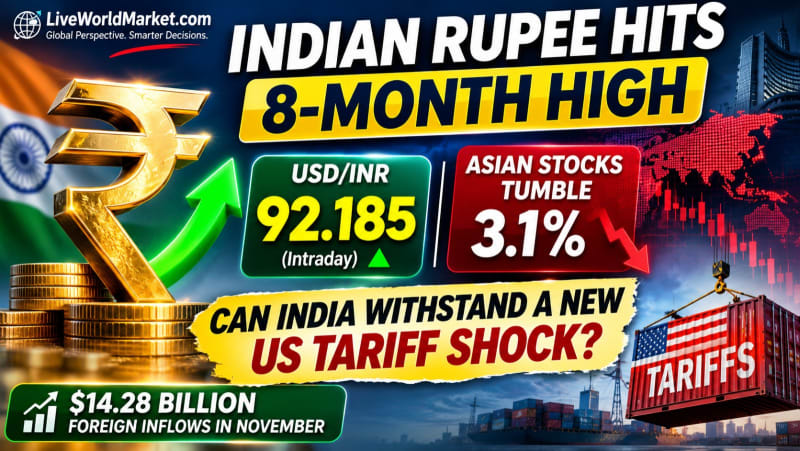
Rupee Hits 8-Month High: Can India Survive New US Tariffs?
India & Global Connections · Nov 25, 2026 · 11 min read
The Indian rupee staged an impressive recovery on November 25, 2026, touching an eight-month high of 92.185 against the US dollar, even as Asian financial markets experienced another sharp selloff amid renewed US tariff concerns. The rupee closed at 92.23 per dollar, gaining approximately 0.7% during the session and extending its November appreciation to 2.9%. Meanwhile, the…
Read more...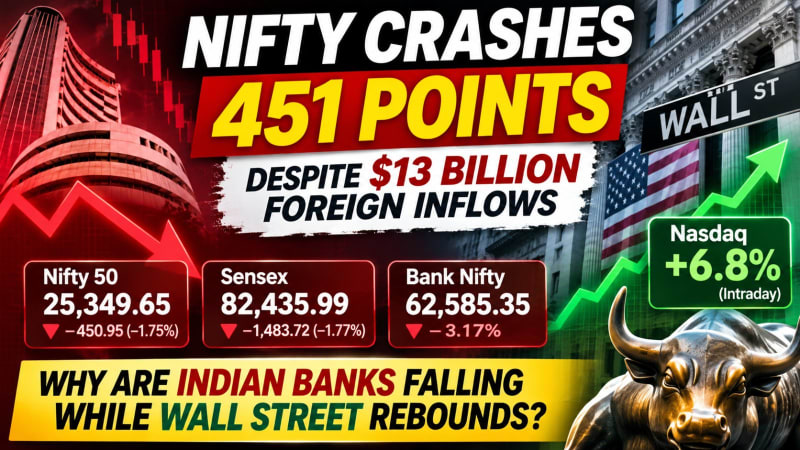
Nifty Crashes 451 Points Despite $13 Billion Foreign Inflows: Why Are Indian Banks Falling While Wall Street Rebounds?
Trend · Nov 23, 2026 · 11 min read
India's stock market suffered a sharp reversal on Monday, November 23, as heavy selling in banking and financial stocks dragged the Nifty 50 down nearly 451 points. The decline came despite approximately $13 billion in foreign equity inflows during November and a powerful rebound in US technology shares. The contrasting movements raise an important question: Why are Indian…
Read more...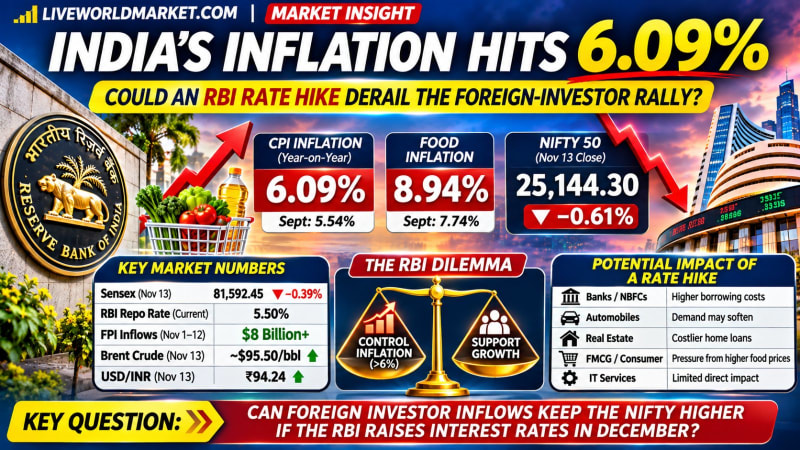
India Inflation Hits 6.09%: Will RBI Rate Hike Hurt Nifty?
News · Nov 14, 2026 · 13 min read
India's Inflation Hits 6.09% as Nifty Falls Below 25,150: Could an RBI Rate Hike Derail the Foreign-Investor Rally? India's retail inflation has breached the RBI's 6% tolerance ceiling, driven by rising food prices and renewed energy risks. With foreign investors pouring more than $8 billion into Indian equities this month, could higher interest rates interrupt the Nifty's…
Read more...
Why $6.4 Billion Is Flowing Into Indian Stocks Despite 5% US Yields
News · Nov 12, 2026 · 11 min read
Foreign Investors Pour $6.4 Billion Into Indian Stocks as US Treasury Yields Cross 5%: Why Is Global Money Returning to India? Key Takeaway: Foreign portfolio investors have poured approximately $6.43 billion into Indian equities in November, reversing a prolonged period of selling and helping the Nifty 50 and Sensex gain around 10% this month. The buying comes despite US…
Read more...
Brent Below $92: Can Cheaper Oil Lift Nifty Despite Fed Risks?
Commodities & Energy · Nov 10, 2026 · 12 min read
Brent Crude Falls Below $92 as Wall Street Surges: Could Cheaper Oil Offset the Fed Rate-Hike Threat to Indian Stocks? Key Takeaway: Brent crude's sharp decline has given global equity markets an unexpected source of support, even as investors prepare for the possibility of another US Federal Reserve interest-rate increase. For India, lower oil prices could ease inflation…
Read more...
Big Tech Gains $750B as AI Data Centre Stocks Crash
Global Markets & Economy · Nov 5, 2026 · 12 min read
Big Tech Gains $750 Billion After US Midterms, but AI Data-Centre Stocks Crash: Is Wall Street Rewarding Less AI Spending? Key Takeaway: Wall Street's reaction to the 2026 US midterm elections has exposed a surprising divide in the artificial intelligence investment boom. Established technology giants rallied, with five major companies on course to add more than $750 billion…
Read more...
US Midterm Elections 2026: Impact on Stocks, Dollar & India
Global Markets & Economy · Nov 4, 2026 · 10 min read
US Midterm Elections 2026: Why Treasury Yields, the Dollar and Indian Stocks Could React More Than Wall Street Key Takeaway: Democrats have won control of both chambers of the US Congress in the 2026 midterm elections, creating a divided government under President Donald Trump. The immediate market reaction has been revealing: US Treasury yields declined, the dollar weakened…
Read more...
Apple Overtakes Nvidia: Is Lower AI Spending Winning?
Technology & Sectors · Nov 2, 2026 · 9 min read
Apple Overtakes Nvidia as World's Most Valuable Company Ahead of Earnings: Is Spending Less on AI Becoming Wall Street's Winning Strategy? Key takeaway: Apple has reclaimed the title of the world's most valuable publicly traded company, overtaking Nvidia as investors reassess the enormous cost of artificial intelligence infrastructure. With Apple's upcoming earnings in focus…
Read more...
ExxonMobil Refining Profits Surge: Impact on Indian Oil Stocks
Commodities & Energy · Nov 1, 2026 · 8 min read
ExxonMobil's Refining Profits Overtake Oil Drilling for First Time in 6 Years: Why India's Oil Stocks May Miss the Windfall Key Takeaway: ExxonMobil's refining business has emerged as a bigger earnings contributor than oil production, highlighting an extraordinary shift in global energy markets. But Indian oil companies such as IOC, BPCL and HPCL face a different challenge…
Read more...