
Nifty Crashes 451 Points Despite $13 Billion Foreign Inflows: Why Are Indian Banks Falling While Wall Street Rebounds?
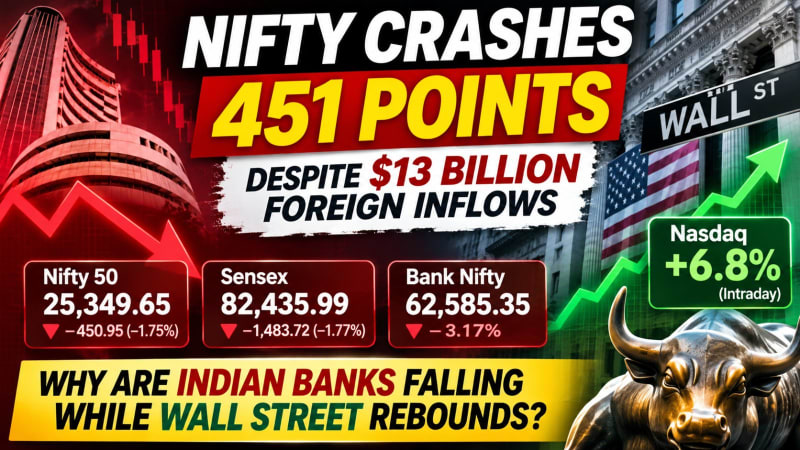
India's stock market suffered a sharp reversal on Monday, November 23, as heavy selling in banking and financial stocks dragged the Nifty 50 down nearly 451 points. The decline came despite approximately $13 billion in foreign equity inflows during November and a powerful rebound in US technology shares.
The contrasting movements raise an important question: Why are Indian investors booking profits when global investors have recently been increasing their exposure to India?
The answer lies in a combination of stretched short-term valuations, concentrated banking-sector gains, derivatives-related positioning and changing global capital flows.
Indian Stock Market Today: Nifty and Sensex Record Sharp Losses
Indian benchmark indices opened positively on Monday but failed to sustain their early momentum.
Selling intensified throughout the session, particularly in heavyweight financial stocks.

The Nifty lost 450.95 points, while the Sensex declined 1,483.72 points.
Fourteen of India's 16 major sector indices finished lower, highlighting the broad nature of the selling pressure.
However, the losses were not evenly distributed. Banking and financial stocks experienced particularly heavy profit-taking, while information technology shares managed to advance.
This divergence offers an important clue about what drove Monday's correction.
1. Why Did Bank Nifty Crash More Than 3%?
Banking stocks had been among the biggest beneficiaries of India's recent market rally.
Over the previous four weeks, banking, financial and related sector indices had gained approximately 18% to 22.5%, according to Reuters.
That strong performance created conditions for substantial profit-taking.
On November 23, Bank Nifty declined 2,049.85 points to close at 62,585.35.
Major banking stocks also came under pressure:
- HDFC Bank declined approximately 3.3%.
- ICICI Bank fell approximately 3.3%.
- Axis Bank lost nearly 4%.
- Both private-sector and public-sector banking indices experienced significant declines.
Profit-taking after a rapid rally
When a sector rises sharply over a short period, investors may begin reducing exposure even without a major deterioration in corporate fundamentals.
This can be particularly significant in banking stocks because they carry substantial weight in India's benchmark indices.
Selling in a few large banks can therefore pull down the broader Nifty and Sensex.
Derivatives expiry increased volatility
Monday's trading also coincided with derivatives-expiry positioning.
Traders adjusting or closing futures and options positions can amplify short-term market movements, particularly when prices begin reversing from elevated levels.
The upcoming Tuesday market holiday added another reason for traders to reduce overnight exposure.
Key takeaway: Monday's banking selloff appears primarily consistent with profit-taking and positioning after a strong rally, rather than clear evidence of a sudden banking-sector earnings crisis.
2. The $13 Billion Paradox: Why Didn't Foreign Inflows Support the Market?
One of the most surprising aspects of Monday's decline was the strength of foreign investment into Indian equities during November.
According to Reuters, foreign investors had invested approximately $13 billion in Indian stocks during November, a record monthly inflow at the time of reporting.
Foreign buying had helped support India's four-week equity rally.
Yet the Nifty still fell nearly 1.8% in a single session.
How can both developments occur simultaneously?
Monthly inflows are not the same as daily buying
The $13 billion figure represents cumulative foreign investment during November.
It does not mean foreign investors purchased $13 billion of Indian stocks on November 23.
A market can experience strong monthly inflows while declining sharply on individual days because of:
- Profit-taking by domestic or foreign investors.
- Selling concentrated in heavily weighted index constituents.
- Institutional portfolio rebalancing.
- Derivatives-related activity.
- A temporary imbalance between buyers and sellers.
Foreign investors had purchased approximately ₹10,308 crore of Indian equities on Friday, November 20, according to provisional data.
However, that earlier buying does not establish the direction of foreign flows during Monday's session.
Why foreign investors have been returning to India
The recent inflows have coincided with growing concerns about the global artificial intelligence investment boom.
US technology companies have faced questions about AI infrastructure spending, debt financing and whether future revenue growth will justify enormous capital commitments.
India's listed equity market has relatively limited direct exposure to the largest global AI infrastructure companies.
That distinction may make Indian equities attractive to international investors seeking geographic and sector diversification.
Improving domestic earnings expectations and economic momentum have also supported sentiment.
Nevertheless, foreign inflows cannot eliminate normal market corrections.
The bigger lesson is that strong capital inflows can support a longer-term rally without guaranteeing positive returns every day.
3. Why Is Wall Street Rebounding While Indian Stocks Are Falling?
The divergence between India and the United States became especially noticeable on Monday.
Following the previous week's severe technology-led selloff, US equities staged a powerful rebound.
According to an Associated Press report, at approximately 10:15 a.m. Eastern Time on November 23:
US market indicator Intraday movement
Nasdaq Composite+6.8%
S&P 5 00 +4.8%
Dow Jones Industrial Average +1,365 points
These were intraday figures, not final US closing returns.
The rebound was concentrated in technology and AI-related companies, with Nvidia experiencing an especially sharp recovery following company-specific developments.
Different markets, different starting points
The apparent contradiction becomes easier to understand when examining what happened before Monday.
US technology stocks had experienced substantial losses during the preceding week.
Indian equities, meanwhile, had enjoyed a strong rally supported by foreign inflows.
Consequently, the two markets entered Monday from very different positions.
US investors were buying shares after a major decline, while Indian investors were taking profits after several weeks of gains.
This demonstrates why global markets do not always move in the same direction.
Could global capital rotate back toward US technology?
A sustained US technology recovery could influence international portfolio allocations.
If investors regain confidence in AI-related earnings and valuations, some funds may reconsider their exposure to emerging markets.
However, one strong US trading session is insufficient to establish that foreign capital is leaving India.
To determine whether a genuine rotation is underway, investors would need to examine several sessions of foreign-flow data, relative market performance and changes in global risk appetite.
4. Why Did Indian IT Stocks Rise While Banks Fell?
An interesting feature of Monday's session was the relative strength of information technology stocks.
The Nifty IT index gained approximately 1.69%, even as banking and metal shares declined sharply.
TCS, Tech Mahindra and HCL Technologies were among the technology companies that recorded gains.
This suggests that Monday's selling was not a uniform rejection of Indian equities.
Instead, investors were differentiating between sectors.
Indian IT services companies have a different business model from US semiconductor manufacturers and AI infrastructure developers.
Their performance depends heavily on enterprise technology spending, outsourcing contracts, digital transformation and client budgets.
A recovery in US technology sentiment could potentially support expectations for enterprise technology spending, although it does not automatically translate into stronger Indian IT earnings.
The contrast between banks and IT stocks therefore deserves attention.
The market may be experiencing a sector rotation rather than a complete withdrawal from Indian equities.
5. What Does the Nifty Crash Mean for Foreign Investors and the Indian Rupee?
A sudden equity-market decline can affect more than stock prices.
Foreign portfolio investment, currency movements and global bond yields are interconnected.
When international investors sell Indian equities and repatriate proceeds, demand for foreign currency can increase.
However, the relationship is not automatic.
The rupee is also influenced by oil prices, trade flows, RBI intervention, US interest rates and broader dollar movements.
On November 23, the rupee ended a five-session winning streak and weakened approximately 0.3% to 92.91 against the US dollar, according to The Indian Express.
A weaker rupee can have different implications across sectors.
Export-oriented companies may benefit from foreign-currency revenue translation, while businesses dependent on imported inputs may face higher costs.
Investors should therefore monitor equity flows and currency movements together rather than interpreting either indicator in isolation.
6. Is This a Healthy Correction or the Beginning of a Bigger Decline?
A single sharp market decline cannot determine whether a longer-term uptrend has ended.
Context matters.
Despite Monday's losses, Reuters reported that the Nifty and Sensex remained approximately 10% and 10.7% higher, respectively, for November.
That means the market was correcting after an unusually strong advance.
There are three possible scenarios.
Scenario A: Profit-taking ends and the rally resumes
If banking stocks stabilize, foreign inflows remain supportive and corporate earnings expectations improve, the market could recover from the correction.
A sustained recovery would require buying across major sectors rather than isolated gains in a few heavyweight stocks.
Scenario B: Markets enter a consolidation phase
The Nifty could experience a period of sideways movement as investors reassess valuations.
This would allow recent gains to be absorbed without necessarily indicating a fundamental deterioration in the economy.
Sector rotation could remain prominent during such a period.
Scenario C: Selling pressure broadens
A more concerning outcome would involve persistent selling across banks, IT, industrials and consumer stocks, accompanied by weakening market breadth and sustained foreign outflows.
Rising global yields, renewed AI-related volatility or deteriorating earnings expectations could add pressure.
At present, Monday's decline alone does not establish which scenario will develop.
7. Key Nifty Levels and Global Indicators to Watch
Technical levels are useful reference points, but they should not be treated as guaranteed turning points.
Following Monday's decline, market participants may monitor:

These levels are observational reference points, not price forecasts.
Investors should also distinguish between a short-term rebound and a sustained improvement in market breadth.
For ongoing market coverage, explore LiveWorldMarket's India market dashboard and global market analysis.
8. What Happens Next for Indian Markets?
Indian exchanges are scheduled to remain closed on Tuesday, November 24, for Guru Nanak Jayanti.
That creates an unusual situation.
US and other international markets may continue reacting to the technology-sector rebound while Indian cash equities are closed.
By the time Indian markets reopen, investors will have additional information about:
- Whether the US technology rebound has continued.
- How Asian equity markets have responded.
- Whether US Treasury yields and the dollar have stabilized.
- Whether international risk appetite is improving.
- Whether banking-sector profit-taking appears likely to continue.
The next Indian trading session will therefore provide an important test of whether Monday's decline was primarily a temporary correction or the beginning of a broader change in sentiment.
9. What Should Investors Learn From This Market Divergence?
The events of November 23 highlight three important principles.
First, foreign inflows do not guarantee rising stock prices. Even record cumulative buying can coexist with sharp daily corrections.
Second, sector concentration matters. When banks have a large weight in benchmark indices, profit-taking in financial stocks can overwhelm gains elsewhere.
Third, global market direction is not uniform. Wall Street can rebound from a technology selloff while Indian equities correct after a domestic rally.
For investors following global markets, the interaction between capital flows, valuations, earnings expectations and market positioning is often more informative than any single headline.
Frequently Asked Questions
Why did Nifty fall 451 points on November 23, 2026?
The Nifty fell primarily because of profit-taking after a four-week rally, heavy selling in banking and financial stocks, and derivatives-expiry positioning. The index closed at 25,349.65, down 450.95 points.
Why did Bank Nifty fall more than the Nifty 50?
Banking stocks had recorded substantial gains over the preceding four weeks. Profit-taking in major financial companies pushed Bank Nifty down 3.17%, exceeding the broader Nifty's 1.75% decline.
Did foreign investors withdraw $13 billion from India?
No. The approximately $13 billion figure refers to cumulative foreign equity inflows during November, not withdrawals. It should not be confused with the net foreign-investor activity on November 23.
Why did Nasdaq rise while Nifty declined?
US technology stocks were recovering after a steep selloff, while Indian equities were correcting after several weeks of strong gains. Different valuations, sector exposures and investor positioning contributed to the divergence.
Is the Indian stock market entering a bear market?
One session of losses does not establish a bear market. Investors would need to assess the persistence and scale of the decline, earnings trends, market breadth and foreign capital flows.
When will Indian stock markets reopen?
Following the scheduled November 24 holiday, Indian stock exchanges are expected to reopen on Wednesday, November 25, 2026, subject to the official exchange calendar.
Final Outlook: A Market Rotation Worth Watching
The Nifty's 451-point decline is a reminder that even strong rallies supported by foreign capital can experience sudden reversals.
India's banking sector was particularly vulnerable after its rapid appreciation, while IT shares demonstrated that investors were still willing to buy selected sectors.
At the same time, Wall Street's rebound showed how quickly sentiment can change following a severe correction.
The most important question is not simply whether the Nifty will recover its losses.
It is whether India's recent foreign-investment-led rally can broaden beyond banking stocks while global investors reassess the AI trade and emerging-market opportunities.
That interaction between domestic profit-taking and international capital allocation could help determine the next phase of Indian equity-market performance.
Sources and references
- Reuters — Financial stocks drag Indian equities lower after four-week rally, November 23, 2026
- Associated Press — US stocks rebound sharply on November 23, 2026
- The Indian Express — Indian markets fall 1.8% on profit booking
- HDFC SKY — November 23 Indian stock market closing report
Disclaimer: This article is intended for informational and educational purposes only. It does not constitute investment advice or a recommendation to buy or sell securities. Market conditions and prices can change rapidly. Readers should independently evaluate financial information and their individual risk tolerance before making investment decisions.
LiveWorldMarket.com — Global Perspective. Smarter Decisions.
Comments (0)
Be the first to comment.
About the author

NISM-Series-X-A Investment Adviser Level 1 examination completed
Amit writes about Indian equity markets, technical analysis, macro themes and the day-to-day mechanics of trading, with a focus on making the flow of global markets legible for retail investors. He has completed the NISM-Series-X-A Investment Adviser Level 1 examination.
You May Also Like

Nasdaq Surges 2.3%: Is the AI Tech Stock Crash Over?
News · Nov 28, 2026 · 5 min read
Wall Street finally gave investors a reason to smile after weeks of uncertainty, sharp sell-offs and growing concerns about the artificial intelligence boom. The Nasdaq Composite surged 2.3% on Friday, November 27, as investors returned from the Thanksgiving holiday and started buying beaten-down technology stocks. The S&P 500 and Dow Jones also registered strong gains…
Read more...
Markets Shrug Off US Tariff Threats, but $95 Brent Creates a New Inflation Risk
Global Markets & Economy · Nov 26, 2026 · 3 min read
What Investors Should Watch Next Global markets have staged a relief rally, with Asian and European equities gaining as investors assessed the latest US tariff proposals as less disruptive than initially feared. But beneath that calm, a more consequential risk is building: Brent crude has moved above $95 a barrel, putting inflation back at the centre of the market…
Read more...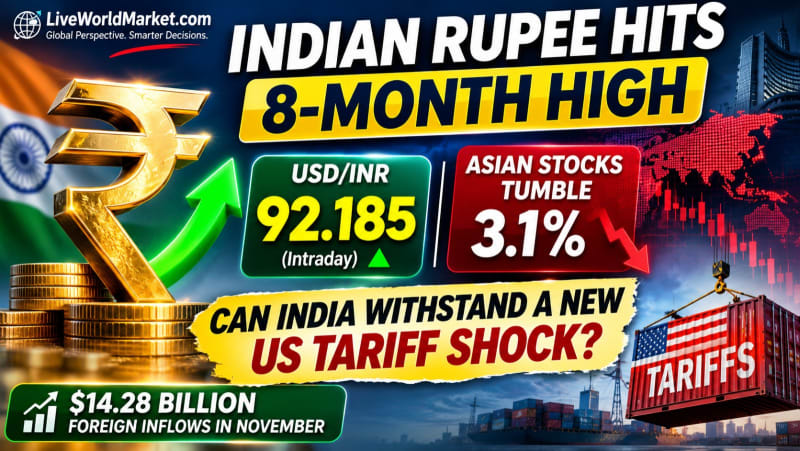
Rupee Hits 8-Month High: Can India Survive New US Tariffs?
India & Global Connections · Nov 25, 2026 · 11 min read
The Indian rupee staged an impressive recovery on November 25, 2026, touching an eight-month high of 92.185 against the US dollar, even as Asian financial markets experienced another sharp selloff amid renewed US tariff concerns. The rupee closed at 92.23 per dollar, gaining approximately 0.7% during the session and extending its November appreciation to 2.9%. Meanwhile, the…
Read more...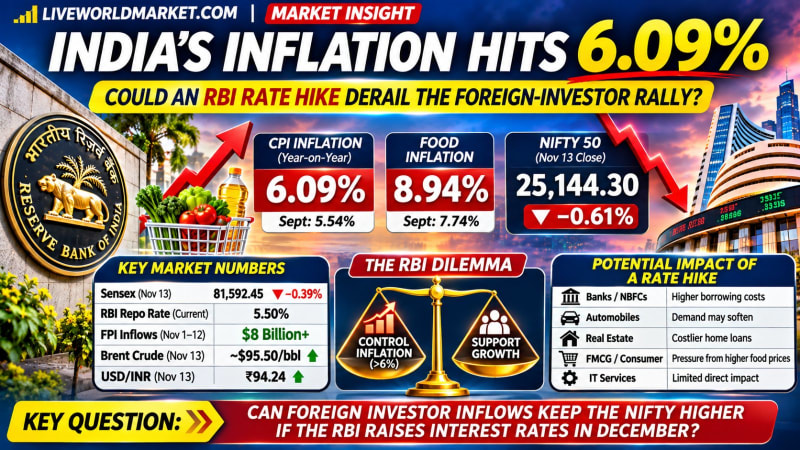
India Inflation Hits 6.09%: Will RBI Rate Hike Hurt Nifty?
News · Nov 14, 2026 · 13 min read
India's Inflation Hits 6.09% as Nifty Falls Below 25,150: Could an RBI Rate Hike Derail the Foreign-Investor Rally? India's retail inflation has breached the RBI's 6% tolerance ceiling, driven by rising food prices and renewed energy risks. With foreign investors pouring more than $8 billion into Indian equities this month, could higher interest rates interrupt the Nifty's…
Read more...
Why $6.4 Billion Is Flowing Into Indian Stocks Despite 5% US Yields
News · Nov 12, 2026 · 11 min read
Foreign Investors Pour $6.4 Billion Into Indian Stocks as US Treasury Yields Cross 5%: Why Is Global Money Returning to India? Key Takeaway: Foreign portfolio investors have poured approximately $6.43 billion into Indian equities in November, reversing a prolonged period of selling and helping the Nifty 50 and Sensex gain around 10% this month. The buying comes despite US…
Read more...
Brent Below $92: Can Cheaper Oil Lift Nifty Despite Fed Risks?
Commodities & Energy · Nov 10, 2026 · 12 min read
Brent Crude Falls Below $92 as Wall Street Surges: Could Cheaper Oil Offset the Fed Rate-Hike Threat to Indian Stocks? Key Takeaway: Brent crude's sharp decline has given global equity markets an unexpected source of support, even as investors prepare for the possibility of another US Federal Reserve interest-rate increase. For India, lower oil prices could ease inflation…
Read more...
Big Tech Gains $750B as AI Data Centre Stocks Crash
Global Markets & Economy · Nov 5, 2026 · 12 min read
Big Tech Gains $750 Billion After US Midterms, but AI Data-Centre Stocks Crash: Is Wall Street Rewarding Less AI Spending? Key Takeaway: Wall Street's reaction to the 2026 US midterm elections has exposed a surprising divide in the artificial intelligence investment boom. Established technology giants rallied, with five major companies on course to add more than $750 billion…
Read more...
US Midterm Elections 2026: Impact on Stocks, Dollar & India
Global Markets & Economy · Nov 4, 2026 · 10 min read
US Midterm Elections 2026: Why Treasury Yields, the Dollar and Indian Stocks Could React More Than Wall Street Key Takeaway: Democrats have won control of both chambers of the US Congress in the 2026 midterm elections, creating a divided government under President Donald Trump. The immediate market reaction has been revealing: US Treasury yields declined, the dollar weakened…
Read more...
Apple Overtakes Nvidia: Is Lower AI Spending Winning?
Technology & Sectors · Nov 2, 2026 · 9 min read
Apple Overtakes Nvidia as World's Most Valuable Company Ahead of Earnings: Is Spending Less on AI Becoming Wall Street's Winning Strategy? Key takeaway: Apple has reclaimed the title of the world's most valuable publicly traded company, overtaking Nvidia as investors reassess the enormous cost of artificial intelligence infrastructure. With Apple's upcoming earnings in focus…
Read more...
ExxonMobil Refining Profits Surge: Impact on Indian Oil Stocks
Commodities & Energy · Nov 1, 2026 · 8 min read
ExxonMobil's Refining Profits Overtake Oil Drilling for First Time in 6 Years: Why India's Oil Stocks May Miss the Windfall Key Takeaway: ExxonMobil's refining business has emerged as a bigger earnings contributor than oil production, highlighting an extraordinary shift in global energy markets. But Indian oil companies such as IOC, BPCL and HPCL face a different challenge…
Read more...