
CXMT DRAM Breakthrough: Samsung, SK Hynix & Micron at Risk?
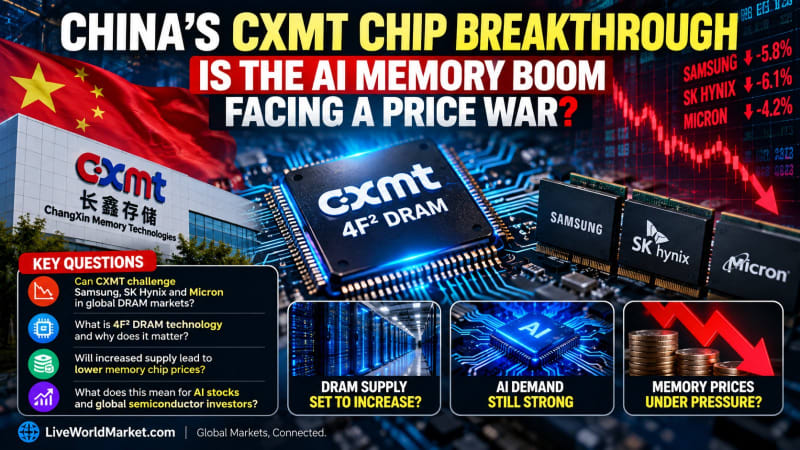
China's CXMT DRAM Breakthrough: Could a Memory Price War Threaten Samsung, SK Hynix and Micron?
The global semiconductor industry is confronting a new question: Could China's progress in memory-chip technology eventually undermine the pricing power of the world's largest DRAM manufacturers?
Chinese chipmaker ChangXin Memory Technologies (CXMT) has reportedly made progress in a denser DRAM cell architecture known as 4F², with plans to introduce server-memory products using the technology by the end of 2026.
The development arrives as global semiconductor stocks face selling pressure, with investors reassessing AI-related valuations, competition and the durability of memory-chip profits.
For Samsung Electronics, SK Hynix and Micron Technology, the concern is not simply whether China can produce more memory chips.
It is whether additional supply could eventually pressure prices in an industry historically characterized by sharp boom-and-bust cycles.
But there is an important distinction: A breakthrough in conventional DRAM does not automatically mean China can immediately challenge the most advanced high-bandwidth memory used in AI accelerators.
Understanding that difference is essential for investors.
Why Is CXMT Suddenly in the Spotlight?
ChangXin Memory Technologies is one of China's most important domestic memory-chip manufacturers.
China has invested heavily in developing its semiconductor supply chain as restrictions on advanced technology exports and geopolitical tensions encourage greater domestic production.
CXMT's reported progress in 4F² DRAM technology could improve memory density by reducing the physical area occupied by each memory cell.
In principle, higher density can allow manufacturers to produce more memory capacity from a given silicon wafer, potentially improving cost efficiency.
However, successful commercial production requires more than a promising chip design.
Manufacturers must achieve acceptable yields, reliability, performance and production economics at scale.
The market is therefore reacting to a potential future competitive threat—not proof that a new wave of low-cost memory supply has already reached customers.
Related: Track U.S. technology and semiconductor stocks.
What Is 4F² DRAM Technology?
DRAM, or dynamic random-access memory, temporarily stores data used by computers, servers and other electronic devices.
Traditional DRAM manufacturing faces an ongoing challenge: fitting more memory cells into smaller physical areas while maintaining reliable performance.
The term 4F² describes a theoretical memory-cell footprint based on the square of the minimum lithographic feature size.
A smaller cell footprint can potentially improve density.
That matters because memory-chip manufacturing is capital-intensive, and cost per bit is a critical measure of competitiveness.
Why Higher Density Matters
If a manufacturer can produce more usable memory bits per wafer without proportionately increasing production costs, it may gain an advantage in cost efficiency.
But theoretical density does not directly translate into commercial profitability.
A new process may require more complex manufacturing steps, suffer from lower yields or face performance and reliability limitations.
For investors, the real question is not whether 4F² technology works in a demonstration.
It is whether CXMT can manufacture competitive products consistently and economically at meaningful scale.
Why Could This Become a Problem for Samsung, SK Hynix and Micron?
The global DRAM industry has historically been dominated by a relatively small group of major manufacturers.
Samsung Electronics, SK Hynix and Micron are central participants.
Their profitability depends on several variables, including production capacity, product mix, demand growth, manufacturing costs and selling prices.
When supply grows faster than demand, memory prices can weaken.
When demand exceeds available supply, prices and margins can improve substantially.
That cyclical pattern makes potential new competition important.
If CXMT successfully expands production of commercially competitive DRAM, established manufacturers could face additional pricing pressure in selected market segments.
The effect would depend on how quickly CXMT ramps production, the quality of its products, customer adoption and whether existing manufacturers adjust their own output.
The risk is gradual erosion of pricing power—not necessarily an immediate collapse in global DRAM prices.
Conventional DRAM Versus HBM: The Critical Difference
One of the biggest mistakes investors can make is treating all memory chips as interchangeable.
Conventional DRAM and high-bandwidth memory serve related but different performance requirements.
HBM is particularly important for advanced AI accelerators because it provides very high memory bandwidth close to the processor.
Its manufacturing and packaging requirements are more demanding than those of many conventional DRAM products.
DRAM and HBM: What Investors Need to Know
FeatureConventional DRAMHigh-Bandwidth Memory
Primary applications
PCs, servers, smartphones
AI accelerators, advanced computing
Main competitive factors
Cost, capacity, speed, reliability
Bandwidth, power efficiency, packaging, qualification
Manufacturing complexity
High
Particularly demanding due to stacking and integration
Exposure to CXMT expansion
Potentially more direct
Less immediate
Investment focus
Supply growth and memory pricing
AI demand, advanced manufacturing and customer qualifications
CXMT's progress in denser DRAM does not establish that it can immediately produce HBM competitive with leading suppliers.
That distinction matters for SK Hynix and other companies benefiting from demand for advanced AI memory.
Even if conventional DRAM becomes more competitive, HBM could retain different supply-demand dynamics.
Could the AI Memory Boom Continue While DRAM Prices Fall?
Yes.
This is the most important investment implication.
Artificial intelligence can drive demand for more computing power, larger memory capacity and faster data transfer.
At the same time, manufacturers can increase supply through new factories, higher production yields and improved manufacturing processes.
If supply in a particular memory category grows faster than demand, prices can fall even while overall AI infrastructure spending continues expanding.
This means two developments can occur simultaneously:
AI computing demand remains strong.
Profit margins for some memory manufacturers come under pressure.
Investors should therefore avoid assuming that every company exposed to AI infrastructure will experience the same earnings trajectory.
The AI investment cycle is not a single market.
It includes processors, conventional memory, HBM, networking, data centers, power infrastructure and software, each with different competitive economics.
Related reading: Explore LiveWorldMarket's global technology and macro Insights.
What Does This Mean for Micron Stock?
Micron Technology is a major U.S. memory manufacturer with exposure to DRAM, NAND flash and advanced memory products.
Its financial performance is sensitive to memory pricing, manufacturing efficiency and product mix.
Potential Chinese competition matters because additional supply could eventually influence prices in certain conventional DRAM categories.
However, investors must also consider Micron's participation in higher-value memory markets, including products designed for AI infrastructure.
The company's prospects cannot be assessed solely through the possibility of increased Chinese output.
Important indicators include:
- DRAM average selling prices
- HBM revenue growth and margins
- Production capacity and utilization
- Capital expenditure
- Inventory levels
- Customer demand and product qualifications
The central question is whether improvements in advanced-memory revenue and manufacturing efficiency can offset any pressure on conventional DRAM pricing.
Samsung Electronics: Competition Across Multiple Memory Markets
Samsung operates across a broad range of semiconductor and electronics businesses.
Its memory operations include conventional DRAM, NAND and advanced memory products.
A more competitive Chinese DRAM industry could affect some product segments more directly than others.
Samsung's ability to respond will depend on technology development, manufacturing efficiency, customer relationships and capacity decisions.
Investors should monitor whether the company maintains pricing discipline while investing in advanced-memory technologies.
Because Samsung has a diversified business model, movements in its share price can reflect factors beyond memory competition alone.
SK Hynix: Why HBM Matters More Than the Headlines
SK Hynix has become particularly important to the AI infrastructure investment theme because of its role in high-bandwidth memory.
HBM is closely linked to advanced AI accelerators and requires specialized manufacturing and packaging capabilities.
That creates a different competitive environment from conventional server or PC memory.
If CXMT's progress is concentrated in standard DRAM, the immediate impact on SK Hynix's most advanced HBM business may be limited.
Nevertheless, conventional DRAM remains relevant to its broader earnings.
Investors should assess the company through both its advanced-memory leadership and its exposure to the wider memory cycle.
Why South Korea's Stock Market Is Especially Sensitive
South Korea's equity market has significant exposure to large semiconductor manufacturers.
As a result, shifts in global chip demand, memory pricing expectations and technology-sector valuations can influence the broader KOSPI.
Concerns about Chinese competition may add to volatility already driven by global interest rates, foreign capital flows and AI-related investment sentiment.
However, a broad Korean market decline should not automatically be attributed to one technology announcement.
Investors should distinguish between company-specific developments and wider market risk aversion.
Related: Monitor global equity markets.
Taiwan and the Wider Semiconductor Supply Chain
Taiwan plays a central role in global semiconductor manufacturing and advanced packaging.
A change in memory-industry competition could influence investor expectations across the wider semiconductor supply chain, but the effects would vary substantially by business model.
Foundries, memory manufacturers, equipment suppliers and packaging companies face different sources of revenue and risk.
A potential decline in conventional DRAM prices does not necessarily imply weaker demand for advanced logic chips or AI accelerators.
In some cases, cheaper memory could even reduce costs for downstream hardware manufacturers.
This is why semiconductor analysis should separate the demand outlook for computing from the pricing outlook for individual components.
Could Cheaper DRAM Benefit Other Technology Companies?
Not every consequence of increased memory supply would be negative.
Lower memory prices can benefit companies that purchase large quantities of memory for their products.
Potential beneficiaries could include manufacturers of PCs, smartphones and certain server systems.
Lower component costs may improve margins or make finished products more affordable.
However, the benefit depends on contract structures, inventory positions, customer pricing and competitive conditions.
For AI infrastructure, cheaper conventional memory could help some parts of the supply chain even while reducing profitability for suppliers.
This illustrates an important market principle:
A negative development for one industry's pricing power can become a cost advantage for another industry.
What Does This Mean for Indian Investors?
India's listed technology and electronics ecosystem is different from that of South Korea, Taiwan or the United States.
Indian IT services companies are generally not direct manufacturers of advanced DRAM chips.
Their exposure to semiconductor developments is more indirect, through enterprise technology spending, hardware costs, customer budgets and broader global market sentiment.
Electronics manufacturers and hardware-related businesses could be affected by changes in component prices, depending on their sourcing and contracts.
For Indian investors, the key is to avoid treating the entire technology sector as one uniform investment category.
The economics of an IT services exporter are very different from those of a memory-chip manufacturer.
Related: Follow the Indian stock market.
Five Indicators Investors Should Watch Next
1. CXMT's Commercial Production Timeline
Does the company begin meaningful commercial shipments of its new DRAM products, and are customers willing to adopt them?
A planned product introduction is not equivalent to large-scale commercial success.
2. Manufacturing Yields
Can CXMT produce high-quality chips economically and consistently?
Yield performance can determine whether a technology breakthrough becomes a viable commercial advantage.
3. DRAM Contract Prices
Do industry prices begin weakening as supply expectations change?
Price movements provide a more direct indication of industry conditions than headlines alone.
4. HBM Demand and Supply
Are advanced-memory suppliers continuing to benefit from strong demand for AI accelerators?
HBM pricing and qualification trends should be evaluated separately from conventional DRAM.
5. Capital Expenditure by Major Manufacturers
Are Samsung, SK Hynix, Micron and Chinese competitors expanding capacity aggressively?
A simultaneous investment cycle could eventually create excess supply in certain categories.
Three Scenarios for the Global Memory Industry
Scenario 1: CXMT's Progress Remains Technically Promising but Commercially Limited
Production challenges, yields or customer qualification requirements could slow expansion.
In this scenario, established manufacturers retain much of their competitive position.
Scenario 2: CXMT Becomes a Stronger Conventional DRAM Competitor
Commercially competitive output increases over time, potentially placing pressure on pricing in selected segments.
Established manufacturers may respond through efficiency improvements, product differentiation or capacity adjustments.
Scenario 3: AI Demand Absorbs Additional Supply
Even with more manufacturing capacity, expanding demand from servers, cloud infrastructure and consumer devices could support industry volumes.
The outcome would depend on how quickly supply grows relative to demand.
None of these scenarios is guaranteed.
The market's challenge is determining which one becomes most likely as commercial evidence emerges.
LiveWorldMarket View: The Real Risk Is Pricing Power, Not the End of AI
CXMT's reported DRAM progress deserves attention because memory manufacturing is a business in which technological improvements can eventually reshape cost structures and competitive positions.
But the announcement should not be confused with proof that a global memory price war has already begun.
Investors need evidence of commercial production, customer adoption, manufacturing yields and sustained supply growth.
The distinction between conventional DRAM and advanced HBM is equally important.
AI infrastructure demand could remain robust while competitive pressure increases in selected memory markets.
For Samsung, SK Hynix and Micron, future stock performance will depend not simply on whether AI spending grows, but on how much of that growth translates into sustainable margins and free cash flow.
The next phase of the semiconductor investment cycle may therefore be less about identifying companies associated with AI and more about identifying which companies can preserve pricing power as competition intensifies.
The key takeaway: AI demand can keep rising while memory-chip pricing power weakens. Investors should watch the economics of supply—not just the excitement surrounding technology breakthroughs.
Explore more original analysis at LiveWorldMarket.com and follow the latest global market Insights.
Sources and further reading
- Reuters — Global markets and semiconductor developments
- CXMT — Official company website
- Micron Technology — Investor Relations
- Samsung Electronics — Investor Relations
- SK Hynix — Investor Relations
Disclaimer: This article is for educational and informational purposes only and does not constitute investment advice. CXMT's reported technology progress and commercialization plans require continued verification. Potential effects on industry prices and listed companies are scenarios, not established outcomes.
Comments (0)
Be the first to comment.
About the author

NISM-Series-X-A Investment Adviser Level 1 examination completed
Amit writes about Indian equity markets, technical analysis, macro themes and the day-to-day mechanics of trading, with a focus on making the flow of global markets legible for retail investors. He has completed the NISM-Series-X-A Investment Adviser Level 1 examination.
You May Also Like
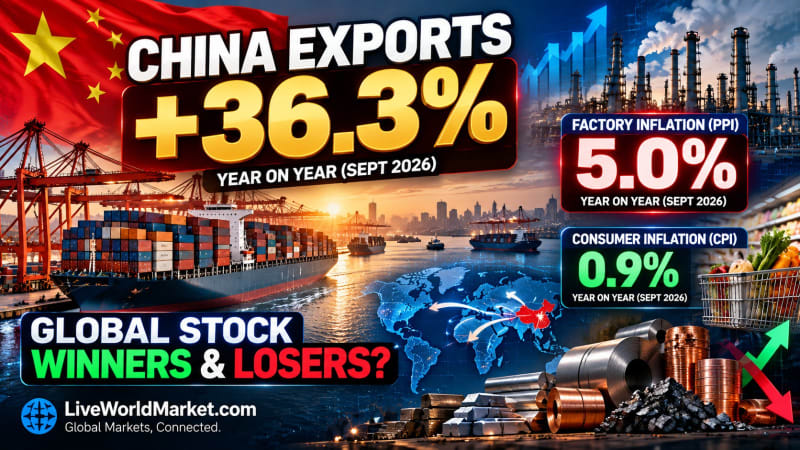
China Exports Surge 36.3%, PPI Hits 5%: Stock Winners & Losers
Geopolitics & Trade · Oct 14, 2026 · 11 min read
China's Exports Surge 36.3% as Factory Inflation Hits 5%: Which Global Stocks Could Win or Lose? China's factories are shipping more goods overseas than expected, but a sharp rise in producer prices is raising a new question about the profitability of the world's manufacturing powerhouse. Official data released on October 14 showed that China's exports surged 36.3%…
Read more...
RBI Dollar Window: Can Rupee Near ₹97 Survive $100 Oil?
Central Banks & Rates · Oct 12, 2026 · 9 min read
RBI Opens Special Dollar Window as Rupee Nears ₹97: Can India Protect Its Stock Market From $100 Oil? India's central bank has introduced a new defense against rupee weakness at a time when crude oil prices remain above $100 per barrel. The Reserve Bank of India (RBI) has announced a special dollar facility for three government-owned oil marketing companies, beginning October…
Read more...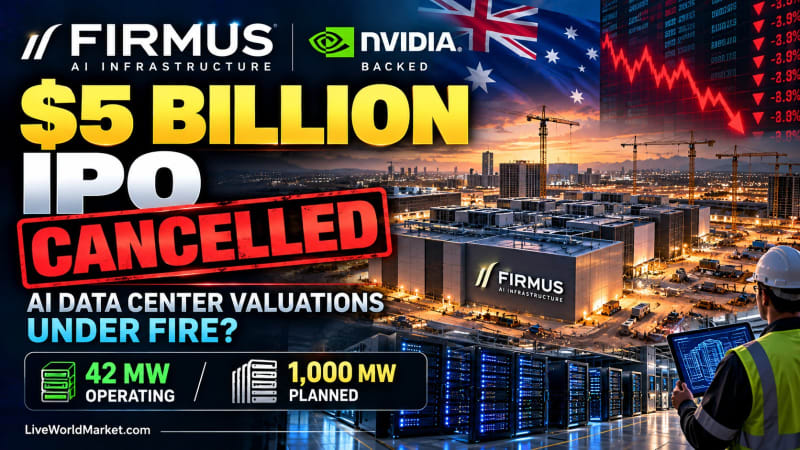
Firmus $5B IPO Cancelled: AI Data Center Valuations at Risk
Technology & Sectors · Oct 11, 2026 · 9 min read
Nvidia-Backed Firmus Cancels $5 Billion IPO: Is Wall Street Finally Questioning AI Data Center Valuations? The global artificial intelligence investment boom has encountered a revealing reality check. Firmus Technologies, an Australian AI data center developer backed by Nvidia, has withdrawn its planned multibillion-dollar stock market listing after struggling to attract…
Read more...
Starlink $8B Spectrum Deal: Telecom Stocks Fall, Towers Rise
Technology & Sectors · Oct 10, 2026 · 10 min read
Starlink's $8 Billion Spectrum Deal: Why Telecom Stocks Fell While Tower Shares Surged A single spectrum deal has sent shockwaves through the global telecommunications industry. On October 8, SpaceX announced an agreement to acquire nationwide 800 MHz wireless spectrum from Grain Management, marking a significant step toward expanding its Starlink Mobile business. The…
Read more...
Two-Thirds of S&P 500 Stocks Rose—Why Did the Index Fall? AI Warning
Technology & Sectors · Oct 9, 2026 · 11 min read
The AI Boom Is Turning Into a $100 Billion Debt Race: Could Borrowing Costs Become the Next Risk for Tech Stocks? For the past three years, artificial intelligence has been one of the biggest forces driving global stock markets. From Nvidia's extraordinary rise to the massive expansion of AI data centres, investors have rewarded companies promising to build the infrastructure…
Read more...
AI Debt Boom 2026: Could Borrowing Costs Hit Tech Stocks?
News · Oct 8, 2026 · 11 min read
The AI Boom Is Turning Into a $100 Billion Debt Race: Could Borrowing Costs Become the Next Risk for Tech Stocks? For the past three years, artificial intelligence has been one of the biggest forces driving global stock markets. From Nvidia's extraordinary rise to the massive expansion of AI data centres, investors have rewarded companies promising to build the infrastructure…
Read more...
$100 Oil Is Back: Which Stock Markets and Sectors Are Most Exposed?
Commodities & Energy · Oct 7, 2026 · 12 min read
The $100 Oil Test Has Arrived: Which Global Stock Markets and Sectors Are Most Exposed If Crude Stays Above Triple Digits? Oil above $100 is no longer a hypothetical risk for global markets. Brent crude traded above $101 a barrel on October 7, while U.S. West Texas Intermediate hovered near $90 as investors confronted a combination of Middle East supply risks, attacks on…
Read more...
Stocks Hit Record Highs While Bond Yields Flash a Warning: Which Market Is Right?
Global Markets & Economy · Oct 6, 2026 · 9 min read
Stocks Are Hitting Records While Bonds Flash a Warning: Which Market Is Right? Something unusual is happening across global financial markets. Stocks are celebrating. Bonds are warning. On October 6, global equities climbed to their highest level in roughly two weeks. The S&P 500 reached another record, while the technology-heavy Nasdaq extended its run of all-time highs. The…
Read more...
France Bond Spread Hits 2011-Era Extreme: Is Europe’s Debt Risk Returning?
Global Markets & Economy · Oct 6, 2026 · 9 min read
France’s Bond Spread Just Hit a 2011-Era Extreme: Is Europe Quietly Re-Entering a Sovereign-Debt Risk Trade? For much of 2026, investors have been focused on the Federal Reserve, oil, inflation and the extraordinary resilience of AI-driven equity markets. But another risk is quietly emerging in Europe. The gap between France’s 10-year government bond yield and Germany’s…
Read more...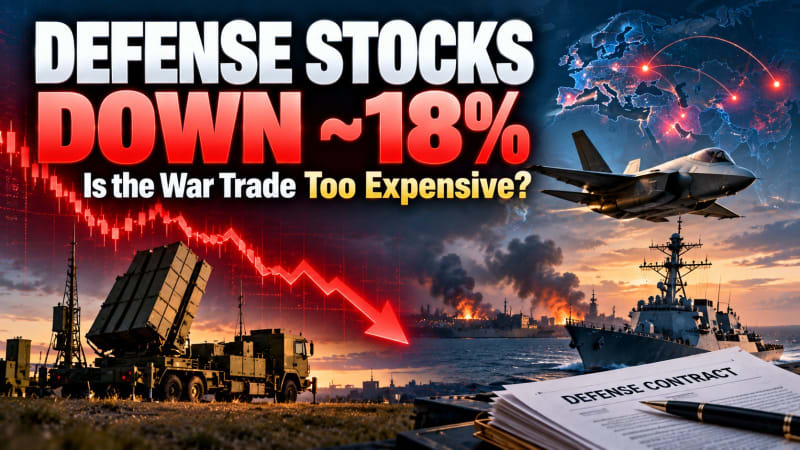
Why Are Defense Stocks Falling Despite Rising Global Military Spending?
Geopolitics & Trade · Oct 5, 2026 · 12 min read
Global military spending is rising. Weapons inventories are being rebuilt. Major defense contractors are receiving some of the largest multiyear orders in years. Yet U.S. defense stocks have been falling. The iShares U.S. Aerospace & Defense ETF has declined by as much as 18.2% from its August 14 record high and has posted seven consecutive weekly losses, its longest such…
Read more...