
China Exports Surge 36.3%, PPI Hits 5%: Stock Winners & Losers
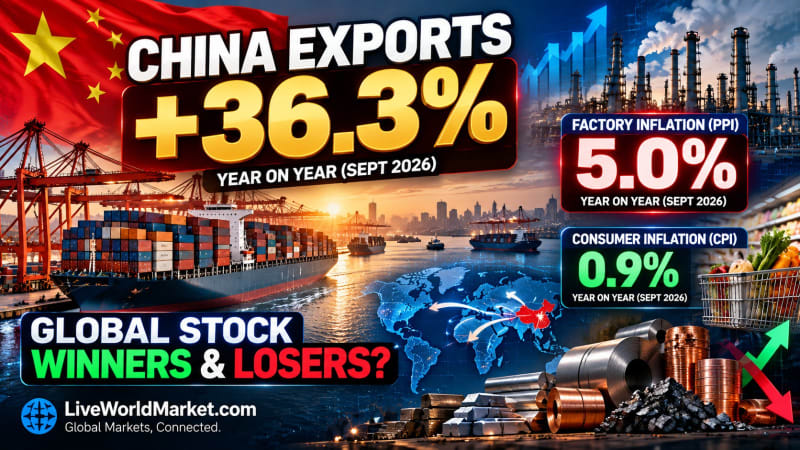
China's Exports Surge 36.3% as Factory Inflation Hits 5%: Which Global Stocks Could Win or Lose?
China's factories are shipping more goods overseas than expected, but a sharp rise in producer prices is raising a new question about the profitability of the world's manufacturing powerhouse.
Official data released on October 14 showed that China's exports surged 36.3% year-on-year in September 2026, significantly exceeding economists' forecasts of 25.5%.
Imports also increased 31%, beating expectations of 24.5%.
At the same time, China's producer price index (PPI) climbed 5% from a year earlier, while consumer price inflation remained subdued at 0.9%.
Together, these figures reveal a striking divergence: China's industrial and export sectors are expanding rapidly, but domestic consumer demand remains relatively weak.
For global stock markets, the important question is not simply whether China's economy is growing.
It is which companies can convert stronger trade activity into higher profits while managing rising energy and raw-material costs.
The answer could differ substantially across Chinese exporters, commodity producers, European industrial companies, Asian manufacturers and Indian businesses.
China's September 2026 Economic Data: What Changed?
China's latest trade and inflation releases delivered stronger-than-expected industrial activity alongside continuing weakness in household demand.

Sources: China's customs authority and National Bureau of Statistics, as reported by Reuters on October 14, 2026.
Exports expanded at their fastest annual pace since February 2026.
China's trade surplus reached approximately $133.5 billion in September, taking the cumulative surplus for January–September to around $938 billion.
The scale of the surplus highlights China's continued reliance on overseas markets to support industrial growth.
However, strong export revenue does not automatically guarantee stronger profits for every manufacturer.
Why Are China's Exports Growing So Quickly?
Several forces are supporting China's export performance.
1. Global Demand for Technology Products
Demand for semiconductors, electronics and equipment connected to AI infrastructure has supported Asian manufacturing activity.
China participates in multiple parts of the global technology supply chain, from electronic components to industrial equipment and finished products.
As international investment in digital infrastructure continues, export-oriented manufacturers can benefit from stronger orders.
Related: Explore U.S. technology stocks and market trends.
2. Strong Overseas Demand for Manufactured Goods
China remains a major supplier of machinery, vehicles, electronics, chemicals and consumer products.
Its extensive industrial supply chains, manufacturing capacity and logistics infrastructure provide competitive advantages in international trade.
3. Trade Policy and Shipment Timing
Exporters may accelerate shipments ahead of anticipated trade restrictions, tariffs or regulatory changes.
This can temporarily boost reported export growth without necessarily indicating that underlying demand will remain equally strong.
4. Currency Competitiveness
Exchange-rate movements can influence the competitiveness of Chinese exports.
However, currency depreciation also raises the local-currency cost of some imported commodities and components.
Therefore, the net impact varies by industry.
The Bigger Surprise: China's Factory Inflation Reaches 5%
China's producer price index increased 5% year-on-year in September, up from 3.8% in August.
This marked the fastest annual increase since June 2022.
The acceleration was associated with higher oil and commodity prices, including increases in fuel processing, chemicals and non-ferrous metals.
Producer price inflation measures changes in prices received by domestic producers for their output.
It is not identical to input-cost inflation.
That distinction matters.
Higher producer prices can benefit companies that successfully charge more for their products.
But businesses purchasing expensive energy and raw materials may experience margin pressure if they cannot pass those costs on to customers.
A rising PPI can therefore create winners and losers within the same manufacturing economy.
Why Is Consumer Inflation Still Below 1%?
China's consumer price index rose only 0.9% year-on-year in September.
Core inflation, excluding food and energy, was approximately 1%.
These readings suggest that consumer demand remains relatively subdued despite stronger industrial activity.
Several factors may contribute to the divergence, including cautious household spending, property-market weakness and limited pricing power among consumer-facing businesses.
The result is an uneven economic recovery.
Export-oriented manufacturers may benefit from international demand while domestic retailers and consumer brands continue facing a more challenging environment.
For investors, this means strong national export growth should not be interpreted as evidence that every part of China's economy is recovering at the same pace.
The Critical Investment Question: Can Higher Export Revenue Offset Rising Costs?
Consider two manufacturers.
Company A sells industrial equipment overseas and can increase its selling prices when input costs rise.
Company B manufactures low-margin consumer goods under contracts that limit its ability to raise prices.
Both may experience stronger export demand.
But Company A could maintain or improve its margins, while Company B could see profitability weaken.
The difference is pricing power.
How Rising Costs Affect Profitability
Stronger export demand → Higher sales volumes → Potential revenue growth
But simultaneously:
Higher oil and raw-material prices → Increased production costs → Margin pressure if selling prices cannot adjust
The outcome depends on whether revenue growth and pricing improvements exceed cost increases.
That is why investors should focus on company-level margins rather than export growth alone.
Which Global Stock Market Sectors Could Benefit?
1. Commodity Producers
Higher industrial activity and commodity prices can support revenue for selected metals, mining and energy companies.
Potential beneficiaries include producers of copper, aluminum and other industrial materials.
However, their profitability also depends on production costs, taxes and supply conditions.
Investors should monitor realized selling prices, production volumes and operating margins.
2. Industrial Machinery and Equipment
Manufacturers supplying factories, automation systems, electrical equipment and logistics infrastructure could benefit from sustained industrial investment.
However, higher material and energy costs may offset some of those gains.
Companies with strong order books and pricing power may be better positioned.
3. Shipping and Logistics
Higher export volumes can increase demand for container shipping, ports and freight services.
But shipping profitability depends on freight rates, available vessel capacity, fuel costs and trade routes.
Rising shipment volumes alone do not guarantee higher earnings.
4. Technology Supply-Chain Companies
Global demand for AI infrastructure, electronics and industrial technology could continue supporting manufacturers across Asia.
Yet technology businesses remain exposed to competitive pricing, trade restrictions and capital expenditure cycles.
Investors should distinguish between strong end-market demand and sustainable company-level returns.
Related: Track global equity-market developments.
Which Sectors Could Face Pressure?
1. Consumer Goods Manufacturers
Companies with limited pricing power may struggle if production costs rise faster than selling prices.
This is particularly relevant for highly competitive, low-margin product categories.
2. Energy-Intensive Industries
Businesses dependent on fuel, chemicals and electricity may experience higher operating costs.
Examples include certain manufacturing, transportation and processing industries.
3. European Manufacturers Competing With Chinese Exports
European companies producing vehicles, machinery, chemicals and industrial goods may face additional competitive pressure from Chinese manufacturers.
The impact depends on product quality, market positioning, tariffs and customer relationships.
Not all European industrial companies will be affected equally.
4. Chinese Consumer-Facing Companies
Weak domestic consumption can limit pricing power for retailers, restaurants and consumer brands.
The export boom does not necessarily resolve the challenges facing household-oriented businesses.
Global Sector Impact: Potential Winners and Losers

These are potential economic effects, not forecasts of stock-price performance.
What Does This Mean for U.S. Stocks?
The United States is an important destination for global manufactured goods and a major source of demand for AI-related infrastructure.
Strong Chinese exports may signal resilient global demand for technology and industrial products.
However, U.S. investors should consider several opposing effects.
Cheaper or more abundant imported products can reduce costs for some American businesses.
At the same time, stronger Chinese manufacturing competition can challenge domestic producers.
Trade restrictions and tariffs can alter these relationships.
Companies sourcing components internationally may also face uncertainty over supply-chain costs.
For U.S. technology stocks, the key issue is whether demand for hardware and computing infrastructure continues translating into sustainable earnings growth.
The broader market also remains sensitive to U.S. inflation and Treasury yields.
Higher global energy costs can influence inflation expectations and potentially affect equity valuations.
Related: LiveWorldMarket U.S. Stock Market Dashboard.
Why European Stocks Should Pay Attention
Europe has extensive economic relationships with China through industrial exports, automotive manufacturing, luxury goods and global supply chains.
A stronger Chinese manufacturing sector could support demand for certain European capital goods and specialized equipment.
But rising Chinese exports could also intensify competition for European manufacturers.
Automobiles
Chinese vehicle exports can increase competitive pressure on European automakers, particularly in price-sensitive markets.
Tariffs, regulatory decisions and product differentiation will influence the outcome.
Industrial Equipment
European machinery companies may benefit if Chinese manufacturers continue investing in production capacity.
However, they must also manage competition and trade-policy uncertainty.
Luxury Goods
Weak Chinese consumer inflation and subdued household demand are less encouraging for businesses dependent on discretionary spending.
Strong Chinese exports do not necessarily imply a recovery in luxury consumption.
For European investors, the distinction between China's industrial economy and its household economy is especially important.
What Does China's Export Boom Mean for India?
India could experience both opportunities and challenges.
Opportunity: Global Supply-Chain Diversification
International companies may continue diversifying manufacturing and sourcing across multiple countries.
Indian engineering, electronics and industrial businesses could benefit from investment and supplier-development opportunities.
However, diversification depends on infrastructure, costs, quality and execution.
Challenge: Competitive Chinese Exports
Stronger Chinese exports may increase competition for Indian manufacturers in selected sectors.
Businesses producing chemicals, textiles, electronics and industrial goods may face pricing pressure depending on the markets they serve.
Commodity Cost Pressure
Higher oil and raw-material prices can raise costs for Indian manufacturers.
Companies with strong pricing power may manage these increases more effectively.
Potential Benefit From Industrial Demand
Indian commodity and engineering companies could benefit indirectly from stronger regional manufacturing activity.
The outcome depends on their product exposure and customer relationships.
Related: LiveWorldMarket India Stock Market Dashboard.
China's Export Strength Creates a New Global Trade Risk
China's large trade surplus could increase political pressure from major trading partners.
Governments may respond through tariffs, investigations, import restrictions or negotiations.
For investors, trade policy creates uncertainty around future demand, supply-chain arrangements and profitability.
A company benefiting from strong exports today could face additional restrictions tomorrow.
That makes the geographic composition of revenue increasingly important.
Businesses with diversified customers and production locations may be better positioned to manage sudden policy changes.
Three Scenarios for Global Markets
Scenario 1: Strong Exports, Moderating Commodity Prices
This would be relatively supportive for manufacturers.
Revenue growth could remain healthy while cost pressures ease.
Export-oriented industrial companies with competitive advantages may benefit.
Scenario 2: Strong Exports, Persistently High Factory Inflation
Industrial activity could remain robust, but profitability would depend heavily on pricing power.
Commodity producers may benefit while cost-sensitive manufacturers face pressure.
Sector differentiation would become more important.
Scenario 3: Export Growth Slows While Costs Remain Elevated
This would be a more difficult combination.
Manufacturers could face weaker orders alongside high operating costs.
Margin pressure, inventory accumulation and reduced investment could become greater concerns.
The likelihood of each scenario will depend on global demand, commodity prices, trade policy and China's domestic economic conditions.
Five Indicators Investors Should Monitor Next
1. China's Export Orders
Do overseas orders remain strong after September's unusually rapid growth?
2. Producer Price Inflation
Does PPI remain elevated, or do commodity-price pressures begin to ease?
3. Consumer Spending
Does stronger industrial activity eventually translate into better employment, income and household demand?
4. Corporate Profit Margins
Are manufacturers successfully passing through higher costs, or are margins weakening?
5. Trade Restrictions
Do the United States, European Union or other trading partners introduce measures affecting Chinese exports?
These indicators will help determine whether China's current export momentum can support sustainable corporate earnings.
LiveWorldMarket View: China's Export Boom Is Not a Universal Profit Boom
China's September data confirms that its export sector remains a powerful engine of economic activity.
Exports rising 36.3% and imports increasing 31% demonstrate substantial international trade momentum.
But factory-gate inflation of 5%, combined with consumer inflation of only 0.9%, reveals a more complicated economic picture.
China's industrial economy is benefiting from strong external demand, while domestic household spending remains relatively subdued.
For investors, this creates opportunities and risks across multiple markets.
Commodity producers may benefit from higher prices.
Export-oriented manufacturers may benefit from stronger orders.
Shipping companies may experience greater trade activity.
But consumer-facing businesses, energy-intensive manufacturers and companies facing stronger Chinese competition may encounter challenges.
The key takeaway: China's export boom may support global industrial activity, but the biggest stock-market winners will be companies that can convert higher demand into sustainable profits—not simply those reporting stronger sales.
For more global market analysis, visit LiveWorldMarket.com and explore our latest Market Insights.
Sources and further reading
- Reuters — China's exports surge 36.3% in September, imports rise 31%
- Reuters — China's factory-gate inflation accelerates as commodity costs rise
- Associated Press — China's trade surplus reaches $938 billion in January–September
- National Bureau of Statistics of China
- General Administration of Customs of China
Disclaimer: This article is for educational and informational purposes only and does not constitute investment advice. Economic figures reflect information reported on October 14, 2026. Sector implications are analytical scenarios, not predictions of individual stock performance.
Comments (0)
Be the first to comment.
About the author

NISM-Series-X-A Investment Adviser Level 1 examination completed
Amit writes about Indian equity markets, technical analysis, macro themes and the day-to-day mechanics of trading, with a focus on making the flow of global markets legible for retail investors. He has completed the NISM-Series-X-A Investment Adviser Level 1 examination.
You May Also Like
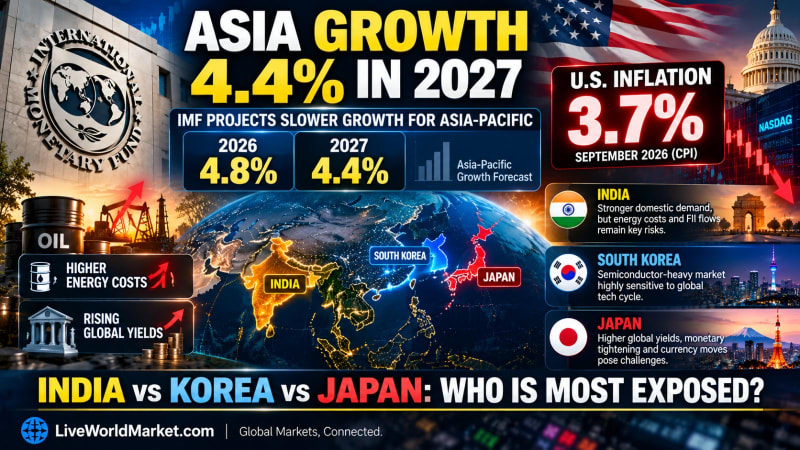
IMF Asia Growth 4.4%, US CPI 3.7%: Which Stocks Are at Risk?
News · Oct 15, 2026 · 12 min read
IMF Sees Asia Growth Slowing to 4.4% as U.S. Inflation Hits 3.7%: Which Stock Markets Are Most Vulnerable? Asia's stock markets are facing a critical test as two major economic developments collide: the International Monetary Fund's warning about slower regional growth and an unexpected rise in U.S. inflation. The IMF's October Asia-Pacific outlook projects regional economic…
Read more...
CXMT DRAM Breakthrough: Samsung, SK Hynix & Micron at Risk?
Technology & Sectors · Oct 13, 2026 · 11 min read
China's CXMT DRAM Breakthrough: Could a Memory Price War Threaten Samsung, SK Hynix and Micron? The global semiconductor industry is confronting a new question: Could China's progress in memory-chip technology eventually undermine the pricing power of the world's largest DRAM manufacturers? Chinese chipmaker ChangXin Memory Technologies (CXMT) has reportedly made progress in a…
Read more...
RBI Dollar Window: Can Rupee Near ₹97 Survive $100 Oil?
Central Banks & Rates · Oct 12, 2026 · 9 min read
RBI Opens Special Dollar Window as Rupee Nears ₹97: Can India Protect Its Stock Market From $100 Oil? India's central bank has introduced a new defense against rupee weakness at a time when crude oil prices remain above $100 per barrel. The Reserve Bank of India (RBI) has announced a special dollar facility for three government-owned oil marketing companies, beginning October…
Read more...
Firmus $5B IPO Cancelled: AI Data Center Valuations at Risk
Technology & Sectors · Oct 11, 2026 · 9 min read
Nvidia-Backed Firmus Cancels $5 Billion IPO: Is Wall Street Finally Questioning AI Data Center Valuations? The global artificial intelligence investment boom has encountered a revealing reality check. Firmus Technologies, an Australian AI data center developer backed by Nvidia, has withdrawn its planned multibillion-dollar stock market listing after struggling to attract…
Read more...
Starlink $8B Spectrum Deal: Telecom Stocks Fall, Towers Rise
Technology & Sectors · Oct 10, 2026 · 10 min read
Starlink's $8 Billion Spectrum Deal: Why Telecom Stocks Fell While Tower Shares Surged A single spectrum deal has sent shockwaves through the global telecommunications industry. On October 8, SpaceX announced an agreement to acquire nationwide 800 MHz wireless spectrum from Grain Management, marking a significant step toward expanding its Starlink Mobile business. The…
Read more...
Two-Thirds of S&P 500 Stocks Rose—Why Did the Index Fall? AI Warning
Technology & Sectors · Oct 9, 2026 · 11 min read
The AI Boom Is Turning Into a $100 Billion Debt Race: Could Borrowing Costs Become the Next Risk for Tech Stocks? For the past three years, artificial intelligence has been one of the biggest forces driving global stock markets. From Nvidia's extraordinary rise to the massive expansion of AI data centres, investors have rewarded companies promising to build the infrastructure…
Read more...
AI Debt Boom 2026: Could Borrowing Costs Hit Tech Stocks?
News · Oct 8, 2026 · 11 min read
The AI Boom Is Turning Into a $100 Billion Debt Race: Could Borrowing Costs Become the Next Risk for Tech Stocks? For the past three years, artificial intelligence has been one of the biggest forces driving global stock markets. From Nvidia's extraordinary rise to the massive expansion of AI data centres, investors have rewarded companies promising to build the infrastructure…
Read more...
$100 Oil Is Back: Which Stock Markets and Sectors Are Most Exposed?
Commodities & Energy · Oct 7, 2026 · 12 min read
The $100 Oil Test Has Arrived: Which Global Stock Markets and Sectors Are Most Exposed If Crude Stays Above Triple Digits? Oil above $100 is no longer a hypothetical risk for global markets. Brent crude traded above $101 a barrel on October 7, while U.S. West Texas Intermediate hovered near $90 as investors confronted a combination of Middle East supply risks, attacks on…
Read more...
Stocks Hit Record Highs While Bond Yields Flash a Warning: Which Market Is Right?
Global Markets & Economy · Oct 6, 2026 · 9 min read
Stocks Are Hitting Records While Bonds Flash a Warning: Which Market Is Right? Something unusual is happening across global financial markets. Stocks are celebrating. Bonds are warning. On October 6, global equities climbed to their highest level in roughly two weeks. The S&P 500 reached another record, while the technology-heavy Nasdaq extended its run of all-time highs. The…
Read more...
France Bond Spread Hits 2011-Era Extreme: Is Europe’s Debt Risk Returning?
Global Markets & Economy · Oct 6, 2026 · 9 min read
France’s Bond Spread Just Hit a 2011-Era Extreme: Is Europe Quietly Re-Entering a Sovereign-Debt Risk Trade? For much of 2026, investors have been focused on the Federal Reserve, oil, inflation and the extraordinary resilience of AI-driven equity markets. But another risk is quietly emerging in Europe. The gap between France’s 10-year government bond yield and Germany’s…
Read more...