
What Is an Index Fund? A Beginner's Guide to Smart Long-Term Investing
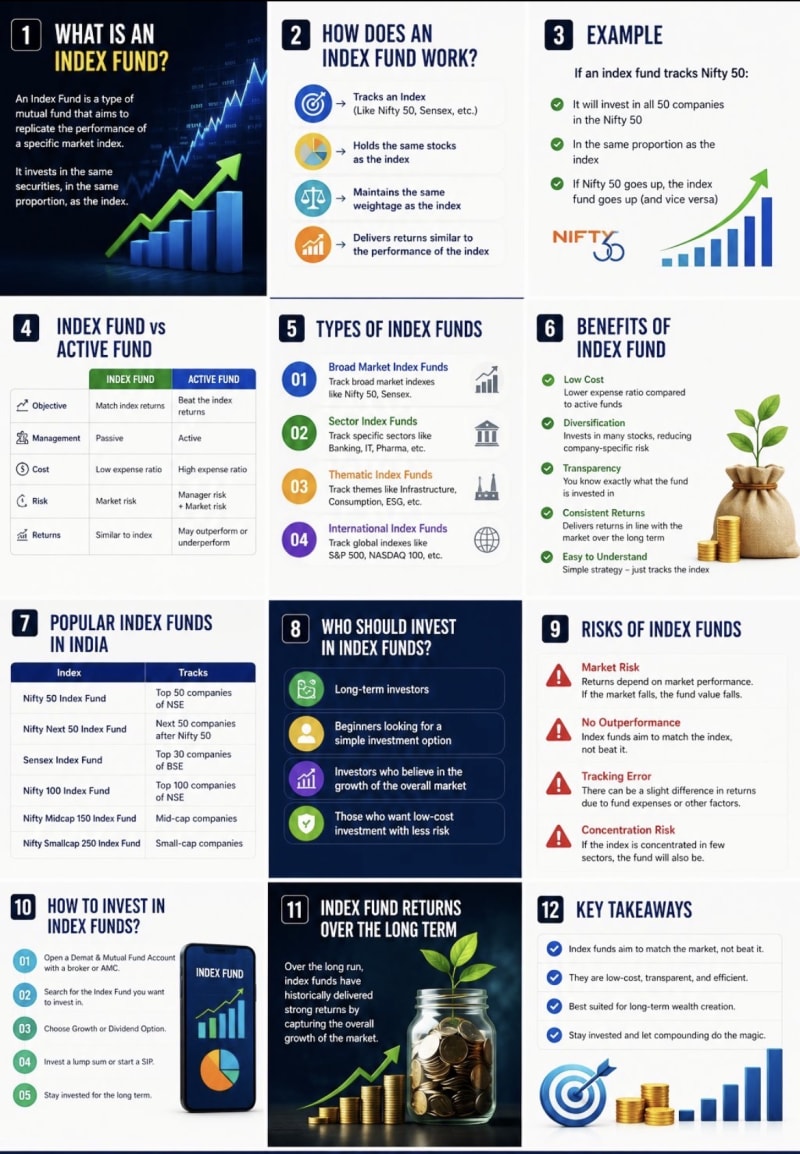
For many people, investing in the stock market feels complicated. With thousands of stocks to choose from, selecting the right companies can be overwhelming. This is whereIndex Funds offer a simple and effective solution.
Instead of trying to beat the market by picking individual stocks, index funds aim tomatch the performance of a market index. They have become one of the most popular investment choices worldwide because of their low cost, transparency, and long-term wealth creation potential.
Whether you're a first-time investor or someone planning for retirement, understanding index funds can help you make better investment decisions.

What Is an Index Fund?
AnIndex Fund is a type of mutual fund or Exchange Traded Fund (ETF) that tracks the performance of a specific stock market index.
Rather than relying on a fund manager to select stocks, an index fund simply invests in the same companies that make up the chosen index and in the same proportion.
For example, if an index fund tracks theNifty 50, it invests in all 50 companies included in the Nifty 50 index using approximately the same weightage as the index itself.
As the index rises or falls, the value of the fund generally moves in the same direction.
How Does an Index Fund Work?
An index fund follows a simple investment strategy.
- It tracks a market index such as the Nifty 50 or Sensex.
- It buys the same stocks that are part of the index.
- It maintains nearly the same allocation as the index.
- When the index changes, the fund automatically adjusts its portfolio.
- The objective is to closely match the index's performance rather than outperform it.
Since there is very little buying and selling based on market opinions, the operating costs remain much lower than actively managed mutual funds.
Example
Suppose you invest in aNifty 50 Index Fund.
Your money is automatically invested across India's 50 largest listed companies, including sectors such as banking, IT, automobiles, FMCG, pharmaceuticals and energy.
If the Nifty 50 gains12% during the year, the index fund is also expected to deliver a return close to that level (after deducting expenses).
Similarly, if the index falls by8%, the fund value is also likely to decline by a similar percentage.
Index Fund vs Active Mutual Fund

Types of Index Funds
Different index funds track different parts of the market.
Broad Market Index Funds
These track major market indices like:
- Nifty 50
- Sensex
- Nifty 100
Suitable for most long-term investors.
Sector Index Funds
These invest only in one industry such as:
- Banking
- Information Technology
- Pharma
- Auto
- Energy
Sector funds carry higher risk because they depend on one industry.
Thematic Index Funds
These focus on a specific investment theme such as:
- Infrastructure
- Consumption
- ESG
- Digital Economy
International Index Funds
These invest in global indices like:
- S&P 500
- Nasdaq-100
- MSCI World
They provide international diversification.
Benefits of Investing in Index Funds
Low Cost
Since index funds simply follow an index, they require less research and trading.
This results in a much lower expense ratio compared to actively managed funds.
Diversification
One investment gives exposure to multiple companies across different sectors.
This reduces company-specific risk.
Transparency
Investors always know what companies the fund owns because the portfolio mirrors a publicly available index.
Consistent Market Returns
Index funds are designed to deliver returns similar to the overall market over the long term.
Easy to Understand
There is no complex investment strategy.
If the market grows over time, your investment also has the potential to grow.
Popular Index Funds in India
Some widely followed index funds include:
- Nifty 50 Index Fund
- Nifty Next 50 Index Fund
- Sensex Index Fund
- Nifty 100 Index Fund
- Nifty Midcap 150 Index Fund
- Nifty Smallcap 250 Index Fund
Investors should compare expense ratios, tracking error, fund size and historical consistency before selecting a fund.
Who Should Invest in Index Funds?
Index funds are suitable for:
- Beginners entering the stock market.
- Long-term wealth creators.
- Investors planning retirement.
- SIP investors.
- Those who prefer a simple investment strategy.
- Investors who do not have time to research individual stocks.
- People looking for lower investment costs.
Risks of Index Funds
Although index funds are considered relatively simple investments, they arenot risk-free.
Market Risk
If the stock market falls, the value of your investment will also decline.
No Outperformance
An index fund aims to match the market—not beat it.
If you're looking for returns significantly higher than the index, an index fund may not meet that objective.
Tracking Error
Small differences between the fund's return and the index return may occur due to fund expenses, cash holdings and portfolio adjustments.
Sector Concentration
Some indices may have a high allocation to a few sectors.
For example, if banking and IT dominate the index, those sectors will also have a larger influence on the fund's performance.
How to Invest in an Index Fund
Getting started is easy.
- Complete your KYC process.
- Open an account with a mutual fund platform or broker.
- Choose an index fund that matches your financial goals.
- Compare expense ratio and tracking error.
- Invest either as a lump sum or through a SIP.
- Stay invested for the long term.
Consistency is often more important than timing the market.
Why Investors Prefer Index Funds
Many experienced investors recommend index investing because it removes emotional decision-making.
Instead of worrying about buying and selling individual stocks every day, investors simply participate in the overall growth of the economy.
Historically, equity markets have rewarded patient investors over long periods. Index funds allow investors to benefit from this growth without the need to actively manage a portfolio.
Key Takeaways
- Index funds are passive investment vehicles that track a market index.
- They offer diversification, transparency and lower costs.
- Returns generally move in line with the underlying index.
- They are ideal for beginners and long-term investors.
- Regular SIP investments can help build wealth through the power of compounding.
- While index funds reduce company-specific risk, they are still exposed to overall market fluctuations.
For investors seeking a simple, disciplined and cost-effective way to participate in the stock market, index funds remain one of the best long-term investment options.
Conclusion
Index funds have transformed investing by making it easier for anyone to own a diversified portfolio with minimal effort. They eliminate the need to constantly monitor individual stocks and allow investors to benefit from the long-term growth of the economy.
If your goal is to build wealth steadily over time rather than chase short-term market movements, an index fund can be an excellent addition to your investment portfolio. Start early, invest regularly through SIPs, and remain invested through market ups and downs to maximize the benefits of compounding.
Disclaimer: This article is for educational and informational purposes only and should not be considered investment advice. Mutual fund investments are subject to market risks. Read all scheme-related documents carefully before investing.
Comments (0)
Be the first to comment.
About the author

NISM-Series-X-A Investment Adviser Level 1 examination completed
Amit writes about Indian equity markets, technical analysis, macro themes and the day-to-day mechanics of trading, with a focus on making the flow of global markets legible for retail investors. He has completed the NISM-Series-X-A Investment Adviser Level 1 examination.
You May Also Like

US Midterm Elections 2026: Impact on Stocks, Dollar & India
Global Markets & Economy · Nov 4, 2026 · 10 min read
US Midterm Elections 2026: Why Treasury Yields, the Dollar and Indian Stocks Could React More Than Wall Street Key Takeaway: Democrats have won control of both chambers of the US Congress in the 2026 midterm elections, creating a divided government under President Donald Trump. The immediate market reaction has been revealing: US Treasury yields declined, the dollar weakened…
Read more...
Apple Overtakes Nvidia: Is Lower AI Spending Winning?
Technology & Sectors · Nov 2, 2026 · 9 min read
Apple Overtakes Nvidia as World's Most Valuable Company Ahead of Earnings: Is Spending Less on AI Becoming Wall Street's Winning Strategy? Key takeaway: Apple has reclaimed the title of the world's most valuable publicly traded company, overtaking Nvidia as investors reassess the enormous cost of artificial intelligence infrastructure. With Apple's upcoming earnings in focus…
Read more...
ExxonMobil Refining Profits Surge: Impact on Indian Oil Stocks
Commodities & Energy · Nov 1, 2026 · 8 min read
ExxonMobil's Refining Profits Overtake Oil Drilling for First Time in 6 Years: Why India's Oil Stocks May Miss the Windfall Key Takeaway: ExxonMobil's refining business has emerged as a bigger earnings contributor than oil production, highlighting an extraordinary shift in global energy markets. But Indian oil companies such as IOC, BPCL and HPCL face a different challenge…
Read more...
Fed Decision and Microsoft–Google Earnings: Two Critical Tests for the AI Stock Market Rally
Global Markets & Economy · Oct 28, 2026 · 15 min read
Global stock markets are approaching one of the most important financial evenings of October 2026. The U.S. Federal Reserve is preparing to announce its latest interest-rate decision, while Microsoft and Alphabet, Google's parent company, are scheduled to publish quarterly earnings after Wall Street closes. These developments arrive as investors reassess the sustainability of…
Read more...
JetBlue Stock Surges 20%, Bond Yield Tops 30%: Warning?
Global Markets & Economy · Oct 28, 2026 · 16 min read
JetBlue Stock Surges 20% While Its Bonds Yield Over 30%: Is Airline Debt Flashing a Warning for Investors? Something unusual is happening in the U.S. airline industry. Shares of JetBlue Airways surged approximately 20% on October 27, after the airline raised its revenue outlook and attempted to reassure investors about its financial position. But an entirely different story…
Read more...
US Consumer Staples Rally 9.6%: FMCG Valuation Risk for India
Global Markets & Economy · Oct 25, 2026 · 16 min read
US Consumer Staples Surge 9.6% as Valuations Overtake Tech: Is the Safe-Stock Trade Becoming a Trap for Indian FMCG Investors? Something unexpected is happening on Wall Street. As investors become increasingly cautious about expensive artificial intelligence stocks, money has been moving into an unlikely market leader: consumer staples. The U.S. consumer-staples sector has…
Read more...
SpaceX 80,000 Cell Sites: Will Starlink Challenge Jio & Airtel?
Global Markets & Economy · Oct 24, 2026 · 17 min read
SpaceX's 80,000 Cell-Site Plan Sends US Telecom Stocks Down 8%: Could Starlink Disrupt Jio and Airtel Next? A major shift may be emerging in the global telecommunications industry—and Wall Street has already started reacting. Shares of American telecommunications giants AT&T and T-Mobile plunged nearly 8% on October 23 after reports revealed that Elon Musk's SpaceX was…
Read more...
US 10-Year Treasury Yield Below 5%: Growth Shock Warning?
Central Banks & Rates · Oct 23, 2026 · 17 min read
US 10-Year Treasury Yield Falls Below 5% Despite $114 Oil: Is the Bond Market Warning of a Global Growth Shock? Something unusual is happening across global financial markets. The yield on the benchmark U.S. 10-year Treasury has fallen sharply below the psychologically important 5% level, even as Brent crude oil has surged toward $114 per barrel and technology stocks have…
Read more...
Brent Crude Tops $110: Impact on Indian Stocks & Earnings
Global Markets & Economy · Oct 22, 2026 · 14 min read
Brent Crude Tops $110: Why Indian Airlines, Paints and Tyre Stocks Face a Hidden Earnings Risk Brent crude oil has climbed above $110 per barrel, intensifying concerns that rising global energy prices could squeeze corporate profit margins, increase India's import costs and create further volatility in domestic equities. On October 22, Brent futures traded above $111 after…
Read more...
India Optical Fibre Exports Jump 158%: AI's Hidden Winners
Global Markets & Economy · Oct 21, 2026 · 12 min read
India's Optical Fibre Exports Jump 158% as Japan's Chip Shipments Surge 49%: The Hidden Winners of the AI Infrastructure Boom Artificial intelligence may be transforming the technology industry, but some of its most important economic beneficiaries are not necessarily the companies developing AI models. They may be the businesses manufacturing the physical infrastructure that…
Read more...