
India's Largest Trade Deficit Partners in FY 2025-26: What It Means for the Economy
India is one of the world's fastest-growing economies and a major player in global trade. Every year, the country imports billions of dollars' worth of goods such as crude oil, electronics, machinery, gold, and industrial raw materials while exporting products like pharmaceuticals, software services, engineering goods, textiles, and agricultural products.
However, when the value of imports from a country exceeds the value of exports to that country, it results in a trade deficit.
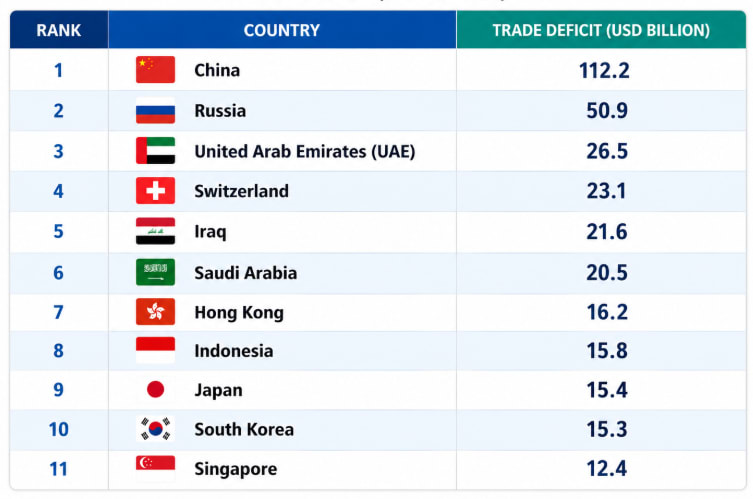
According to data from the Ministry of Commerce & Industry, China remains India's largest trade deficit partner during-FY 2025-26, followed by Russia, the UAE, Switzerland, Iraq, Saudi Arabia, Hong Kong, Indonesia, Japan, South Korea, and Singapore.
India's Top Trade Deficit Partners (FY 2025-26)
Country Trade Deficit (USD Billion)

Source: Ministry of Commerce & Industry
What is a Trade Deficit?
A trade deficit occurs when a country imports more goods and services than it exports to another country.
Simple Example
Imagine India imports:
- Electronics worth $120 billion from China
But exports:
- Pharmaceuticals, chemicals, and engineering goods worth $8 billion
The difference ($112 billion) becomes India's trade deficit with China.
A trade deficit is not always a negative sign. Fast-growing economies often import more machinery, energy, and technology to support industrial growth. However, a large and persistent deficit can increase dependence on foreign countries and put pressure on the economy.
Why Does India Have Such a Large Trade Deficit with China?
China has remained India's biggest trading partner for manufactured goods.
India imports:
- Mobile phones and components
- Consumer electronics
- Electrical equipment
- Industrial machinery
- Solar panels
- Chemicals
- Active pharmaceutical ingredients (APIs)
Although India's exports to China include iron ore, chemicals, marine products, and agricultural goods, they are much smaller than imports, resulting in a trade deficit of over $112 billion.
Why is Russia India's Second Largest Trade Deficit Partner?
The sharp rise in imports from Russia is mainly due to:
- Crude oil
- Petroleum products
- Coal
- Fertilizers
Since 2022, India has significantly increased crude oil purchases from Russia because of attractive pricing, making Russia one of India's largest import partners.
Why Are UAE and Switzerland High on the List?
United Arab Emirates (UAE)
India imports:
- Gold
- Petroleum products
- Precious metals
- Gems
Gold imports remain one of the biggest contributors to the trade gap.
Switzerland
Most imports from Switzerland include:
- Gold bullion
- Precious metals
- Luxury watches
- High-value machinery
These imports are expensive, leading to a higher trade deficit.
Why Are Iraq and Saudi Arabia Important?
Both countries are major suppliers of:
- Crude oil
- Liquefied petroleum gas (LPG)
- Petroleum products
Since India imports nearly 85% of its crude oil requirements, energy imports naturally contribute to a higher trade deficit.
Why Does India Import So Much from East Asian Economies?
Countries such as Japan, South Korea, Singapore, Hong Kong, and Indonesia supply:
- Electronic components
- Semiconductors
- Industrial machinery
- Chemicals
- Steel
- Technology equipment
These products are essential for India's manufacturing sector and infrastructure development.
Why Does a Large Trade Deficit Matter?
A widening trade deficit can affect the economy in several ways.
Pressure on the Indian Rupee
Higher imports require more payments in foreign currencies like the U.S. dollar.
This increases demand for dollars, which can weaken the Indian Rupee.
Higher Import Bill
When imports rise significantly, businesses and the government spend more on purchasing goods from abroad.
This increases overall import costs.
Inflation Risks
If imported goods such as crude oil become more expensive, transportation, manufacturing, and logistics costs also rise.
These increased costs can eventually be passed on to consumers in the form of higher prices.
Impact on Domestic Manufacturing
Heavy dependence on imported electronics, machinery, and industrial inputs may limit the growth of domestic manufacturing unless local production capacity expands.
Is a Trade Deficit Always Bad?
Not necessarily.
A trade deficit can be healthy when imports are used to:
- Build infrastructure
- Expand manufacturing
- Increase industrial production
- Improve technology
- Support economic growth
However, if the deficit remains high for many years without a corresponding rise in exports, it can create economic challenges.
The key is maintaining a balanced and sustainable trade relationship over time.
What Can Help Reduce India's Trade Deficit?
India has been taking several steps to narrow the trade gap:
- Promoting domestic manufacturing through theMake in India initiative.
- Encouraging electronics and semiconductor production.
- Expanding Production Linked Incentive (PLI) schemes.
- Diversifying export markets.
- Increasing exports of pharmaceuticals, engineering goods, software, and services.
- Investing in renewable energy to reduce dependence on imported crude oil.
- Signing free trade agreements (FTAs) to improve market access for Indian exporters.
Key Takeaways
- China remains India's largest trade deficit partner, with a deficit exceeding$112 billion.
- Russia ranks second, mainly because of increased crude oil imports.
- Energy, electronics, machinery, gold, and industrial raw materials are the biggest contributors to India's import bill.
- A trade deficit is common for developing economies but should be monitored carefully.
- Strengthening exports and boosting domestic manufacturing are critical for improving India's long-term trade balance.
Closing View
India's trade relationships reflect the country's growing economy and its increasing demand for energy, technology, and industrial goods. While importing essential products supports economic growth, reducing excessive dependence on imports and expanding exports will remain key priorities for maintaining a healthy trade balance.
Understanding trade deficit data also helps investors identify sectors that could benefit from government policies focused on import substitution, export promotion, and domestic manufacturing.
Disclaimer: This article is for educational and informational purposes only. Trade deficit figures are based on data released by the Ministry of Commerce & Industry. They should not be interpreted as investment advice.
Comments (0)
Be the first to comment.
About the author

NISM-Series-X-A Investment Adviser Level 1 examination completed
Amit writes about Indian equity markets, technical analysis, macro themes and the day-to-day mechanics of trading, with a focus on making the flow of global markets legible for retail investors. He has completed the NISM-Series-X-A Investment Adviser Level 1 examination.
You May Also Like

US Midterm Elections 2026: Impact on Stocks, Dollar & India
Global Markets & Economy · Nov 4, 2026 · 10 min read
US Midterm Elections 2026: Why Treasury Yields, the Dollar and Indian Stocks Could React More Than Wall Street Key Takeaway: Democrats have won control of both chambers of the US Congress in the 2026 midterm elections, creating a divided government under President Donald Trump. The immediate market reaction has been revealing: US Treasury yields declined, the dollar weakened…
Read more...
Apple Overtakes Nvidia: Is Lower AI Spending Winning?
Technology & Sectors · Nov 2, 2026 · 9 min read
Apple Overtakes Nvidia as World's Most Valuable Company Ahead of Earnings: Is Spending Less on AI Becoming Wall Street's Winning Strategy? Key takeaway: Apple has reclaimed the title of the world's most valuable publicly traded company, overtaking Nvidia as investors reassess the enormous cost of artificial intelligence infrastructure. With Apple's upcoming earnings in focus…
Read more...
ExxonMobil Refining Profits Surge: Impact on Indian Oil Stocks
Commodities & Energy · Nov 1, 2026 · 8 min read
ExxonMobil's Refining Profits Overtake Oil Drilling for First Time in 6 Years: Why India's Oil Stocks May Miss the Windfall Key Takeaway: ExxonMobil's refining business has emerged as a bigger earnings contributor than oil production, highlighting an extraordinary shift in global energy markets. But Indian oil companies such as IOC, BPCL and HPCL face a different challenge…
Read more...
Fed Decision and Microsoft–Google Earnings: Two Critical Tests for the AI Stock Market Rally
Global Markets & Economy · Oct 28, 2026 · 15 min read
Global stock markets are approaching one of the most important financial evenings of October 2026. The U.S. Federal Reserve is preparing to announce its latest interest-rate decision, while Microsoft and Alphabet, Google's parent company, are scheduled to publish quarterly earnings after Wall Street closes. These developments arrive as investors reassess the sustainability of…
Read more...
JetBlue Stock Surges 20%, Bond Yield Tops 30%: Warning?
Global Markets & Economy · Oct 28, 2026 · 16 min read
JetBlue Stock Surges 20% While Its Bonds Yield Over 30%: Is Airline Debt Flashing a Warning for Investors? Something unusual is happening in the U.S. airline industry. Shares of JetBlue Airways surged approximately 20% on October 27, after the airline raised its revenue outlook and attempted to reassure investors about its financial position. But an entirely different story…
Read more...
US Consumer Staples Rally 9.6%: FMCG Valuation Risk for India
Global Markets & Economy · Oct 25, 2026 · 16 min read
US Consumer Staples Surge 9.6% as Valuations Overtake Tech: Is the Safe-Stock Trade Becoming a Trap for Indian FMCG Investors? Something unexpected is happening on Wall Street. As investors become increasingly cautious about expensive artificial intelligence stocks, money has been moving into an unlikely market leader: consumer staples. The U.S. consumer-staples sector has…
Read more...
SpaceX 80,000 Cell Sites: Will Starlink Challenge Jio & Airtel?
Global Markets & Economy · Oct 24, 2026 · 17 min read
SpaceX's 80,000 Cell-Site Plan Sends US Telecom Stocks Down 8%: Could Starlink Disrupt Jio and Airtel Next? A major shift may be emerging in the global telecommunications industry—and Wall Street has already started reacting. Shares of American telecommunications giants AT&T and T-Mobile plunged nearly 8% on October 23 after reports revealed that Elon Musk's SpaceX was…
Read more...
US 10-Year Treasury Yield Below 5%: Growth Shock Warning?
Central Banks & Rates · Oct 23, 2026 · 17 min read
US 10-Year Treasury Yield Falls Below 5% Despite $114 Oil: Is the Bond Market Warning of a Global Growth Shock? Something unusual is happening across global financial markets. The yield on the benchmark U.S. 10-year Treasury has fallen sharply below the psychologically important 5% level, even as Brent crude oil has surged toward $114 per barrel and technology stocks have…
Read more...
Brent Crude Tops $110: Impact on Indian Stocks & Earnings
Global Markets & Economy · Oct 22, 2026 · 14 min read
Brent Crude Tops $110: Why Indian Airlines, Paints and Tyre Stocks Face a Hidden Earnings Risk Brent crude oil has climbed above $110 per barrel, intensifying concerns that rising global energy prices could squeeze corporate profit margins, increase India's import costs and create further volatility in domestic equities. On October 22, Brent futures traded above $111 after…
Read more...
India Optical Fibre Exports Jump 158%: AI's Hidden Winners
Global Markets & Economy · Oct 21, 2026 · 12 min read
India's Optical Fibre Exports Jump 158% as Japan's Chip Shipments Surge 49%: The Hidden Winners of the AI Infrastructure Boom Artificial intelligence may be transforming the technology industry, but some of its most important economic beneficiaries are not necessarily the companies developing AI models. They may be the businesses manufacturing the physical infrastructure that…
Read more...