
Fed vs Bank of Japan: Could Two Rate Hikes Trigger the Next Global Market Shock?
Global financial markets are heading into an unusually important week.
Two of the world's most influential central banks—the U.S. Federal Reserve and the Bank of Japan—are preparing major monetary-policy decisions within days of each other.
Markets are currently leaning toward a 25-basis-point Federal Reserve rate increase, while the Bank of Japan is widely expected to raise its policy rate by 25 basis points to around 1.25%.
Individually, either decision would matter.
Together, they could create a much bigger question for global investors:
What happens when the world's most important central bank tightens policy at the same time that one of the world's biggest sources of cheap funding becomes more expensive?
The answer could influence the U.S. dollar, Japanese yen, Treasury yields, technology stocks, the Nikkei, emerging markets and global capital flows.
Why This Week Matters So Much
For years, investors became accustomed to very different monetary conditions in the United States and Japan.
The Federal Reserve operated with relatively high interest rates.
Japan, meanwhile, maintained exceptionally low borrowing costs.
That gap encouraged investors to borrow cheaply in yen and invest the money elsewhere—a strategy commonly known as the yen carry trade.
Now both sides of that equation are changing.
The Federal Reserve may increase rates again because inflation remains persistent, while the Bank of Japan is gradually moving away from decades of ultra-loose monetary policy.
This creates a rare environment where:
U.S. rates may rise
while simultaneously:
Japanese rates may also rise
That combination could tighten global financial conditions from two directions.
Why Is the Federal Reserve Considering Another Rate Hike?
U.S. inflation remains above the Federal Reserve's long-term target.
August consumer prices rose 0.4% month-on-month and 3.4% from a year earlier, reinforcing expectations that the Fed may need to tighten policy further.
At the same time, the U.S. labour market has remained relatively resilient.
Markets therefore face a difficult combination:
economic growth remains firm
inflation remains persistent
oil and other commodity prices have risen
That reduces the Fed's ability to quickly lower rates.
In fact, markets recently placed roughly an 85% probability on a quarter-point rate increase at the upcoming meeting.
Why Is the Bank of Japan Raising Rates?
Japan is dealing with the opposite problem from the one it faced for much of the past three decades.
For years, policymakers struggled against low inflation and weak price growth.
Now inflation pressures and a weak yen have encouraged the Bank of Japan to gradually normalise monetary policy.
Markets are nearly fully pricing a 25-basis-point increase to 1.25% at the September meeting, which would take Japanese rates to levels not seen for more than three decades.
But the immediate rate increase may not be the most important part.
Investors will be listening closely for signals about what comes next.
If the BOJ indicates that further rate increases are likely in October, December or early 2027, the market may begin pricing a faster tightening cycle.
That could have consequences far beyond Japan.
The Two-Way Global Liquidity Squeeze
The simplest way to understand the risk is through global liquidity.
A Federal Reserve rate increase makes U.S. money more expensive.
A Bank of Japan rate increase makes Japanese funding less cheap.
Put them together:
Higher Fed rates
↓
Higher global borrowing costs
and
Higher BOJ rates
↓
Less attractive yen-funded leverage
Together:
Less cheap money available globally
That is why this week's decisions could matter even to investors who do not trade currencies or bonds.
Liquidity eventually influences almost every major asset market.
The Federal Reserve Side: Why Higher Rates Pressure Stocks
When interest rates rise, investors receive higher returns from relatively low-risk assets such as U.S. Treasury securities.
The U.S. 10-year Treasury yield recently climbed as high as 4.9915%, briefly putting the closely watched 5% threshold within reach.
Readers can track major U.S. equity benchmarks such as the S&P 500 and Nasdaq Composite as markets react to changing rate expectations.
The basic competition becomes:
Treasury bond offering around 5%
versus
stock offering uncertain future returns
Investors may still prefer equities if corporate earnings are strong enough.
But the higher the risk-free return becomes, the higher the return investors may demand from stocks.
That puts particular pressure on highly valued growth shares.
Why Technology Stocks Are Especially Sensitive
Technology stocks often derive a large part of their valuation from profits expected many years into the future.
Higher interest rates increase the discount rate used to value those future earnings.
This means:
higher yields → lower present value of future profits
That is one reason the technology-heavy Nasdaq Composite can be particularly sensitive to changes in Treasury yields.
The current AI investment boom has helped technology stocks remain resilient.
But if Treasury yields move decisively above 5%, markets may become less willing to tolerate expensive valuations unless earnings growth remains exceptional.
The Bank of Japan Side: Why the Yen Matters
The Japanese yen has played a unique role in global finance.
Because Japanese interest rates remained extremely low for many years, investors could borrow yen cheaply and invest the proceeds in higher-return assets elsewhere.
This became known as the yen carry trade.
A typical trade might look like:
Borrow yen cheaply
↓
Convert yen into dollars
↓
Buy U.S. stocks, bonds or other risk assets
As long as Japanese rates remained low and the yen stayed weak or stable, the trade could be attractive.
But higher BOJ rates change that equation.
What Happens When the Yen Carry Trade Unwinds?
Suppose an investor borrowed yen to buy U.S. technology stocks.
If the BOJ raises rates and the yen strengthens sharply, the investor can face two pressures:
- The cost of financing increases.
- The yen becomes more expensive to buy back when repaying the loan.
The investor may decide to exit the position.
That process becomes:
Sell U.S. asset
↓
Sell dollars
↓
Buy yen
↓
Repay yen borrowing
If many investors do this at the same time, the yen can strengthen further.
That creates more pressure on remaining carry trades.
The result can become a self-reinforcing deleveraging cycle.
Why the Nikkei Could React Strongly
Japanese equities are directly exposed to both interest rates and the yen.
A stronger yen can reduce the value of overseas earnings for Japanese exporters.
This can influence businesses in:
- automobiles
- electronics
- industrial machinery
- technology hardware
- exporters with large overseas sales
Investors can follow the Nikkei 225 and LiveWorldMarket's Asia Stock Market Dashboard to compare Japan's reaction with other major Asian markets.
A BOJ hike does not automatically mean Japanese equities must fall.
Japanese banks, for example, can potentially benefit from a more normal interest-rate environment.
But a rapid strengthening of the yen could create pressure on export-heavy parts of the market.
Could Both Decisions Hit Global Markets at the Same Time?
This is where the situation becomes particularly interesting.
Imagine the following sequence:
Fed raises rates
↓
U.S. Treasury yields stay near or above 5%
↓
Technology valuations come under pressure
At nearly the same time:
BOJ raises rates
↓
Yen strengthens
↓
Carry trades begin to unwind
↓
Investors reduce leverage
Put the two together:
higher discount rates + lower global liquidity
This could create a more difficult environment for equities than either policy decision alone.
Why the Dollar-Yen Relationship Matters
USD/JPY may become one of the most important global-market indicators around the BOJ meeting.
If USD/JPY falls rapidly, it means the yen is strengthening against the dollar.
A gradual move may be manageable.
A sudden move could be more disruptive.
Investors can use LiveWorldMarket's Currency Converter to monitor currency relationships alongside global-market developments.
The speed of currency movements often matters more than the absolute exchange-rate level.
Markets can usually adapt to gradual changes.
Sudden changes can force leveraged traders to reposition quickly.
What Could Happen to U.S. Stocks?
The U.S. market could experience several different forces simultaneously.
Higher Fed rates can pressure valuations.
Higher Treasury yields increase competition from bonds.
A stronger yen could encourage carry-trade deleveraging.
But strong corporate earnings—particularly among AI and technology companies—could provide support.
That creates an important tug-of-war.
Strong earnings
versus
tighter liquidity
The eventual market direction may depend on which force becomes stronger.
What Could Happen to European Markets?
European markets would not be isolated.
Global institutional investors often manage portfolios across regions.
When volatility rises sharply, investors may reduce risk across multiple markets rather than selling only assets directly connected to the policy decision.
European equities can therefore react to:
- rising global bond yields
- stronger dollar movements
- reduced global liquidity
- lower risk appetite
- changing energy prices
This is why global investors should monitor markets together instead of treating central-bank decisions as purely domestic events.
What Could Happen to Emerging Markets?
Emerging markets may be especially sensitive if both U.S. and Japanese monetary conditions tighten simultaneously.
A Federal Reserve hike can strengthen the attractiveness of U.S. assets.
At the same time, a BOJ hike could reduce yen-funded investment flows.
The possible chain becomes:
Higher U.S. yields
Less cheap Japanese funding
↓
Lower appetite for global risk
↓
Potential foreign outflows from emerging markets
Currencies may also experience greater volatility.
What Could It Mean for India?
India could feel the impact through several channels.
Foreign Institutional Flows
If global investors reduce risk, FII flows into Indian equities may weaken.
U.S. Dollar
Higher U.S. rates can support the dollar, potentially creating pressure on emerging-market currencies.
Oil Prices
Higher energy prices remain an additional challenge for India because the country imports much of its crude-oil requirement.
Global Equity Sentiment
Sharp declines in Wall Street or Asian markets often influence sentiment before the Indian market opens.
Readers can monitor major global indices and futures through LiveWorldMarket's Global Indices & Futures Hub.
The important point is that India does not need a domestic economic problem to experience short-term volatility.
A global liquidity shock can affect Indian markets through foreign flows and risk sentiment even when domestic fundamentals remain relatively stable.
Oil Makes the Situation More Complicated
Central banks are not making these decisions in a calm commodity environment.
Brent crude recently surged above $100 per barrel before easing to around $104, while remaining sharply higher for the week.
Higher oil prices can contribute to inflation.
That makes it harder for central banks to lower interest rates.
The chain becomes:
Oil rises
↓
Inflation risk increases
↓
Central banks remain hawkish
↓
Bond yields stay high
↓
Global liquidity tightens
The combination of oil above $100, U.S. yields near 5% and simultaneous Fed/BOJ tightening is therefore much more significant than any one development viewed in isolation.
What Should Investors Watch During Fed Week?
Rather than focusing only on the headline interest-rate decision, several indicators deserve attention.
1. Federal Reserve Guidance
A 25-basis-point rate increase may already be partly priced into markets.
The bigger surprise could come from what policymakers say about future increases.
2. U.S. 10-Year Treasury Yield
The 5% level is likely to remain closely watched.
A sustained break above 5% could increase competition between bonds and equities.
3. Nasdaq Composite
The Nasdaq Composite may provide one of the clearest signals of how growth stocks are absorbing higher interest rates.
4. USD/JPY
A rapid strengthening of the yen could signal pressure on carry trades.
5. Nikkei 225
The Nikkei 225 will provide an important indication of how Japanese equities interpret BOJ policy.
6. Global Market Breadth
Compare the reaction across the United States, Japan, Europe and emerging markets.
LiveWorldMarket's Global Market Dashboard can be used to view major markets together.
The Fed Decision May Not Be the Biggest Surprise
Markets already expect that the Fed may raise rates.
That means the actual announcement may not necessarily produce the largest move.
Markets could react more strongly to:
- future rate guidance
- inflation projections
- comments from the Fed Chair
- changes in the expected peak rate
- the possibility of additional hikes
Financial markets move based on the difference between expectations and reality.
A rate hike everyone expects can sometimes produce a relatively small reaction.
An unexpected statement about future policy can produce a much larger one.
The Same Is True for the Bank of Japan
Markets have nearly fully priced a BOJ increase to around 1.25%.
Therefore, the bigger question is not necessarily:
Will the BOJ raise rates?
It may be:
How quickly could rates rise after September?
If policymakers signal more aggressive tightening, Japanese bond yields could rise and the yen could strengthen further.
That could increase the probability of global capital returning toward Japan.
Could Japanese Money Return Home?
Japanese investors have historically invested large amounts overseas because yields on domestic bonds were extremely low.
If Japanese government bonds begin offering more attractive returns, investors may reconsider the need to take foreign currency and market risk.
Some capital could gradually move back to Japan.
This is often called capital repatriation.
If it becomes significant, the impact could extend into:
- U.S. Treasuries
- European bonds
- global equities
- foreign currencies
This is another reason BOJ normalisation matters beyond Japan itself.
Three Possible Market Scenarios
Scenario 1: Both Central Banks Deliver What Markets Expect
The Fed raises rates modestly.
The BOJ raises rates modestly.
Both communicate gradual future policy.
Treasury yields and USD/JPY remain relatively stable.
Markets may absorb the decisions without major disruption.
This would likely be the most orderly outcome.
Scenario 2: Fed Turns More Hawkish
The Fed signals that inflation remains a serious concern and additional tightening may be needed.
Treasury yields move decisively above 5%.
Technology stocks face valuation pressure.
The dollar strengthens.
Emerging markets experience greater volatility.
Scenario 3: BOJ Surprises With Faster Tightening
The BOJ delivers the expected rate increase but signals additional hikes sooner than markets expected.
The yen strengthens sharply.
Carry trades begin unwinding.
Japanese stocks become volatile.
Global risk assets experience a broader deleveraging move.
The Most Difficult Scenario
The biggest risk could occur if both happen simultaneously:
Fed becomes more hawkish
and
BOJ signals faster tightening
That could create:
higher U.S. yields + stronger yen + reduced leverage
This combination would represent a genuine tightening of global liquidity.
Could Markets Actually Rally After Both Rate Hikes?
Yes.
Rate hikes do not automatically cause markets to fall.
Markets are forward-looking.
If the decisions match expectations and central banks signal confidence that inflation can eventually stabilise, investors may view uncertainty as reduced.
Stocks could even rally if:
- policy decisions are already priced in,
- forward guidance is less hawkish than feared,
- Treasury yields retreat,
- oil prices fall, or
- corporate earnings remain strong.
This is why trying to predict market direction based solely on "rate hike = stocks down" can be misleading.
Expectations matter.
The Bigger Global Market Story
What makes this period unusual is that several major macro forces are moving together.
Global markets are currently dealing with:
oil above $100
U.S. Treasury yields close to 5%
persistent inflation
possible Federal Reserve tightening
expected Bank of Japan tightening
a changing yen carry trade
Any one of these could influence markets.
Together, they represent a broader question:
Is the era of abundant cheap global liquidity ending?
That question could matter more to markets over the next several years than any single central-bank meeting.
Final Thoughts
The Federal Reserve and Bank of Japan represent opposite ends of the global monetary system.
For years, the U.S. offered higher interest rates while Japan provided exceptionally cheap funding.
That relationship supported global capital flows and contributed to the popularity of the yen carry trade.
Now both sides are tightening.
The potential chain is:
Fed rate hike
→ higher U.S. borrowing costs
while simultaneously:
BOJ rate hike
→ more expensive yen funding
Together:
tighter global liquidity
→ possible deleveraging
→ higher volatility across stocks, bonds and currencies
This does not mean a global market shock is inevitable.
If both decisions match expectations and policymakers communicate carefully, markets may absorb them smoothly.
But if either central bank surprises investors—particularly through future policy guidance—the impact could extend far beyond Washington or Tokyo.
For global investors, this is therefore not simply a Fed week or a BOJ week.
It is a global liquidity week.
Readers can follow the S&P 500, Nasdaq Composite, Nikkei 225, wider Asian stock markets and other major global benchmarks through LiveWorldMarket's Global Indices Dashboard.
Data note: Interest-rate probabilities, Treasury yields, currency levels and commodity prices can change rapidly before central-bank decisions. Market expectations referenced in this article reflect information available through September 12, 2026.
Disclaimer: This article is intended for general informational and educational purposes only. It does not constitute investment advice, research advice or a recommendation to buy or sell any security, currency or financial instrument. Financial markets involve risk, and readers should conduct their own research and seek appropriately qualified professional advice where necessary.
Comments (0)
Be the first to comment.
About the author

NISM-Series-X-A Investment Adviser Level 1 examination completed
Amit writes about Indian equity markets, technical analysis, macro themes and the day-to-day mechanics of trading, with a focus on making the flow of global markets legible for retail investors. He has completed the NISM-Series-X-A Investment Adviser Level 1 examination.
You May Also Like

US 10-Year Treasury Yield Below 5%: Growth Shock Warning?
Central Banks & Rates · Oct 23, 2026 · 17 min read
US 10-Year Treasury Yield Falls Below 5% Despite $114 Oil: Is the Bond Market Warning of a Global Growth Shock? Something unusual is happening across global financial markets. The yield on the benchmark U.S. 10-year Treasury has fallen sharply below the psychologically important 5% level, even as Brent crude oil has surged toward $114 per barrel and technology stocks have…
Read more...
Brent Crude Tops $110: Impact on Indian Stocks & Earnings
Global Markets & Economy · Oct 22, 2026 · 14 min read
Brent Crude Tops $110: Why Indian Airlines, Paints and Tyre Stocks Face a Hidden Earnings Risk Brent crude oil has climbed above $110 per barrel, intensifying concerns that rising global energy prices could squeeze corporate profit margins, increase India's import costs and create further volatility in domestic equities. On October 22, Brent futures traded above $111 after…
Read more...
India Optical Fibre Exports Jump 158%: AI's Hidden Winners
Global Markets & Economy · Oct 21, 2026 · 12 min read
India's Optical Fibre Exports Jump 158% as Japan's Chip Shipments Surge 49%: The Hidden Winners of the AI Infrastructure Boom Artificial intelligence may be transforming the technology industry, but some of its most important economic beneficiaries are not necessarily the companies developing AI models. They may be the businesses manufacturing the physical infrastructure that…
Read more...
Nasdaq Rises 1.1%, KOSPI Falls 3.6%: AI Stocks and India Impact
Global Markets & Economy · Oct 20, 2026 · 12 min read
Nasdaq Jumps 1.1% but KOSPI Crashes Over 3%: Why the AI Stock Rebound Is Failing in Asia—and What It Means for India Global technology stocks are sending conflicting signals. On Monday, October 19, the Nasdaq Composite gained 1.11%, recovering part of the losses suffered during the previous week's technology selloff. U.S. semiconductor stocks also rebounded, with the…
Read more...
Jio IPO 2026: $108 Billion Valuation Amid Global AI Selloff
Market Valuation & Behaviour · Oct 19, 2026 · 14 min read
Jio IPO at $108 Billion Amid Global AI Stock Selloff: Can India's Biggest IPO Defy the Tech Market Rout? India is preparing for what could become its largest-ever initial public offering at a time when global investors are reassessing technology valuations, artificial intelligence spending and the financial sustainability of digital infrastructure. Jio Platforms, the digital…
Read more...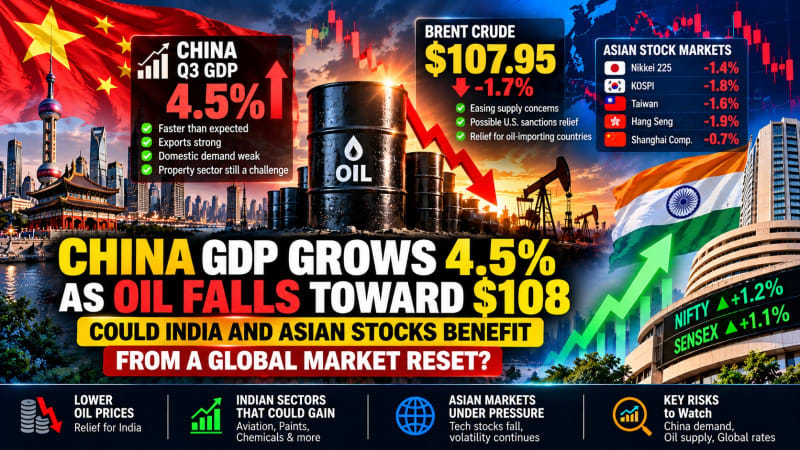
China GDP Grows 4.5% as Oil Falls: Can India Stocks Benefit?
Global Markets & Economy · Oct 19, 2026 · 12 min read
China GDP Grows 4.5% as Oil Falls Toward $108: Could India and Asian Stocks Benefit From a Global Market Reset? China's economy expanded faster than expected in the third quarter of 2026, but the latest economic data reveals a growing divide between its powerful export industries and weak domestic demand. At the same time, global crude oil prices declined toward $108 per…
Read more...
STOXX 600 Rises 2% as Nasdaq Falls 4.5%: Is Europe Taking the Lead?
Global Markets & Economy · Oct 18, 2026 · 13 min read
Europe’s STOXX 600 Gains Over 2% as Nasdaq Falls 4.5%: Is Global Stock Market Leadership Shifting? Europe's stock markets delivered their strongest week since June while U.S. technology shares suffered their worst weekly decline in months. The divergence raises a critical question for global investors: Is the market beginning to reward diversified earnings growth instead of…
Read more...
CoreWeave Bond Yields Hit 16%: AI Data Center Debt Risks
Technology & Sectors · Oct 17, 2026 · 13 min read
CoreWeave Bond Yields Hit 16%: Is AI Data-Center Debt Becoming the Next Big Risk for Global Stocks? The artificial intelligence boom has entered a new phase. Investors are no longer asking only how much money AI companies can earn. They are increasingly questioning how much it costs to finance the infrastructure supporting that growth. This week, CoreWeave, a U.S.-based AI…
Read more...
Indonesia Stocks Crash 11.57%: Will MSCI Downgrade Benefit India?
India & Global Connections · Oct 16, 2026 · 12 min read
Indonesia Stocks Plunge 11% as MSCI Proposes Downgrade: Could India and Other Emerging Markets Benefit? Indonesia's stock market has suffered its sharpest one-day decline in nearly three decades, but the bigger story extends far beyond Jakarta. A proposed MSCI downgrade could eventually force global index funds to remove Indonesian equities from their portfolios, potentially…
Read more...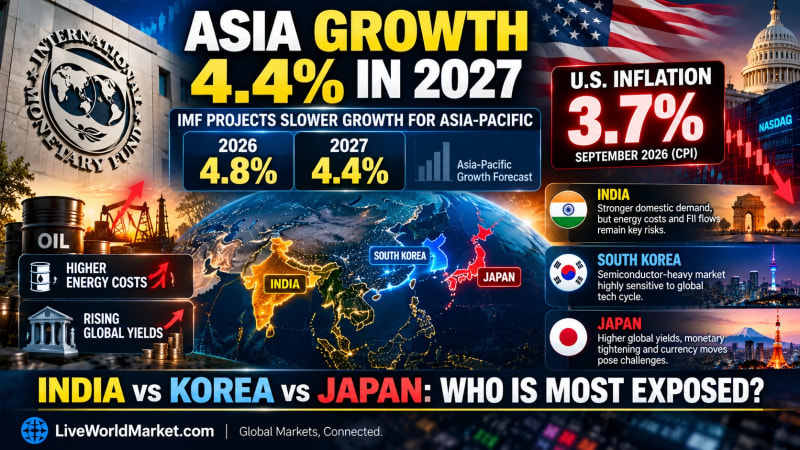
IMF Asia Growth 4.4%, US CPI 3.7%: Which Stocks Are at Risk?
News · Oct 15, 2026 · 12 min read
IMF Sees Asia Growth Slowing to 4.4% as U.S. Inflation Hits 3.7%: Which Stock Markets Are Most Vulnerable? Asia's stock markets are facing a critical test as two major economic developments collide: the International Monetary Fund's warning about slower regional growth and an unexpected rise in U.S. inflation. The IMF's October Asia-Pacific outlook projects regional economic…
Read more...