
ETF Pricing Explained: What Are NAV, iNAV & Fair Value?
Reading Time: 6 Minutes
Why Does an ETF Price Keep Changing?
Have you ever noticed that an ETF's price changes every second while the stock market is open? Yet, experts often talk about NAV, iNAV, and Fair Value as if they are different from the market price.
Understanding these three concepts can help you avoid paying more than an ETF is actually worth and make smarter investment decisions.
Let's simplify everything.
What is an ETF?
An Exchange Traded Fund (ETF) is a basket of investments such as stocks, bonds, commodities, or other securities that trades on a stock exchange just like a normal stock.
Instead of buying many individual stocks, investors can buy one ETF that provides exposure to an entire sector, index, or theme.
Example
Instead of buying all 50 companies in the Nifty 50 individually, you can simply purchase a Nifty 50 ETF.
This saves time, reduces costs, and provides instant diversification.
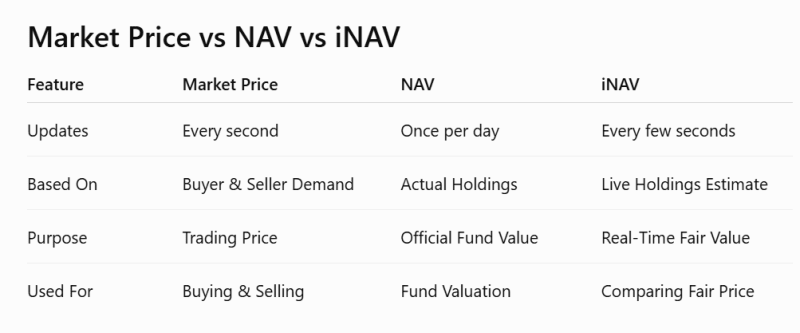
Understanding the Three Important Prices
Although you see only one trading price on your screen, an ETF actually has three different values.
1. Market Price
This is the price at which investors buy and sell ETF units on the exchange.
It changes continuously during market hours based on:
- Demand
- Supply
- Investor sentiment
- Liquidity
This is the number visible on your trading app.
2. NAV (Net Asset Value)
NAV represents the actual value of one ETF unit based on the total value of all investments held inside the fund.
It is usually calculated after the market closes each trading day.
NAV Formula
NAV = (Total Value of Assets + Income – Expenses – Liabilities) ÷ Total Outstanding ETF Units
Think of NAV as the ETF's official report card at the end of the day.
3. iNAV (Indicative NAV)
iNAV is simply a real-time estimate of the ETF's NAV.
Instead of waiting until market close, iNAV updates every few seconds using the latest prices of the securities held by the ETF.
It gives investors an estimate of what the ETF is worth right now.

Why Doesn't the Market Price Always Equal NAV?
Sometimes ETFs trade:
- Above NAV → Premium
- Below NAV → Discount
This happens because buyers and sellers determine the market price.
Fortunately, these differences are usually very small.
How ETF Prices Stay Close to NAV
The reason ETFs remain fairly priced is due to a process called Creation and Redemption.
Large financial institutions known as Authorized Participants (APs) continuously remove pricing differences.
When ETF Trades Above NAV (Premium)
If the ETF becomes expensive:
- APs buy the underlying stocks.
- They create new ETF units.
- Sell those ETF units in the market.
Result:
➡ Supply increases.
➡ ETF price falls closer to NAV.
When ETF Trades Below NAV (Discount)
If the ETF becomes cheaper:
- APs buy ETF units from the exchange.
- Redeem them for the underlying securities.
- Sell those securities.
Result:
➡ ETF supply decreases.
➡ ETF price rises toward NAV.
This mechanism keeps ETFs fairly priced most of the time.
Why Should Investors Check iNAV?
Suppose an ETF is trading at $102, but its iNAV shows the actual estimated value is only $100.
That means you're paying a 2% premium.
Similarly, if the ETF trades at $98 while iNAV is $100, you may be buying at a discount.
Checking iNAV before placing large orders can help you avoid overpaying.
Where Can You Find NAV and iNAV?
You can easily check these values on:
- AMC (Asset Management Company) websites
- Stock exchange websites
- Trading platforms
- ETF factsheets
- Financial market portals
Most exchanges update iNAV during market hours for actively traded ETFs.
Premium, Discount & Tracking Error
Premium / Discount
Shows how much the ETF's market price differs from its NAV.
Smaller differences usually indicate better pricing efficiency.
Tracking Error
Tracking Error measures how closely an ETF follows its benchmark index.
A lower tracking error generally means the ETF is performing as intended.
Simple Example
Imagine an ETF that owns stocks worth $100 per unit.

This ETF is trading very close to its actual value, which is generally a positive sign.
Now imagine:
| NAV | $100 |
| iNAV | $100 |
| Market Price | $103 |
Here, investors are paying a 3% premium.
Unless there is a valid reason, waiting for a better entry price may be wise.
Key Takeaways
✅ NAV is the official value calculated after market close.
✅ iNAV provides a real-time estimate during trading hours.
✅ Market Price is what investors actually pay on the exchange.
✅ Small premiums and discounts are normal.
✅ Comparing Market Price with iNAV helps investors make better buying decisions.
✅ ETFs stay fairly priced because of the creation and redemption mechanism.
Comments (0)
Be the first to comment.
About the author

NISM-Series-X-A Investment Adviser Level 1 examination completed
Amit writes about Indian equity markets, technical analysis, macro themes and the day-to-day mechanics of trading, with a focus on making the flow of global markets legible for retail investors. He has completed the NISM-Series-X-A Investment Adviser Level 1 examination.
You May Also Like

US Midterm Elections 2026: Impact on Stocks, Dollar & India
Global Markets & Economy · Nov 4, 2026 · 10 min read
US Midterm Elections 2026: Why Treasury Yields, the Dollar and Indian Stocks Could React More Than Wall Street Key Takeaway: Democrats have won control of both chambers of the US Congress in the 2026 midterm elections, creating a divided government under President Donald Trump. The immediate market reaction has been revealing: US Treasury yields declined, the dollar weakened…
Read more...
Apple Overtakes Nvidia: Is Lower AI Spending Winning?
Technology & Sectors · Nov 2, 2026 · 9 min read
Apple Overtakes Nvidia as World's Most Valuable Company Ahead of Earnings: Is Spending Less on AI Becoming Wall Street's Winning Strategy? Key takeaway: Apple has reclaimed the title of the world's most valuable publicly traded company, overtaking Nvidia as investors reassess the enormous cost of artificial intelligence infrastructure. With Apple's upcoming earnings in focus…
Read more...
ExxonMobil Refining Profits Surge: Impact on Indian Oil Stocks
Commodities & Energy · Nov 1, 2026 · 8 min read
ExxonMobil's Refining Profits Overtake Oil Drilling for First Time in 6 Years: Why India's Oil Stocks May Miss the Windfall Key Takeaway: ExxonMobil's refining business has emerged as a bigger earnings contributor than oil production, highlighting an extraordinary shift in global energy markets. But Indian oil companies such as IOC, BPCL and HPCL face a different challenge…
Read more...
Fed Decision and Microsoft–Google Earnings: Two Critical Tests for the AI Stock Market Rally
Global Markets & Economy · Oct 28, 2026 · 15 min read
Global stock markets are approaching one of the most important financial evenings of October 2026. The U.S. Federal Reserve is preparing to announce its latest interest-rate decision, while Microsoft and Alphabet, Google's parent company, are scheduled to publish quarterly earnings after Wall Street closes. These developments arrive as investors reassess the sustainability of…
Read more...
JetBlue Stock Surges 20%, Bond Yield Tops 30%: Warning?
Global Markets & Economy · Oct 28, 2026 · 16 min read
JetBlue Stock Surges 20% While Its Bonds Yield Over 30%: Is Airline Debt Flashing a Warning for Investors? Something unusual is happening in the U.S. airline industry. Shares of JetBlue Airways surged approximately 20% on October 27, after the airline raised its revenue outlook and attempted to reassure investors about its financial position. But an entirely different story…
Read more...
US Consumer Staples Rally 9.6%: FMCG Valuation Risk for India
Global Markets & Economy · Oct 25, 2026 · 16 min read
US Consumer Staples Surge 9.6% as Valuations Overtake Tech: Is the Safe-Stock Trade Becoming a Trap for Indian FMCG Investors? Something unexpected is happening on Wall Street. As investors become increasingly cautious about expensive artificial intelligence stocks, money has been moving into an unlikely market leader: consumer staples. The U.S. consumer-staples sector has…
Read more...
SpaceX 80,000 Cell Sites: Will Starlink Challenge Jio & Airtel?
Global Markets & Economy · Oct 24, 2026 · 17 min read
SpaceX's 80,000 Cell-Site Plan Sends US Telecom Stocks Down 8%: Could Starlink Disrupt Jio and Airtel Next? A major shift may be emerging in the global telecommunications industry—and Wall Street has already started reacting. Shares of American telecommunications giants AT&T and T-Mobile plunged nearly 8% on October 23 after reports revealed that Elon Musk's SpaceX was…
Read more...
US 10-Year Treasury Yield Below 5%: Growth Shock Warning?
Central Banks & Rates · Oct 23, 2026 · 17 min read
US 10-Year Treasury Yield Falls Below 5% Despite $114 Oil: Is the Bond Market Warning of a Global Growth Shock? Something unusual is happening across global financial markets. The yield on the benchmark U.S. 10-year Treasury has fallen sharply below the psychologically important 5% level, even as Brent crude oil has surged toward $114 per barrel and technology stocks have…
Read more...
Brent Crude Tops $110: Impact on Indian Stocks & Earnings
Global Markets & Economy · Oct 22, 2026 · 14 min read
Brent Crude Tops $110: Why Indian Airlines, Paints and Tyre Stocks Face a Hidden Earnings Risk Brent crude oil has climbed above $110 per barrel, intensifying concerns that rising global energy prices could squeeze corporate profit margins, increase India's import costs and create further volatility in domestic equities. On October 22, Brent futures traded above $111 after…
Read more...
India Optical Fibre Exports Jump 158%: AI's Hidden Winners
Global Markets & Economy · Oct 21, 2026 · 12 min read
India's Optical Fibre Exports Jump 158% as Japan's Chip Shipments Surge 49%: The Hidden Winners of the AI Infrastructure Boom Artificial intelligence may be transforming the technology industry, but some of its most important economic beneficiaries are not necessarily the companies developing AI models. They may be the businesses manufacturing the physical infrastructure that…
Read more...