
Capital Gains Tax Exemptions India 2026: Sections 82–88 Explained
Selling property, agricultural land or another capital asset can create a taxable capital gain. Indian tax law, however, provides several situations in which eligible taxpayers can reduce or defer the taxable capital gain by reinvesting the amount in specified assets within prescribed timelines.
An important change took effect on 1 April 2026.
The Income-tax Act, 2025 replaced the Income-tax Act, 1961 and introduced a simplified structure and new section numbering. As a result, familiar references such as Sections 54, 54B, 54EC and 54F of the old Act are no longer the primary statutory references for transactions governed by the new Act. The underlying reinvestment concepts have largely been retained, but they now appear mainly in Sections 82 to 88 of the Income-tax Act, 2025.
This guide explains those provisions in simple language and also shows their commonly known equivalents under the old Income-tax Act, 1961.
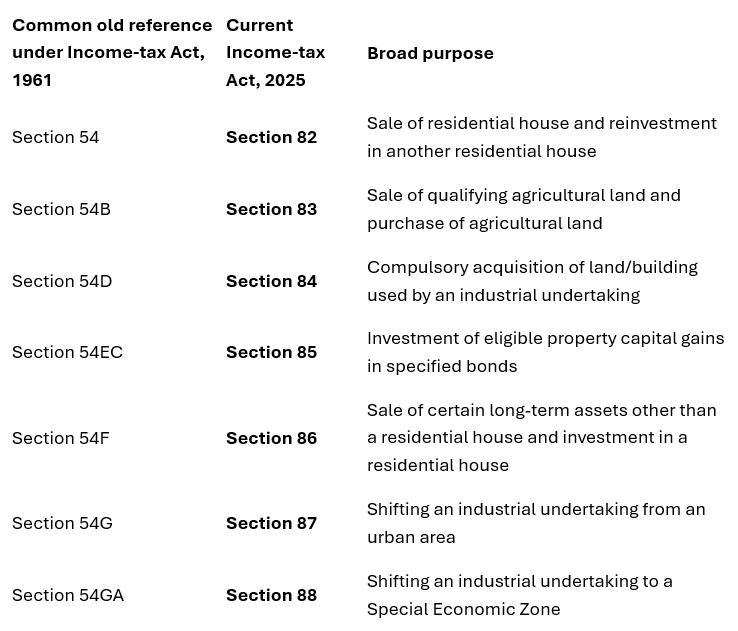
Old Sections vs New Sections

The current Act itself sets out these reliefs sequentially in Sections 82–88.
Section 82: Selling a Residential House and Buying Another House
Section 82 of the Income-tax Act, 2025 is broadly the successor to the familiar Section 54 exemption.
It applies to an individual or Hindu Undivided Family (HUF) where a long-term capital gain arises from transferring a residential house property and the taxpayer reinvests in an eligible residential house in India.
The new residential house generally has to be purchased within one year before or two years after the transfer of the original property. Alternatively, a residential house may be constructed within three years after the transfer.
The exemption is broadly linked to the lower of the eligible capital gain and the amount invested in the qualifying new residential property, subject to the detailed statutory rules.
Two-house option
Where the capital gain does not exceed ₹2 crore, the law permits an eligible taxpayer to choose investment in two residential houses in India instead of one. This option can be exercised only once under the provision.
₹10 crore ceiling
The Income-tax Act, 2025 also retains a ₹10 crore ceiling for calculating the eligible investment/capital-gain amount under this relief. Amounts above the statutory ceiling are not taken into account for the exemption calculation.
Example of Section 82
Suppose an individual sells a qualifying long-term residential property and generates a capital gain of ₹40 lakh.
If the taxpayer purchases another qualifying residential house for ₹40 lakh within the permitted period and all other conditions are satisfied, the eligible capital gain may potentially be fully covered by the exemption.
If only ₹25 lakh is eligible for reinvestment, the remaining portion may remain taxable depending on the precise facts and statutory computation.
The example is simplified and should not be treated as an individual tax calculation.
Section 83: Capital Gain From Agricultural Land
Section 83 broadly corresponds to the old Section 54B.
The relief applies to an individual or HUF where capital gain arises from transferring land that had been used for agricultural purposes by the taxpayer, the taxpayer's parent, or the HUF during the two years immediately preceding the transfer.
To qualify, another agricultural land must generally be purchased within two years after the transfer.
The exemption broadly depends on the relationship between the capital gain and the amount invested in the new agricultural land.
A particularly important point is that Section 83 can apply to qualifying capital gains on agricultural land subject to its conditions; taxpayers should not assume that every sale of agricultural land is automatically exempt.
The tax treatment also depends on whether the land itself qualifies as a capital asset under the Act.
Section 84: Compulsory Acquisition of Industrial Land or Building
Section 84 broadly replaces the old Section 54D.
This provision addresses cases where land, a building, or rights in land/building forming part of an industrial undertaking are compulsorily acquired under law.
The qualifying property must have been used for the industrial undertaking during the two years immediately preceding the transfer.
The taxpayer generally needs to acquire qualifying replacement land/building or construct another building within three years after the compulsory acquisition for purposes such as shifting, re-establishing or setting up an industrial undertaking.
This is a specialized business provision and will normally require transaction-specific professional review.
Section 85: Capital-Gains Bonds
Section 85 is the current equivalent of the well-known Section 54EC capital-gains bond exemption.
It applies where a taxpayer has eligible long-term capital gains arising from the transfer of land or a building, or both, and invests the qualifying capital gain in a specified long-term asset within the prescribed period.
Six-month investment period
The investment must generally be made within six months after the date of transfer.
₹50 lakh limit
The statute caps eligible investment at ₹50 lakh, subject to the detailed rule covering the tax year of transfer and the subsequent tax year.
Eligible specified bonds
The Act currently identifies qualifying bonds including eligible bonds issued by the National Highways Authority of India (NHAI) and Rural Electrification Corporation Limited (REC), together with any other bonds that may be notified by the Central Government.
Five-year holding requirement
The specified asset is generally redeemable after five years. If it is transferred or converted into money within the restricted period, the previously exempted amount can become taxable under the provisions of the Act. Taking a loan or advance against the security of the specified asset can also trigger the statutory consequences.
This makes Section 85 useful for eligible property sellers who do not necessarily want to reinvest their capital gain in another property.
Section 86: Selling Another Long-Term Asset and Buying a House
Section 86 broadly corresponds to the old Section 54F.
This is different from Section 82.
Section 82 deals with a capital gain arising from a residential house.
Section 86 covers an eligible long-term capital asset other than a residential house, where an individual or HUF invests in one residential house in India.
The house may generally be purchased within one year before or two years after the asset transfer, or constructed within three years after the transfer.
Why Section 86 Is Different From Section 82
Under Section 82, the exemption focuses primarily on the qualifying capital gain and eligible reinvestment.
Under Section 86, the exemption calculation considers the relationship between the investment in the new house and the net consideration received from the original asset. If the entire eligible net consideration is not invested, the exemption may be proportionately reduced.
This distinction is easy to miss and can materially affect the tax outcome.
Existing-House Restrictions Under Section 86
Section 86 contains additional ownership conditions.
The exemption may not be available where the taxpayer owns more than one other residential house on the date of transfer, subject to the wording and conditions of the provision.
Purchasing or constructing additional residential houses within specified periods can also affect the exemption.
The law therefore requires more than simply selling an asset and buying a house.
₹10 Crore Limit Under Section 86
Section 86 also contains a ₹10 crore statutory ceiling in relation to the cost of the new residential house and relevant net consideration used for the exemption computation.
Taxpayers involved in high-value transactions should pay particular attention to this limit.
Section 87: Shifting an Industrial Undertaking From an Urban Area
Section 87 broadly corresponds to old Section 54G.
It provides capital-gains relief in specified circumstances where an industrial undertaking is shifted from an urban area to another qualifying area.
Eligible reinvestment can include expenditure relating to new machinery or plant, acquiring land or buildings, constructing premises, shifting original assets and certain other notified expenditure.
The statute generally permits qualifying expenditure incurred within one year before or three years after the relevant transfer.
Because this provision concerns industrial restructuring rather than ordinary personal investing, businesses should obtain professional tax advice before relying on it.
Section 88: Shifting an Industrial Undertaking to an SEZ
Section 88 broadly corresponds to the old Section 54GA.
It applies in specified circumstances where an industrial undertaking is shifted from an urban area to a Special Economic Zone (SEZ).
Qualifying expenditure can include machinery, plant, land, buildings and specified relocation expenses, subject to the detailed requirements of the Act.
The applicable investment window generally covers one year before to three years after the relevant transfer.
What Is the Capital Gains Account Scheme?
A taxpayer may intend to claim a reinvestment exemption but be unable to complete the purchase or construction before the income-tax return is due.
For several of these provisions, the Income-tax Act permits the underutilized qualifying amount to be deposited in a specified bank or institution under the government-notified capital-gains deposit framework.
Under the current Act, the deposit generally must be made before filing the return and no later than the applicable return-filing due date under Section 263(1).
The deposited money must subsequently be used for the qualifying purpose within the statutory investment period.
If it is not used within the prescribed period, the underutilized amount can become taxable according to the relevant section.
A Simple Comparison

What Happened to the Familiar Section Numbers?
Many taxpayers and tax websites still use names such as Section 54, Section 54EC and Section 54F because these numbers were widely recognized under the Income-tax Act, 1961.
Those terms remain useful as historical cross-references, particularly for transactions and proceedings governed by the earlier law.
However, for Tax Year 2026–27 onward, articles should clearly identify the corresponding provisions of the Income-tax Act, 2025, which has been in force since 1 April 2026.
For example:
Old Section 54 → Current Section 82
Old Section 54EC → Current Section 85
Old Section 54F → Current Section 86
Using both references during the transition is useful, but presenting the old numbers alone as the current law can be misleading.
What About Old Sections 54EE and 54GB?
Older guides to the Income-tax Act, 1961 may also list provisions such as Sections 54EE and 54GB.
The current core reinvestment-relief sequence under the Income-tax Act, 2025 is structured through Sections 82 to 88, followed by Section 89 dealing with extension of time in specified compulsory-acquisition situations.
Accordingly, older provisions should not simply be copied into a current 2026 tax guide without checking whether they remain applicable to the particular transaction, tax year and transitional provisions.
Where a transaction arose under the earlier Income-tax Act, 1961, the old law and transitional rules may still be relevant.
Common Mistakes to Avoid
The biggest source of confusion is assuming that all capital-gains exemptions operate in the same way.
Section 82 and Section 86, for example, both involve residential property but use different eligibility and calculation rules.
Section 85 applies specifically to eligible long-term gains from land or buildings and requires investment within six months.
Agricultural-land relief under Section 83 has its own prior-use conditions.
Another common mistake is missing the reinvestment or deposit deadline. An exemption may be lost or reduced if statutory time limits are not met.
Finally, tax law should not be applied only from a summary table. Definitions, ownership conditions, transfer dates, property type, residential status and transitional rules can materially change the result.
Key Takeaway
Capital-gains tax exemptions remain available under India's new direct-tax framework, but the section numbers have changed.
For transactions governed by the Income-tax Act, 2025, the major reinvestment-based exemptions are now primarily found in Sections 82 to 88.
For most individual taxpayers, the provisions most likely to be relevant are:
Section 82 for selling one residential house and investing in another;
Section 85 for eligible long-term capital gains from land/building invested in specified bonds; and
Section 86 for selling certain other long-term assets and investing the eligible consideration in a residential house.
The correct exemption depends on the type of asset sold, the nature of the capital gain, the amount reinvested, timing and several other statutory conditions.
Sources and Legal Basis
Primary legal source: Income-tax Act, 2025, as amended by the Finance Act, 2026 — Sections 82 to 89.
Government confirmation: Ministry of Finance / Income Tax Department confirmation that the Income-tax Act, 2025 came into force on 1 April 2026 and replaced the Income-tax Act, 1961.
All explanations in this article are summaries intended to make the legislation easier to understand. Where there is any difference between this summary and the legislation, rules, notifications or official guidance, the applicable law and official material prevail.
Editorial Note
Last reviewed: 18 August 2026
Applicable framework: Income-tax Act, 2025, effective from 1 April 2026
Content type: Tax education / Personal finance
Tax laws, rules and notifications can change. LiveWorldMarket periodically reviews tax-related educational content against official government sources.
Disclaimer
This article is provided for general educational and informational purposes only. It is not legal, tax, accounting or investment advice.
Capital-gains taxation depends on the facts of each transaction, including the type of asset, acquisition and sale dates, taxpayer status, property ownership, reinvestment amount and applicable transitional provisions.
Readers should verify the latest provisions on the official Income Tax Department website and consult a qualified chartered accountant or tax professional before making a transaction or filing a tax return.
Comments (0)
Be the first to comment.
About the author

NISM-Series-X-A Investment Adviser Level 1 examination completed
Amit writes about Indian equity markets, technical analysis, macro themes and the day-to-day mechanics of trading, with a focus on making the flow of global markets legible for retail investors. He has completed the NISM-Series-X-A Investment Adviser Level 1 examination.
You May Also Like

US Midterm Elections 2026: Impact on Stocks, Dollar & India
Global Markets & Economy · Nov 4, 2026 · 10 min read
US Midterm Elections 2026: Why Treasury Yields, the Dollar and Indian Stocks Could React More Than Wall Street Key Takeaway: Democrats have won control of both chambers of the US Congress in the 2026 midterm elections, creating a divided government under President Donald Trump. The immediate market reaction has been revealing: US Treasury yields declined, the dollar weakened…
Read more...
Apple Overtakes Nvidia: Is Lower AI Spending Winning?
Technology & Sectors · Nov 2, 2026 · 9 min read
Apple Overtakes Nvidia as World's Most Valuable Company Ahead of Earnings: Is Spending Less on AI Becoming Wall Street's Winning Strategy? Key takeaway: Apple has reclaimed the title of the world's most valuable publicly traded company, overtaking Nvidia as investors reassess the enormous cost of artificial intelligence infrastructure. With Apple's upcoming earnings in focus…
Read more...
ExxonMobil Refining Profits Surge: Impact on Indian Oil Stocks
Commodities & Energy · Nov 1, 2026 · 8 min read
ExxonMobil's Refining Profits Overtake Oil Drilling for First Time in 6 Years: Why India's Oil Stocks May Miss the Windfall Key Takeaway: ExxonMobil's refining business has emerged as a bigger earnings contributor than oil production, highlighting an extraordinary shift in global energy markets. But Indian oil companies such as IOC, BPCL and HPCL face a different challenge…
Read more...
Fed Decision and Microsoft–Google Earnings: Two Critical Tests for the AI Stock Market Rally
Global Markets & Economy · Oct 28, 2026 · 15 min read
Global stock markets are approaching one of the most important financial evenings of October 2026. The U.S. Federal Reserve is preparing to announce its latest interest-rate decision, while Microsoft and Alphabet, Google's parent company, are scheduled to publish quarterly earnings after Wall Street closes. These developments arrive as investors reassess the sustainability of…
Read more...
JetBlue Stock Surges 20%, Bond Yield Tops 30%: Warning?
Global Markets & Economy · Oct 28, 2026 · 16 min read
JetBlue Stock Surges 20% While Its Bonds Yield Over 30%: Is Airline Debt Flashing a Warning for Investors? Something unusual is happening in the U.S. airline industry. Shares of JetBlue Airways surged approximately 20% on October 27, after the airline raised its revenue outlook and attempted to reassure investors about its financial position. But an entirely different story…
Read more...
US Consumer Staples Rally 9.6%: FMCG Valuation Risk for India
Global Markets & Economy · Oct 25, 2026 · 16 min read
US Consumer Staples Surge 9.6% as Valuations Overtake Tech: Is the Safe-Stock Trade Becoming a Trap for Indian FMCG Investors? Something unexpected is happening on Wall Street. As investors become increasingly cautious about expensive artificial intelligence stocks, money has been moving into an unlikely market leader: consumer staples. The U.S. consumer-staples sector has…
Read more...
SpaceX 80,000 Cell Sites: Will Starlink Challenge Jio & Airtel?
Global Markets & Economy · Oct 24, 2026 · 17 min read
SpaceX's 80,000 Cell-Site Plan Sends US Telecom Stocks Down 8%: Could Starlink Disrupt Jio and Airtel Next? A major shift may be emerging in the global telecommunications industry—and Wall Street has already started reacting. Shares of American telecommunications giants AT&T and T-Mobile plunged nearly 8% on October 23 after reports revealed that Elon Musk's SpaceX was…
Read more...
US 10-Year Treasury Yield Below 5%: Growth Shock Warning?
Central Banks & Rates · Oct 23, 2026 · 17 min read
US 10-Year Treasury Yield Falls Below 5% Despite $114 Oil: Is the Bond Market Warning of a Global Growth Shock? Something unusual is happening across global financial markets. The yield on the benchmark U.S. 10-year Treasury has fallen sharply below the psychologically important 5% level, even as Brent crude oil has surged toward $114 per barrel and technology stocks have…
Read more...
Brent Crude Tops $110: Impact on Indian Stocks & Earnings
Global Markets & Economy · Oct 22, 2026 · 14 min read
Brent Crude Tops $110: Why Indian Airlines, Paints and Tyre Stocks Face a Hidden Earnings Risk Brent crude oil has climbed above $110 per barrel, intensifying concerns that rising global energy prices could squeeze corporate profit margins, increase India's import costs and create further volatility in domestic equities. On October 22, Brent futures traded above $111 after…
Read more...
India Optical Fibre Exports Jump 158%: AI's Hidden Winners
Global Markets & Economy · Oct 21, 2026 · 12 min read
India's Optical Fibre Exports Jump 158% as Japan's Chip Shipments Surge 49%: The Hidden Winners of the AI Infrastructure Boom Artificial intelligence may be transforming the technology industry, but some of its most important economic beneficiaries are not necessarily the companies developing AI models. They may be the businesses manufacturing the physical infrastructure that…
Read more...