
AIF Categories I, II & III: The Choice That Shapes Your Fund
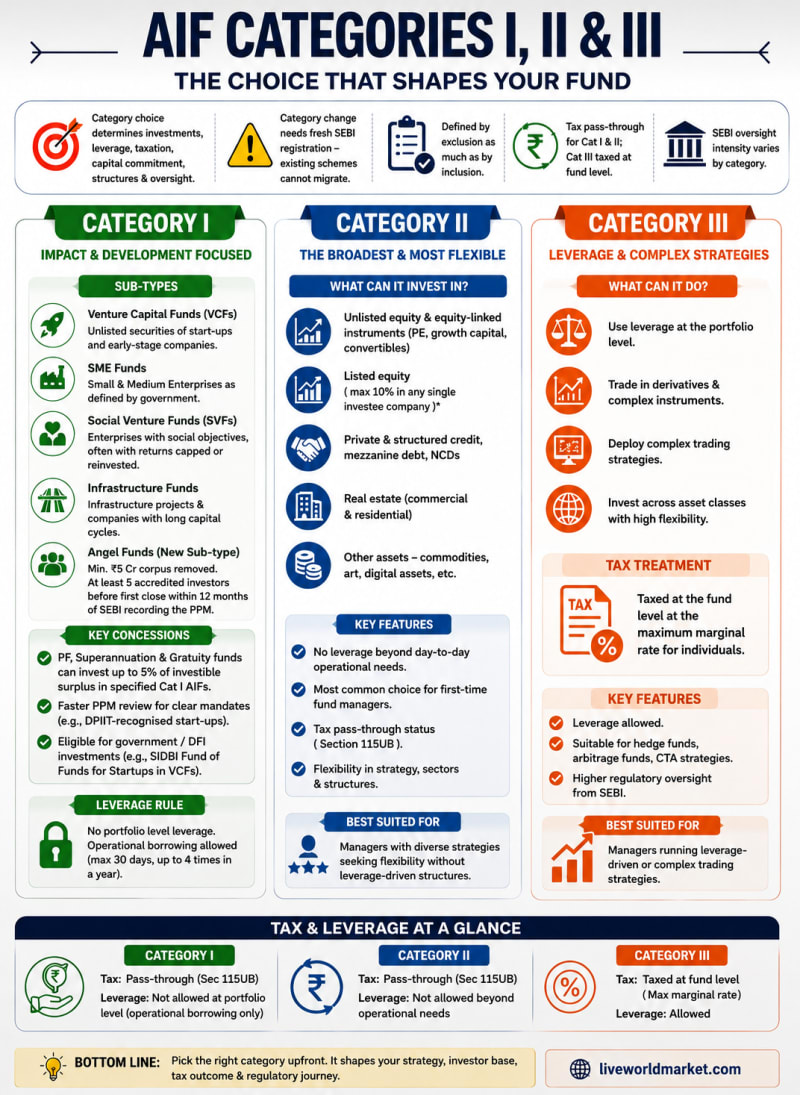
AIF Categories I, II & III Explained: How the Right Category Shapes Strategy, Risk, Leverage and Taxation
Alternative Investment Funds, commonly known as AIFs, have become an important part of India’s investment landscape, particularly for sophisticated and high-net-worth investors looking beyond traditional mutual funds, fixed deposits and direct equities. Unlike conventional investment products, AIFs can invest in areas such as private equity, venture capital, infrastructure, private credit and complex market strategies.
Under the SEBI Alternative Investment Funds framework, AIFs are broadly divided into Category I, Category II and Category III. The classification is not merely a label. It determines the type of investments a fund can pursue, the extent to which leverage may be used, the regulatory framework surrounding the strategy and, importantly, the tax treatment that may apply. SEBI’s AIF Regulations provide the regulatory foundation for these categories.

Category I AIF: Investing With a Development Focus
Category I AIFs generally include funds investing in sectors or businesses considered economically or socially desirable. This category includes areas such as venture capital, small and medium enterprises, infrastructure and social-impact-oriented investments.
Venture Capital Funds are perhaps the best-known part of Category I. They typically provide capital to startups and early-stage companies where the potential for growth may be high, but so is the investment risk.
SME-focused funds invest in small and medium enterprises, while infrastructure funds concentrate on assets and businesses connected with infrastructure development. SEBI's published AIF statistics separately track categories including Infrastructure Funds, SME Funds, Social Impact Funds, Venture Capital Funds and Angel Funds, demonstrating the diversity within Category I.
Angel Funds also operate within the Category I framework. SEBI revised the regulatory framework applicable to Angel Funds in September 2025, reflecting the regulator's continuing effort to formalise and strengthen the early-stage funding ecosystem.
One of the defining characteristics of Category I is that these funds are generally not designed around portfolio-level leverage. Category I and Category II AIFs are restricted from regular borrowing and leverage, except for permitted temporary funding or operational requirements under the regulatory framework.
For investors, Category I may therefore appeal when the objective is long-term participation in businesses, infrastructure or impact-driven opportunities rather than short-term leveraged trading.
Category II AIF: The Broad and Flexible Middle Ground
Category II is arguably the broadest AIF category. It covers funds that do not fall under Category I or Category III and that do not ordinarily employ leverage except where permitted for temporary operational requirements. SEBI's own FAQ describes Category II funds on this basis.
This category is commonly associated with private equity funds, private credit funds, real estate-oriented strategies and other privately negotiated investment structures.
The attraction of Category II lies in its flexibility. A fund manager can construct a portfolio involving unlisted companies, equity-linked instruments, debt securities, structured credit and other permitted assets depending on the fund's investment mandate.
For example, a private equity fund may invest in an established but unlisted company and hold the investment for several years before seeking an exit. A private credit fund may provide financing to businesses using carefully structured debt instruments.
At the same time, Category II is fundamentally different from a hedge-fund-style product because routine portfolio leverage is restricted. This can make Category II particularly relevant to managers seeking strategic flexibility without building the fund around leveraged trading.
Category III AIF: Complex and Market-Driven Strategies
Category III sits at the other end of the spectrum. These funds may employ more sophisticated trading strategies and can use leverage subject to applicable SEBI requirements, investor consent and regulatory limits.
Category III strategies may involve listed equities, derivatives, arbitrage, long-short portfolios and other complex market-based approaches. SEBI's regulatory material recognises the ability of Category III AIFs to engage in leverage or borrowing subject to prescribed conditions.
This makes Category III particularly relevant for hedge-fund-style strategies or investment approaches that attempt to generate returns from both rising and falling markets.
However, leverage is a double-edged sword. It can magnify profits when a strategy works, but it can also magnify losses when markets move unexpectedly. This is one reason why Category III funds typically require more intensive risk management, liquidity monitoring and regulatory oversight.
Taxation Is One of the Biggest Differences
Tax treatment is an important distinction between the categories.
The Income Tax Department confirms that Category I and Category II AIFs receive statutory pass-through treatment under Section 115UB for qualifying non-business income. In simple terms, income generally retains its character and is taxed in the hands of investors rather than being taxed first as ordinary income of the fund.
There is an important exception: business income is taxable at the AIF level, while other eligible income is generally passed through to investors and taxed according to the applicable provisions.
Category III AIFs do not receive the same general Section 115UB pass-through treatment. Their taxation can depend on factors such as the fund's legal structure, the nature of its income and the status of investors. Therefore, statements such as “Category III is always taxed at one fixed rate” can be an oversimplification.
Investors should consequently examine the actual fund documents and obtain professional tax advice before investing.
Choosing the Right Category Matters
The most important message from the infographic is simple: the AIF category shapes the entire investment structure.
Category I is generally suited to development-oriented, venture capital, infrastructure and similar long-term opportunities. Category II offers a wider platform for private equity, private credit and flexible non-leveraged strategies. Category III provides greater freedom for sophisticated trading and leveraged market strategies.
None of these categories is automatically “better” than another. The appropriate choice depends on the investment objective, time horizon, liquidity expectations, risk tolerance, tax position and the capabilities of the fund manager.
For investors, the category name should therefore be the beginning of due diligence—not the end of it. Before committing capital, it is essential to understand where the fund can invest, how it generates returns, whether it can borrow or use leverage, how long money may remain locked in, what fees are charged and how income will be taxed.
Bottom Line
AIF Categories I, II and III represent three different approaches to alternative investing. Category I focuses largely on venture, infrastructure and development-oriented capital; Category II provides broad flexibility for private-market strategies without routine leverage; and Category III permits more complex and potentially leveraged investment approaches.
Understanding these differences can help investors look beyond headline returns and evaluate the real combination of strategy, risk, liquidity, taxation and regulation behind an AIF.
Disclaimer: This article is for educational and informational purposes only and should not be treated as investment, legal or tax advice. AIF regulations and tax provisions can change, and investors should review the latest SEBI regulations, fund documents and applicable tax rules before making an investment decision.
Comments (0)
Be the first to comment.
About the author

NISM-Series-X-A Investment Adviser Level 1 examination completed
Amit writes about Indian equity markets, technical analysis, macro themes and the day-to-day mechanics of trading, with a focus on making the flow of global markets legible for retail investors. He has completed the NISM-Series-X-A Investment Adviser Level 1 examination.
You May Also Like

US Midterm Elections 2026: Impact on Stocks, Dollar & India
Global Markets & Economy · Nov 4, 2026 · 10 min read
US Midterm Elections 2026: Why Treasury Yields, the Dollar and Indian Stocks Could React More Than Wall Street Key Takeaway: Democrats have won control of both chambers of the US Congress in the 2026 midterm elections, creating a divided government under President Donald Trump. The immediate market reaction has been revealing: US Treasury yields declined, the dollar weakened…
Read more...
Apple Overtakes Nvidia: Is Lower AI Spending Winning?
Technology & Sectors · Nov 2, 2026 · 9 min read
Apple Overtakes Nvidia as World's Most Valuable Company Ahead of Earnings: Is Spending Less on AI Becoming Wall Street's Winning Strategy? Key takeaway: Apple has reclaimed the title of the world's most valuable publicly traded company, overtaking Nvidia as investors reassess the enormous cost of artificial intelligence infrastructure. With Apple's upcoming earnings in focus…
Read more...
ExxonMobil Refining Profits Surge: Impact on Indian Oil Stocks
Commodities & Energy · Nov 1, 2026 · 8 min read
ExxonMobil's Refining Profits Overtake Oil Drilling for First Time in 6 Years: Why India's Oil Stocks May Miss the Windfall Key Takeaway: ExxonMobil's refining business has emerged as a bigger earnings contributor than oil production, highlighting an extraordinary shift in global energy markets. But Indian oil companies such as IOC, BPCL and HPCL face a different challenge…
Read more...
Fed Decision and Microsoft–Google Earnings: Two Critical Tests for the AI Stock Market Rally
Global Markets & Economy · Oct 28, 2026 · 15 min read
Global stock markets are approaching one of the most important financial evenings of October 2026. The U.S. Federal Reserve is preparing to announce its latest interest-rate decision, while Microsoft and Alphabet, Google's parent company, are scheduled to publish quarterly earnings after Wall Street closes. These developments arrive as investors reassess the sustainability of…
Read more...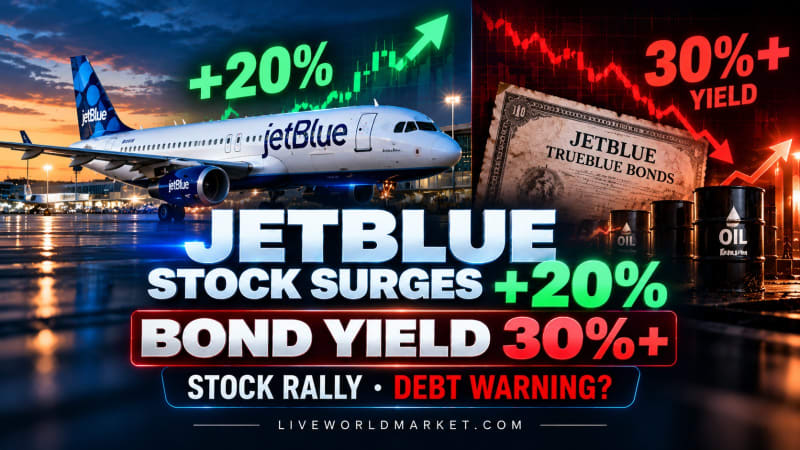
JetBlue Stock Surges 20%, Bond Yield Tops 30%: Warning?
Global Markets & Economy · Oct 28, 2026 · 16 min read
JetBlue Stock Surges 20% While Its Bonds Yield Over 30%: Is Airline Debt Flashing a Warning for Investors? Something unusual is happening in the U.S. airline industry. Shares of JetBlue Airways surged approximately 20% on October 27, after the airline raised its revenue outlook and attempted to reassure investors about its financial position. But an entirely different story…
Read more...
US Consumer Staples Rally 9.6%: FMCG Valuation Risk for India
Global Markets & Economy · Oct 25, 2026 · 16 min read
US Consumer Staples Surge 9.6% as Valuations Overtake Tech: Is the Safe-Stock Trade Becoming a Trap for Indian FMCG Investors? Something unexpected is happening on Wall Street. As investors become increasingly cautious about expensive artificial intelligence stocks, money has been moving into an unlikely market leader: consumer staples. The U.S. consumer-staples sector has…
Read more...
SpaceX 80,000 Cell Sites: Will Starlink Challenge Jio & Airtel?
Global Markets & Economy · Oct 24, 2026 · 17 min read
SpaceX's 80,000 Cell-Site Plan Sends US Telecom Stocks Down 8%: Could Starlink Disrupt Jio and Airtel Next? A major shift may be emerging in the global telecommunications industry—and Wall Street has already started reacting. Shares of American telecommunications giants AT&T and T-Mobile plunged nearly 8% on October 23 after reports revealed that Elon Musk's SpaceX was…
Read more...
US 10-Year Treasury Yield Below 5%: Growth Shock Warning?
Central Banks & Rates · Oct 23, 2026 · 17 min read
US 10-Year Treasury Yield Falls Below 5% Despite $114 Oil: Is the Bond Market Warning of a Global Growth Shock? Something unusual is happening across global financial markets. The yield on the benchmark U.S. 10-year Treasury has fallen sharply below the psychologically important 5% level, even as Brent crude oil has surged toward $114 per barrel and technology stocks have…
Read more...
Brent Crude Tops $110: Impact on Indian Stocks & Earnings
Global Markets & Economy · Oct 22, 2026 · 14 min read
Brent Crude Tops $110: Why Indian Airlines, Paints and Tyre Stocks Face a Hidden Earnings Risk Brent crude oil has climbed above $110 per barrel, intensifying concerns that rising global energy prices could squeeze corporate profit margins, increase India's import costs and create further volatility in domestic equities. On October 22, Brent futures traded above $111 after…
Read more...
India Optical Fibre Exports Jump 158%: AI's Hidden Winners
Global Markets & Economy · Oct 21, 2026 · 12 min read
India's Optical Fibre Exports Jump 158% as Japan's Chip Shipments Surge 49%: The Hidden Winners of the AI Infrastructure Boom Artificial intelligence may be transforming the technology industry, but some of its most important economic beneficiaries are not necessarily the companies developing AI models. They may be the businesses manufacturing the physical infrastructure that…
Read more...