
The Power of Staying Invested: Why Patience Matters in Long-Term Investing
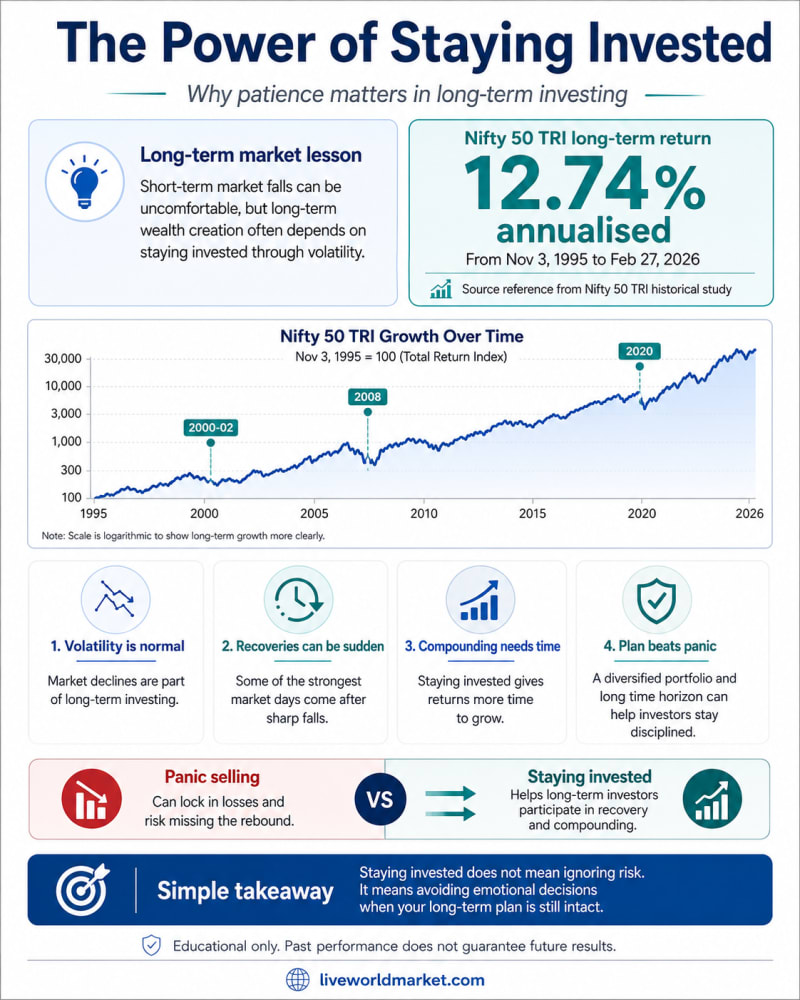
Stock-market investing often becomes most difficult at exactly the moment discipline matters most.
When markets are rising, remaining invested can feel easy. When indices fall sharply, economic headlines turn negative and portfolio values decline, the instinct to sell and “come back when things become clearer” can become very strong.
The problem is that financial markets rarely wait for clarity.
Recoveries can begin while the economic outlook still looks uncertain, which means an investor who exits during a decline must make two difficult decisions correctly: when to sell and when to re-enter.
This is why long-term investing is often less about predicting every market movement and more about building a portfolio and financial plan that can survive periods of volatility.
What Does Staying Invested Actually Mean?
Staying invested does not mean buying a stock and refusing to sell it regardless of what happens.
It means avoiding unnecessary decisions driven only by short-term fear or excitement when the investor's long-term objective, asset allocation and investment thesis remain intact.
There is an important difference between:
selling because a company's fundamentals have permanently deteriorated
and
selling simply because the market has fallen sharply for several weeks.
Likewise, an investor may legitimately reduce equity exposure because a financial goal is approaching, risk tolerance has changed or the portfolio has become too concentrated.
Long-term discipline should therefore not be confused with blindly holding every investment forever.
India's Market History Shows Why Time Matters
The Nifty 50 has experienced numerous difficult periods.
Indian investors have lived through:
- the technology-market collapse of the early 2000s;
- the Global Financial Crisis;
- the European debt crisis;
- the COVID-19 crash;
- inflation and interest-rate shocks;
- geopolitical conflicts; and
- repeated periods of heavy foreign-investor selling.
Despite these disruptions, Indian equities have created substantial long-term wealth.
NSE Indices' 2026 study reported that from November 1995 through February 27, 2026, the Nifty 50 Price Return Index generated an annualised return of approximately 11.23%.
When dividends were included and reinvested through the Nifty 50 Total Return Index, the annualised return was approximately 12.74%.
Those returns did not arrive smoothly.
They included multiple corrections and major bear markets.
That distinction matters because long-term return is the reward investors see when looking backward, while volatility is the experience they must live through along the way.

The Best Days Can Arrive Suddenly
One of the biggest difficulties with market timing is that some of the strongest market days can occur close to periods of severe weakness.
Consider a widely used historical illustration from Fidelity involving the S&P 500.
In its study covering 1980 through 2022, $10,000 hypothetically invested throughout the full period grew to substantially more than the same investment when the investor missed only a handful of the strongest market days.
Missing the 10 best days reduced the hypothetical ending value dramatically.
The lesson is not that investors must remain 100% invested in stocks at all times.
The lesson is that exiting after a market fall can create another risk: missing the recovery.
Recoveries often begin before headlines become comfortable again.
Why Re-Entering the Market Is Difficult
Imagine an investor sells after a 20% correction because the economic outlook appears uncertain.
The investor plans to buy back once conditions improve.
Then the market rises 5%.
The investor thinks:
“I will wait for another correction.”
The market rises another 8%.
Now prices seem too expensive.
Another month passes and the market continues higher.
The investor who intended to remain out for a few weeks may remain in cash for months.
This is the practical difficulty with market timing.
Selling is only the first decision.
The investor must subsequently decide when to return.
Being correct twice is considerably harder than simply predicting one market move.
Compounding Needs Time
Long-term investing benefits from compounding.
When an investment generates a return and that return remains invested, future returns can potentially be earned on both the original capital and previous gains.
This effect becomes increasingly important as the investment period grows.
Interrupting that process repeatedly through unnecessary buying and selling can reduce the amount of capital remaining invested.
Taxes, brokerage, bid-ask spreads and other transaction costs can add further friction.
Compounding therefore benefits from three things:
time, reasonable returns and consistency.
None of these guarantees wealth, but continuously resetting an investment strategy can make long-term compounding more difficult.
Staying Invested Does Not Mean Ignoring Risk
This is where many articles on long-term investing become too simplistic.
“Stay invested” is not appropriate advice for every rupee an individual owns.
Money needed for:
- emergency expenses;
- next year's school fees;
- a near-term house purchase;
- medical expenses; or
- other short-term commitments
may not belong entirely in volatile equities.
An investor with a 20-year retirement horizon can usually tolerate very different market risk from someone who needs the money within twelve months.
The correct investment mix therefore depends on time horizon, financial goals and ability to tolerate loss.
Diversification Matters
Remaining invested is easier when the portfolio itself is properly diversified.
An investor holding one speculative stock faces a very different risk from someone holding a diversified portfolio across companies, sectors and potentially different asset classes.
A broad market may eventually recover from a recession.
An individual company can permanently fail.
This is why the statement:
“Markets eventually recover”
should never be interpreted as:
“Every stock eventually recovers.”
Companies can lose competitiveness, accumulate excessive debt, suffer governance failures or disappear entirely.
Long-term investing should therefore be combined with diversification.
SIPs Can Reduce the Pressure to Time Markets
For investors building wealth gradually, systematic investing can provide another useful behavioural framework.
With a fixed periodic contribution, an investor purchases more units when prices are lower and fewer when prices are higher.
This does not guarantee a profit or protect against losses.
Its main advantage is discipline.
Instead of repeatedly deciding whether today is the perfect day to invest, the investor follows a predefined contribution schedule.
This can reduce the temptation to make every investment decision based on headlines.
When Should Investors Reconsider an Investment?
Patience is valuable, but there are legitimate reasons to make changes.
An investor may need to review a position when:
- the original investment thesis no longer holds;
- a company's financial health deteriorates materially;
- corporate governance becomes questionable;
- portfolio concentration becomes excessive;
- a financial goal is approaching;
- risk capacity has changed; or
- the existing asset allocation is no longer appropriate.
These are fundamentally different from selling merely because an index has experienced a temporary correction.
A Market Crash Tests Behaviour
During a bull market, almost everyone believes they can tolerate volatility.
The real test comes during a large decline.
A 5% fall may feel manageable.
A 15% fall feels different.
At 25% or 30%, financial news becomes increasingly negative and investors naturally begin questioning previous assumptions.
This is why asset allocation should ideally be designed before a crisis occurs.
If an investor consistently loses sleep during moderate corrections, the portfolio may simply contain more equity risk than the investor can realistically tolerate.
The solution may not be better market prediction.
It may be a more suitable portfolio.
Long-Term Investing Is Not the Same as Doing Nothing
A disciplined investor can still review the portfolio periodically.
Rebalancing can restore the intended allocation when one asset class has become disproportionately large.
Fundamental investors can review company earnings and balance sheets.
Mutual-fund investors can assess whether a scheme continues to follow its stated mandate.
The difference is that these reviews are based on a structured process rather than emotional reactions to daily price movements.
What India's Long-Term Nifty History Tells Us
Nifty's history does not prove that future returns will match historical returns.
It does demonstrate how misleading short periods can be.
The index has experienced individual years of severe losses alongside years of exceptional gains.
NSE's historical data show declines exceeding 50% during major crises, but also very strong recovery years.
Investors who focus only on the worst months can therefore develop an incomplete view of equity investing.
Equally, looking only at long-term averages can hide the very real risk experienced along the journey.
Both perspectives matter.
The Real Lesson: Build a Plan You Can Maintain
The strongest long-term investment strategy is not necessarily the one with the highest theoretical return.
It may be the one an investor can realistically maintain during difficult markets.
That usually requires:
- an emergency fund;
- appropriate diversification;
- realistic return expectations;
- a suitable equity allocation;
- manageable debt;
- a long enough investment horizon; and
- periodic portfolio review.
With these foundations in place, investors may be less likely to make emotional decisions during temporary market stress.
Final Takeaway
The power of staying invested is not based on the idea that markets always rise.
They do not.
Markets can fall sharply, remain weak for extended periods and deliver disappointing returns.
The more useful principle is that attempting to escape every decline can create another risk—the possibility of missing unpredictable recoveries and interrupting long-term compounding.
For investors with appropriate diversification, sufficient time and a portfolio aligned with their financial goals, patience can be a powerful advantage.
But patience should always be combined with risk management and financial planning.
The objective is not to stay invested blindly.
It is to avoid allowing short-term fear to repeatedly override a well-designed long-term plan.
Data note: Historical Nifty figures referenced in this article are based on NSE Indices' 2026 Nifty 50 research. Historical performance does not predict future returns.
Disclaimer: This article is for educational and informational purposes only. It does not constitute investment advice, financial planning advice or a recommendation to buy or sell securities, mutual funds or other financial products. Equity investments can lose value. Investors should consider their goals, time horizon, financial circumstances and risk tolerance before investing.
Helpful Resources on LiveWorldMarket
Nifty Monthly Returns 1994–2026
Explore more than three decades of monthly Nifty performance and see how strong rallies and large declines have occurred across different market cycles.
Bear Market History
Understand how major historical market declines compare and why past crashes should be used for risk awareness rather than predicting an exact market bottom.
Read the Bear Market History Guide
How to Build Wealth Through Compounding
Learn how time, regular investing, business quality and compounding can influence long-term wealth creation.
Read the Compounding and Wealth Guide
Nifty 50 Valuation Guide
Understand how earnings and valuation can provide more context than index price movements alone.
India Stock Market Dashboard
Track current Nifty 50, Sensex, Bank Nifty, India VIX, sectors and broader Indian market conditions.
Open India Stock Market Dashboard
Educational Note: Staying invested does not mean ignoring changes in financial goals, asset allocation, company fundamentals or risk tolerance. Historical market recoveries do not guarantee future results.
Comments (0)
Be the first to comment.
About the author

NISM-Series-X-A Investment Adviser Level 1 examination completed
Amit writes about Indian equity markets, technical analysis, macro themes and the day-to-day mechanics of trading, with a focus on making the flow of global markets legible for retail investors. He has completed the NISM-Series-X-A Investment Adviser Level 1 examination.
You May Also Like

Big Tech Gains $750B as AI Data Centre Stocks Crash
Global Markets & Economy · Nov 5, 2026 · 12 min read
Big Tech Gains $750 Billion After US Midterms, but AI Data-Centre Stocks Crash: Is Wall Street Rewarding Less AI Spending? Key Takeaway: Wall Street's reaction to the 2026 US midterm elections has exposed a surprising divide in the artificial intelligence investment boom. Established technology giants rallied, with five major companies on course to add more than $750 billion…
Read more...
US Midterm Elections 2026: Impact on Stocks, Dollar & India
Global Markets & Economy · Nov 4, 2026 · 10 min read
US Midterm Elections 2026: Why Treasury Yields, the Dollar and Indian Stocks Could React More Than Wall Street Key Takeaway: Democrats have won control of both chambers of the US Congress in the 2026 midterm elections, creating a divided government under President Donald Trump. The immediate market reaction has been revealing: US Treasury yields declined, the dollar weakened…
Read more...
Apple Overtakes Nvidia: Is Lower AI Spending Winning?
Technology & Sectors · Nov 2, 2026 · 9 min read
Apple Overtakes Nvidia as World's Most Valuable Company Ahead of Earnings: Is Spending Less on AI Becoming Wall Street's Winning Strategy? Key takeaway: Apple has reclaimed the title of the world's most valuable publicly traded company, overtaking Nvidia as investors reassess the enormous cost of artificial intelligence infrastructure. With Apple's upcoming earnings in focus…
Read more...
ExxonMobil Refining Profits Surge: Impact on Indian Oil Stocks
Commodities & Energy · Nov 1, 2026 · 8 min read
ExxonMobil's Refining Profits Overtake Oil Drilling for First Time in 6 Years: Why India's Oil Stocks May Miss the Windfall Key Takeaway: ExxonMobil's refining business has emerged as a bigger earnings contributor than oil production, highlighting an extraordinary shift in global energy markets. But Indian oil companies such as IOC, BPCL and HPCL face a different challenge…
Read more...
Fed Decision and Microsoft–Google Earnings: Two Critical Tests for the AI Stock Market Rally
Global Markets & Economy · Oct 28, 2026 · 15 min read
Global stock markets are approaching one of the most important financial evenings of October 2026. The U.S. Federal Reserve is preparing to announce its latest interest-rate decision, while Microsoft and Alphabet, Google's parent company, are scheduled to publish quarterly earnings after Wall Street closes. These developments arrive as investors reassess the sustainability of…
Read more...
JetBlue Stock Surges 20%, Bond Yield Tops 30%: Warning?
Global Markets & Economy · Oct 28, 2026 · 16 min read
JetBlue Stock Surges 20% While Its Bonds Yield Over 30%: Is Airline Debt Flashing a Warning for Investors? Something unusual is happening in the U.S. airline industry. Shares of JetBlue Airways surged approximately 20% on October 27, after the airline raised its revenue outlook and attempted to reassure investors about its financial position. But an entirely different story…
Read more...
US Consumer Staples Rally 9.6%: FMCG Valuation Risk for India
Global Markets & Economy · Oct 25, 2026 · 16 min read
US Consumer Staples Surge 9.6% as Valuations Overtake Tech: Is the Safe-Stock Trade Becoming a Trap for Indian FMCG Investors? Something unexpected is happening on Wall Street. As investors become increasingly cautious about expensive artificial intelligence stocks, money has been moving into an unlikely market leader: consumer staples. The U.S. consumer-staples sector has…
Read more...
SpaceX 80,000 Cell Sites: Will Starlink Challenge Jio & Airtel?
Global Markets & Economy · Oct 24, 2026 · 17 min read
SpaceX's 80,000 Cell-Site Plan Sends US Telecom Stocks Down 8%: Could Starlink Disrupt Jio and Airtel Next? A major shift may be emerging in the global telecommunications industry—and Wall Street has already started reacting. Shares of American telecommunications giants AT&T and T-Mobile plunged nearly 8% on October 23 after reports revealed that Elon Musk's SpaceX was…
Read more...
US 10-Year Treasury Yield Below 5%: Growth Shock Warning?
Central Banks & Rates · Oct 23, 2026 · 17 min read
US 10-Year Treasury Yield Falls Below 5% Despite $114 Oil: Is the Bond Market Warning of a Global Growth Shock? Something unusual is happening across global financial markets. The yield on the benchmark U.S. 10-year Treasury has fallen sharply below the psychologically important 5% level, even as Brent crude oil has surged toward $114 per barrel and technology stocks have…
Read more...
Brent Crude Tops $110: Impact on Indian Stocks & Earnings
Global Markets & Economy · Oct 22, 2026 · 14 min read
Brent Crude Tops $110: Why Indian Airlines, Paints and Tyre Stocks Face a Hidden Earnings Risk Brent crude oil has climbed above $110 per barrel, intensifying concerns that rising global energy prices could squeeze corporate profit margins, increase India's import costs and create further volatility in domestic equities. On October 22, Brent futures traded above $111 after…
Read more...