
Tax Audit Thresholds in India: Business, Professionals and Presumptive Taxation Explained
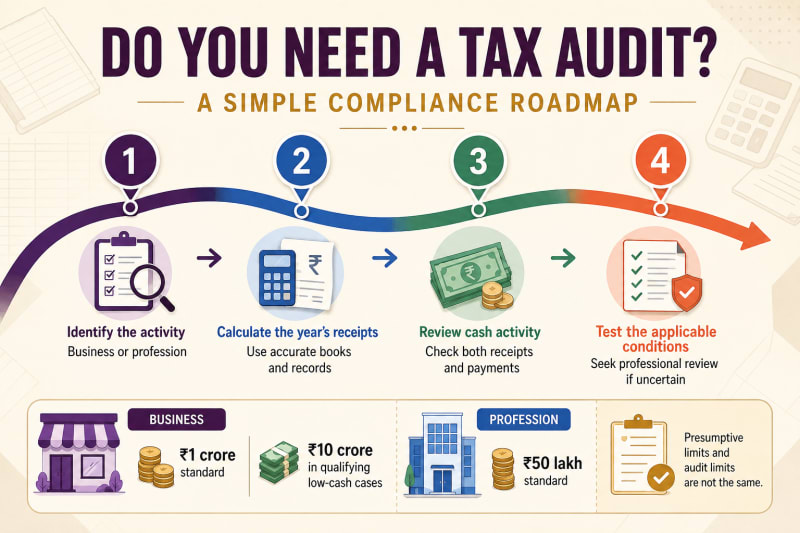
A tax audit is a detailed examination of a taxpayer’s accounts by a chartered accountant. Its purpose is to verify whether income, expenses, deductions and other financial information have been reported according to the applicable income-tax provisions.
Tax audit requirements are commonly associated with Section 44AB of the Income-tax Act, 1961. From tax year 2026–27, corresponding provisions under the Income-tax Act, 2025 may apply. Although the section numbering changes under the new framework, the key audit thresholds continue broadly on the same basis.
Crossing an audit threshold does not automatically mean that a business owes more tax. It generally means that its accounts must be examined and the prescribed audit report must be filed within the applicable deadline.

Standard tax-audit limit for businesses
A person carrying on a business is generally required to obtain a tax audit when total sales, turnover or gross receipts exceed ₹1 crore during the financial year.
Turnover should be calculated carefully using the accounting and tax principles applicable to the activity. It is not always the same as the amount credited to a bank account. Taxes collected on behalf of the government, reimbursements, advances, cancelled transactions and the method used to recognize revenue may affect the calculation.
Businesses should maintain sales invoices, purchase records, expense bills, bank statements, inventory information and supporting agreements. Waiting until the end of the year to reconstruct these records can create discrepancies between the books, GST returns, bank transactions and the income-tax return.
Higher ₹10 crore threshold for digital businesses
The standard ₹1 crore business threshold may increase to ₹10 crore when cash transactions remain within the prescribed limits.
To qualify for this higher threshold:
- Cash receipts must not exceed 5% of total receipts.
- Cash payments must not exceed 5% of total payments.
Both conditions must be satisfied. A business cannot claim the ₹10 crore threshold merely because most customer payments are received digitally if more than 5% of its total payments are made in cash.
The law also contains rules concerning certain non-account-payee instruments and cash-equivalent transactions. Therefore, businesses should not assume that every cheque transaction qualifies as a non-cash transaction.
A company with ₹6 crore of turnover may not require an audit under the normal business-turnover provision when both cash conditions are satisfied. If its cash payments exceed the permitted limit, however, the standard ₹1 crore threshold may become relevant.
Tax-audit limit for professionals
A person carrying on a specified or recognized profession is generally required to obtain a tax audit when annual gross professional receipts exceed ₹50 lakh.
Professionals may include doctors, lawyers, architects, accountants, engineers, technical consultants and other people covered by the relevant provisions or notifications.
The ₹50 lakh figure is the standard professional tax-audit threshold. It should not be confused with the ₹75 lakh enhanced eligibility limit available under the presumptive taxation scheme of Section 44ADA in qualifying low-cash cases.
Professional receipts should be distinguished from business turnover. A person’s job title alone does not always determine the classification. The nature of the activity, qualifications, contractual relationship and manner in which services are delivered can all be relevant.
Presumptive taxation under Section 44AD
Section 44AD offers a simplified method for calculating income from eligible businesses. Subject to its conditions, qualifying taxpayers may declare income at a prescribed percentage of turnover instead of calculating taxable profit through a detailed expense-based process.
The scheme is generally available when turnover does not exceed ₹2 crore. This ceiling increases to ₹3 crore when cash receipts do not exceed 5% of total turnover or gross receipts.
Presumptive income is commonly calculated at 8% of eligible turnover, with a 6% rate applying to qualifying digital receipts. A taxpayer may voluntarily declare a higher amount.
Not every activity qualifies. Agency businesses, commission or brokerage activities and businesses covered by certain other presumptive provisions may be excluded. Eligibility also depends on the taxpayer’s legal status and residential conditions.
Declaring profit below the prescribed rate can create bookkeeping and audit obligations when the taxpayer’s income exceeds the applicable basic exemption limit. The consequences of leaving the scheme after using it should also be considered because Section 44AD contains a continuity rule affecting later years.
Presumptive taxation under Section 44ADA
Section 44ADA applies to eligible resident individuals and partnership firms other than LLPs carrying on specified professions.
The usual gross-receipts ceiling is ₹50 lakh. It increases to ₹75 lakh when cash receipts do not exceed 5% of total professional receipts.
Under this scheme, 50% of gross professional receipts is generally treated as taxable professional income. A taxpayer may declare a higher amount. Expenses are considered to have been allowed within the presumptive calculation, meaning separate deductions for normal professional expenses generally cannot be claimed again.
Suppose an eligible consultant has gross receipts of ₹65 lakh and receives no more than 5% in cash. The consultant may potentially fall within the enhanced ₹75 lakh ceiling, subject to all other conditions. If cash receipts cross 5%, the standard ₹50 lakh ceiling becomes relevant.
The ₹75 lakh amount is therefore not a general tax-audit exemption for every professional. It is a conditional ceiling connected with Section 44ADA.
What does a tax audit involve?
When an audit is required, a chartered accountant examines the books and prepares the prescribed report. Form 3CA is generally relevant when the accounts are already audited under another law, while Form 3CB may apply in other tax-audit cases. Form 3CD contains detailed particulars concerning income, expenditure, depreciation, tax deductions and specified transactions.
The taxpayer remains responsible for providing complete and accurate information. Appointment of an auditor does not transfer the underlying compliance responsibility.
A business should reconcile turnover with GST filings, TDS statements, AIS information and bank records. Professionals should reconcile invoices, receipts, tax deductions and expense claims. Unexplained differences should be addressed before the audit report and return are filed.
Why early review matters
Audit applicability should ideally be checked before the financial year ends. Monitoring turnover, gross receipts and cash percentages during the year provides time to correct bookkeeping gaps and collect missing evidence.
Late identification of an audit requirement can lead to rushed reporting, missed deadlines and possible penalties. It can also affect the due date applicable to the income-tax return.
The Income Tax Department confirms that the regular business threshold is ₹1 crore, rising to ₹10 crore when cash receipts and cash payments each remain within 5%. It also confirms the ₹50 lakh professional threshold. Official Section 44AB guidance
The Department’s presumptive taxation guidance explains the ₹3 crore Section 44AD and ₹75 lakh Section 44ADA limits for eligible low-cash cases.
Final takeaway
Tax-audit applicability cannot be determined from turnover alone. The nature of the activity, cash receipts, cash payments, presumptive-taxation eligibility, declared profit and total income must all be considered.
Maintain reliable records, review the thresholds during the year and obtain professional advice when the classification is uncertain.
Disclaimer: This original article is for general education only and is not tax or legal advice. Provisions, forms and deadlines may change. Verify the latest official rules before filing or taking a compliance decision.
Comments (0)
Be the first to comment.
About the author

NISM-Series-X-A Investment Adviser Level 1 examination completed
Amit writes about Indian equity markets, technical analysis, macro themes and the day-to-day mechanics of trading, with a focus on making the flow of global markets legible for retail investors. He has completed the NISM-Series-X-A Investment Adviser Level 1 examination.
You May Also Like

Big Tech Gains $750B as AI Data Centre Stocks Crash
Global Markets & Economy · Nov 5, 2026 · 12 min read
Big Tech Gains $750 Billion After US Midterms, but AI Data-Centre Stocks Crash: Is Wall Street Rewarding Less AI Spending? Key Takeaway: Wall Street's reaction to the 2026 US midterm elections has exposed a surprising divide in the artificial intelligence investment boom. Established technology giants rallied, with five major companies on course to add more than $750 billion…
Read more...
US Midterm Elections 2026: Impact on Stocks, Dollar & India
Global Markets & Economy · Nov 4, 2026 · 10 min read
US Midterm Elections 2026: Why Treasury Yields, the Dollar and Indian Stocks Could React More Than Wall Street Key Takeaway: Democrats have won control of both chambers of the US Congress in the 2026 midterm elections, creating a divided government under President Donald Trump. The immediate market reaction has been revealing: US Treasury yields declined, the dollar weakened…
Read more...
Apple Overtakes Nvidia: Is Lower AI Spending Winning?
Technology & Sectors · Nov 2, 2026 · 9 min read
Apple Overtakes Nvidia as World's Most Valuable Company Ahead of Earnings: Is Spending Less on AI Becoming Wall Street's Winning Strategy? Key takeaway: Apple has reclaimed the title of the world's most valuable publicly traded company, overtaking Nvidia as investors reassess the enormous cost of artificial intelligence infrastructure. With Apple's upcoming earnings in focus…
Read more...
ExxonMobil Refining Profits Surge: Impact on Indian Oil Stocks
Commodities & Energy · Nov 1, 2026 · 8 min read
ExxonMobil's Refining Profits Overtake Oil Drilling for First Time in 6 Years: Why India's Oil Stocks May Miss the Windfall Key Takeaway: ExxonMobil's refining business has emerged as a bigger earnings contributor than oil production, highlighting an extraordinary shift in global energy markets. But Indian oil companies such as IOC, BPCL and HPCL face a different challenge…
Read more...
Fed Decision and Microsoft–Google Earnings: Two Critical Tests for the AI Stock Market Rally
Global Markets & Economy · Oct 28, 2026 · 15 min read
Global stock markets are approaching one of the most important financial evenings of October 2026. The U.S. Federal Reserve is preparing to announce its latest interest-rate decision, while Microsoft and Alphabet, Google's parent company, are scheduled to publish quarterly earnings after Wall Street closes. These developments arrive as investors reassess the sustainability of…
Read more...
JetBlue Stock Surges 20%, Bond Yield Tops 30%: Warning?
Global Markets & Economy · Oct 28, 2026 · 16 min read
JetBlue Stock Surges 20% While Its Bonds Yield Over 30%: Is Airline Debt Flashing a Warning for Investors? Something unusual is happening in the U.S. airline industry. Shares of JetBlue Airways surged approximately 20% on October 27, after the airline raised its revenue outlook and attempted to reassure investors about its financial position. But an entirely different story…
Read more...
US Consumer Staples Rally 9.6%: FMCG Valuation Risk for India
Global Markets & Economy · Oct 25, 2026 · 16 min read
US Consumer Staples Surge 9.6% as Valuations Overtake Tech: Is the Safe-Stock Trade Becoming a Trap for Indian FMCG Investors? Something unexpected is happening on Wall Street. As investors become increasingly cautious about expensive artificial intelligence stocks, money has been moving into an unlikely market leader: consumer staples. The U.S. consumer-staples sector has…
Read more...
SpaceX 80,000 Cell Sites: Will Starlink Challenge Jio & Airtel?
Global Markets & Economy · Oct 24, 2026 · 17 min read
SpaceX's 80,000 Cell-Site Plan Sends US Telecom Stocks Down 8%: Could Starlink Disrupt Jio and Airtel Next? A major shift may be emerging in the global telecommunications industry—and Wall Street has already started reacting. Shares of American telecommunications giants AT&T and T-Mobile plunged nearly 8% on October 23 after reports revealed that Elon Musk's SpaceX was…
Read more...
US 10-Year Treasury Yield Below 5%: Growth Shock Warning?
Central Banks & Rates · Oct 23, 2026 · 17 min read
US 10-Year Treasury Yield Falls Below 5% Despite $114 Oil: Is the Bond Market Warning of a Global Growth Shock? Something unusual is happening across global financial markets. The yield on the benchmark U.S. 10-year Treasury has fallen sharply below the psychologically important 5% level, even as Brent crude oil has surged toward $114 per barrel and technology stocks have…
Read more...
Brent Crude Tops $110: Impact on Indian Stocks & Earnings
Global Markets & Economy · Oct 22, 2026 · 14 min read
Brent Crude Tops $110: Why Indian Airlines, Paints and Tyre Stocks Face a Hidden Earnings Risk Brent crude oil has climbed above $110 per barrel, intensifying concerns that rising global energy prices could squeeze corporate profit margins, increase India's import costs and create further volatility in domestic equities. On October 22, Brent futures traded above $111 after…
Read more...