
Position Sizing in Trading: How to Control Risk and Protect Your Capital
Finding a good trading opportunity is only one part of the process. A trader must also decide how much capital to place behind that idea. This decision is known as position sizing, and it can have a greater influence on long-term results than any single entry signal.
Position sizing refers to the number of shares, futures lots or options contracts used in a trade. Its purpose is not to eliminate losses—no risk-control method can do that. It helps keep the possible loss within an amount the trader has decided is acceptable.
A promising setup can still fail because markets are uncertain. When a position is too large, one unexpected move can damage the trading account. When the position is calculated according to a predefined risk limit, the trader has a better chance of managing an ordinary losing streak without exhausting available capital.
Position Size and Investment Amount Are Different
Suppose a trader buys 500 shares at ₹200. The total position value is ₹1,00,000, but that does not necessarily mean the full ₹1,00,000 is at risk.
If the trading plan calls for an exit at ₹194, the planned price risk is ₹6 per share. Before brokerage, taxes, slippage and gaps, the estimated trade risk would be:
500 shares × ₹6 = ₹3,000
This distinction is important. Position value tells us how much market exposure has been taken, while planned risk estimates how much could be lost if the exit occurs near the intended price.
The actual loss can be higher. A stop-loss is a trigger, not a guarantee of execution at an exact price. NSE explains that a stop-loss order enters the regular order book only after its trigger level is reached. During a fast move or an overnight gap, execution may occur at a less favorable price.
A Basic Position-Sizing Formula
One commonly used calculation is:
Maximum planned risk = Trading capital × Chosen risk percentage
Quantity = Maximum planned risk ÷ Risk per share
Risk per share is normally the difference between the proposed entry and the planned exit level.
Consider a trader with capital of ₹5,00,000 who independently decides to limit the planned loss on one trade to 0.75% of the account.
Maximum planned risk:
₹5,00,000 × 0.75% = ₹3,750
Suppose the proposed entry is ₹250 and the exit level is ₹242. The price risk is ₹8 per share.
Calculated quantity:
₹3,750 ÷ ₹8 = 468.75 shares
Because fractional shares cannot normally be purchased in the Indian cash market, the quantity would have to be rounded down. The trader may choose 468 shares or fewer after allowing for transaction charges and possible slippage.
The calculation does not predict whether the trade will succeed. It simply connects the trade quantity to the amount of risk the trader is prepared to accept.
Is the 1% Rule Suitable for Everyone?
The idea of risking around 1% on a trade is frequently discussed in trading education, but it is a guideline—not an exchange rule or a guarantee of safety. Some traders may choose a smaller limit, while others may decide that active trading is unsuitable for their financial position.
An appropriate risk limit depends on account size, experience, strategy, instrument volatility, number of simultaneous positions and personal ability to tolerate losses. Money required for household expenses, loan payments, emergencies or near-term goals should not be treated as trading capital.
A percentage that looks small can also become substantial when several correlated positions are open together. Buying three banking stocks, for example, may appear to be three separate trades, but all three could react to the same sector-wide development.
Why Losing Streaks Must Be Expected
Even a strategy that has worked historically can produce several losses in succession. Market conditions change, signals fail and unexpected news can disrupt an otherwise reasonable setup.
If a trader repeatedly commits a large part of the account to individual trades, a losing sequence can create a deep drawdown. Recovery then becomes mathematically harder. A 20% loss requires a 25% gain on the remaining capital to return to the starting amount. A 50% loss requires a 100% gain.
Keeping risk moderate cannot prevent drawdowns, but it may reduce the chance that a normal series of losses becomes financially destructive.
Position Sizing in Futures and Options
Leveraged products require additional care. Futures positions are determined by contract lot sizes, so the calculated risk may not fit neatly into one lot. If the risk associated with the minimum lot is above the trader’s limit, the disciplined decision may be to avoid the trade rather than force it into the account.
Options introduce other complications. An option buyer can lose the entire premium paid, while certain option-selling strategies can carry very large or theoretically unlimited loss potential. Premiums are influenced by the underlying price, volatility and time remaining until expiry. Therefore, a simple entry-to-stop calculation may not fully represent option risk.
Margin availability should also not be confused with affordability. A broker permitting a position does not mean the position is appropriate for the trader.
Common Position-Sizing Mistakes
A frequent mistake is increasing quantity after a few profitable trades because confidence has risen. Another is doubling the next trade after a loss in an attempt to recover quickly. Both decisions replace a consistent process with an emotional response.
Other mistakes include moving the stop-loss farther away without reducing quantity, ignoring the combined risk of open trades, using borrowed money and calculating size without considering brokerage, taxes or slippage.
It is also risky to choose the quantity first and then adjust the stop-loss merely to justify that quantity. The exit level should be based on the trade idea and market structure. Position size should then be calculated from that risk.
A Practical Pre-Trade Checklist
Before placing a trade, write down the entry range, invalidation or exit level, estimated risk per unit, maximum acceptable account loss and final quantity. Also consider gaps, liquidity, transaction costs and exposure from other open positions.
Position sizing will not turn an untested strategy into a profitable one. What it can do is make the financial consequence of being wrong more deliberate and measurable. In trading, uncertainty cannot be removed, but exposure to that uncertainty can be managed.
Disclaimer: This article is for educational purposes only and does not constitute investment or trading advice. Trading and investing involve risk, including possible loss of capital. Examples are hypothetical and exclude some costs and execution differences. Consult a qualified financial professional before making financial decisions.
Comments (0)
Be the first to comment.
About the author

NISM-Series-X-A Investment Adviser Level 1 examination completed
Amit writes about Indian equity markets, technical analysis, macro themes and the day-to-day mechanics of trading, with a focus on making the flow of global markets legible for retail investors. He has completed the NISM-Series-X-A Investment Adviser Level 1 examination.
You May Also Like

Big Tech Gains $750B as AI Data Centre Stocks Crash
Global Markets & Economy · Nov 5, 2026 · 12 min read
Big Tech Gains $750 Billion After US Midterms, but AI Data-Centre Stocks Crash: Is Wall Street Rewarding Less AI Spending? Key Takeaway: Wall Street's reaction to the 2026 US midterm elections has exposed a surprising divide in the artificial intelligence investment boom. Established technology giants rallied, with five major companies on course to add more than $750 billion…
Read more...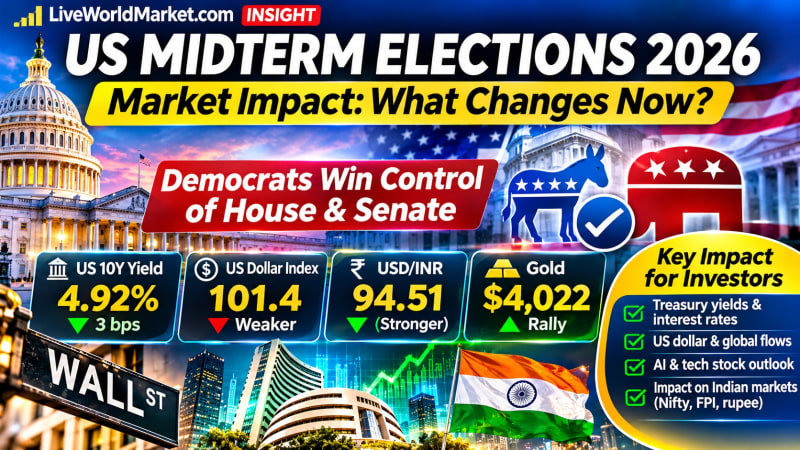
US Midterm Elections 2026: Impact on Stocks, Dollar & India
Global Markets & Economy · Nov 4, 2026 · 10 min read
US Midterm Elections 2026: Why Treasury Yields, the Dollar and Indian Stocks Could React More Than Wall Street Key Takeaway: Democrats have won control of both chambers of the US Congress in the 2026 midterm elections, creating a divided government under President Donald Trump. The immediate market reaction has been revealing: US Treasury yields declined, the dollar weakened…
Read more...
Apple Overtakes Nvidia: Is Lower AI Spending Winning?
Technology & Sectors · Nov 2, 2026 · 9 min read
Apple Overtakes Nvidia as World's Most Valuable Company Ahead of Earnings: Is Spending Less on AI Becoming Wall Street's Winning Strategy? Key takeaway: Apple has reclaimed the title of the world's most valuable publicly traded company, overtaking Nvidia as investors reassess the enormous cost of artificial intelligence infrastructure. With Apple's upcoming earnings in focus…
Read more...
ExxonMobil Refining Profits Surge: Impact on Indian Oil Stocks
Commodities & Energy · Nov 1, 2026 · 8 min read
ExxonMobil's Refining Profits Overtake Oil Drilling for First Time in 6 Years: Why India's Oil Stocks May Miss the Windfall Key Takeaway: ExxonMobil's refining business has emerged as a bigger earnings contributor than oil production, highlighting an extraordinary shift in global energy markets. But Indian oil companies such as IOC, BPCL and HPCL face a different challenge…
Read more...
Fed Decision and Microsoft–Google Earnings: Two Critical Tests for the AI Stock Market Rally
Global Markets & Economy · Oct 28, 2026 · 15 min read
Global stock markets are approaching one of the most important financial evenings of October 2026. The U.S. Federal Reserve is preparing to announce its latest interest-rate decision, while Microsoft and Alphabet, Google's parent company, are scheduled to publish quarterly earnings after Wall Street closes. These developments arrive as investors reassess the sustainability of…
Read more...
JetBlue Stock Surges 20%, Bond Yield Tops 30%: Warning?
Global Markets & Economy · Oct 28, 2026 · 16 min read
JetBlue Stock Surges 20% While Its Bonds Yield Over 30%: Is Airline Debt Flashing a Warning for Investors? Something unusual is happening in the U.S. airline industry. Shares of JetBlue Airways surged approximately 20% on October 27, after the airline raised its revenue outlook and attempted to reassure investors about its financial position. But an entirely different story…
Read more...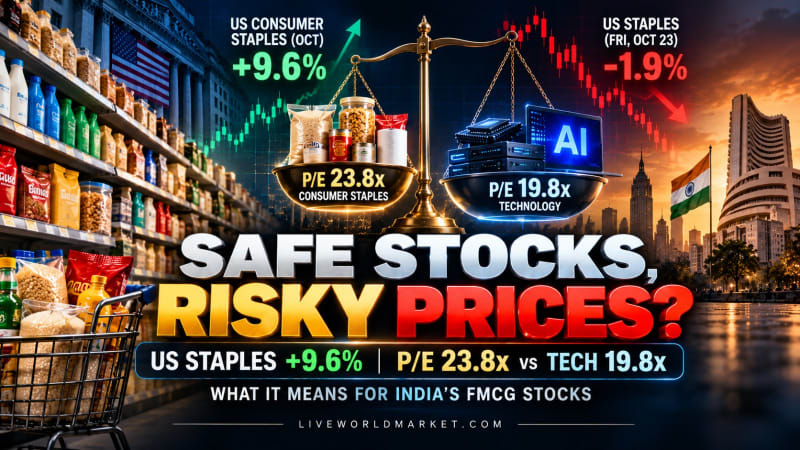
US Consumer Staples Rally 9.6%: FMCG Valuation Risk for India
Global Markets & Economy · Oct 25, 2026 · 16 min read
US Consumer Staples Surge 9.6% as Valuations Overtake Tech: Is the Safe-Stock Trade Becoming a Trap for Indian FMCG Investors? Something unexpected is happening on Wall Street. As investors become increasingly cautious about expensive artificial intelligence stocks, money has been moving into an unlikely market leader: consumer staples. The U.S. consumer-staples sector has…
Read more...
SpaceX 80,000 Cell Sites: Will Starlink Challenge Jio & Airtel?
Global Markets & Economy · Oct 24, 2026 · 17 min read
SpaceX's 80,000 Cell-Site Plan Sends US Telecom Stocks Down 8%: Could Starlink Disrupt Jio and Airtel Next? A major shift may be emerging in the global telecommunications industry—and Wall Street has already started reacting. Shares of American telecommunications giants AT&T and T-Mobile plunged nearly 8% on October 23 after reports revealed that Elon Musk's SpaceX was…
Read more...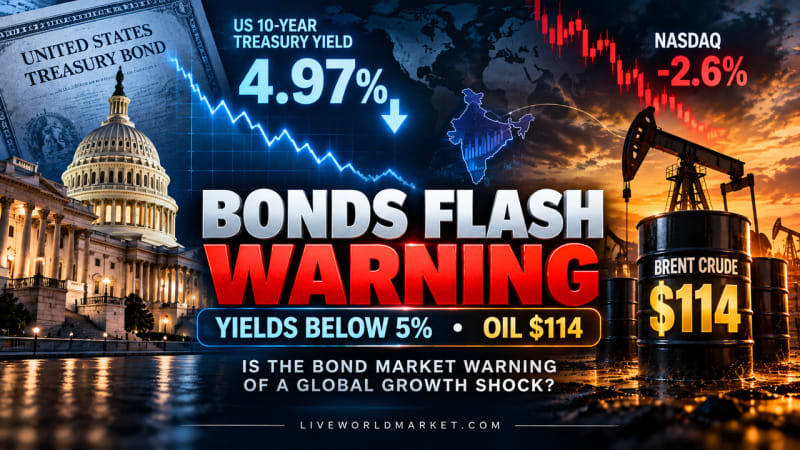
US 10-Year Treasury Yield Below 5%: Growth Shock Warning?
Central Banks & Rates · Oct 23, 2026 · 17 min read
US 10-Year Treasury Yield Falls Below 5% Despite $114 Oil: Is the Bond Market Warning of a Global Growth Shock? Something unusual is happening across global financial markets. The yield on the benchmark U.S. 10-year Treasury has fallen sharply below the psychologically important 5% level, even as Brent crude oil has surged toward $114 per barrel and technology stocks have…
Read more...
Brent Crude Tops $110: Impact on Indian Stocks & Earnings
Global Markets & Economy · Oct 22, 2026 · 14 min read
Brent Crude Tops $110: Why Indian Airlines, Paints and Tyre Stocks Face a Hidden Earnings Risk Brent crude oil has climbed above $110 per barrel, intensifying concerns that rising global energy prices could squeeze corporate profit margins, increase India's import costs and create further volatility in domestic equities. On October 22, Brent futures traded above $111 after…
Read more...