
India’s SIP Investors Still Prefer Equity: What the 80% Allocation Really Tells Us
Systematic Investment Plans, or SIPs, have become one of the most visible ways Indian households participate in mutual funds. The latest available data provides another indication of how strongly equity continues to dominate monthly SIP allocations—but the headline number tells only part of the story.
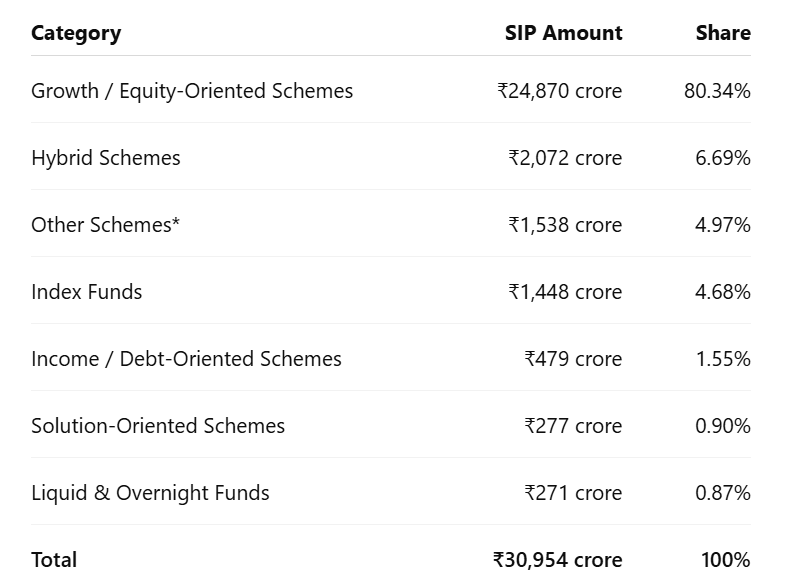
AMFI reported total SIP contributions of ₹30,954 crore in May 2026. An analysis of industry SIP allocation data published by CafeMutual shows that approximately ₹24,870 crore, or 80.34%, was directed to growth/equity-oriented mutual fund schemes during the month.
At first glance, the conclusion appears simple: Indian SIP investors overwhelmingly prefer equities.
A deeper look, however, reveals a more interesting trend. Equity's share of SIP money has remained broadly stable around 80%, while the absolute amount being invested through equity SIPs has increased substantially. At the same time, index funds, hybrid funds and other categories are also attracting meaningful amounts of incremental investment.
That makes the story less about investors becoming continuously more aggressive and more about the overall SIP ecosystem expanding while equity remains its core allocation.
The May 2026 SIP Allocation Picture
Based on the published category-wise industry analysis, SIP contributions in May 2026 were distributed approximately as follows:

*The “Other Schemes” classification in the underlying industry analysis includes categories such as domestic fund of funds and other eligible schemes.
The dominance of equity is clear. But comparing the current numbers with earlier periods gives investors a better perspective.
Equity SIP Money Has Increased Even Though Its Percentage Share Has Not
In May 2024, total SIP inflows in the category-wise dataset were approximately ₹20,904 crore, of which ₹17,060 crore went to equity-oriented schemes. By May 2026, total SIP flows had risen to ₹30,954 crore and equity SIP flows to ₹24,870 crore.
That represents roughly a 48% increase in total SIP flows over two years, while the amount directed to equity-oriented schemes increased by approximately 46%.
Yet equity's percentage share actually moved slightly lower—from 81.61% in May 2024 to 80.34% in May 2026.
This distinction matters.
The data does not necessarily show investors continually increasing the percentage of their SIP portfolios allocated to equity. Instead, it suggests that the entire SIP market has become substantially larger, with equity continuing to capture roughly four out of every five rupees invested through SIPs.
In other words, equity remains dominant, but diversification outside traditional active equity funds is also becoming more visible.
T30 and B30 Investors Show Similar Equity Preference
Another interesting feature of the data is the similarity between investors in India's largest cities and those outside them.
T30 refers broadly to the top 30 locations by mutual fund business, while B30 represents locations beyond those top 30 centres.
In May 2026, equity-oriented schemes accounted for roughly 80% of SIP allocations in T30 locations and around 81% in B30 locations.
The difference is relatively small.
This suggests that equity participation through SIPs is no longer predominantly a large-metro phenomenon. Investors outside the largest financial centres are also using systematic investing extensively to gain equity-market exposure.
However, this should not be interpreted to mean that B30 households necessarily have more aggressive overall portfolios than T30 households.
The data shows where their SIP money is going. It does not reveal their complete household balance sheets, which may also include bank deposits, gold, property, provident funds, insurance products, direct equities and other investments.
That distinction is important when interpreting investor risk appetite.
Index Funds Are Becoming a More Meaningful Part of SIP Investing
Traditional equity-oriented mutual funds remain dominant, but index funds are becoming more relevant.
Industry data shows approximately ₹1,448 crore of SIP money went into index funds in May 2026, representing about 4.68% of total SIP flows in the category-wise analysis.
This is still small compared with actively managed equity funds, but it indicates that passive investing has established a meaningful position within India's SIP ecosystem.
The growth of index investing may reflect several trends:
- greater awareness of passive investing;
- increased availability of index products;
- growing investor focus on costs;
- easier access through digital investment platforms;
- increasing familiarity with benchmark-based investing.
Passive and active investing do not necessarily have to be viewed as competing approaches. Many investors may eventually use both—active funds for selected exposures and index funds for broad-market allocation.
Hybrid Funds Continue to Play a Diversification Role
Hybrid schemes received approximately ₹2,072 crore, or 6.69% of SIP allocations, in May 2026.
Hybrid funds combine equity and debt in varying proportions depending on the scheme category and investment mandate.
Their continued share of SIP flows suggests that a segment of investors prefers a more diversified structure rather than taking pure equity exposure through every SIP.
This becomes particularly relevant for investors whose risk tolerance, financial goals or investment horizon may not justify a very high equity allocation.
The popularity of equity SIPs should therefore not be interpreted as evidence that every investor should maintain an 80% equity portfolio.
Debt and Liquid Funds Have a Much Smaller SIP Share
Debt-oriented schemes accounted for approximately 1.55%, while liquid and overnight funds represented less than 1% of the category-wise SIP flows in May 2026.
That may partly reflect the way these products are commonly used.
Equity mutual funds naturally fit the long-term, recurring-investment behaviour associated with SIPs. Liquid and short-duration debt products, in contrast, are often used for liquidity management, parking surplus cash or shorter-term financial requirements, where lump-sum investing can be more common.
Therefore, a low share of SIP flows into debt funds should not automatically be interpreted as Indian investors having little exposure to fixed-income assets overall.
SIP statistics represent only one part of household investment behaviour.
What Does the 80% Equity Figure Actually Tell Us?
The data highlights several broad trends in India's mutual fund market.
1. Equity remains the foundation of SIP investing
Despite periods of market volatility, equity-oriented funds continue to receive the majority of systematic investment flows.
That suggests many investors increasingly see SIPs as a long-term participation mechanism rather than something to start or stop based solely on short-term market movements.
2. SIP participation itself is expanding
The rise from roughly ₹20,904 crore in total monthly SIP flows in May 2024 to ₹30,954 crore in May 2026 is arguably more significant than the 80% equity headline.
It indicates significant growth in the amount of money being invested systematically.
3. Smaller-city participation is important
The similar equity preference across T30 and B30 locations shows that systematic equity investing has spread well beyond India's largest metropolitan markets.
4. Investors are not allocating everything to traditional active equity funds
Index funds, hybrid funds and other categories together account for a meaningful portion of SIP money.
That suggests the Indian mutual fund market is gradually becoming broader and more diverse.
What the 80% Statistic Does Not Mean
Financial statistics can easily be misunderstood when viewed without context.
The 80% figure does not mean that:
- 80% of all Indian household savings are invested in equities;
- 80% of total mutual fund industry assets are necessarily in equity funds;
- every SIP investor has 80% of their portfolio invested in equities;
- investors should maintain an 80% equity allocation;
- equity funds will necessarily outperform other asset classes;
- high SIP participation eliminates equity-market risk.
It means that approximately 80% of the SIP flows represented in this particular category-wise industry dataset for May 2026 were directed toward growth/equity-oriented schemes.
That is a much narrower—and more accurate—interpretation.
What Investors Can Learn From the Trend
The most useful takeaway from the data is not that investors should simply copy the majority.
Instead, the numbers demonstrate the growing importance of systematic, goal-oriented investing in India.
A suitable asset allocation depends on factors such as:
- investment horizon;
- financial goals;
- ability to tolerate market declines;
- income stability;
- emergency liquidity requirements;
- existing investments and liabilities;
- overall household asset allocation.
An investor saving for a goal 15 years away may have a very different appropriate equity allocation from someone who expects to need the money within two years.
Market popularity should never replace individual suitability.
The Bigger Picture: SIPs Are Becoming Embedded in Indian Investing
AMFI's latest data shows the scale at which SIP investing is now operating. Total SIP contributions reached ₹30,954 crore in May 2026, and AMFI's published monthly records continue to track the expansion of systematic investment activity across the mutual fund industry.
The approximately 80% allocation to equity-oriented schemes reinforces the long-term role that equity mutual funds currently play within this system.
But the more important development may be broader:
Indian investors are putting significantly more money into SIPs overall, while gradually using a wider mix of equity, passive, hybrid and other investment products.
That is a sign of an evolving investment market rather than simply a story about investors chasing equity returns.
Key Takeaway
More than four-fifths of SIP flows in the May 2026 category-wise industry analysis went to equity-oriented mutual fund schemes. But the underlying trend is more nuanced.
Equity's percentage share has remained broadly stable, while the absolute amount invested through SIPs has risen sharply. Meanwhile, index funds, hybrid schemes and other categories are becoming meaningful parts of the systematic-investment landscape.
For investors, the lesson is not to follow the 80% figure blindly. It is to recognize the growing role of disciplined investing while choosing an asset allocation suited to personal goals, time horizon and risk tolerance.
Data Sources and Methodology
Primary source: Association of Mutual Funds in India (AMFI) — monthly SIP contribution and mutual fund industry data, May 2026.
Category-wise reference: Industry SIP allocation analysis published by CafeMutual on July 14, 2026, based on AMFI/industry SIP asset-allocation data.
LiveWorldMarket has independently interpreted the published figures for educational purposes. Percentage comparisons and growth calculations in this article are derived from the reported underlying numbers.
Disclaimer
This article is intended solely for educational and informational purposes. It does not constitute investment advice, a recommendation to invest in any particular mutual fund category, or a solicitation to buy or sell any financial product.
Mutual fund investments are subject to market risks. Investors should read all scheme-related documents carefully and consider their financial objectives, investment horizon and risk profile before making investment decisions.
Comments (0)
Be the first to comment.
About the author

NISM-Series-X-A Investment Adviser Level 1 examination completed
Amit writes about Indian equity markets, technical analysis, macro themes and the day-to-day mechanics of trading, with a focus on making the flow of global markets legible for retail investors. He has completed the NISM-Series-X-A Investment Adviser Level 1 examination.
You May Also Like

Big Tech Gains $750B as AI Data Centre Stocks Crash
Global Markets & Economy · Nov 5, 2026 · 12 min read
Big Tech Gains $750 Billion After US Midterms, but AI Data-Centre Stocks Crash: Is Wall Street Rewarding Less AI Spending? Key Takeaway: Wall Street's reaction to the 2026 US midterm elections has exposed a surprising divide in the artificial intelligence investment boom. Established technology giants rallied, with five major companies on course to add more than $750 billion…
Read more...
US Midterm Elections 2026: Impact on Stocks, Dollar & India
Global Markets & Economy · Nov 4, 2026 · 10 min read
US Midterm Elections 2026: Why Treasury Yields, the Dollar and Indian Stocks Could React More Than Wall Street Key Takeaway: Democrats have won control of both chambers of the US Congress in the 2026 midterm elections, creating a divided government under President Donald Trump. The immediate market reaction has been revealing: US Treasury yields declined, the dollar weakened…
Read more...
Apple Overtakes Nvidia: Is Lower AI Spending Winning?
Technology & Sectors · Nov 2, 2026 · 9 min read
Apple Overtakes Nvidia as World's Most Valuable Company Ahead of Earnings: Is Spending Less on AI Becoming Wall Street's Winning Strategy? Key takeaway: Apple has reclaimed the title of the world's most valuable publicly traded company, overtaking Nvidia as investors reassess the enormous cost of artificial intelligence infrastructure. With Apple's upcoming earnings in focus…
Read more...
ExxonMobil Refining Profits Surge: Impact on Indian Oil Stocks
Commodities & Energy · Nov 1, 2026 · 8 min read
ExxonMobil's Refining Profits Overtake Oil Drilling for First Time in 6 Years: Why India's Oil Stocks May Miss the Windfall Key Takeaway: ExxonMobil's refining business has emerged as a bigger earnings contributor than oil production, highlighting an extraordinary shift in global energy markets. But Indian oil companies such as IOC, BPCL and HPCL face a different challenge…
Read more...
Fed Decision and Microsoft–Google Earnings: Two Critical Tests for the AI Stock Market Rally
Global Markets & Economy · Oct 28, 2026 · 15 min read
Global stock markets are approaching one of the most important financial evenings of October 2026. The U.S. Federal Reserve is preparing to announce its latest interest-rate decision, while Microsoft and Alphabet, Google's parent company, are scheduled to publish quarterly earnings after Wall Street closes. These developments arrive as investors reassess the sustainability of…
Read more...
JetBlue Stock Surges 20%, Bond Yield Tops 30%: Warning?
Global Markets & Economy · Oct 28, 2026 · 16 min read
JetBlue Stock Surges 20% While Its Bonds Yield Over 30%: Is Airline Debt Flashing a Warning for Investors? Something unusual is happening in the U.S. airline industry. Shares of JetBlue Airways surged approximately 20% on October 27, after the airline raised its revenue outlook and attempted to reassure investors about its financial position. But an entirely different story…
Read more...
US Consumer Staples Rally 9.6%: FMCG Valuation Risk for India
Global Markets & Economy · Oct 25, 2026 · 16 min read
US Consumer Staples Surge 9.6% as Valuations Overtake Tech: Is the Safe-Stock Trade Becoming a Trap for Indian FMCG Investors? Something unexpected is happening on Wall Street. As investors become increasingly cautious about expensive artificial intelligence stocks, money has been moving into an unlikely market leader: consumer staples. The U.S. consumer-staples sector has…
Read more...
SpaceX 80,000 Cell Sites: Will Starlink Challenge Jio & Airtel?
Global Markets & Economy · Oct 24, 2026 · 17 min read
SpaceX's 80,000 Cell-Site Plan Sends US Telecom Stocks Down 8%: Could Starlink Disrupt Jio and Airtel Next? A major shift may be emerging in the global telecommunications industry—and Wall Street has already started reacting. Shares of American telecommunications giants AT&T and T-Mobile plunged nearly 8% on October 23 after reports revealed that Elon Musk's SpaceX was…
Read more...
US 10-Year Treasury Yield Below 5%: Growth Shock Warning?
Central Banks & Rates · Oct 23, 2026 · 17 min read
US 10-Year Treasury Yield Falls Below 5% Despite $114 Oil: Is the Bond Market Warning of a Global Growth Shock? Something unusual is happening across global financial markets. The yield on the benchmark U.S. 10-year Treasury has fallen sharply below the psychologically important 5% level, even as Brent crude oil has surged toward $114 per barrel and technology stocks have…
Read more...
Brent Crude Tops $110: Impact on Indian Stocks & Earnings
Global Markets & Economy · Oct 22, 2026 · 14 min read
Brent Crude Tops $110: Why Indian Airlines, Paints and Tyre Stocks Face a Hidden Earnings Risk Brent crude oil has climbed above $110 per barrel, intensifying concerns that rising global energy prices could squeeze corporate profit margins, increase India's import costs and create further volatility in domestic equities. On October 22, Brent futures traded above $111 after…
Read more...