
India’s Biggest Demerger Pipeline: Can Corporate Restructuring Unlock Shareholder Value?
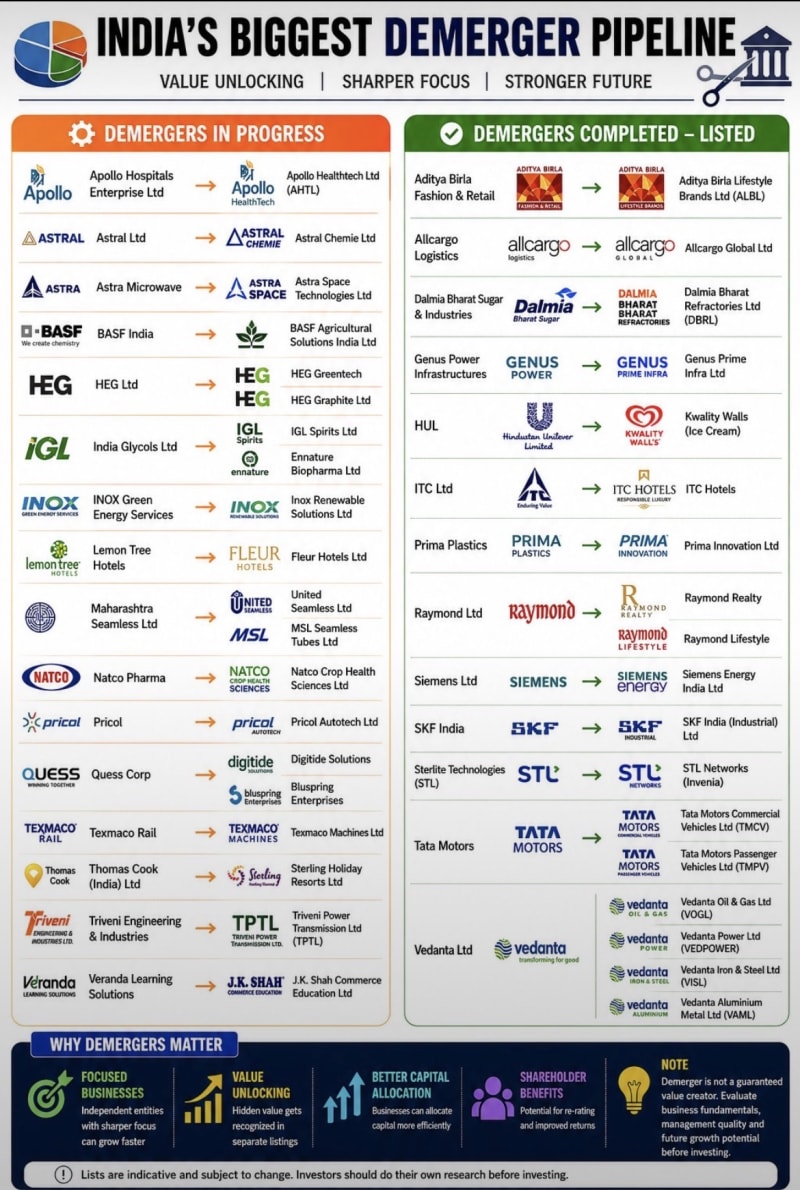
India’s corporate sector is witnessing a strong wave of demergers and business restructurings. Large companies are separating divisions into independent entities to create sharper management focus, improve capital allocation and potentially unlock value for shareholders.
From hospitality and automobiles to consumer goods, pharmaceuticals, logistics and renewable energy, several well-known companies have either completed demergers or announced plans to separate their businesses.
However, investors should remember that a demerger does not automatically create wealth. The long-term outcome depends on the quality, profitability, debt position and growth potential of each resulting company.
What Is a Demerger ?
A demerger is a corporate restructuring process in which a company transfers one or more business divisions into a separate entity.
Depending on the approved scheme, existing shareholders may receive shares in the newly created company according to a predetermined entitlement ratio.
For example, a diversified company may separate its hotel, energy, real-estate or consumer-products division so that each business can operate independently.
Major Completed Demergers
1. ITC and ITC Hotels
ITC separated its hotel business into ITC Hotels Limited, with the scheme becoming effective from January 1, 2025. ITC retained a strategic stake, while the remaining ownership was distributed among ITC shareholders under the approved arrangement. ITC Hotels subsequently became a separately listed company. (ITC Portal)
The restructuring allows ITC’s core businesses and the hotel company to pursue their individual growth strategies with more appropriate capital structures.
2. Tata Motors Business Separation
Tata Motors implemented a restructuring that separated its commercial-vehicle business from the passenger-vehicle, electric-vehicle and Jaguar Land Rover operations.
The scheme became effective on October 1, 2025, creating two distinct listed automobile businesses with different investment requirements, demand cycles and growth drivers. (Tata Motors)
This separation can help investors evaluate the commercial-vehicle and passenger-vehicle operations independently.
3. Hindustan Unilever and Kwality Wall’s
Hindustan Unilever separated its ice-cream business into Kwality Wall’s (India) Limited. The structure was designed to give the ice-cream business greater operational flexibility and an independent growth strategy.
The approved entitlement ratio provided one Kwality Wall’s share for every eligible HUL share held on the record date. (Unilever)
Ice cream requires a specialised cold-chain network and has a business model that is different from several other fast-moving consumer-goods categories.

Other Prominent Restructurings
The broader demerger landscape highlighted in the accompanying infographic includes companies and groups such as:
- Siemens and Siemens Energy India
- Raymond, Raymond Realty and Raymond Lifestyle
- Vedanta and its proposed sector-focused businesses
- Aditya Birla Fashion and Retail
- Allcargo Logistics
- Genus Power Infrastructures
- SKF India
- Sterlite Technologies
- Dalmia Bharat Sugar and Industries
The image also highlights proposed or developing restructurings involving Apollo Hospitals Enterprise, Astral, Astra Microwave, BASF India, HEG, India Glycols, Inox Green Energy Services, Lemon Tree Hotels, Natco Pharma, Pricol, Quess Corp, Texmaco Rail, Thomas Cook India and other companies.
The status, timetable and structure of these transactions can change because demergers generally require approvals from company boards, shareholders, lenders, stock exchanges, regulators and the National Company Law Tribunal.
Why Are Indian Companies Choosing Demergers?
Sharper Business Focus
An independent company can develop a strategy specifically suited to its market. Its management no longer needs to compete with unrelated divisions for attention and resources.
Better Capital Allocation
Different businesses have different funding requirements. A capital-intensive manufacturing division may need a financing structure very different from that of an asset-light services business.
After separation, each company can raise and deploy capital according to its own needs.
Improved Financial Transparency
A separately listed business provides investors with clearer information about its revenue, margins, debt, cash flow and return ratios.
This can make it easier to identify which division is creating value and which one is under performing.
Potential Value Discovery
A high-growth business may not receive an appropriate valuation while it remains part of a diversified parent company. Independent listing can allow the market to value that business against specialized peers.
Nevertheless, value discovery may work in either direction. A newly listed company can trade below investors’ expectations when its fundamentals are weak or its initial valuation is expensive.
What Should Investors Examine?
Before investing purely because of a demerger announcement, investors should study:
Business fundamentals: Check revenue growth, operating margins, cash generation and competitive position.
Debt allocation: Understand how loans and financial obligations will be divided between the parent and the resulting company.
Share-entitlement ratio: Review how many shares investors will receive and whether any fractional entitlement rules apply.
Management quality: Examine the leadership team, corporate-governance record and related-party transactions.
Capital requirements: Determine whether the separated company will require frequent borrowing or equity dilution.
Valuation: Compare the new company with appropriate listed peers instead of assuming that every independent listing will command a premium.
Implementation status: Distinguish between a board proposal, shareholder approval, NCLT approval, scheme effectiveness and actual stock-exchange listing.
Can a Demerger Create Wealth?
A well-planned demerger can create value by removing organisational complexity and allowing each business to follow an independent strategy.
However, the corporate action itself does not improve sales, profitability or cash flow overnight. Shareholder wealth is ultimately created when the resulting businesses deliver sustainable earnings growth and use capital efficiently.
Investors should therefore view demergers as a starting point for detailed research, rather than an automatic buy signal.
Conclusion
India’s growing demerger pipeline reflects an important shift toward focused and independently managed businesses. Companies are increasingly recognizing that unrelated divisions may receive better strategic attention and market valuations when operated separately.
For investors, these restructurings can provide opportunities to participate in specialized businesses. At the same time, careful analysis of debt, valuation, management quality and future growth remains essential.
Disclaimer: This article is intended exclusively for educational and informational purposes. It does not constitute investment advice, a stock recommendation or an offer to buy or sell securities. Investors should conduct independent research and consult a SEBI-registered investment adviser where appropriate.
#Demerger #IndianStockMarket #StockMarketIndia #CorporateActions #Investing #ShareMarket #ValueInvesting #ITC #TataMotors #LiveWorldMarket
Comments (0)
Be the first to comment.
About the author

NISM-Series-X-A Investment Adviser Level 1 examination completed
Amit writes about Indian equity markets, technical analysis, macro themes and the day-to-day mechanics of trading, with a focus on making the flow of global markets legible for retail investors. He has completed the NISM-Series-X-A Investment Adviser Level 1 examination.
You May Also Like

Big Tech Gains $750B as AI Data Centre Stocks Crash
Global Markets & Economy · Nov 5, 2026 · 12 min read
Big Tech Gains $750 Billion After US Midterms, but AI Data-Centre Stocks Crash: Is Wall Street Rewarding Less AI Spending? Key Takeaway: Wall Street's reaction to the 2026 US midterm elections has exposed a surprising divide in the artificial intelligence investment boom. Established technology giants rallied, with five major companies on course to add more than $750 billion…
Read more...
US Midterm Elections 2026: Impact on Stocks, Dollar & India
Global Markets & Economy · Nov 4, 2026 · 10 min read
US Midterm Elections 2026: Why Treasury Yields, the Dollar and Indian Stocks Could React More Than Wall Street Key Takeaway: Democrats have won control of both chambers of the US Congress in the 2026 midterm elections, creating a divided government under President Donald Trump. The immediate market reaction has been revealing: US Treasury yields declined, the dollar weakened…
Read more...
Apple Overtakes Nvidia: Is Lower AI Spending Winning?
Technology & Sectors · Nov 2, 2026 · 9 min read
Apple Overtakes Nvidia as World's Most Valuable Company Ahead of Earnings: Is Spending Less on AI Becoming Wall Street's Winning Strategy? Key takeaway: Apple has reclaimed the title of the world's most valuable publicly traded company, overtaking Nvidia as investors reassess the enormous cost of artificial intelligence infrastructure. With Apple's upcoming earnings in focus…
Read more...
ExxonMobil Refining Profits Surge: Impact on Indian Oil Stocks
Commodities & Energy · Nov 1, 2026 · 8 min read
ExxonMobil's Refining Profits Overtake Oil Drilling for First Time in 6 Years: Why India's Oil Stocks May Miss the Windfall Key Takeaway: ExxonMobil's refining business has emerged as a bigger earnings contributor than oil production, highlighting an extraordinary shift in global energy markets. But Indian oil companies such as IOC, BPCL and HPCL face a different challenge…
Read more...
Fed Decision and Microsoft–Google Earnings: Two Critical Tests for the AI Stock Market Rally
Global Markets & Economy · Oct 28, 2026 · 15 min read
Global stock markets are approaching one of the most important financial evenings of October 2026. The U.S. Federal Reserve is preparing to announce its latest interest-rate decision, while Microsoft and Alphabet, Google's parent company, are scheduled to publish quarterly earnings after Wall Street closes. These developments arrive as investors reassess the sustainability of…
Read more...
JetBlue Stock Surges 20%, Bond Yield Tops 30%: Warning?
Global Markets & Economy · Oct 28, 2026 · 16 min read
JetBlue Stock Surges 20% While Its Bonds Yield Over 30%: Is Airline Debt Flashing a Warning for Investors? Something unusual is happening in the U.S. airline industry. Shares of JetBlue Airways surged approximately 20% on October 27, after the airline raised its revenue outlook and attempted to reassure investors about its financial position. But an entirely different story…
Read more...
US Consumer Staples Rally 9.6%: FMCG Valuation Risk for India
Global Markets & Economy · Oct 25, 2026 · 16 min read
US Consumer Staples Surge 9.6% as Valuations Overtake Tech: Is the Safe-Stock Trade Becoming a Trap for Indian FMCG Investors? Something unexpected is happening on Wall Street. As investors become increasingly cautious about expensive artificial intelligence stocks, money has been moving into an unlikely market leader: consumer staples. The U.S. consumer-staples sector has…
Read more...
SpaceX 80,000 Cell Sites: Will Starlink Challenge Jio & Airtel?
Global Markets & Economy · Oct 24, 2026 · 17 min read
SpaceX's 80,000 Cell-Site Plan Sends US Telecom Stocks Down 8%: Could Starlink Disrupt Jio and Airtel Next? A major shift may be emerging in the global telecommunications industry—and Wall Street has already started reacting. Shares of American telecommunications giants AT&T and T-Mobile plunged nearly 8% on October 23 after reports revealed that Elon Musk's SpaceX was…
Read more...
US 10-Year Treasury Yield Below 5%: Growth Shock Warning?
Central Banks & Rates · Oct 23, 2026 · 17 min read
US 10-Year Treasury Yield Falls Below 5% Despite $114 Oil: Is the Bond Market Warning of a Global Growth Shock? Something unusual is happening across global financial markets. The yield on the benchmark U.S. 10-year Treasury has fallen sharply below the psychologically important 5% level, even as Brent crude oil has surged toward $114 per barrel and technology stocks have…
Read more...
Brent Crude Tops $110: Impact on Indian Stocks & Earnings
Global Markets & Economy · Oct 22, 2026 · 14 min read
Brent Crude Tops $110: Why Indian Airlines, Paints and Tyre Stocks Face a Hidden Earnings Risk Brent crude oil has climbed above $110 per barrel, intensifying concerns that rising global energy prices could squeeze corporate profit margins, increase India's import costs and create further volatility in domestic equities. On October 22, Brent futures traded above $111 after…
Read more...