
India Leads Asian FPI Inflows in July 2026: What Drove the Foreign Investor Comeback?
Foreign portfolio investors returned to Indian equities in July 2026 after several months of heavy selling.
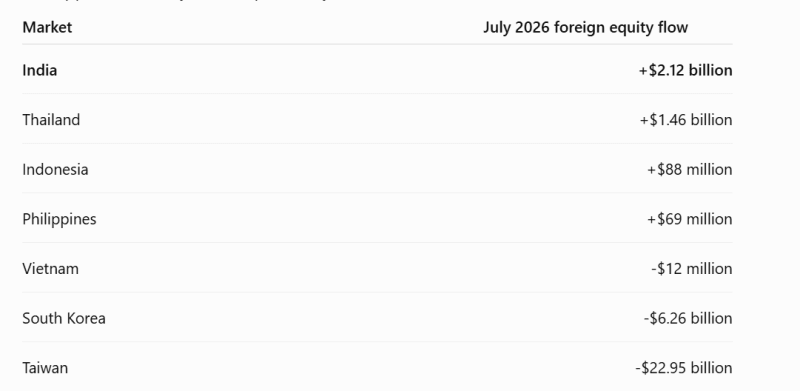
According to LSEG data reported by Reuters, overseas investors purchased approximately $2.12 billion of Indian equities during July.
Among the Asian markets that recorded positive foreign flows in the comparison, India received the largest amount.
Thailand followed with approximately $1.46 billion, while Indonesia and the Philippines attracted much smaller inflows of around $88 million and $69 million respectively.
At first glance, this looks like a major vote of confidence in India.
But the full regional picture is more complicated.
Foreign investors actually withdrew approximately $25.48 billion from the seven Asian equity markets tracked in the dataset during July, largely because technology-heavy Taiwan and South Korea experienced enormous selling.
Understanding that distinction provides a much more useful picture of India's relative attractiveness.
July 2026 Foreign Equity Flows Across Asia
The approximate July flows reported by Reuters/LSEG were:

India therefore led the markets receiving inflows, but regional flows remained deeply negative overall.
This distinction should be made prominently in the article.
Why Did Foreign Investors Return to India?
Several factors appear to have contributed.
One was simply relative positioning.
Foreign investors had already withdrawn substantial amounts from Indian equities before July. Reuters reported that foreign investors had removed more than $50 billion from Indian stocks between October 2024 and June 2026, leaving foreign ownership at a 17-year low.
After such prolonged selling, valuations and positioning in parts of the Indian market began to look different compared with markets where international investors had built very large technology exposures.
July therefore represented a partial reversal of previous selling, rather than evidence that foreign investors had suddenly become universally bullish on India.
India Benefited From Rotation Away From AI-Heavy Markets
One of the most interesting developments during July occurred outside India.
Taiwan and South Korea had become major beneficiaries of the global artificial-intelligence investment boom because of their large semiconductor and technology industries.
But investor sentiment changed as concerns increased about:
- AI infrastructure spending;
- corporate cash burn;
- semiconductor demand;
- leverage; and
- extremely crowded technology positions.
Foreign investors withdrew approximately $22.95 billion from Taiwan and $6.26 billion from South Korea in July.
This encouraged some international investors to search for markets with different sector exposure.
India is comparatively less dependent on semiconductor hardware.
Its major indices have greater exposure to:
- banks;
- financial services;
- consumer companies;
- industrials;
- pharmaceuticals;
- energy;
- automobiles; and
- domestic services.
That made India one possible diversification destination when investors reduced exposure to heavily crowded AI trades.
Was India an “Anti-AI Trade”?
Some market commentary began describing India as an “anti-AI trade.”
The phrase does not mean India has no AI opportunity.
Instead, it refers to India's different stock-market composition.
South Korea and Taiwan contain major semiconductor businesses directly exposed to global AI infrastructure spending.
India's benchmark indices are more heavily influenced by domestic financial services, consumption and industrial activity.
When global investors became more cautious about AI-related valuations, India's lower direct semiconductor concentration temporarily became a relative advantage.
Reuters commentary in early August noted that this differentiation, alongside domestic economic resilience, helped renew investor interest in Indian equities.
However, the “anti-AI” label should not be taken literally.
India itself is receiving substantial investment in AI infrastructure, cloud computing and data centres.
Indian Corporate Earnings Also Improved
Foreign investors do not make allocation decisions solely on sector composition.
Corporate earnings matter.
Indian companies showed stronger earnings momentum during the June 2026 quarter, giving investors more confidence that profit growth could support valuations.
This matters because India has historically traded at a premium to several other emerging markets.
A high valuation can remain sustainable if corporate profits grow quickly enough.
If earnings disappoint, however, international investors may decide that the valuation premium is too large.
July's foreign buying therefore needs to be considered alongside improving corporate earnings rather than interpreted only as a reaction to global technology volatility.
Which Indian Sectors Attracted FPI Buying?
The foreign-investor comeback was not evenly distributed across all sectors.
NSDL data for the first half of July showed particularly strong foreign buying in:
- consumer services: around ₹7,361 crore;
- metals and mining: around ₹5,993 crore; and
- healthcare: around ₹4,101 crore.
Meanwhile, sectors including automobiles, auto components and capital goods experienced selling during the same period.
This is another reason why the headline:
“FPIs returned to India”
does not mean foreign investors were buying everything.
Institutional investors continuously rotate between industries depending on valuation, earnings expectations and global conditions.
How Was July Different From the Previous Four Months?
The July inflows were especially notable because they followed a prolonged period of selling.
Foreign portfolio investors had been net sellers during the previous four months.
For example, reported equity outflows included approximately:
- March: ₹1.17 lakh crore;
- April: ₹60,847 crore;
- May: ₹32,963 crore; and
- June: ₹49,340 crore.
The return to net buying in July therefore represented a meaningful change in short-term behaviour.
But one positive month does not automatically establish a new long-term trend.
FPI and FDI Are Not the Same
This is worth explaining because the terms are frequently confused.
FPI — Foreign Portfolio Investment
Generally refers to foreign investment in financial assets such as listed equities and bonds.
These flows can change rapidly.
FDI — Foreign Direct Investment
Typically refers to longer-term investment involving ownership or strategic participation in businesses and productive assets.
An FPI investor can purchase shares today and sell relatively quickly.
An FDI investor generally has a different economic objective.
Therefore, July's FPI inflows should not be confused with India's broader foreign-direct-investment statistics.
Foreign Buying Does Not Guarantee Rising Stock Prices
Another important AdSense/YMYL point is to avoid presenting FPI inflows as a buy signal.
Foreign investors can be wrong.
They can also reverse their positions quickly.
A stock or index can fall despite FPI buying if:
- domestic investors sell;
- earnings disappoint;
- valuations decline;
- crude oil rises;
- the rupee weakens;
- global bond yields increase; or
- geopolitical risks intensify.
FPI data are useful for understanding liquidity and institutional positioning.
They do not predict market direction with certainty.
Domestic Investors Remain Extremely Important
India's market structure has changed substantially because domestic mutual funds and retail investors now provide a large and relatively consistent source of equity-market liquidity.
Even while foreign investors were selling aggressively earlier in 2026, domestic participation helped prevent a significantly larger decline.
Monthly SIP contributions into Indian mutual funds have remained substantial.
In July, equity mutual funds still recorded approximately ₹24,697 crore of net inflows, despite flows declining from June. SIP contributions remained close to record levels at approximately ₹31,961 crore.
This means India's equity market can no longer be analysed solely through foreign flows.
The interaction among FPIs, domestic institutions and retail investors matters.
Why Crude Oil Remains a Risk
One reason foreign investors could change their view again is oil.
India imports a large proportion of its crude requirements.
Sustained high crude prices can potentially:
- increase India's import bill;
- worsen inflation;
- pressure the rupee;
- increase corporate costs; and
- complicate monetary policy.
The renewed U.S.–Iran tensions during 2026 have therefore remained important for India's foreign-investment outlook.
Strong earnings may attract foreign investors, while simultaneously high oil prices can create pressure in the opposite direction.
Global Bond Yields Also Matter
Foreign investors compare Indian equities with opportunities available elsewhere.
If U.S. Treasury yields rise substantially, investors can earn higher returns from comparatively lower-risk dollar assets.
This can make emerging-market equities relatively less attractive.
India's FPI flows are therefore influenced by both domestic conditions and international financial markets.
Important variables include:
- U.S. Treasury yields;
- Federal Reserve policy;
- the dollar;
- USD/INR;
- global risk sentiment; and
- emerging-market valuations.
Does July Signal a Long-Term FPI Comeback?
It is too early to make that conclusion.
July represented an important improvement, but foreign participation in Indian equities remains low by historical standards.
As of August, foreign ownership of Indian equities remained around a 17-year low, while SEBI was working on market reforms designed partly to improve accessibility and attract international capital.
A sustained FPI recovery would probably require a combination of:
- continued earnings growth;
- reasonable valuations;
- manageable crude-oil prices;
- currency stability;
- competitive returns relative to other markets; and
- confidence in India's longer-term economic growth.
One month alone cannot establish all of these conditions.
Final Takeaway
India's approximately $2.12 billion of foreign equity inflows in July 2026 represented an important reversal after several months of heavy foreign selling.
Among Asian markets recording inflows, India attracted the largest amount, ahead of Thailand, Indonesia and the Philippines.
But the wider Asian picture remained weak.
Taiwan and South Korea suffered enormous withdrawals as investors reconsidered crowded semiconductor and AI-related positions, causing the seven Asian markets included in the comparison to record a combined $25.48 billion net outflow.
India's July performance should therefore be understood as relative resilience and renewed international interest, rather than evidence of a broad Asian capital-inflow boom.
For investors, FPI data are best used alongside corporate earnings, valuations, domestic institutional flows, crude oil, bond yields and currency movements.
Foreign inflows can influence market liquidity.
They cannot guarantee future stock-market returns.
Data note: Cross-market foreign equity-flow figures refer to full-month July 2026 LSEG data reported by Reuters. Different databases can produce slightly different totals because of methodology, reporting dates and whether primary-market transactions are included.
Disclaimer: This article is for educational and informational purposes only. FPI activity does not constitute an investment signal or recommendation. Equity investments involve market risk, and institutional flows can change rapidly.
Helpful Resources on LiveWorldMarket
India Stock Market Dashboard — Track Nifty 50, Sensex, Bank Nifty, India VIX, sector performance and current market conditions.
Open India Stock Market Dashboard
FII/DII and Pre-Market Briefing — Follow institutional flows alongside GIFT Nifty, global markets, crude oil and USD/INR before the Indian market opens.
Post-Market Wrap — Review daily institutional activity, sector rotation and the major drivers of Nifty and Sensex.
Nifty July 2026 Performance — See how FPI buying, IT-sector strength and crude-oil volatility affected the completed July market return.
Comments (0)
Be the first to comment.
About the author

NISM-Series-X-A Investment Adviser Level 1 examination completed
Amit writes about Indian equity markets, technical analysis, macro themes and the day-to-day mechanics of trading, with a focus on making the flow of global markets legible for retail investors. He has completed the NISM-Series-X-A Investment Adviser Level 1 examination.
You May Also Like

Big Tech Gains $750B as AI Data Centre Stocks Crash
Global Markets & Economy · Nov 5, 2026 · 12 min read
Big Tech Gains $750 Billion After US Midterms, but AI Data-Centre Stocks Crash: Is Wall Street Rewarding Less AI Spending? Key Takeaway: Wall Street's reaction to the 2026 US midterm elections has exposed a surprising divide in the artificial intelligence investment boom. Established technology giants rallied, with five major companies on course to add more than $750 billion…
Read more...
US Midterm Elections 2026: Impact on Stocks, Dollar & India
Global Markets & Economy · Nov 4, 2026 · 10 min read
US Midterm Elections 2026: Why Treasury Yields, the Dollar and Indian Stocks Could React More Than Wall Street Key Takeaway: Democrats have won control of both chambers of the US Congress in the 2026 midterm elections, creating a divided government under President Donald Trump. The immediate market reaction has been revealing: US Treasury yields declined, the dollar weakened…
Read more...
Apple Overtakes Nvidia: Is Lower AI Spending Winning?
Technology & Sectors · Nov 2, 2026 · 9 min read
Apple Overtakes Nvidia as World's Most Valuable Company Ahead of Earnings: Is Spending Less on AI Becoming Wall Street's Winning Strategy? Key takeaway: Apple has reclaimed the title of the world's most valuable publicly traded company, overtaking Nvidia as investors reassess the enormous cost of artificial intelligence infrastructure. With Apple's upcoming earnings in focus…
Read more...
ExxonMobil Refining Profits Surge: Impact on Indian Oil Stocks
Commodities & Energy · Nov 1, 2026 · 8 min read
ExxonMobil's Refining Profits Overtake Oil Drilling for First Time in 6 Years: Why India's Oil Stocks May Miss the Windfall Key Takeaway: ExxonMobil's refining business has emerged as a bigger earnings contributor than oil production, highlighting an extraordinary shift in global energy markets. But Indian oil companies such as IOC, BPCL and HPCL face a different challenge…
Read more...
Fed Decision and Microsoft–Google Earnings: Two Critical Tests for the AI Stock Market Rally
Global Markets & Economy · Oct 28, 2026 · 15 min read
Global stock markets are approaching one of the most important financial evenings of October 2026. The U.S. Federal Reserve is preparing to announce its latest interest-rate decision, while Microsoft and Alphabet, Google's parent company, are scheduled to publish quarterly earnings after Wall Street closes. These developments arrive as investors reassess the sustainability of…
Read more...
JetBlue Stock Surges 20%, Bond Yield Tops 30%: Warning?
Global Markets & Economy · Oct 28, 2026 · 16 min read
JetBlue Stock Surges 20% While Its Bonds Yield Over 30%: Is Airline Debt Flashing a Warning for Investors? Something unusual is happening in the U.S. airline industry. Shares of JetBlue Airways surged approximately 20% on October 27, after the airline raised its revenue outlook and attempted to reassure investors about its financial position. But an entirely different story…
Read more...
US Consumer Staples Rally 9.6%: FMCG Valuation Risk for India
Global Markets & Economy · Oct 25, 2026 · 16 min read
US Consumer Staples Surge 9.6% as Valuations Overtake Tech: Is the Safe-Stock Trade Becoming a Trap for Indian FMCG Investors? Something unexpected is happening on Wall Street. As investors become increasingly cautious about expensive artificial intelligence stocks, money has been moving into an unlikely market leader: consumer staples. The U.S. consumer-staples sector has…
Read more...
SpaceX 80,000 Cell Sites: Will Starlink Challenge Jio & Airtel?
Global Markets & Economy · Oct 24, 2026 · 17 min read
SpaceX's 80,000 Cell-Site Plan Sends US Telecom Stocks Down 8%: Could Starlink Disrupt Jio and Airtel Next? A major shift may be emerging in the global telecommunications industry—and Wall Street has already started reacting. Shares of American telecommunications giants AT&T and T-Mobile plunged nearly 8% on October 23 after reports revealed that Elon Musk's SpaceX was…
Read more...
US 10-Year Treasury Yield Below 5%: Growth Shock Warning?
Central Banks & Rates · Oct 23, 2026 · 17 min read
US 10-Year Treasury Yield Falls Below 5% Despite $114 Oil: Is the Bond Market Warning of a Global Growth Shock? Something unusual is happening across global financial markets. The yield on the benchmark U.S. 10-year Treasury has fallen sharply below the psychologically important 5% level, even as Brent crude oil has surged toward $114 per barrel and technology stocks have…
Read more...
Brent Crude Tops $110: Impact on Indian Stocks & Earnings
Global Markets & Economy · Oct 22, 2026 · 14 min read
Brent Crude Tops $110: Why Indian Airlines, Paints and Tyre Stocks Face a Hidden Earnings Risk Brent crude oil has climbed above $110 per barrel, intensifying concerns that rising global energy prices could squeeze corporate profit margins, increase India's import costs and create further volatility in domestic equities. On October 22, Brent futures traded above $111 after…
Read more...