
How Gold and Silver Are Taxed in India in 2026: Physical Gold, ETFs, Mutual Funds and SGBs
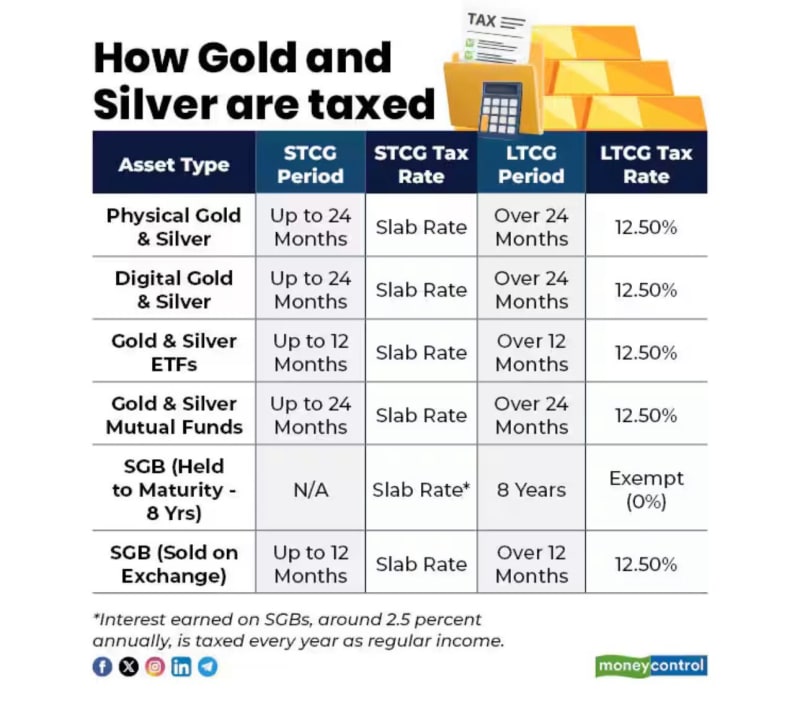
Gold and silver remain among the most widely used investment and savings assets in India. Investors can own them in several forms, including jewelry, coins, bars, digital gold, exchange-traded funds, mutual funds and Sovereign Gold Bonds.
Although all of these products provide some form of exposure to precious metals, their tax treatment is not identical.
The tax outcome can depend on:
- the form in which gold or silver is held;
- whether the investment is listed on a recognised stock exchange;
- how long it is held;
- whether the gain is short-term or long-term; and
- whether a special exemption applies.
For transactions during Tax Year 2026–27, investors should therefore identify the type of investment before calculating capital-gains tax.
Quick Tax Summary for 2026–27

The Income Tax Department's current capital-gains framework uses a 12-month period for listed securities and a 24-month period for most other assets. Long-term capital gains on assets outside the special equity provisions are generally taxed at 12.5%.
1. Tax on Physical Gold and Silver
Physical gold and silver include:
- jewelry;
- coins;
- bars; and
- bullion.
For an investor holding these assets as capital investments, the holding period is generally 24 months.
If the asset is sold after being held for 24 months or less, the gain is treated as short-term capital gain and is generally added to taxable income and taxed at the applicable income-tax slab rate.
If held for more than 24 months, the gain is generally treated as long-term capital gain and taxed at 12.5%, subject to applicable surcharge and cess.
The earlier indexation benefit that many investors associate with gold is no longer generally available under the post-July 2024 capital-gains framework.
Example
Suppose an investor buys gold worth ₹5 lakh and sells it after three years for ₹6.5 lakh.
The capital gain is:
₹6.5 lakh – ₹5 lakh = ₹1.5 lakh
Because the holding period exceeds 24 months, the gain would generally be treated as a long-term capital gain and taxed at the applicable LTCG rate.
This is a simplified example and does not include transaction expenses, surcharge or cess.
2. GST on Physical Gold and Silver
GST is an acquisition cost, not a capital-gains tax.
Gold and silver products falling under the relevant precious-metal headings generally attract 3% GST.
An important point for jewellery buyers is that CBIC has clarified that GST is payable at 3% on the total transaction value of jewellery, even when making charges are shown separately on the invoice.
The commonly repeated statement that a retail jewellery buyer automatically pays “3% GST on gold plus 5% GST on making charges” is therefore misleading.
The 5% rate referred to in CBIC guidance relates to qualifying job-work charges in the manufacturing chain.
3. Tax on Digital Gold and Silver
Digital gold and digital silver represent precious metals purchased through an online platform rather than through an exchange-traded fund.
For capital-gains purposes, they are generally treated more like physical precious metals than listed ETFs.
Therefore:
Held for 24 months or less:
The gain is generally short-term and taxed at the investor's applicable slab rate.
Held for more than 24 months:
The gain is generally long-term and taxed at 12.5%.
Digital precious-metal purchases can also involve GST at the purchase stage.
Investors should additionally understand that digital gold is structurally different from a regulated mutual fund or exchange-traded fund. Platform arrangements, custody and redemption terms should be reviewed separately from tax considerations.
4. Tax on Gold ETFs and Silver ETFs
Gold and Silver ETFs provide exchange-traded exposure to precious-metal prices.
Because these ETF units are listed securities, the holding-period rule is shorter than for physical gold.
A listed Gold or Silver ETF is generally considered:
- short-term when held for 12 months or less;
- long-term when held for more than 12 months.
Short-term gains are generally taxed at the applicable slab rate because Gold and Silver ETFs do not qualify for the special equity-oriented fund treatment under the short-term equity capital-gains provision.
Long-term gains are generally taxed at 12.5% without indexation.
This difference in holding period is important.
An investor selling physical gold after 18 months would generally have a short-term gain, while an investor selling a listed Gold ETF after the same 18-month period may have a long-term gain.
5. What Changed for Gold and Silver Mutual Funds?
Taxation of non-equity mutual funds has changed significantly over recent years, so older online articles can be misleading.
Section 50AA previously captured a much broader range of non-equity mutual funds.
From the relevant 2026 tax framework, the definition of a Specified Mutual Fund is focused on funds investing more than 65% in debt and money-market instruments, or funds investing at least 65% in units of such debt-oriented funds.
As a result, a conventional gold-oriented or silver-oriented fund is not automatically treated as a debt-oriented specified mutual fund merely because it is not an equity fund.
For a typical unlisted Gold or Silver mutual fund/Fund of Funds, the general holding-period framework can therefore result in:
- 24 months or less: short-term;
- more than 24 months: long-term.
Long-term gains are generally taxed at 12.5%, while short-term gains are generally taxed at the applicable slab rate.
However, investors should verify the actual scheme structure because taxation depends on the legal classification and portfolio of the particular fund.
6. Sovereign Gold Bonds: Important 2026 Change
Sovereign Gold Bonds have a special tax rule.
From April 1, 2026, the capital-gains exemption at redemption is available only when:
- the investor is an individual;
- the individual subscribed to the SGB at the time of original issue; and
- the bond is held continuously until redemption on maturity.
The Income Tax Department's Budget 2026 FAQ specifically states that the exemption does not apply to SGBs purchased in the secondary market and does not apply to premature redemption.
This is an important change because older articles often state simply that “SGB redemption is tax-free.”
That statement is no longer complete for Tax Year 2026–27.
If an SGB is sold on an exchange instead of qualifying for the maturity exemption, normal capital-gains rules can apply.
Because an exchange-listed SGB is a listed security, the 12-month listed-security holding-period rule can become relevant when determining whether the resulting gain is short-term or long-term.
7. Is Gold ETF LTCG Eligible for the ₹1.25 Lakh Equity Exemption?
Generally, no.
The ₹1.25 lakh annual exemption commonly discussed under the special long-term capital-gains rules relates to qualifying equity shares, equity-oriented funds and specified business-trust units.
Gold ETFs and Silver ETFs are not equity-oriented funds merely because they trade on a stock exchange.
Their long-term gains therefore generally fall under the ordinary 12.5% LTCG framework rather than the special equity exemption.
Investors should not confuse “listed security” with “equity-oriented fund.”
8. What Happens When Gold or Silver Is Inherited?
Receiving gold or silver through inheritance does not itself normally create a capital-gains event.
Capital gains become relevant when the inherited asset is subsequently sold.
In many inheritance situations, the previous owner's cost and holding period are relevant when calculating the eventual capital gain.
Therefore, families holding old jewellery or bullion should preserve purchase invoices, valuation records and inheritance documentation wherever possible.
If the original purchase dates or values are very old, additional tax rules may apply and professional advice may be useful.
9. Common Tax Mistakes to Avoid
A few mistakes appear repeatedly in gold and silver tax discussions.
Using the old 36-month holding period:
For current transactions, physical gold and silver generally use a 24-month threshold.
Assuming all gold investments have identical tax rules:
Physical gold, ETFs, mutual funds and SGBs can have different holding periods or exemptions.
Treating Gold ETFs like equity ETFs:
Gold ETFs are listed, but they are not equity-oriented funds.
Assuming SGB redemption is always tax-free:
From Tax Year 2026–27, the exemption has tighter conditions.
Applying old indexation rules:
The current LTCG framework generally uses 12.5% without indexation for these assets.
Ignoring purchase records:
Documentation can become important when calculating capital gains, particularly for physical or inherited gold.
Which Gold or Silver Product Is Most Tax-Efficient?
Tax should not be the only factor used to choose an investment.
An investor should also consider:
- liquidity;
- costs;
- tracking difference;
- storage;
- counterparty or platform risk;
- investment horizon;
- ease of buying and selling; and
- the purpose for owning precious metals.
For example, jewellery may provide personal utility but includes design and retail costs. ETFs may provide easier trading and shorter long-term holding periods. SGBs can have a special maturity exemption when all conditions are satisfied.
The most suitable option therefore depends on the investor's circumstances rather than on one tax rate.
Final Takeaway
Gold and silver taxation in India became simpler in some respects after the capital-gains reforms, but different investment formats still require different treatment.
For Tax Year 2026–27, the broad framework is:
Physical and digital gold/silver:
More than 24 months for long-term treatment.
Listed Gold and Silver ETFs:
More than 12 months for long-term treatment.
Typical Gold/Silver mutual funds or FoFs:
Generally more than 24 months for long-term treatment, subject to the scheme's classification.
Long-term capital gains:
Generally 12.5% without indexation.
Short-term capital gains:
Generally taxed at the applicable slab rate.
Sovereign Gold Bonds:
Capital-gains exemption at maturity is now conditional on original subscription by an individual and continuous holding until maturity.
Because tax rules can change and individual situations differ, investors should verify the latest provisions before filing their return.
Disclaimer: This article is for educational and informational purposes only. It does not constitute tax, legal or investment advice. Tax treatment depends on individual circumstances, asset classification and applicable law. Readers should refer to the Income Tax Department, CBIC and other official sources or consult a qualified tax professional before making tax decisions.
Comments (0)
Be the first to comment.
About the author

NISM-Series-X-A Investment Adviser Level 1 examination completed
Amit writes about Indian equity markets, technical analysis, macro themes and the day-to-day mechanics of trading, with a focus on making the flow of global markets legible for retail investors. He has completed the NISM-Series-X-A Investment Adviser Level 1 examination.
You May Also Like

Big Tech Gains $750B as AI Data Centre Stocks Crash
Global Markets & Economy · Nov 5, 2026 · 12 min read
Big Tech Gains $750 Billion After US Midterms, but AI Data-Centre Stocks Crash: Is Wall Street Rewarding Less AI Spending? Key Takeaway: Wall Street's reaction to the 2026 US midterm elections has exposed a surprising divide in the artificial intelligence investment boom. Established technology giants rallied, with five major companies on course to add more than $750 billion…
Read more...
US Midterm Elections 2026: Impact on Stocks, Dollar & India
Global Markets & Economy · Nov 4, 2026 · 10 min read
US Midterm Elections 2026: Why Treasury Yields, the Dollar and Indian Stocks Could React More Than Wall Street Key Takeaway: Democrats have won control of both chambers of the US Congress in the 2026 midterm elections, creating a divided government under President Donald Trump. The immediate market reaction has been revealing: US Treasury yields declined, the dollar weakened…
Read more...
Apple Overtakes Nvidia: Is Lower AI Spending Winning?
Technology & Sectors · Nov 2, 2026 · 9 min read
Apple Overtakes Nvidia as World's Most Valuable Company Ahead of Earnings: Is Spending Less on AI Becoming Wall Street's Winning Strategy? Key takeaway: Apple has reclaimed the title of the world's most valuable publicly traded company, overtaking Nvidia as investors reassess the enormous cost of artificial intelligence infrastructure. With Apple's upcoming earnings in focus…
Read more...
ExxonMobil Refining Profits Surge: Impact on Indian Oil Stocks
Commodities & Energy · Nov 1, 2026 · 8 min read
ExxonMobil's Refining Profits Overtake Oil Drilling for First Time in 6 Years: Why India's Oil Stocks May Miss the Windfall Key Takeaway: ExxonMobil's refining business has emerged as a bigger earnings contributor than oil production, highlighting an extraordinary shift in global energy markets. But Indian oil companies such as IOC, BPCL and HPCL face a different challenge…
Read more...
Fed Decision and Microsoft–Google Earnings: Two Critical Tests for the AI Stock Market Rally
Global Markets & Economy · Oct 28, 2026 · 15 min read
Global stock markets are approaching one of the most important financial evenings of October 2026. The U.S. Federal Reserve is preparing to announce its latest interest-rate decision, while Microsoft and Alphabet, Google's parent company, are scheduled to publish quarterly earnings after Wall Street closes. These developments arrive as investors reassess the sustainability of…
Read more...
JetBlue Stock Surges 20%, Bond Yield Tops 30%: Warning?
Global Markets & Economy · Oct 28, 2026 · 16 min read
JetBlue Stock Surges 20% While Its Bonds Yield Over 30%: Is Airline Debt Flashing a Warning for Investors? Something unusual is happening in the U.S. airline industry. Shares of JetBlue Airways surged approximately 20% on October 27, after the airline raised its revenue outlook and attempted to reassure investors about its financial position. But an entirely different story…
Read more...
US Consumer Staples Rally 9.6%: FMCG Valuation Risk for India
Global Markets & Economy · Oct 25, 2026 · 16 min read
US Consumer Staples Surge 9.6% as Valuations Overtake Tech: Is the Safe-Stock Trade Becoming a Trap for Indian FMCG Investors? Something unexpected is happening on Wall Street. As investors become increasingly cautious about expensive artificial intelligence stocks, money has been moving into an unlikely market leader: consumer staples. The U.S. consumer-staples sector has…
Read more...
SpaceX 80,000 Cell Sites: Will Starlink Challenge Jio & Airtel?
Global Markets & Economy · Oct 24, 2026 · 17 min read
SpaceX's 80,000 Cell-Site Plan Sends US Telecom Stocks Down 8%: Could Starlink Disrupt Jio and Airtel Next? A major shift may be emerging in the global telecommunications industry—and Wall Street has already started reacting. Shares of American telecommunications giants AT&T and T-Mobile plunged nearly 8% on October 23 after reports revealed that Elon Musk's SpaceX was…
Read more...
US 10-Year Treasury Yield Below 5%: Growth Shock Warning?
Central Banks & Rates · Oct 23, 2026 · 17 min read
US 10-Year Treasury Yield Falls Below 5% Despite $114 Oil: Is the Bond Market Warning of a Global Growth Shock? Something unusual is happening across global financial markets. The yield on the benchmark U.S. 10-year Treasury has fallen sharply below the psychologically important 5% level, even as Brent crude oil has surged toward $114 per barrel and technology stocks have…
Read more...
Brent Crude Tops $110: Impact on Indian Stocks & Earnings
Global Markets & Economy · Oct 22, 2026 · 14 min read
Brent Crude Tops $110: Why Indian Airlines, Paints and Tyre Stocks Face a Hidden Earnings Risk Brent crude oil has climbed above $110 per barrel, intensifying concerns that rising global energy prices could squeeze corporate profit margins, increase India's import costs and create further volatility in domestic equities. On October 22, Brent futures traded above $111 after…
Read more...