
Europe Stock Market Today: Oil, ECB Rate Expectations and Sector Moves in Focus
European stock markets opened the week cautiously as investors weighed a fresh rise in crude-oil prices, geopolitical tensions in the Middle East and expectations around the European Central Bank's next interest-rate decision.
The pan-European STOXX 600 was slightly lower in early trade, while major national indices such as the FTSE 100, DAX and CAC 40 were mixed. Energy stocks found some support from higher oil prices, while healthcare and parts of the consumer sector were under pressure.
The more important question for investors today is not simply whether European indices are up or down. It is which sectors are driving the move and why.
Europe Market Snapshot
Early European trading was broadly cautious:
- STOXX Europe 600 was modestly lower
- FTSE 100 traded slightly weaker
- Germany's DAX was close to flat
- France's CAC 40 was also relatively stable
- Italy's FTSE MIB showed comparatively stronger performance
- Energy shares benefited from higher crude prices
- Technology stocks received some support from semiconductor names
- Healthcare and consumer shares were among the weaker areas.
This mixed performance reflects an unusual combination of still-resilient equity markets and rising macroeconomic uncertainty.
1. Oil Prices Are the Main Macro Risk Today
The biggest immediate issue for European markets is the renewed rise in crude oil.
Brent crude moved toward $97 per barrel as geopolitical tensions involving the United States and Iran intensified around the Strait of Hormuz.
Higher oil prices matter for Europe because they can raise:
- transportation costs
- manufacturing expenses
- household energy bills
- inflation expectations
- bond yields
- pressure on central banks to maintain tighter monetary policy
This creates a difficult environment for equities.
Energy producers can benefit from higher oil prices, but companies that consume large amounts of energy can face weaker margins.
Which European sectors are most sensitive?
Higher oil prices can be relatively supportive for:
- integrated oil companies
- exploration and production companies
- some energy-service businesses
At the same time, persistently expensive energy can create pressure for:
- airlines
- logistics
- chemicals
- industrial manufacturers
- consumer companies
- travel and leisure businesses
This is why today's market should be viewed as a sector-rotation story, not simply as a broad risk-off move.
2. ECB Rate Expectations Are Back in Focus
European investors are also preparing for the next European Central Bank decision.
Recent inflation data has increased expectations that the ECB may need to tighten monetary policy again. Deutsche Bank now expects an additional rate increase later in the year after an anticipated September move, reflecting concern that higher energy costs could keep inflation elevated.
For equities, higher interest rates can have very different effects across sectors.
Banks
Higher rates can sometimes support bank interest margins, although this depends on deposit costs, credit demand and asset quality.
Technology
Technology and other growth-oriented companies can come under valuation pressure when bond yields rise because future earnings are discounted at a higher rate.
Real estate and utilities
Interest-rate-sensitive sectors can face pressure when financing costs increase.
Consumer companies
Higher borrowing costs and energy prices can weaken household purchasing power.
Investors should therefore watch European bond yields alongside the stock indices.
3. Technology Stocks Are Showing Relative Strength
Technology was one of the stronger pockets of today's European market.
Semiconductor stocks helped provide support, with Infineon gaining in Germany and ASML rising in Amsterdam during early trade.
The European technology sector is smaller than its U.S. counterpart, but several companies have become important beneficiaries of:
- artificial-intelligence infrastructure spending
- semiconductor demand
- automation
- industrial digitisation
- data-centre investment
ASML remains particularly important because of its role in supplying advanced lithography equipment used in semiconductor manufacturing.
However, technology investors should also watch bond yields carefully.
A stock can have strong long-term business prospects while still experiencing short-term valuation pressure if interest rates rise.
4. Energy Stocks Benefit From Higher Oil
Energy companies were among the relative beneficiaries of today's market environment.
European names such as:
- BP
- Shell
- Eni
- Repsol
received some support as oil prices rose.
But higher crude should not automatically be interpreted as universally positive for energy stocks.
Investors also need to consider:
- refining margins
- production volumes
- taxes
- capital expenditure
- commodity hedging
- company-specific guidance
The broader market impact of high oil can also eventually become negative if energy inflation damages economic growth.
5. Healthcare Is Under Pressure
Healthcare was one of the weaker sectors in early European trading.
Individual company moves can be driven by:
- clinical-trial results
- drug approvals
- patent developments
- regulatory decisions
- guidance changes
This makes the sector less sensitive to the economic cycle than banks or industrial companies, but it does not make healthcare stocks immune to broader market sentiment.
For investors, today's weakness is worth comparing with each company's underlying fundamentals rather than interpreting the whole sector move as a single signal.
6. FTSE 100: Energy Helps, but Consumer Weakness Matters
The UK market has a relatively high exposure to:
- energy
- mining
- financials
- consumer staples
That means the FTSE 100 can behave differently from technology-heavy global indices.
Higher commodity prices can support some of its largest constituents, while consumer or beverage companies may face pressure when inflation expectations increase.
The result is often a more defensive market profile than in the U.S.
Investors comparing the FTSE 100 with the S&P 500 or Nasdaq should therefore remember that the sector composition is very different.
7. DAX: Industrial and Technology Exposure
Germany's DAX is heavily influenced by globally exposed companies in:
- industrials
- automobiles
- chemicals
- software
- engineering
These companies are sensitive to global growth, exports, energy costs and currency movements.
A strong euro can reduce the translated value of foreign revenue for exporters, while a weaker euro may improve competitiveness but can also increase imported inflation.
With energy prices elevated, German industrial companies remain especially important to watch.
8. CAC 40: Luxury, Energy and Global Consumption
France's CAC 40 contains several globally significant luxury-goods companies along with industrial, banking and energy groups.
This means the index is influenced not only by the French economy but also by:
- Chinese consumption
- U.S. consumer demand
- tourism
- currency movements
- global luxury spending
Luxury stocks can therefore behave differently from domestic European sectors.
Investors should not interpret a flat CAC 40 as meaning all French shares are behaving similarly.
9. Political Risk Is Also Returning to the Market
European investors are increasingly watching political developments alongside economic data.
Recent developments in Germany and France have raised concerns about political fragmentation and the potential implications for fiscal policy, European integration and the euro.
Political uncertainty generally matters most when markets believe it could affect:
- government spending
- taxation
- public debt
- regulation
- the euro
- investor confidence
For long-term investors, political headlines should be interpreted carefully. Markets can react sharply in the short term even when the economic consequences remain uncertain.
10. What Investors Should Watch This Week
Several factors could determine the direction of European equities over the next few sessions.
ECB decision
The ECB's next policy decision is the most important European event of the week.
Investors will focus not only on the rate decision itself but also on:
- inflation projections
- growth outlook
- guidance on future rates
- comments on energy prices
Oil
If Brent remains around current elevated levels or moves higher, inflation concerns may become more important.
If oil retreats, some of the pressure on bond yields and rate expectations could ease.
European bond yields
Rising German, French and UK government-bond yields can put pressure on expensive equity valuations.
Euro
Currency movement matters particularly for multinational European companies.
U.S. inflation
European markets are also highly sensitive to U.S. monetary-policy expectations, so upcoming U.S. inflation data could affect European bond yields and equity valuations.
Europe Market View
European equities are entering a more complicated phase.
Earlier in 2026, markets benefited from improving earnings, relatively attractive valuations and stronger investor interest in European assets. European indices also reached record levels during the year.
The current environment is less straightforward.
Higher oil prices increase inflation risk at the same time that investors are debating whether the ECB may need to tighten policy further.
That does not necessarily mean the European equity rally is over.
Instead, the market may become increasingly selective.
Companies with:
- strong pricing power
- healthy balance sheets
- sustainable margins
- lower financing requirements
- resilient earnings
may be better positioned than highly leveraged or economically sensitive businesses if borrowing costs remain elevated.
Key Takeaways
- European equities were slightly weaker to mixed in early trading on September 7.
- Rising crude-oil prices are increasing concerns about European inflation.
- Investors are preparing for an important ECB policy decision.
- Energy stocks are benefiting from higher oil prices.
- Technology shares are receiving support from semiconductor-related strength.
- Healthcare and some consumer shares are under pressure.
- Higher bond yields remain an important risk for equity valuations.
- Political developments in Germany and France are adding another layer of uncertainty.
- Investors should focus on sector leadership rather than relying only on the headline STOXX 600 move.
Sources and Methodology
This article uses publicly available market information and current reporting from sources including:
- STOXX
- London Stock Exchange
- Deutsche Börse
- Euronext
- European Central Bank
- Reuters
- LiveWorldMarket European market data
Market prices and index levels can change throughout the trading session. Readers should verify current values using an exchange, broker or recognised market-data provider before making financial decisions.
Disclaimer
This article is provided solely for general educational and informational purposes.
References to indices, sectors or individual companies are intended to explain current market activity and do not constitute buy, sell or hold recommendations.
LiveWorldMarket.com is not a SEBI-registered Investment Adviser or Research Analyst. The information does not consider any individual's financial situation, objectives, risk tolerance or portfolio.
Investments in securities markets involve risk. Readers should conduct independent research and seek professional advice where appropriate before making financial decisions.
Comments (0)
Be the first to comment.
About the author

NISM-Series-X-A Investment Adviser Level 1 examination completed
Amit writes about Indian equity markets, technical analysis, macro themes and the day-to-day mechanics of trading, with a focus on making the flow of global markets legible for retail investors. He has completed the NISM-Series-X-A Investment Adviser Level 1 examination.
You May Also Like

Big Tech Gains $750B as AI Data Centre Stocks Crash
Global Markets & Economy · Nov 5, 2026 · 12 min read
Big Tech Gains $750 Billion After US Midterms, but AI Data-Centre Stocks Crash: Is Wall Street Rewarding Less AI Spending? Key Takeaway: Wall Street's reaction to the 2026 US midterm elections has exposed a surprising divide in the artificial intelligence investment boom. Established technology giants rallied, with five major companies on course to add more than $750 billion…
Read more...
US Midterm Elections 2026: Impact on Stocks, Dollar & India
Global Markets & Economy · Nov 4, 2026 · 10 min read
US Midterm Elections 2026: Why Treasury Yields, the Dollar and Indian Stocks Could React More Than Wall Street Key Takeaway: Democrats have won control of both chambers of the US Congress in the 2026 midterm elections, creating a divided government under President Donald Trump. The immediate market reaction has been revealing: US Treasury yields declined, the dollar weakened…
Read more...
Apple Overtakes Nvidia: Is Lower AI Spending Winning?
Technology & Sectors · Nov 2, 2026 · 9 min read
Apple Overtakes Nvidia as World's Most Valuable Company Ahead of Earnings: Is Spending Less on AI Becoming Wall Street's Winning Strategy? Key takeaway: Apple has reclaimed the title of the world's most valuable publicly traded company, overtaking Nvidia as investors reassess the enormous cost of artificial intelligence infrastructure. With Apple's upcoming earnings in focus…
Read more...
ExxonMobil Refining Profits Surge: Impact on Indian Oil Stocks
Commodities & Energy · Nov 1, 2026 · 8 min read
ExxonMobil's Refining Profits Overtake Oil Drilling for First Time in 6 Years: Why India's Oil Stocks May Miss the Windfall Key Takeaway: ExxonMobil's refining business has emerged as a bigger earnings contributor than oil production, highlighting an extraordinary shift in global energy markets. But Indian oil companies such as IOC, BPCL and HPCL face a different challenge…
Read more...
Fed Decision and Microsoft–Google Earnings: Two Critical Tests for the AI Stock Market Rally
Global Markets & Economy · Oct 28, 2026 · 15 min read
Global stock markets are approaching one of the most important financial evenings of October 2026. The U.S. Federal Reserve is preparing to announce its latest interest-rate decision, while Microsoft and Alphabet, Google's parent company, are scheduled to publish quarterly earnings after Wall Street closes. These developments arrive as investors reassess the sustainability of…
Read more...
JetBlue Stock Surges 20%, Bond Yield Tops 30%: Warning?
Global Markets & Economy · Oct 28, 2026 · 16 min read
JetBlue Stock Surges 20% While Its Bonds Yield Over 30%: Is Airline Debt Flashing a Warning for Investors? Something unusual is happening in the U.S. airline industry. Shares of JetBlue Airways surged approximately 20% on October 27, after the airline raised its revenue outlook and attempted to reassure investors about its financial position. But an entirely different story…
Read more...
US Consumer Staples Rally 9.6%: FMCG Valuation Risk for India
Global Markets & Economy · Oct 25, 2026 · 16 min read
US Consumer Staples Surge 9.6% as Valuations Overtake Tech: Is the Safe-Stock Trade Becoming a Trap for Indian FMCG Investors? Something unexpected is happening on Wall Street. As investors become increasingly cautious about expensive artificial intelligence stocks, money has been moving into an unlikely market leader: consumer staples. The U.S. consumer-staples sector has…
Read more...
SpaceX 80,000 Cell Sites: Will Starlink Challenge Jio & Airtel?
Global Markets & Economy · Oct 24, 2026 · 17 min read
SpaceX's 80,000 Cell-Site Plan Sends US Telecom Stocks Down 8%: Could Starlink Disrupt Jio and Airtel Next? A major shift may be emerging in the global telecommunications industry—and Wall Street has already started reacting. Shares of American telecommunications giants AT&T and T-Mobile plunged nearly 8% on October 23 after reports revealed that Elon Musk's SpaceX was…
Read more...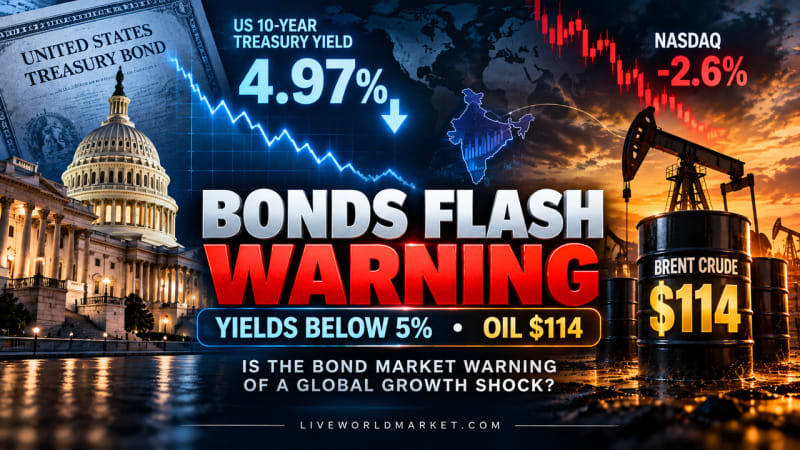
US 10-Year Treasury Yield Below 5%: Growth Shock Warning?
Central Banks & Rates · Oct 23, 2026 · 17 min read
US 10-Year Treasury Yield Falls Below 5% Despite $114 Oil: Is the Bond Market Warning of a Global Growth Shock? Something unusual is happening across global financial markets. The yield on the benchmark U.S. 10-year Treasury has fallen sharply below the psychologically important 5% level, even as Brent crude oil has surged toward $114 per barrel and technology stocks have…
Read more...
Brent Crude Tops $110: Impact on Indian Stocks & Earnings
Global Markets & Economy · Oct 22, 2026 · 14 min read
Brent Crude Tops $110: Why Indian Airlines, Paints and Tyre Stocks Face a Hidden Earnings Risk Brent crude oil has climbed above $110 per barrel, intensifying concerns that rising global energy prices could squeeze corporate profit margins, increase India's import costs and create further volatility in domestic equities. On October 22, Brent futures traded above $111 after…
Read more...